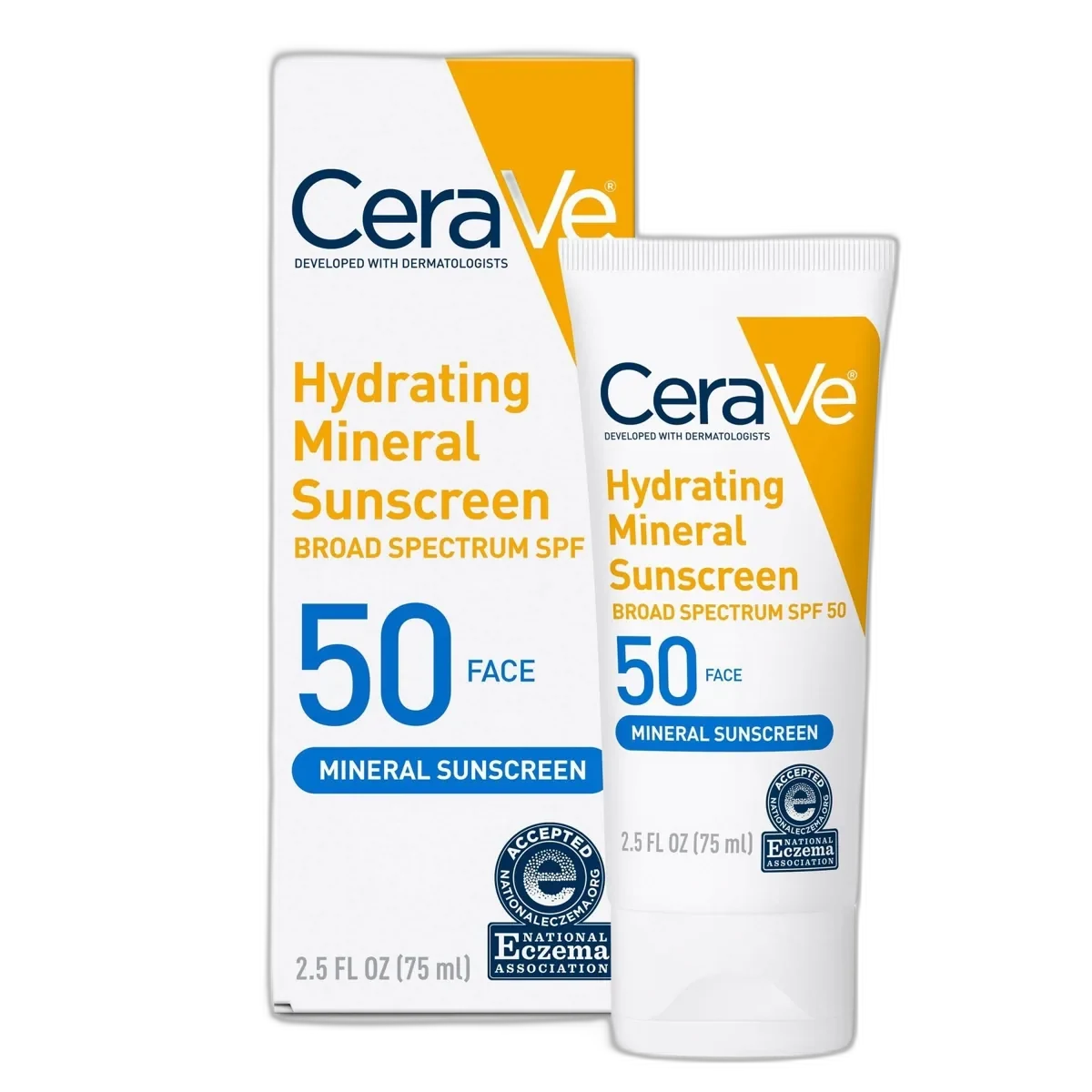
Hydrating Mineral Sunscreen SPF 50
Sensitive Skin SPF Workhorse
 Verified reviewer
Pros & cons.
- +100% mineral SPF 50 protection that is stable, reef-safe, and gentle on the most reactive skin types
- +CeraVe's three-ceramide complex actively repairs the skin barrier during UV exposure hours
- +Dual endorsements from Skin Cancer Foundation and National Eczema Association
- +Fragrance-free, non-comedogenic formula safe for eczema, rosacea, and post-procedure skin
- +Generous 2.5 oz size at ~$16 undercuts most mineral SPF 50 competitors
- +Niacinamide and panthenol add anti-inflammatory and hydrating support beyond basic UV blocking
- +Suitable for children over 6 months — one of the safest sunscreen options for families
- −Significant white cast on medium to deep skin tones is the product's defining limitation
- −Thick texture requires extra blending effort compared to chemical or hybrid sunscreens
- −Can pill under makeup if not given adequate setting time or if applied with rubbing motions
- −No tint option at the SPF 50 level — tinted version is only available as SPF 30
- −Heavier feel may be uncomfortable for oily skin types in warm, humid conditions
The full review.
CeraVe’s Hydrating Mineral Sunscreen SPF 50 is the kind of product that dermatologists love and aesthetes tolerate. It checks every clinical box — 100% mineral filters, fragrance-free, non-comedogenic, loaded with barrier-supportive ceramides, recommended by both the Skin Cancer Foundation and the National Eczema Association. It is, by nearly every objective measure, one of the safest and most effective face sunscreens available at the drugstore. And then you apply it, and you understand why mineral sunscreen has an image problem.
Let us address the white cast directly, because it is the single most discussed aspect of this product and it would be dishonest to bury it. Titanium dioxide at 9% and zinc oxide at 7% — the concentrations needed to achieve SPF 50 with mineral-only filters — leave a white film on the skin that is immediately visible and stubbornly resistant to blending. On fair skin, it settles into a subtle luminosity that some users find acceptable or even flattering, lending a soft-focus, lit-from-within quality. On medium skin tones, it reads as a grayish-white sheen that never fully disappears. On deep skin tones, it can look frankly ashen. This is not a subtle concern. It is the primary reason this product, despite its clinical excellence, generates polarized reviews.
The formula itself deserves respect. Mineral UV filters work by sitting on the skin’s surface and absorbing UV radiation (the old ‘physical reflection’ explanation has been largely debunked — they absorb and convert to heat, similar in principle to chemical filters but with superior photostability). The combination of titanium dioxide and zinc oxide provides genuinely broad-spectrum protection: titanium handles the UVB heavy lifting, while zinc covers the UVA I wavelengths that titanium misses. Unlike chemical filters, these minerals do not degrade in sunlight, meaning your protection level remains consistent throughout the wear period.
The ceramide complex elevates this beyond standard sun protection. UV exposure actively degrades the stratum corneum’s lipid barrier, increasing trans-epidermal water loss and leaving skin more vulnerable to environmental stressors. CeraVe’s three essential ceramides (NP, AP, and EOP), combined with cholesterol and phytosphingosine, replenish these lipids during the period of highest UV stress. Niacinamide stimulates additional ceramide synthesis from within. Hyaluronic acid and panthenol maintain hydration beneath the mineral filter layer. The result is a sunscreen that actively repairs the barrier while protecting it — a genuinely useful proposition for anyone whose skin is compromised, sensitized, or prone to reactive conditions.
Best for
For sensitive skin, this product is close to perfect. No fragrance, no chemical UV filters (which are the most common cause of sunscreen-related contact reactions), no parabens, no common irritants. The National Eczema Association seal means it has been evaluated for use on eczema-prone skin — a population that desperately needs reliable sun protection but often reacts to conventional sunscreen ingredients. The Skin Cancer Foundation recommendation confirms adequate UV protection. Together, these endorsements represent a level of third-party validation that few drugstore sunscreens achieve.
Texture
The texture is thick and rich — unmistakably a mineral sunscreen rather than the weightless, watery formulas that chemical and hybrid sunscreens can achieve. Application requires patience and thorough blending. The product does not spread as easily as a chemical sunscreen, and rushing the application makes the white cast worse. It sits comfortably once set — hydrating without being greasy — but the initial application process is not elegant.
Pairs Well With
Under makeup, results are mixed. Foundation and concealer can mask most of the white cast, but the mineral particles can cause pilling if you apply makeup too quickly or use rubbing motions. Patting and pressing motions work better. Some users report success with a silicone-based primer between the sunscreen and foundation to create a smoother base.
Value
The value proposition is surprisingly strong. At approximately sixteen dollars for 2.5 ounces — a generous size for a face sunscreen — CeraVe undercuts most mineral SPF 50 competitors significantly. The ceramide complex adds genuine skincare value that you would pay extra for in prestige mineral sunscreens. If white cast is not a concern for your skin tone, or if you plan to wear this under tinted products, the cost-per-ounce is excellent for what the formula delivers.
The honest assessment is this: CeraVe Hydrating Mineral Sunscreen SPF 50 is a superior sunscreen wrapped in an inferior cosmetic experience. If you need mineral-only protection for medical, ethical, or sensitivity reasons — and particularly if you have fair skin where the white cast is manageable — this is one of the best options available at any price. The barrier support alone sets it apart from mineral sunscreens that protect but do not nourish. But if wearability is your priority, and your skin tone makes the white cast unacceptable, CeraVe’s own tinted SPF 30 or a mineral-chemical hybrid sunscreen will serve you better in practice, even if they are less perfect on paper.
The best sunscreen is the one you will actually wear every day. For some people, this is that sunscreen. For others, the clinical excellence does not overcome the aesthetic compromise. Both positions are valid, and CeraVe’s expanding sun care range suggests the brand understands it needs options for both audiences.
Ingredient analysis.
Full INCI list
Active Ingredients: Titanium Dioxide (9%), Zinc Oxide (7%). Inactive Ingredients: Water, Glycerin, C12-15 Alkyl Benzoate, Dimethicone, Isododecane, Styrene/Acrylates Copolymer, Glyceryl Stearate, Butyloctyl Salicylate, Dicaprylyl Carbonate, Propanediol, Stearic Acid, Aluminum Hydroxide, PEG-100 Stearate, Sorbitan Stearate, Niacinamide, PEG-8 Laurate, Ceramide NP, Ceramide AP, Ceramide EOP, Sorbitan Isostearate, Carbomer, Cetearyl Alcohol, Ceteareth-20, Triethoxycaprylylsilane, Dimethiconol, Sodium Citrate, Sodium Lauroyl Lactylate, Sodium Dodecylbenzenesulfonate, Myristic Acid, Sodium Hyaluronate, Cholesterol, Palmitic Acid, Phenoxyethanol, Chlorphenesin, Tocopherol, Hydroxyethyl Acrylate/Sodium Acryloyldimethyl Taurate Copolymer, Caprylyl Glycol, Citric Acid, Panthenol, Xanthan Gum, Phytosphingosine, Polyhydroxystearic Acid, Polysorbate 60, Ethylhexylglycerin
Skin match.
The science.
The Science
The mineral UV filter combination of titanium dioxide (9%) and zinc oxide (7%) provides complementary spectral coverage. Titanium dioxide efficiently absorbs UVB and short-wave UVA II (290-340nm), while zinc oxide covers the longer UVA I wavelengths (340-400nm) that titanium dioxide attenuates poorly. Together, they achieve genuine broad-spectrum protection — a requirement that the FDA evaluates through critical wavelength testing (must exceed 370nm).
Modern understanding of mineral sunscreen mechanisms has shifted from the traditional 'physical blocker' model. Research published in Photochemical & Photobiological Sciences demonstrates that zinc oxide and titanium dioxide primarily function by absorbing UV photons and converting them to thermal energy (heat), similar in principle to chemical UV filters. The key distinction is photostability: mineral filters do not undergo photodegradation, maintaining consistent protection levels throughout wear, whereas chemical filters like avobenzone can lose efficacy after prolonged UV exposure without photostabilizers.
The ceramide system addresses UV-induced barrier damage. A study in the Journal of Investigative Dermatology (Holleran et al., 1997) established that UV exposure disrupts the lamellar body secretion system that delivers lipids to the stratum corneum, leading to measurable barrier dysfunction. The three-ceramide complex (NP, AP, EOP) directly replenishes the lipid species most affected by this UV-induced disruption. Phytosphingosine serves as a precursor for ceramide synthesis, while cholesterol completes the equimolar lipid ratio that characterizes a healthy stratum corneum.
Niacinamide provides additional photodamage defense through its role as a precursor to NAD+ and NADPH, which are consumed during UV-induced DNA repair processes. Research published in the Journal of Investigative Dermatology (Thompson et al., 2015) demonstrated that oral nicotinamide (the systemic equivalent of topical niacinamide) reduced the rate of new non-melanoma skin cancers, suggesting meaningful photoprotective activity beyond simple barrier support.
Dermatologist Perspective
Board-certified dermatologists consider this product a cornerstone of sensitive skin sun protection protocols. It is frequently the first sunscreen recommendation for patients with eczema, contact dermatitis, rosacea, and post-procedural skin because the mineral-only, fragrance-free formula minimizes the risk of adverse reactions. Dermatologists acknowledge the white cast limitation but note that for patients whose primary concern is skin safety rather than cosmetic finish — particularly children, post-surgical patients, and those with active inflammatory skin conditions — this product's safety profile outweighs its aesthetic drawbacks. The ceramide complex is especially valued in dermatological practice, as it allows the sunscreen to serve double duty as barrier therapy.
Where it fits in your routine.
Apply liberally to face and neck 15 minutes before sun exposure. Use at least 1/4 teaspoon (approximately two finger-lengths) for the face alone. Blend thoroughly by patting and pressing; do not rub, as rubbing streaks the mineral particles. Let the sunscreen set for 3-5 minutes before applying makeup. Reapply every 2 hours during outdoor activities, and immediately after swimming, sweating heavily, or towel-drying. Double cleanse in the evening to remove all mineral filters.
At about $16 for 2.5 fl oz, this is one of the cheapest mineral SPF 50 face sunscreens. For comparison, EltaMD UV Physical SPF 41 costs about $38 for 3 oz, and La Roche-Posay Anthelios Mineral SPF 50 costs $25-35 for similar sizes. The CeraVe formula provides similar mineral protection and includes a ceramide complex. A 2.5 oz tube lasts about 1-2 months with daily face application, making annual costs $100-200. HSA/FSA eligibility adds value for users with health spending accounts. If white cast is not a dealbreaker, this is one of the best values in mineral sun protection.
This works for sensitive, eczema-prone, rosacea-affected, or post-procedure skin needing the gentlest high-SPF protection. It is ideal for fair-skinned users where the white cast is manageable. It is an excellent choice for parents seeking a safe, high-SPF mineral sunscreen for children. It suits those who prioritize clinical safety and barrier support over cosmetic elegance.
Medium to deep skin tones that find the white cast unacceptable for daily wear should use CeraVe's tinted SPF 30 or a mineral-chemical hybrid. Oily skin types need a lightweight, matte-finish sunscreen. Use these if you prioritize cosmetic elegance and seamless blending over maximum mineral protection.
Product details.
No fragrance. Faint, neutral mineral sunscreen scent.
The 2.5 oz squeeze tube uses CeraVe's blue-and-white branding. This size is large for a face sunscreen. It dispenses easily.
The white cast is the first thing you notice. On fair skin, it fades to a subtle luminosity within minutes. On medium skin, a grayish-white sheen remains visible. On deep skin, it looks ashen or chalky even after thorough blending. The texture feels hydrating and comfortable—no stinging, tightness, or irritation—but the visual finish is the product's most polarizing characteristic.
1-2 months with daily face application at recommended amount
12 months
All Year
The backstory.
CeraVe developed this SPF 50 mineral sunscreen as the highest-protection option in their sun care range, specifically targeting the sensitive skin population that cannot tolerate chemical UV filters. The formula prioritizes safety and barrier support above all else — a design philosophy that explains both its clinical strengths and its cosmetic limitations.
About CeraVe
Legacy Brand (20+ years)Dermatologists helped develop CeraVe in 2005, and clinicians have recommended it for over two decades. The brand uses its patented MVE delivery technology and three essential ceramides in its formulations. CeraVe has National Eczema Association seals and is among the most frequently recommended brands by board-certified dermatologists in the United States.
Common myths.
The white cast shows the sunscreen provides more protection.
White cast is a cosmetic side effect of mineral particles on the skin surface, not a measure of protection. A chemical sunscreen with no white cast at SPF 50 provides the same UV protection. White cast is an aesthetic trade-off for mineral filter safety and stability, not a benefit.
Mineral sunscreens work by physically reflecting UV rays like a mirror.
Modern research shows mineral filters absorb most UV radiation and convert it to heat, just like chemical filters. The "physical blocker" label is misleading. Mineral filters offer stability; they do not degrade in sunlight and cause fewer sensitization reactions.
FAQ.
How bad is the white cast on CeraVe Mineral Sunscreen SPF 50?
Most users complain about the white cast. On fair skin (Fitzpatrick I-II), the cast fades to a subtle luminosity after blending. On medium skin (Fitzpatrick III-IV), a grayish-white sheen stays visible. On deep skin (Fitzpatrick V-VI), the cast looks ashen or chalky. If white cast is a concern, use CeraVe's tinted SPF 30 mineral sunscreen; it uses iron oxides to counteract the white film.
Is this sunscreen safe for babies and children?
Yes. This 100% mineral formula has no chemical UV filters, no fragrance, and no common irritants. It is one of the safest sunscreen options for children and babies over 6 months old. The Skin Cancer Foundation and National Eczema Association recommendations reflect this safety profile. Consult your pediatrician before applying sunscreen to infants.
Can I use this over retinol or after a chemical peel?
This is a strong post-treatment sunscreen choice. The mineral-only filters stay on the skin surface instead of absorbing, which lowers irritation risk on sensitized skin. The ceramides support barrier recovery, and the SPF 50 provides the high-level protection photosensitized skin requires. Many dermatologists specifically recommend CeraVe mineral sunscreen for post-procedure care.
Why does this pill under my makeup?
Pilling happens when mineral particles interact with silicone-based or water-based products applied on top. To reduce pilling: let the sunscreen set for 3-5 minutes before applying makeup, pat foundation on instead of rubbing, and use a primer designed for mineral sunscreens between the SPF and makeup steps.
Is SPF 50 necessary or is SPF 30 enough?
SPF 50 blocks about 98% of UVB rays, while SPF 30 blocks 97% — a small difference in lab tests. SPF 50 offers a larger margin of error for imperfect application, which is how most people use sunscreen. If you apply less than the recommended amount or skip reapplication, SPF 50 provides a meaningful safety buffer.
What the community says.
"Extremely gentle — no stinging even on sensitive or eczema-prone skin"
"Ceramide complex keeps skin hydrated and comfortable all day"
"Good value for a mineral SPF 50"
"Reliable broad-spectrum protection for outdoor activities"
"Safe for children and sensitive skin conditions"
"Significant white cast, especially on medium to deep skin tones"
"Thick texture can be difficult to blend evenly"
"Can feel heavy and greasy under makeup"
"May pill when layered over certain products"
"Uneven finish requires extra blending time"