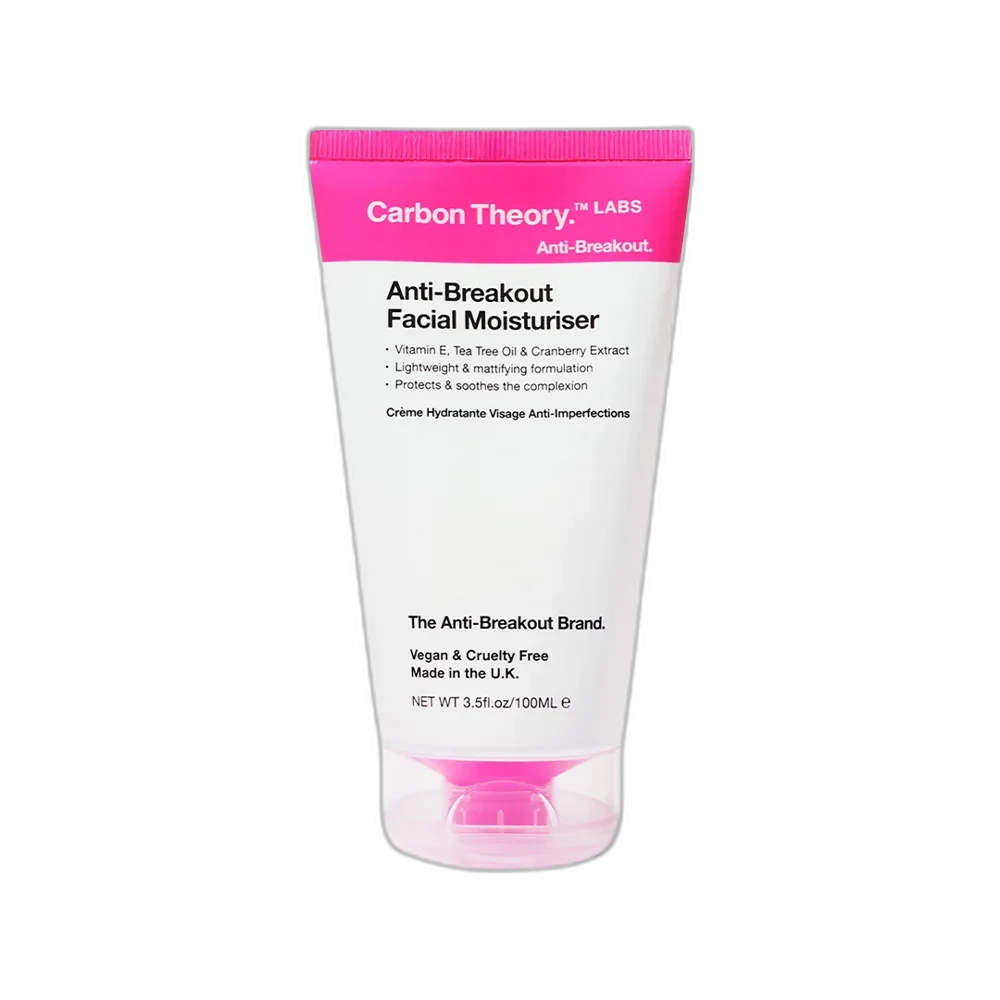
Breakout Control Facial Moisturiser
Budget Acne Moisturiser
 Verified reviewer
Pros & cons.
- +Integrates 0.5% salicylic acid into a daily leave-on moisturiser step
- +Niacinamide and panthenol buffer the BHA and tea tree irritation
- +Non-greasy finish that oily and combination skin can wear under SPF
- +Addresses oiliness, small comedones, and redness at once
- +Cruelty-free and vegan certification
- +Strong value compared to prestige acne moisturisers
- +Made for a specific user rather than trying to please everyone
- −Tea tree scent is strong and persistent for a few minutes after application
- −Contains linalool and limonene, so not suitable for fragrance-sensitive skin
- −Not fungal-acne safe thanks to the shea butter and triglyceride base
- −Small 50ml tube disappears fast with twice-daily use
- −Layered irritant load makes it risky for compromised or rosacea-prone barriers
The full review.
Carbon Theory is the UK skincare industry’s most unlikely success story of the last decade. Founder Rachael Henke built a charcoal and tea tree cleansing bar in her kitchen after failing to find affordable acne solutions. She pitched it to Boots, saw repeated sell-outs, and built a viral brand. This moisturiser is the leave-on companion to that bar—a low-dose BHA cream that continues the cleansing bar’s work after rinsing.
The 0.5% salicylic acid at the middle of the ingredients list earns the ‘Breakout Control’ label, pH-buffered to roughly 5.5. This concentration works as a daily leave-on treatment rather than a weekly exfoliant, letting acne-prone users combine ‘moisturiser’ and ‘BHA’ into one step. Niacinamide, tea tree oil, allantoin, panthenol, shea butter, and caprylic/capric triglyceride surround it to prevent the cream from drying skin like a straight salicylic toner. It is a coherent, acne-specific formulation, not a standard moisturiser with tea tree added for marketing.
The texture is between a gel and a traditional cream. It spreads softer than the ingredient list suggests, and the non-greasy finish suits oily skin. The first application has a distinct herbal tea tree note that lasts a few minutes—familiar if you used chemist-shop spot treatments, but present. If you are scent-sensitive, this won’t work; the range lacks an unfragranced alternative.
After one or two weeks, oily-combination users see fewer small comedones on the forehead and chin, less midday shine, and a quieter complexion. The 0.5% BHA dissolves dead cells that plug pores before they become visible spots. Niacinamide adds its usual sebum-regulating effect. It does not treat deep inflammatory acne, which a leave-on cream cannot reach. If you have cystic breakouts, use a prescription route; this cream maintains calm after that treatment rather than acting as the hero.
The irritation budget is its honest limitation. A moisturiser combining salicylic acid, tea tree oil, and the fragrance terpenes linalool and limonene is not gentle. This is fine for resilient oily skin without barrier issues. On skin that is dry, flushed, or recovering from a retinoid, it will sting. The fragrance-free crowd—most modern derm-recommended acne moisturisers—will find this a step backwards. While shea butter softens the experience, it also makes the product unsafe for fungal-acne.
Carbon Theory sells this at a strong value. Mid-teens pounds sterling for an acne-targeted leave-on moisturiser with a measured BHA dose is cheaper than most active-acne products at Boots or Ulta. You get a focused acne cream from a small brand that built the product around the actual problem, not prestige extracts or luxurious packaging. For oily, breakout-prone, non-sensitive users prepared for tea tree, this price is hard to beat. Everyone else will find a fragrance-free, niacinamide-centric option better.
Formula
Ingredient analysis.
Full INCI list · pH 5.5
Aqua (Water), Caprylic/Capric Triglyceride, Glycerin, Cetearyl Alcohol, Glyceryl Stearate, Niacinamide, Butyrospermum Parkii (Shea) Butter, Dimethicone, Salicylic Acid, Melaleuca Alternifolia (Tea Tree) Leaf Oil, Tocopheryl Acetate, Allantoin, Panthenol, Sodium Hyaluronate, Xanthan Gum, Phenoxyethanol, Ethylhexylglycerin, Citric Acid, Sodium Hydroxide, Linalool, Limonene
Skin match.
The science.
The Science
Each active in this moisturiser has a solid evidence base. Salicylic acid at 0.5-2% is well-studied for mild-to-moderate acne vulgaris; its lipophilic penetration into the follicle dissolves sebum plugs, and dermatology reviews confirm its use as a daily keratolytic. Randomised trials show niacinamide at 2-5% reduces inflammatory acne lesions similarly to topical clindamycin in at least one controlled study, while also lowering sebum excretion rate. Tea tree oil has moderate evidence for mild inflammatory acne; an Australian study found 5% tea tree oil gel works slower but is better tolerated than 5% benzoyl peroxide, though this leave-on moisturiser uses a much lower dose than those trials. From a formulation science standpoint, combining these three at sub-treatment doses to share the daily workload is interesting, rather than pushing one to its clinical ceiling. This creates a buffered, lower-risk acne cream, but do not expect the dramatic clearance of a prescription retinoid or 2.5% benzoyl peroxide. No studies exist for this exact combination within a moisturiser matrix, so view the formulation as a thoughtful synthesis of single-ingredient evidence rather than a clinically validated combination.
Dermatologist Perspective
Dermatologists often recommend low-dose leave-on BHA moisturisers like this for acne-prone patients who find acid toners too drying. Board-certified dermatologists note the 0.5% salicylic acid dose affects comedogenesis over weeks of daily use while staying within most patients' irritation tolerance. Dermatologists view tea tree oil more cautiously; it is a common fragrance allergen in acne products, so they often steer sensitive patients toward fragrance-free equivalents. This cream fits mild-to-moderate comedonal acne on resilient skin, but it is a poor fit for patients with rosacea, eczema, or a history of essential oil reactions.
Where it fits in your routine.
Apply a pea-sized amount twice daily after cleansing and leave-on serums. If you are new to salicylic acid, use it once daily for the first week and watch for stinging on the nose and chin. Do not use another BHA, retinol, or benzoyl peroxide during the same application; alternate retinoids on opposite nights. Use sunscreen every morning because daily salicylic acid increases photosensitivity. Stop use if redness or flaking does not settle within a few days.
At roughly $18 for a 50ml tube, this sits in the lower-middle acne moisturiser market. You get a moisturiser and a daily BHA in one step, which simplifies routines and costs less than buying two separate products. This is a stronger buy than prestige acne creams that charge double for similar actives. Compared to fragrance-free drugstore niacinamide moisturisers from larger derm-developed brands, the value is closer—you pay a small premium for the BHA integration and the indie branding. No larger size exists, which is a mild frustration if it becomes a staple.
Oily and combination skin with mild-to-moderate comedonal acne, small whiteheads, and visible pores. Use this if you want a moisturizer that works on breakouts and you like a herbal tea tree scent. It fits teenagers and young adults starting a budget acne routine.
Dry, sensitive, or rosacea-prone skin. People with a compromised barrier, those using a retinoid, or anyone with a fragrance allergy. Pregnant users, fungal acne sufferers, and people who prefer unscented products should look elsewhere.
Product details.
Distinct herbal tea tree note
Squeeze tube with a flip cap — hygienic for acne-prone users
The first application has a recognizable tea tree scent and a mild tingle if you have active breakouts; both settle within minutes. Users with compromised barriers may feel short-term tightness.
Roughly 2 months with twice-daily face application
12 months
All Year
The backstory.
Carbon Theory launched in 2018 after founder Rachael Henke struggled with adult acne and wanted a simpler, more affordable alternative to the big clinical skincare brands. The charcoal and tea tree cleansing bar went viral in Boots UK, and this moisturiser was built to sit in the same routine — trading the bar's purging wash-off for a leave-on BHA hit.
About Carbon Theory
Emerging Brand (2–5 years)Rachael Henke founded Carbon Theory in 2018 in the UK after her own adult acne struggles. The brand became a Boots viral success. Carbon Theory focuses on affordable acne care; its cleansing bar has strong anecdotal backing, but formal clinical validation of its products remains limited.
Common myths.
A moisturiser with acne actives dries skin like a spot treatment.
This formula uses 0.5% salicylic acid with shea butter, glycerin, and panthenol. The result is a soft cream rather than a targeted treatment.
FAQ.
Does this replace a separate BHA exfoliant?
For most users, yes — the 0.5% salicylic acid in this moisturiser provides a mild daily BHA dose. This is why using it with another leave-on acid usually causes more irritation than benefit.
Is this moisturiser okay during pregnancy?
Skip it. It combines salicylic acid with tea tree oil, and both are common pregnancy avoids even at low doses. A fragrance-free niacinamide cream is a safer swap.
Can I use this with retinol?
Don't use them on the same night. The salicylic acid and tea tree layer two irritants; adding retinol often causes acne-prone skin to peel. Use them on alternate nights.
Will the tea tree scent fade?
The scent comes from essential oils, not a masking fragrance, so it lasts for a few minutes after application. This moisturizer is not for scent-sensitive users.
Is it fungal acne safe?
No. Shea butter and caprylic/capric triglyceride in this formula can feed Malassezia. Fungal acne sufferers should use the Carbon Theory range's lighter wash-off products instead.
How quickly does it start working on breakouts?
Expect smoother texture within a week and fewer new comedones by week 2-3. A leave-on BHA alone won't clear deep cystic acne; that requires a prescription.
Community
What the community says.
"doesn't feel heavy on oily skin"
"calms active breakouts"
"affordable"
"tea tree scent is strong"
"too active for sensitive skin"
"small 50ml tube"