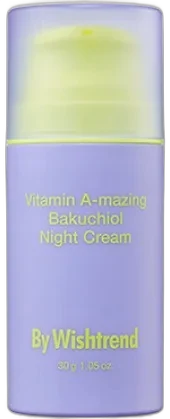
Vitamin A-mazing Bakuchiol Night Cream
Hybrid Retinoid Pick
 Verified reviewer
Pros & cons.
- +Pairs real retinal with bakuchiol in one formula
- +Niacinamide, ceramide NP and peptide supporting cast is genuinely substantive
- +Centella asiatica buffers the retinoid irritation effectively
- +Opaque tube packaging correctly protects the light-sensitive retinal
- +Texture-smoothing results emerge within 3-4 weeks for most users
- +Tolerable for nightly use thanks to the buffering ingredients
- +Works as a single-step PM treatment-and-moisturizer in one
- +No fragrance, alcohol or essential oils
- −Not pregnancy or breastfeeding safe due to retinal content
- −Not fungal-acne safe due to macadamia oil and emulsifiers
- −30g is small for a daily-use night cream at this price
- −Six-month post-opening window is shorter than most night creams
- −Not vegan due to collagen content
The full review.
The bakuchiol-versus-retinol conversation has been one of the more entertaining debates in skincare for the last decade. Bakuchiol launched as the headline plant alternative — a meroterpene from the Indian babchi plant whose gene expression profile in skin cells looks remarkably similar to retinol, with a substantially milder irritation profile. The clinical literature behind it has grown steadily but is still nowhere near the depth of the retinoid evidence base. So the consumer position has settled into a familiar split: retinoid loyalists who consider bakuchiol a marketing ingredient with thin data, and bakuchiol enthusiasts who consider retinoid orthodoxy a refusal to update on new evidence. Both camps have a point. By Wishtrend’s Vitamin A-mazing Bakuchiol Night Cream is the rare product that simply refuses to take a side. The formula contains both — actual retinal in the back half of the INCI, bakuchiol higher up — and treats them as complementary rather than competitive.
The choice of retinal specifically is worth pausing on. Most over-the-counter vitamin A products use retinol, which is two enzymatic steps away from retinoic acid (the active form of vitamin A in the skin). Retinal — retinaldehyde — is one step closer, which means it converts more efficiently and delivers more bioactive vitamin A at lower concentrations. The trade-off is that retinal is more light-sensitive and harder to formulate stably, which is why this cream ships in an opaque tube and has a six-month opening window. Pairing retinal with bakuchiol in the same formula gives users two complementary anti-aging actives whose effects compound rather than redundantly stacking — and the supporting cast around them is what makes nightly use practical.
That supporting cast is unusually serious. Niacinamide sits high on the INCI for barrier support, sebum modulation and tone-evening, and it has its own evidence for buffering retinoid irritation. Ceramide NP appears further down to provide the barrier-replacement lipid layer that any retinoid user genuinely benefits from. Palmitoyl tripeptide-8 is a documented calming peptide that pairs with centella asiatica’s better-known soothing action. Beta-glucan, sodium hyaluronate, hydrolyzed hyaluronic acid, trehalose and beta-glucan provide the humectant cushion. Macadamia oil, caprylic/capric triglyceride and a touch of phenyl trimethicone create the lipid layer. Adenosine adds a quiet anti-aging signaling layer. The whole thing reads like a dedicated retinoid-support cream with the active built in, rather than a retinal product with token soothing additions.
Application is where the formulation logic translates into the actual experience. The cream is rich, creamy, slightly cushioned, and absorbs into a satin finish without the tackiness or heaviness that some retinoid creams produce. Most users notice mild dryness or a slight tingling in the first two weeks — normal for a retinal product, and the supporting cast keeps it from tipping into the visible peeling or aggressive flaking that more aggressive retinoid initiations can produce. By week three to four, the skin acclimates, and texture starts feeling noticeably smoother. By week eight to twelve, fine-line softening and tone evenness become more obvious. The timeline is what every honest retinoid product follows; the difference here is that the pairing with bakuchiol seems to let users tolerate the active more frequently than a retinal-alone formula, which translates into faster cumulative results because the use frequency is higher.
The pregnancy limitation is the most important one to flag. Retinoids of any kind — including the retinal in this cream — are generally avoided during pregnancy and breastfeeding because of the well-documented teratogenic risk associated with the broader vitamin A family. Bakuchiol on its own is generally considered pregnancy-safe, but the retinal in this formula disqualifies it. Pregnant users looking for a bakuchiol-only option should look elsewhere. Sensitive and rosacea-adjacent skin should also approach with caution and start at the lowest possible frequency — twice a week, well-buffered with moisturizer, ramping up only if tolerated.
The other limitations are smaller. The 30g tube is small for the price, and at three to five nights per week of use it lasts about two to three months, which puts the per-month cost in serum territory rather than moisturizer territory. Macadamia oil and several emulsifiers disqualify the formula for fungal-acne-prone users. The formula is not vegan due to the collagen content. And the six-month post-opening window for retinal stability is shorter than most night creams, so users who buy two tubes ahead and let them sit on the shelf will lose some active before the second tube is opened.
For combination, normal and resilient dry skin chasing a serious anti-aging cream that combines a real retinoid with the leading plant alternative — and willing to commit to nightly sunscreen, gradual ramp-up, and the discipline that any retinoid routine requires — this is one of the more thoughtfully formulated hybrid products in production. It is not the right cream for pregnancy, fungal-acne-prone users, or anyone unwilling to wear daily SPF. But for the audience it fits, the pairing is genuinely interesting, the supporting cast is real, and the texture-smoothing results show up faster than bakuchiol-only creams typically deliver. Within the hybrid retinoid lane, this is one of the better-built options on the K-beauty shelf right now.
Ingredient analysis.
Full INCI list · pH 5.5
Aqua (Water), Glycerin, Hydrogenated Polydecene, Caprylic/Capric Triglyceride, Betaine, Phenyl Trimethicone, Polyglyceryl-3 Methylglucose Distearate, Cetyl Alcohol, Macadamia Integrifolia Seed Oil, Niacinamide, Glyceryl Glucoside, Glyceryl Stearate, Bakuchiol, Trehalose, Behenyl Alcohol, Pentaerythrityl Distearate, 1,2-Hexanediol, Polyglyceryl-10 Laurate, Ammonium Acryloyldimethyltaurate/VP Copolymer, Dipropylene Glycol, Hydroxyacetophenone, Laminaria Japonica Extract, Eclipta Prostrata Leaf Extract, Sodium Stearoyl Glutamate, Ethylhexylglycerin, Adenosine, Glucose, Fructooligosaccharides, Butylene Glycol, Sodium Hyaluronate, Retinal, Hydrogenated Lecithin, Beta-Glucan, Hydrolyzed Hyaluronic Acid, Centella Asiatica Extract, Ficus Carica (Fig) Fruit Extract, Ceramide NP, Tocopherol, Collagen, Leuconostoc/Radish Root Ferment Filtrate, Palmitoyl Tripeptide-8, Dextran
Skin match.
The science.
The Science
Retinaldehyde (retinal) sits between retinol and retinoic acid in the vitamin A conversion cascade — a single enzymatic step from the active form versus retinol's two steps — making it more potent than retinol at equivalent concentrations while remaining available without prescription. A 1999 study published in the British Journal of Dermatology compared topical retinal to placebo in patients with photoaged skin and found measurable improvement in fine lines, surface roughness and pigmentation after 18 weeks of use, with a tolerability profile substantially better than tretinoin. Bakuchiol is a meroterpene isolated from the seeds and leaves of Psoralea corylifolia, with a chemical structure that has nothing to do with the vitamin A family. A landmark 2018 study published in the British Journal of Dermatology randomized 44 patients to either 0.5% bakuchiol or 0.5% retinol twice daily for 12 weeks, and found that both treatments produced statistically significant improvement in wrinkles and hyperpigmentation, with the bakuchiol group reporting fewer side effects (less stinging, scaling and dryness). Comparative gene expression profiling has shown that bakuchiol modulates several of the same skin pathways as retinol despite the structural differences, providing the mechanistic basis for its inclusion as a complementary anti-aging active. The combination of retinal and bakuchiol in this cream is intended to deliver compounding anti-aging effects through partially overlapping pathways while keeping the irritation profile manageable. Niacinamide has documented evidence for barrier support, sebum modulation and reduction of hyperpigmentation, and a 2014 paper in the International Journal of Cosmetic Science specifically examined niacinamide's role in buffering retinoid irritation in combination products. Ceramide NP is one of the most-studied skin barrier lipids, with extensive evidence for its role in stratum corneum integrity and trans-epidermal water loss reduction. Palmitoyl tripeptide-8 has been studied as a calming peptide with documented anti-inflammatory activity in keratinocyte models. The combination matters because retinoid initiation is the single most common reason people abandon anti-aging routines, and a formulation that pairs the active with substantive barrier-and-calming support produces better long-term compliance and therefore better cumulative results.
References
- Prospective, randomized, double-blind assessment of topical bakuchiol and retinol for facial photoaging — British Journal of Dermatology (2018)
- Topical retinaldehyde in photoaging: clinical evaluation — British Journal of Dermatology (1999)
Dermatologist Perspective
Dermatologists generally consider topical retinoids — including retinal — the most evidence-supported topical anti-aging intervention available, and retinal specifically is increasingly recommended as a middle-ground option for patients who find tretinoin too irritating but want stronger results than retinol delivers. Bakuchiol has gained cautious acceptance in dermatological conversations as a legitimate plant-derived anti-aging active, particularly for patients who cannot tolerate retinoids or who are pregnant or breastfeeding. Board-certified dermatologists frequently note that the strongest evidence for bakuchiol comes from a single well-designed comparative study, and that the depth of the retinoid literature remains substantially greater. The hybrid approach in this cream — pairing both actives in one formula — is consistent with how dermatologists sometimes recommend layering retinoids with calming and barrier-supporting ingredients for sensitive patients. Clinical guidance emphasizes that retinoids increase sun sensitivity and that daily broad-spectrum sunscreen is non-negotiable, and that retinoids should be avoided during pregnancy and breastfeeding. Patients should start at low frequency and titrate up.
Where it fits in your routine.
Apply to dry, fully cleansed skin as your final PM step in the evening. Use 2-3 nights per week for the first two weeks. If your skin tolerates it, increase to 4-5 nights weekly. Experienced retinoid users with resilient skin can use it daily. Always use daily broad-spectrum SPF the next morning because retinoids increase sun sensitivity. Do not stack with other retinol products, AHA/BHA exfoliants, or high-strength vitamin C in the same evening. Store the tube in a cool, dark place and use within 6 months of opening to maintain potency.
At about $36 for 30g, this night cream sits in the upper-mid K-beauty range. It costs less than clinical retinal products and matches other Korean retinal moisturizers in this size. Only the 30g tube is available. One tube lasts two to three months using it three to five nights per week, making the monthly cost similar to a serum. The price reflects the dual-active formulation, the niacinamide, ceramide NP, and peptides, and the opaque packaging that protects the light-sensitive retinal. Cheaper bakuchiol creams exist without retinal; cheaper retinal creams exist without the bakuchiol pairing and supporting ingredients. Pay for this version if you want the hybrid approach.
Combination, normal, and resilient dry skin types seeking an anti-aging cream that pairs a real retinoid with the leading plant alternative. Users wanting to test both retinal and bakuchiol in one formula. Anyone who uses daily sunscreen and follows a gradual ramp-up.
Pregnant or breastfeeding users (the retinal disqualifies it). Fungal-acne-prone users who can't tolerate the macadamia oil and emulsifiers. People with very sensitive or rosacea-flared skin. Users unwilling to wear daily SPF.
Product details.
Thick, creamy emulsion that absorbs into a soft, slightly cushioned satin finish.
No added fragrance; faint cosmetic-base smell that dissipates quickly.
Opaque tube with screw cap; the opaque packaging is essential because retinal is light-sensitive.
Most users notice mild dryness or slight tingling during the first two weeks — this is normal for a retinal product. By week three to four, the skin acclimates and the texture-smoothing effect shows more clearly. Persistent burning or peeling means you must drop frequency, not push through.
30g lasts about 2-3 months at 3-5 nights per week.
6 months
All Year
The backstory.
By Wishtrend developed this cream in 2022 as part of a broader move into anti-aging actives, betting that a hybrid retinal-plus-bakuchiol approach could appeal both to retinoid skeptics curious about plant alternatives and to retinoid users looking for a barrier-supportive vehicle. The brand chose retinal over retinol specifically for its higher potency and shorter conversion path to retinoic acid.
About By Wishtrend
Established Brand (5–20 years)By Wishtrend launched in 2013 as Korean retailer Wishtrend's in-house brand. The Vitamin A-mazing Bakuchiol Night Cream is the brand's hybrid retinal-and-bakuchiol night moisturizer, combining a true vitamin A active with the plant-derived alternative.
Common myths.
Bakuchiol is a complete retinol replacement.
Comparative studies show bakuchiol modulates similar gene expression pathways with less irritation, but retinoic acid and other retinoids have more clinical evidence. Bakuchiol is a legitimate anti-aging active, but calling it identical to a retinoid oversells the data.
Retinal is the same as retinol.
Retinal (retinaldehyde) is one enzymatic step closer to retinoic acid than retinol, which makes it more potent at the same concentration. It is also more light-sensitive and requires opaque packaging — which this cream uses correctly.
FAQ.
How is retinal different from retinol?
Retinal (retinaldehyde) is one enzymatic conversion step closer to retinoic acid — the active form of vitamin A — than retinol is. This makes retinal more potent than retinol at the same concentration. It is also more light-sensitive, so this cream uses opaque packaging.
Can I use it during pregnancy?
No — avoid all retinoids during pregnancy and breastfeeding. The bakuchiol component is pregnancy-safe, but the retinal in this formula is not. Check the brand's other moisturizers for a pregnancy-safe option.
Will I purge?
Most users do not experience a dramatic purge from this formula. The moderate retinal concentration and the ceramides, niacinamide and centella buffer typical retinoid initiation reactions. Some users notice mild dryness or tingling during the first two weeks; if symptoms are stronger, reduce frequency and ramp up more slowly.
Can I use it with vitamin C?
Apply vitamin C in the morning and this cream at night. These two work well in one routine but do not stack them in one application. Pair this cream with the brand's Pure Vitamin C 21.5% Advanced Serum for a complete anti-aging routine.
Is it fungal acne safe?
No — the formula has macadamia oil, glyceryl stearate, and other ingredients that feed Malassezia. Fungal-acne-prone users should find another option.
How often should I use it?
Use 2-3 nights per week for the first two weeks, then increase to 4-5 nights weekly as your skin acclimates. Experienced retinoid users with resilient skin can use it daily. Always use daily SPF because retinoids increase sun sensitivity.
What the community says.
"gentler than expected for a retinal cream"
"smoothed texture in a few weeks"
"ceramide and peptide support is real"
"no purging for most users"
"pairs well as a single PM step"
"30g is small at the price"
"still requires a slow ramp-up"
"not pregnancy safe"
"not fungal acne safe"