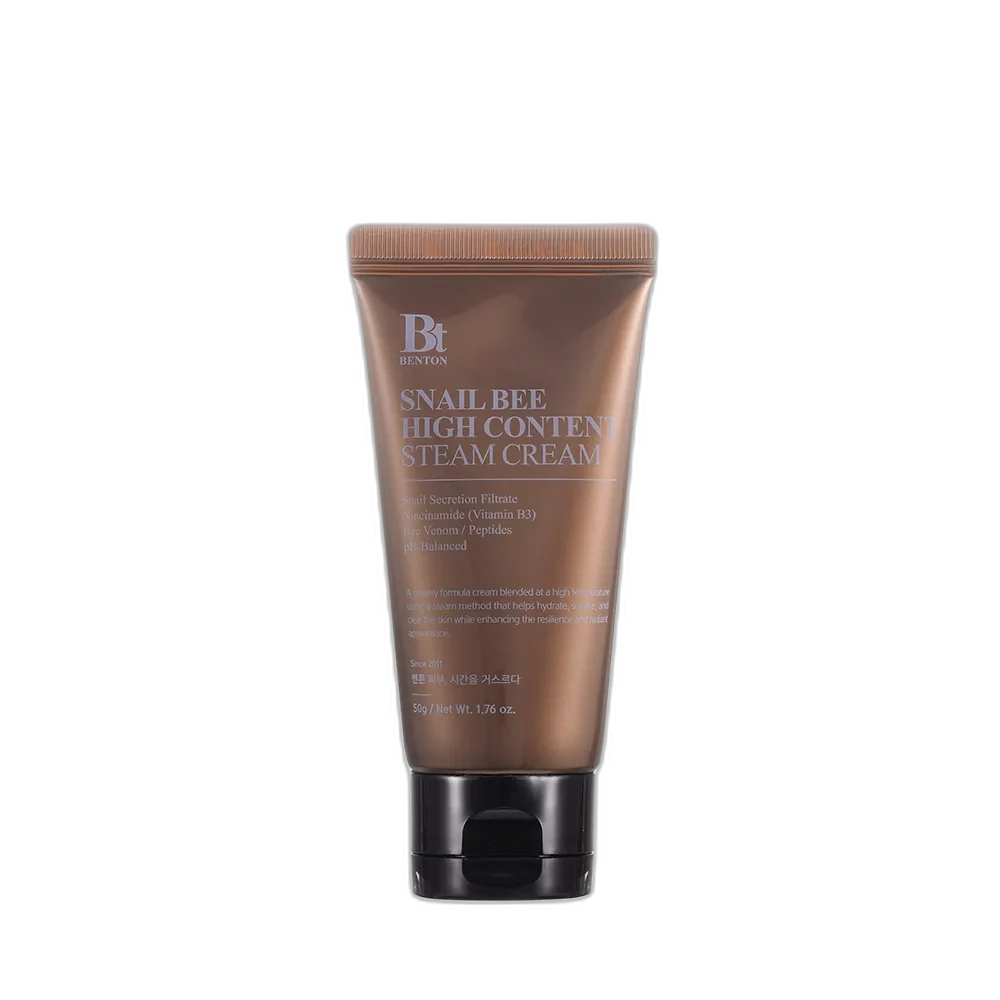
Snail Bee High Content Steam Cream
Snail Mucin In A Jar
 Verified reviewer
Pros & cons.
- +Snail secretion filtrate at the third position on the INCI
- +Readable niacinamide dose at position six
- +Four-oil botanical lipid base (jojoba, sunflower, safflower, argan)
- +Includes urea as a humectant-keratolytic dual function
- +Fragrance-free, alcohol-free, silicone-free
- +Cushioned texture that absorbs without greasiness
- −Contains bee venom — not suitable for bee-allergic users
- −Too rich for most oily and combination-oily skin
- −Open-jar packaging is not ideal for oil and peptide stability
- −Cetyl ethylhexanoate and behenyl alcohol may concern acne-prone users
- −50g size is smaller than most competitor rich creams
The full review.
Dozens of K-beauty snail mucin creams use a common trick: they put ‘snail mucin’ on the box but hide the ingredient at the back of the INCI. Benton’s Snail Bee Steam Cream avoids this. Snail secretion filtrate is third on the list, after water and butylene glycol—ahead of glycerin, niacinamide, and all emollient oils. This means the formula contains a meaningful amount of mucin. This is a snail mucin product with a thoughtful supporting cast, not a cream pretending to have it. For a brand built on ingredient transparency, the flagship snail cream performs as expected.
The cream earns its ‘steam cream’ name via the traditional Korean whipped manufacturing process. This creates a dense, cushiony texture instead of the flat paste found in cold-mixed moisturizers. The surface has a slight bounce, and the cream holds its shape on a spatula. On skin, it melts into a soft cushion and absorbs within one to two minutes. It leaves a satin finish that works for dry cheeks in winter without feeling occlusive. Most Korean rich creams fail to reach this format, but Benton succeeds. The lack of fragrance or alcohol makes the experience feel clean.
The supporting cast drives the cream’s reputation. Niacinamide at the sixth position provides a real dose—likely 2-4%—to add tone evenness, sebum regulation, and mild barrier support. A four-oil botanical bench (jojoba, sunflower, safflower, argan) provides the lipid backbone. Jojoba’s wax esters mirror skin’s natural sebum, sunflower and safflower deliver linoleic acid for barrier repair, and argan brings tocopherol and squalane. Plant extracts from the Snail Bee line (plantain, persimmon leaf, willow bark, elm bark, kelp) add soothing and antioxidant layers. Urea sits mid-INCI and works as both a humectant and a mild keratolytic. This choice shows the developers addressed real dry-skin problems. sh-Oligopeptide-1 (EGF) is present for the Benton peptide signature, though topical EGF penetration literature remains contested.
Results follow a standard rich-cream arc: softer, less tight skin by the next morning; smoother texture within two weeks; and reduced redness and post-acne marks after 4-8 weeks of nightly use. This is a comfort product for dry and dehydrated skin, especially in winter or when a barrier is stressed by retinoids, seasonal air, or over-exfoliation. It works well in evening routines for combination skin if applied thinly on oily zones. For oily skin, it is usually too rich; Benton’s lighter moisturizers or the Snail Bee Essence with a gel cream are better fits.
Limitations match the Snail Bee line, with a few cream-specific issues. Bee venom at the end of the INCI is a hard skip for anyone with a bee sting allergy. The glass jar and spatula are attractive but suboptimal for a cream with plant oils and peptides; airless packaging would improve stability. Cetyl ethylhexanoate and behenyl alcohol are on the comedogenicity watch-list, so acne-prone users should patch test for two weeks. The 50g size is small for a rich cream; nightly face-and-neck use lasts 6-10 weeks, making the per-ounce cost higher than the Snail Bee Essence or the toner. Even so, it is one of the better snail mucin creams in K-beauty and an excellent pick for dry or compromised skin in winter.
Ingredient analysis.
Full INCI list
Water, Butylene Glycol, Snail Secretion Filtrate, Glycerin, Cetyl Ethylhexanoate, Niacinamide, Behenyl Alcohol, 1,2-Hexanediol, Cetearyl Olivate, Palmitic Acid, Sorbitan Olivate, Simmondsia Chinensis (Jojoba) Seed Oil, Helianthus Annuus (Sunflower) Seed Oil, Carthamus Tinctorius (Safflower) Seed Oil, Argania Spinosa Kernel Oil, Sodium Hyaluronate, Plantago Asiatica Extract, Diospyros Kaki Leaf Extract, Salix Alba (Willow) Bark Extract, Ulmus Campestris (Elm) Bark Extract, Laminaria Digitata Extract, Tocopheryl Acetate, sh-Oligopeptide-1, Glyceryl Stearate, Stearic Acid, Lauric Acid, Myristic Acid, Carbomer, Urea, Arginine, Adenosine, Bee Venom, Pentylene Glycol, Zanthoxylum Piperitum Fruit Extract, Pulsatilla Koreana Extract, Usnea Barbata (Lichen) Extract, Polysorbate 20, Lecithin
Skin match.
The science.
The Science
This science combines snail mucin research with the strong evidence for niacinamide and plant-oil fatty acid profiles. Snail secretion filtrate has research supporting wound healing and post-inflammatory recovery. Brieva et al.'s 2009 Skin Pharmacology and Physiology paper examines its antioxidant and fibroblast-related properties, while later literature covers its natural allantoin, glycolic acid, and glycoprotein content. At the third position in this cream, it delivers a meaningful portion of the total active payload.
Niacinamide has one of the strongest evidence bases in modern cosmetic dermatology. Hakozaki et al.'s 2005 paper in the British Journal of Dermatology shows hyperpigmentation reductions at 5%, and a 2004 paper in the Journal of Cosmetic Dermatology covers effects on sebum output, pore appearance, and transepidermal water loss. At the dose position in this cream (roughly 2-4%), niacinamide provides a measurable fraction of the reported tone and barrier benefits.
The plant-oil science is interesting. Linoleic acid—the dominant fatty acid in sunflower and safflower seed oils—is essential for healthy stratum corneum lipid structure. Literature shows acne-prone skin often has reduced sebum linoleic acid content. A 2013 review in Skin Pharmacology and Physiology covers how linoleic-acid-rich oils support ceramide synthesis and barrier recovery. Jojoba wax esters approximate human sebum structure and have moderate literature support as occlusive-substitute emollients. Argan oil provides tocopherol and squalane, both with independent antioxidant literature. Urea's humectant and keratolytic effects are well-established in dermatology, with decades of use in prescription and OTC formulations for dry and hyperkeratotic skin conditions.
Dermatologist Perspective
Dermatologists often recommend the Benton Snail Bee Steam Cream as a reasonable K-beauty option for patients with dry, sensitive, or mildly acne-prone skin who want a fragrance-free thick moisturizer. The combination of snail mucin, niacinamide, linoleic-acid-rich oils, and urea suits patients with barrier stress from prescription retinoids, benzoyl peroxide, or over-exfoliation. The standard derm caveat is the bee venom—patients with bee sting allergies should avoid all topical bee venom products regardless of position on the INCI. Board-certified dermatologists also typically suggest patch testing for acne-prone patients because of the cetyl ethylhexanoate and behenyl alcohol content.
Where it fits in your routine.
Apply this as your final nighttime moisturizer on damp skin after toner, essence, and treatment serums. A pea-sized amount covers the face — warm it between fingertips and press it into skin. Use less on oily zones if you have combination skin. For dry or normal skin, use it in the morning under sunscreen; wait two minutes before layering SPF. Use the included spatula to keep the jar hygienic.
At roughly $22 for 50g, the Steam Cream has fair value compared to similar K-beauty snail mucin creams, which usually cost $20-30 for the same size. The 50g size is small for a thick cream, so the per-gram cost is slightly higher than the Benton essence or toner in the same line. For users seeking a snail mucin cream with thoughtful formulation, it is a top choice in this price tier. Benton does not currently offer a larger size.
Dry, normal, combination-dry, and mildly acne-prone skin can use this fragrance-free thick cream. It has a high snail mucin concentration and includes niacinamide and oils. It works well for winter routines and skin recovering from retinoid or BPO irritation.
Avoid this entire line if you have a bee sting allergy. Skip these products if you have oily skin (too thick), fungal-acne-prone skin (oil content is a concern), or strict vegan preferences.
Product details.
A thick, cushiony cream with slight bounce — thicker than the gel-based Benton products but lighter than a pure occlusive.
It is essentially unscented—a faint natural cream note most users do not notice.
The classic white glass jar includes a plastic spatula. This is standard for the category, but an open-mouth jar is not ideal for a product containing plant oils and peptides.
It applies as a thick, cushiony layer that melts into skin within a minute. It leaves a soft satin finish instead of an oily residue. There is no sting, no warming, and no fragrance — the Benton house style of "quietly effective."
Apply to face and neck nightly for 6-10 weeks, or less if used twice daily.
12 months
fall winter
The backstory.
The Steam Cream joined Benton's Snail Bee lineup in 2014 as the rich moisturizer option for users who already used the essence and toner and wanted a heavier final step for winter or sensitive skin. The 'steam cream' name is a reference to the traditional Korean cream format — whipped while warm to create a cushiony texture — rather than any actual steam-based delivery technology.
About Benton
Benton launched in 2011 and the Steam Cream joined the Snail Bee lineup in 2014 as the richest moisturizer in the brand's ingredient-transparency focused range. It has been a long-term K-beauty community favorite for dry, acne-prone skin.
Common myths.
Snail mucin creams use too little mucin to work; they are just marketing.
INCI position matters. Snail secretion filtrate sits third in this cream — before niacinamide and all plant oils — which shows a meaningful concentration, not a token sprinkle. Many competitor creams place mucin in the back half, where marketing-only criticism applies.
FAQ.
Is the Steam Cream better than the Snail Bee Essence?
They serve different purposes. The essence is a water-based treatment; the Steam Cream is a moisturizer. Dry or normal skin types use both in an ideal routine—essence first, then cream. The Steam Cream does not replace the essence, and the essence alone is not enough for most dry skin types.
Is this too rich for oily skin?
Yes, for most oily skin types. The four-oil base and thick cream texture suit drier skin. Oily users should use the Snail Bee Essence or switch to Benton's lighter moisturizers.
Does it clog pores?
Cetyl ethylhexanoate and behenyl alcohol appear on some comedogenicity watch-lists, but individual reactions vary. Acne-prone users should patch test a small area for two weeks before full-face use.
Is it safe in pregnancy?
It lacks retinoids, salicylic acid, hydroquinone, and fragrance. One consideration is the bee venom — if you have not used bee venom products before pregnancy, avoid introducing them now and check with your OB.
Why is it called a 'steam cream'?
This name refers to the traditional Korean whipped-cream manufacturing process that creates the dense, cushiony texture — not a steam-based delivery technology. Several K-beauty brands use this stylistic name for similar formats.
What the community says.
"nourishing without greasiness"
"fragrance-free"
"great for winter dryness"
"calms sensitive skin"
"too rich for oily skin"
"bee venom content"
"small size for a cream"