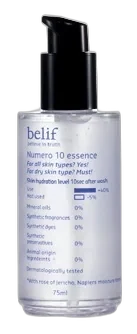
Numero 10 Essence
Long-Running K-Beauty Essence
 Verified reviewer
Pros & cons.
- +Rose of Jericho is a genuinely unusual and conceptually interesting botanical centerpiece
- +10-Herb Complex provides distinctive belif identity from Napiers Herbalist heritage
- +Multi-humectant base (glycerin, dipropylene glycol, trehalose, betaine, panthenol) delivers real hydration
- +Lightweight gel-water finish that oily-skinned users specifically appreciate
- +Vegan and cruelty-free with substantive supporting actives
- +Long-running product with a decade of consumer feedback
- +Pregnancy-compatible with no flagged anti-aging actives
- −SD Alcohol 40-B in second INCI position is meaningfully high
- −Added fragrance further limits the audience for sensitive complexions
- −2014-era formulation chemistry feels dated compared to newer K-beauty essences
- −Not appropriate for dry, sensitive, or barrier-compromised skin
- −$40 for 75 ml is fair but not a bargain given the formulation
- −No transparent reformulation plans despite broader category movement
The full review.
Selaginella lepidophylla is a unique plant. Native to the Chihuahuan Desert in northern Mexico and the southwestern United States, this tiny vascular plant survives complete desiccation. Its leaves curl into a tight brown ball when dry, then unfurl and resume photosynthesis upon rehydration. This works through biochemistry: the plant produces high concentrations of trehalose and other sugar alcohols to protect cellular structures during drought. People in the southwest call it the resurrection plant or Rose of Jericho. This plant is the conceptual centerpiece of belif’s Numero 10 Essence. While “Numero 10” refers to the 10-Herb Complex from belif’s Napiers Herbalist heritage, the resurrection plant defines the product’s identity.
The concept is interesting. Rose of Jericho extract is rare in skincare. Using a desiccation-resistant botanical to anchor a hydration product creates a coherent story rare in K-beauty essence positioning. Trehalose appears later in the formula—the same sugar the plant uses—which extends this coherence. The 10-Herb Complex (oat, calendula, catnip, raspberry leaf, wild indigo, chickweed, lady’s mantle, heartsease, damask rose, meadowsweet) provides the Napiers Herbalist apothecary identity, while algae extract adds water-binding marine support. Both the botanical concept and brand identity work well.
The formulation chemistry shows its age. SD Alcohol 40-B is the second INCI position, right after water. It sits higher than glycerin and every supporting active. This is a 2014-era K-beauty essence chemistry choice with real consequences. SD alcohol delivers fast absorption, a lightweight finish, and a slightly mattifying effect that some users, particularly oily-skinned users, prefer. However, it disrupts the lipid barrier when used in high concentrations on dry, sensitive, or compromised skin. This is why newer K-beauty essences mostly use alcohol-free formulations. Glycerin in third position offsets some drying, but not all. Users with normal-to-oily skin generally tolerate this. Users with dry, sensitive, or barrier-compromised skin will likely find Numero 10 Essence too aggressive.
The added fragrance is another dated marker. K-beauty has moved toward fragrance-free formulations recently, as the periorbital area and reactive complexions handle fragrance allergens poorly. Numero 10 Essence still has added fragrance, which, combined with the SD alcohol, limits the audience. Users who buy this typically enjoy the herbal-rose scent profile and lack fragrance sensitivities. This is a narrower audience than the brand’s newer essences serve.
The supporting ingredients are more interesting. Glycerin, dipropylene glycol, trehalose, betaine, and panthenol form a multi-humectant base for hydration. Algae extract sits relatively high. The 10-Herb Complex adds soothing botanical character, and the Rose of Jericho extract provides the conceptual anchor. The formulation is vegan and cruelty-free.
Texture-wise, the experience suits the right skin type. The essence is a lightweight clear gel-water that absorbs in seconds without stickiness or residue. Oily-skinned K-beauty fans often look for this cool, fast-absorbing finish in a first essence, and Numero 10 Essence delivers it. The herbal-rose scent profile works for users who enjoy belif’s olfactory identity. The product layers cleanly under serums and moisturizers and does not pill under makeup. Most fans use it twice daily as a first essence and report a more comfortable hydrated baseline within one to two weeks of consistent use.
The caveats are significant. The SD alcohol content makes the product unsuitable for dry, sensitive, or barrier-compromised skin; these users should choose fragrance-free, alcohol-free essences, including newer options from belif. The added fragrance compounds this. The price ($40 for 75 ml) is fair for this level of formulation work but is not a bargain. The 2014-era formulation feels dated compared to the cleaner essences dominating the current K-beauty category. The brand shows no transparent plans to reformulate, which is surprising given the category direction.
Buy this if you have normal-to-oily skin, prefer a lightweight alcohol-forward finish, love the belif herbal-rose scent profile, and want an interesting botanical concept. Skip it if you have dry, sensitive, or reactive skin, avoid fragrance and alcohol, or want a more current K-beauty essence formulation. Numero 10 Essence is a long-running cult favorite, but it has not aged equally well in every dimension.
Ingredient analysis.
Full INCI list
Water, SD Alcohol 40-B, Glycerin, Dipropylene Glycol, Glycerin, Glyceryl Acrylate/Acrylic Acid Copolymer, Algae Extract, 1,2-Hexanediol, Butylene Glycol, Trehalose, Betaine, Panthenol, Ammonium Acryloyldimethyltaurate/VP Copolymer, PEG-40 Hydrogenated Castor Oil, Octyldodeceth-16, Selaginella Lepidophylla Extract, Fragrance, Avena Sativa (Oat) Kernel Extract, Calendula Officinalis Flower Extract, Nepeta Cataria Extract, Rubus Idaeus (Raspberry) Leaf Extract, Baptisia Tinctoria Root Extract, Stellaria Media (Chickweed) Extract, Alchemilla Vulgaris Leaf Extract, Viola Tricolor Extract, Rosa Damascena Flower Extract, Spiraea Ulmaria Flower Extract, Althaea Officinalis Root Extract, Carbomer, Sodium Polyacrylate, Tromethamine, Trisodium EDTA
Skin match.
The science.
The Science
Rose of Jericho — Selaginella lepidophylla — is a desert resurrection plant that has attracted growing interest in cosmetic chemistry over the past decade for its unique desiccation tolerance. The mechanism is well-understood biochemically: the plant produces high concentrations of trehalose and other sugar alcohols that stabilize cellular membranes and protein structures during drought, and that allow the plant to revive when rehydrated. Topical application of Selaginella lepidophylla extract delivers some of these compounds to the skin, with published in vitro work suggesting water-binding and barrier-supportive effects. The clinical evidence base is still early — most studies are in vitro or small-scale — and the human skin effects are likely modest compared to dedicated humectants like glycerin or hyaluronic acid. Trehalose, included separately further down the INCI list, has more substantial evidence as a humectant and cell-protectant, with published work on its use in maintaining hydration during osmotic stress. Glycerin's evidence base for humectant action is among the most robust in cosmetic chemistry. The 10-Herb Complex (oat, calendula, catnip, raspberry leaf, wild indigo, chickweed, lady's mantle, heartsease, damask rose, meadowsweet) sits in the more emerging category — individual herbs have varying evidence for topical anti-inflammatory effects, mostly from in vitro and small clinical studies. Oat kernel extract has the strongest evidence base of the group, with multiple controlled trials supporting its use in inflammatory and barrier-compromised conditions. The SD Alcohol 40-B in the second INCI position is the most consequential ingredient choice from a clinical perspective. SD alcohol delivers fast absorption, a lightweight finish, and antimicrobial preservation support, but published work consistently shows that high concentrations of denatured alcohol can disrupt skin barrier function in dry and sensitive complexions. The trade-off is well-documented: tolerable for normal-to-oily skin, problematic for compromised skin. Newer K-beauty essence formulations have largely moved away from alcohol-forward chemistry, which makes Numero 10 an increasingly dated example of the older essence tradition.
Dermatologist Perspective
Dermatologists generally view alcohol-forward essences cautiously, because high-position SD alcohol in a daily-use formulation can disrupt the skin barrier in dry, sensitive, or compromised complexions over time. Board-certified dermatologists tend to recommend alcohol-free essences for patients with eczema, rosacea, or reactive skin, and the broader K-beauty category has moved meaningfully in this direction over the past several years. For patients with normal-to-oily skin without sensitivity issues, dermatologists generally consider moderate SD alcohol exposure tolerable, and some practitioners specifically recommend alcohol-forward formulations for oily-skinned patients who prefer fast-absorbing lightweight textures. The added fragrance is the second concern dermatologists raise — fragrance is one of the most common causes of cosmetic contact dermatitis, and patients with established fragrance sensitivities are typically advised to choose fragrance-free alternatives. The Rose of Jericho concept is interesting from a botanical standpoint but doesn't significantly change the clinical picture; the supporting humectants and the SD alcohol content are doing more of the actual work than the resurrection plant extract.
Where it fits in your routine.
After cleansing, pat 4-5 drops of the essence into the face, neck, and decollete as the first essence step. Wait thirty seconds for absorption before layering serums. Apply treatment serums and moisturizer next. Use morning and night. The lightweight gel-water finish layers cleanly under subsequent products. In dry climates or winter months, follow immediately with a thicker moisturizer to offset the alcohol content. Store in a cool place and use within twelve months of opening to prevent fragrance degradation.
At $40 for 75 ml, Numero 10 Essence costs about $10-$13 per month using it twice daily. This price is fair for a K-beauty essence with this formulation work, but it is not a bargain. The value is better than luxury K-beauty essences at $60-$120, but worse than newer alcohol-free essences in the $25-$35 tier using more current formulation chemistry. A smaller travel size exists; it has the same per-ml value but works for testing. belif's brand status under LG Household & Health Care and the Napiers Herbalist heritage justify the price more than a typical mid-tier K-beauty brand. However, the 2014-era formulation chemistry — specifically the high-position SD alcohol and the added fragrance — warrants a lower price in a K-beauty market where alcohol-free and fragrance-free essences are the standard.
This works for normal-to-oily skin buyers who like a lightweight alcohol-forward essence finish. It suits belif brand fans who value the Napiers Herbalist heritage and herbal-rose scent, and users interested in the Rose of Jericho botanical concept in the formulation.
Skip if you have dry, sensitive, rosacea-prone, eczema-prone, or barrier-compromised skin, if you prefer fragrance-free or alcohol-free skincare on principle, or if you'd rather have a more current K-beauty essence formulation with cleaner supporting chemistry.
Product details.
Lightweight clear gel-water absorbs in seconds without stickiness or residue
Herbal-rose aroma with a slight alcohol top note
Tall plastic bottle with screw cap and dispensing opening
First use feels cool and rapidly absorbing, with a noticeable alcohol top note from the SD Alcohol 40-B that fades within seconds. The herbal-rose fragrance follows. Most users with normal-to-oily skin feel the lightweight finish immediately; very dry users may notice tightness from the alcohol content.
3-4 months at twice-daily face use
12 months
All Year
The backstory.
belif launched Numero 10 Essence around 2014 as one of the brand's earliest K-beauty 'first essence' products, building it around the conceptually striking Rose of Jericho and the 10-Herb Complex from the Napiers apothecary tradition. The product became a long-running fan favorite, particularly with oily-skinned users who appreciated the fast-absorbing alcohol-forward texture, though the formulation hasn't been updated to match the fragrance-free, alcohol-free direction of newer K-beauty essences.
About belif
Established Brand (5–20 years)belif launched in 2010 under LG Household & Health Care. It uses British apothecary traditions from Napiers Herbalists (founded 1860). Numero 10 Essence is one of the brand's first K-beauty 'first essence' products and uses the alcohol-forward K-beauty essence chemistry common to that era.
Common myths.
All K-beauty essences are the same
K-beauty essences differ in alcohol content, fragrance, and supporting actives. This 2014-era formulation uses more alcohol than the fragrance-free, alcohol-free essences that now dominate the K-beauty category.
Alcohol in skincare is universally bad
SD alcohol at moderate concentrations does not harm normal-to-oily skin. It absorbs fast and leaves a lightweight finish that some users prefer. SD alcohol disrupts the barrier in dry, sensitive, or compromised skin.
FAQ.
Does the alcohol in this essence dry out the skin?
It can — SD Alcohol 40-B is second on the INCI list, which is high. Glycerin and humectants usually offset the drying effect for normal-to-oily skin. For dry, sensitive, or compromised skin, the alcohol content is significant; use an alcohol-free essence instead.
Is this safe for sensitive skin?
Probably not. Between the SD alcohol high in the formula and the added fragrance further down, there are two ingredients commonly associated with reactivity. Choose a fragrance-free, alcohol-free essence if you have known sensitivities or eczema.
How is this different from belif's other essences and toners?
Numero 10 uses an older, alcohol-forward formula with Rose of Jericho and the 10-Herb Complex. Belif's newer essences and toners use fragrance-free and alcohol-free chemistry for sensitive K-beauty fans.
Is this safe during pregnancy?
Yes. No flagged actives are present — no salicylic acid, no retinoids, and no high-risk botanicals. The fragrance is the only ingredient an extra-cautious user might flag with their OB.
How does Rose of Jericho work?
Selaginella lepidophylla is a desert resurrection plant. It survives complete desiccation and revives when rehydrated. The extract contains compounds like trehalose, which the plant uses naturally, that bind water strongly. Clinical evidence is early, but the concept has a real botanical basis.
Is it vegan?
Yes — the formula is fully plant-based. belif is also cruelty-free.
Should I use this if I have oily skin?
This is one of the better matches for oily skin in the belif essence lineup. The alcohol-forward formulation absorbs fast and leaves a matte-leaning finish that oily-skinned users often prefer over richer hydrating essences.
What the community says.
"Users consistently praise the lightweight gel-water texture"
"Fast absorption with no stickiness"
"Pleasant herbal-rose scent"
"Long-running cult favorite for oily K-beauty fans"
"SD alcohol may dry out sensitive skin"
"Fragrance limits use for reactive complexions"
"Newer K-beauty essences feel more sophisticated"
"Premium price for an alcohol-forward formula"