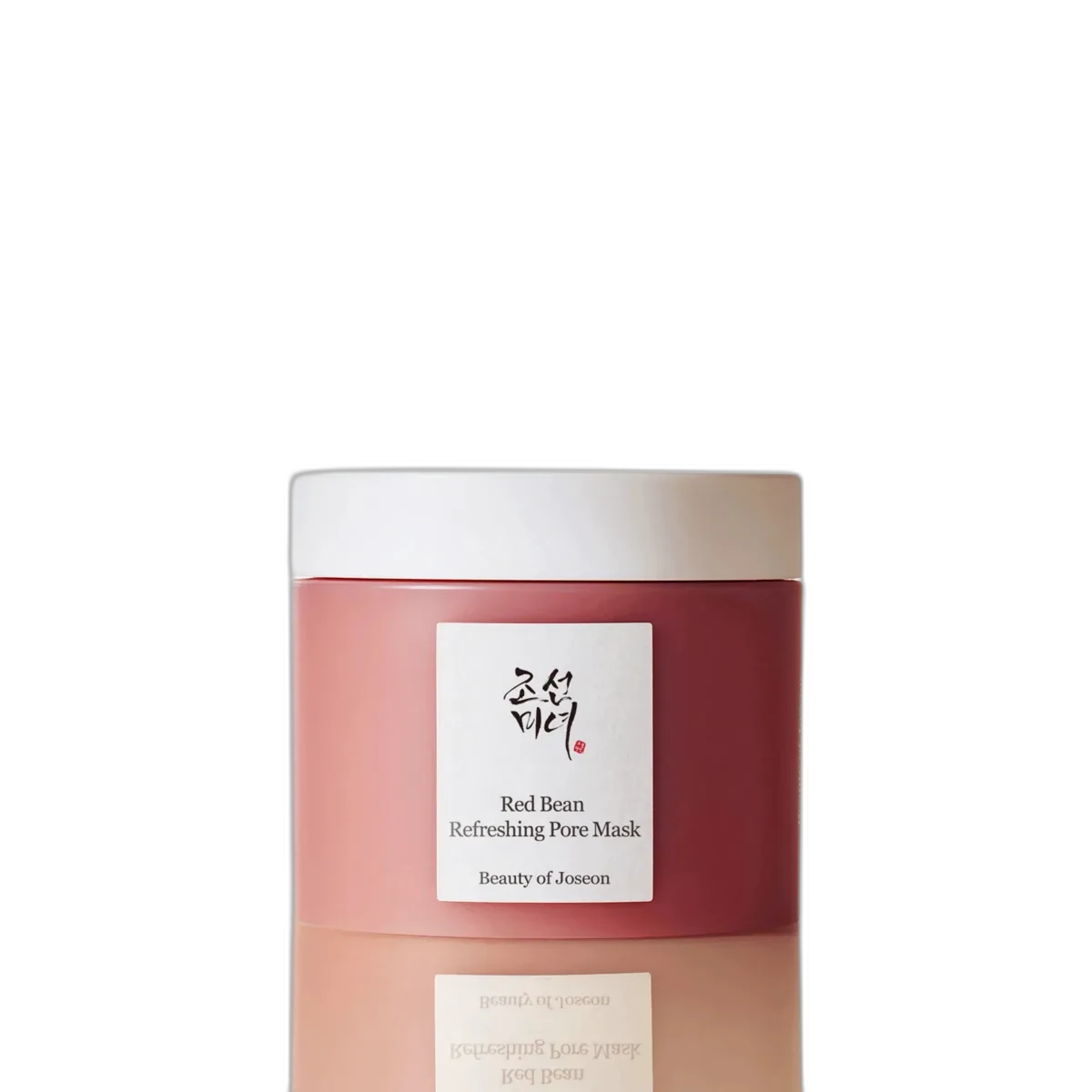
Red Bean Refreshing Pore Mask
Hanbang Pore-Care Ritual
 Verified reviewer
Pros & cons.
- +30% red bean extract provides saponin-based pore clearing gentler than pure clay
- +High glycerin prevents tight, dehydrated feeling common with clay masks
- +Multi-mechanism approach: saponins loosen, clay absorbs, bean powder exfoliates
- +Skin feels velvety soft rather than stripped
- +Good value at $16 for 140ml — lasts 4-6 months weekly
- +Traditional Korean ingredient heritage in modern formula
- −Results subtle and incremental — not strong enough for severe congestion
- −Physical particles may irritate very sensitive skin
- −Not suitable for active breakouts or compromised barriers
- −Pore-refining effects temporary (1-2 days)
- −Some find it too gentle compared to stronger clay masks
The full review.
There is a specific memory that many Korean people share: watching their grandmother or mother take a handful of dried red beans, grind them in a mortar, and mix the powder with water into a rusty-colored paste. This paste went on the face, was gently rubbed in circles, and rinsed off with cold water. The skin underneath was always impossibly soft. Beauty of Joseon has taken this particular memory and turned it into a product that honors the tradition while delivering measurably better results than a kitchen-prepared paste ever could.
The Red Bean Refreshing Pore Mask leads with its namesake ingredient at 30% — a concentration that puts the red bean front and center rather than burying it behind a wall of synthetic actives. Phaseolus angularis seed extract is rich in saponins, natural surfactant compounds that dissolve and lift oil from pores. This is a fundamentally different approach from pure clay absorption: where kaolin clay sits on the skin surface and soaks up oil passively, red bean saponins actively interact with sebum at a molecular level, loosening the bonds that hold oily deposits in pores.
Kaolin clay does appear in the formula as the third ingredient, playing an important supporting role. While the red bean saponins do the molecular loosening, the kaolin absorbs the freed oil and provides the satisfying mattifying effect. The partnership is well-designed: saponin loosens, clay absorbs, and the high glycerin content (second ingredient) prevents either from leaving skin dehydrated.
The red bean seed powder adds physical exfoliation. These are finely ground particles — nothing like jagged walnut shells. They provide gentle buffing action when you wet your fingers and massage before rinsing, smoothing surface texture and helping clear dead cell buildup. The combination of chemical clearing (saponins), oil absorption (clay), and physical exfoliation (powder) is a thoughtful multi-mechanism approach.
The texture is a thick, creamy paste with a distinctive earthy-red color. It spreads evenly, stays in place, and crucially, doesn’t dry down to a tight, cracking shell. After ten to fifteen minutes, the mask feels slightly damp rather than bone-dry — a direct result of the glycerin. This is important: a clay mask that dries completely is actively pulling moisture from your skin. This formula avoids that trap entirely.
After rinsing, the results are gratifying. Skin feels velvety soft and noticeably smoother. Pores look temporarily refined, and there’s a matte but not tight finish that suggests oil has been removed without moisture sacrifice. The effect lasts about a day or two, typical for any topical pore treatment.
The limitations are straightforward. This is not a dramatic deep-purging treatment — severe congestion and deep blackheads may need stronger chemical interventions like BHA serums. The red bean particles, while gentle, still constitute physical exfoliation, making this inappropriate for very sensitive skin or compromised barriers. And the results are incremental rather than transformative — this is a maintenance tool, not a rescue product.
At 140ml for $16, used once weekly, this tube should last four to six months, bringing the per-use cost to well under a dollar. The formula’s restraint — its refusal to load up on aggressive actives at the expense of gentleness — is actually its greatest strength. In a mask category that too often confuses aggression with effectiveness, the Red Bean Pore Mask takes the quieter, wiser approach.
Texture
The texture is a thick, creamy paste with a distinctive earthy-red color. It spreads evenly, stays in place, and crucially, doesn’t dry down to a tight, cracking shell. After ten to fifteen minutes, the mask feels slightly damp rather than bone-dry — a direct result of the glycerin. This is important: a clay mask that dries completely is actively pulling moisture from your skin. This formula avoids that trap entirely.
Best for
After rinsing, the results are gratifying. Skin feels velvety soft and noticeably smoother. Pores look temporarily refined, and there’s a matte but not tight finish that suggests oil has been removed without moisture sacrifice. The effect lasts about a day or two, typical for any topical pore treatment.
Not ideal for
The limitations are straightforward. This is not a dramatic deep-purging treatment — severe congestion and deep blackheads may need stronger chemical interventions like BHA serums. The red bean particles, while gentle, still constitute physical exfoliation, making this inappropriate for very sensitive skin or compromised barriers. And the results are incremental rather than transformative — this is a maintenance tool, not a rescue product.
Ingredient analysis.
Full INCI list
Phaseolus Angularis Seed Extract, Glycerin, Kaolin, Caprylic/Capric Triglyceride, 1,2-Hexanediol, Phaseolus Angularis Seed Powder, Hectorite, Cetyl Alcohol, Glyceryl Stearate SE, Sorbitan Olivate, Cetearyl Olivate, Ultramarines, Pyrus Communis (Pear) Fruit Extract, Ethylhexylglycerin, Sodium Acrylate/Sodium Acryloyldimethyl Taurate Copolymer, Hedera Helix (Ivy) Leaf/Stem Extract, Water, Polyisobutene, Pyrus Malus (Apple) Leaf Extract, Fragaria Chiloensis (Strawberry) Fruit Extract, Ci 77491, Caprylyl/Capryl Glucoside, Sorbitan Oleate, Triethoxycaprylylsilane
Skin match.
The science.
The Science
The red bean has been studied for its saponin content, which provides natural surfactant properties. Saponins are amphiphilic glycosides with both water-loving and oil-loving regions, enabling them to dissolve sebum at the surface level.
Kaolin clay operates through physical adsorption — its layered silicate structure binds to oil through electrostatic interaction. Combined with saponin-based loosening, this creates more thorough pore clearing than either alone.
Glycerin as the second ingredient is scientifically significant. Research in the British Journal of Dermatology established glycerin as one of the most effective humectants available. In a clay mask, it counteracts mineral oil absorption's dehydrating tendency, maintaining stratum corneum hydration and preventing compensatory sebum overproduction.
The fruit extracts (pear, apple, strawberry) provide supplementary antioxidant activity from polyphenolics. Ivy leaf extract (Hedera helix) contributes additional saponin content.
Dermatologist Perspective
Dermatologists generally recommend weekly pore-clearing masks for oily and combination skin. Board-certified dermatologists note that the high glycerin content addresses the most common clay mask complaint — post-use tightness. The physical exfoliation from red bean seed powder falls within the range dermatologists consider safe for regular use. Dermatologists often recommend pairing gentle physical exfoliating masks with regular BHA use for comprehensive pore maintenance.
Where it fits in your routine.
Apply evenly to clean, dry skin. Avoid eyes. Leave for 10-15 minutes. Wet fingers with lukewarm water and massage in gentle circles. Rinse thoroughly. Use toner and moisturizer after. Use 1-2x per week.
At $16 for 140ml used weekly, this lasts 4-6 months at under $1 per use. The 30% red bean extract is high, and the supporting ingredients work well together. Comparable masks cost $20-35 for 75-100ml and have less interesting formulations.
Oily and combination skin types seeking a gentle weekly pore ritual. This works for people who find clay masks too drying, K-beauty enthusiasts who value traditional ingredients, and anyone managing enlarged pores without harsh treatments.
Use for very sensitive skin, active rosacea, eczema, or compromised barriers. Skip if you want aggressive deep-pore treatment — this is maintenance, not rescue.
Product details.
Thick creamy paste with visible fine red bean particles. Deep earthy-red color. Stays in place without dripping.
No added fragrance. Subtle natural earthy aroma.
140ml squeeze tube with signature Beauty of Joseon design.
The thick earthy-red cream spreads smoothly. Visible red bean particles do not scratch. It does not dry to a tight shell. Skin feels soft and refreshed after rinsing.
4-6 months with 1-2 weekly uses
12 months
All Year
The backstory.
Red beans (pat in Korean) have been used in Korean skincare for generations, ground into powder and mixed with water as a gentle face wash. The saponins create mild natural lather that dissolves oil without soap's harshness. Beauty of Joseon concentrated this into a 30% extract mask.
About Beauty of Joseon
Established Brand (5–20 years)Beauty of Joseon launched in 2016 and updated its approach in 2019. The brand combines traditional Korean hanbang ingredients with modern formulation science. Beauty of Joseon has a large global following and sells at Sephora, with products that earn high user ratings on many retail platforms.
Common myths.
Pore masks can permanently shrink pores.
Genetics determine pore size. Pore masks temporarily reduce their appearance by removing oil and debris. Effects last 1-2 days.
Natural ingredients like red bean lack the efficacy of modern actives for pore care.
Red bean saponins act as surfactants that dissolve sebum. They work differently than BHA, providing gentle surface-level clearing for weekly maintenance.
FAQ.
How often should I use the Red Bean Pore Mask?
Use 1-2 times per week. Do not use kaolin clay and red bean exfoliation daily. Skip other exfoliants on mask days.
Is this mask better than the Ground Rice and Honey Glow Mask?
Different purposes. Red Bean uses 30% extract and kaolin to clear pores. Ground Rice uses honey hydration to balance purification. Choose Red Bean for oily, pore-focused concerns.
Can I use this on dry skin?
Yes, less often — once every 1-2 weeks. High glycerin makes it gentler than most clay masks. Follow with a thick moisturizer.
Does it help with blackheads?
Yes. Red bean saponins dissolve oil plugs, kaolin absorbs loosened sebum, and seed powder exfoliates physically. For deeper blackheads, use BHA toner before masking.
Why is the mask reddish?
30% red bean extract and ultramarines (safe cosmetic pigment) provide the color. The ingredients have this natural color.
What the community says.
"Velvety soft skin without dryness"
"Satisfying gentle exfoliation from red bean particles"
"Pores look visibly cleaner"
"Creamy pleasant texture"
"Results subtle rather than dramatic for severe congestion"
"Physical exfoliation may irritate very sensitive skin"
"Too gentle compared to stronger clay masks"
People also looked at.