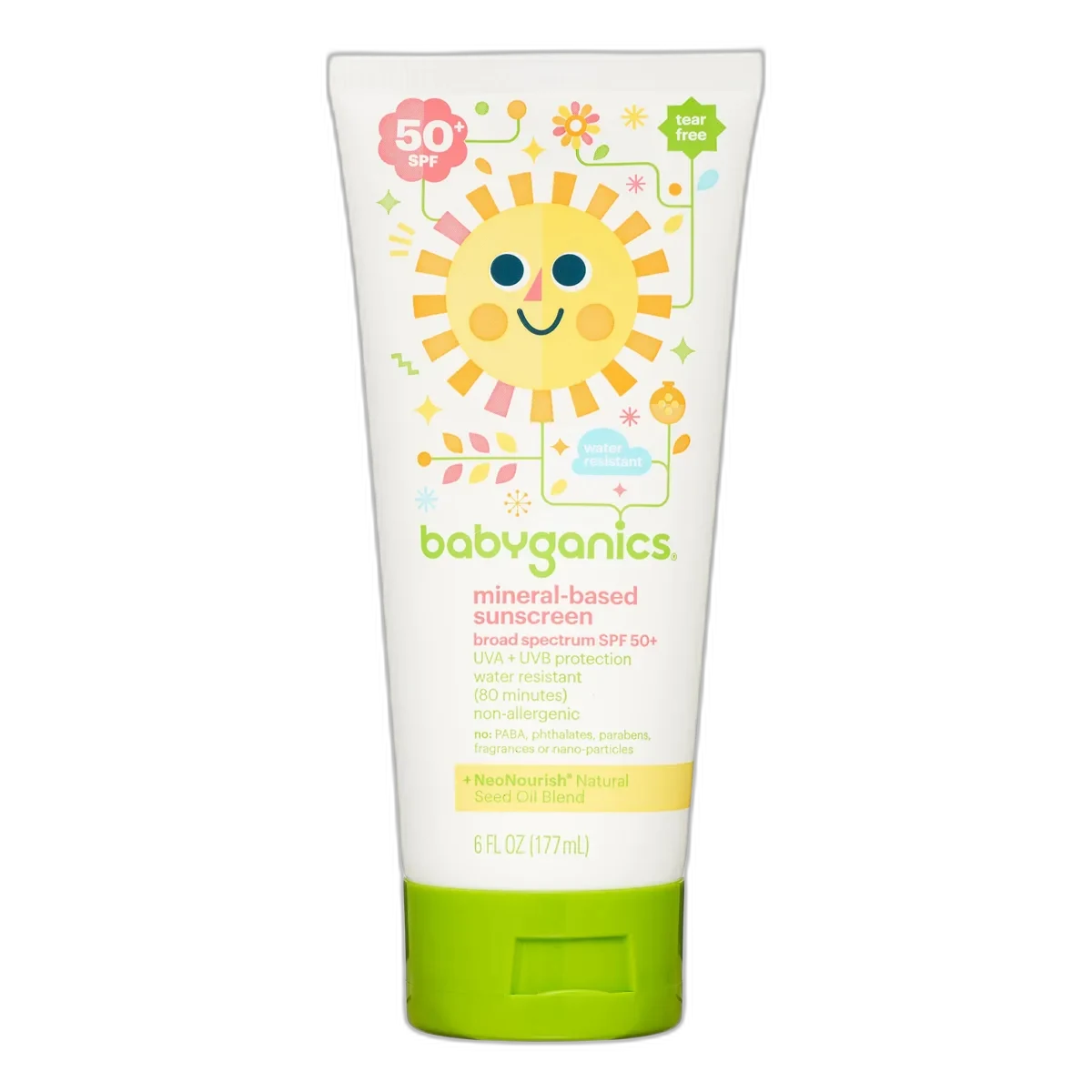
Mineral-Based Sunscreen Lotion SPF 50
Mineral Baby Sunscreen Staple
 Verified reviewer
Pros & cons.
- +High 12% zinc oxide concentration provides genuinely broad-spectrum UVA and UVB protection
- +Fully mineral UV filter system with zero chemical absorbers in current formulation
- +Tear-free formula that does not sting or irritate baby eyes during face application
- +Completely fragrance-free and essential-oil-free for maximum gentleness
- +NeoNourish seed oil blend provides moisturization and antioxidant support beneath the UV shield
- +Short, clean ingredient list that avoids most common allergens and sensitizers
- −Noticeable white cast that is particularly visible on medium to dark skin tones
- −Thick texture requires patient, deliberate blending on uncooperative toddlers
- −Water resistance is adequate but requires more frequent reapplication than chemical alternatives
- −Goes through product quickly with the generous application needed for proper SPF coverage
- −Contains isopropyl myristate which some parents may prefer to avoid in baby products
The full review.
Around 2018, the parenting internet rejected chemical sunscreen filters, forcing brands to reformulate. Babyganics led this shift; their sunscreen has always leaned mineral. The current version uses 12% zinc oxide and 3% titanium dioxide with no chemical UV absorbers. Earlier versions used octisalate as a UVB booster, but removing it satisfies parents seeking the simplest filter system for baby skin.
The 12% zinc oxide concentration is high compared to many competing baby sunscreens. Zinc oxide is the only single UV filter covering the full UVA spectrum, including deep UVA I rays that reach the dermis. Combined with titanium dioxide for UVB absorption, the formula provides SPF 50+ broad-spectrum coverage.
Paper and skin differ. This sunscreen is thick. It requires deliberate, patient spreading instead of the effortless glide of a chemical formula. This texture matters when applying to a squirming, impatient toddler. It blends better on slightly damp skin, which helps with post-pool reapplication.
The white cast is present. At 12% zinc oxide, no formulation makes this disappear entirely. On fair-skinned babies, it fades to a subtle sheen within minutes. On medium to dark skin tones, it stays visible and looks chalky if not blended thoroughly. Some parents prefer the visible layer as a visual reminder of coverage, but do not expect an invisible finish.
The NeoNourish seed oil blend returns, using the same tomato, sunflower, cranberry, black cumin, and red raspberry seed oil found in the Babyganics skincare line. In this sunscreen, these oils moisturize baby skin to prevent dryness from mineral filters and provide antioxidant support alongside UV protection. The bisabolol adds chamomile-derived soothing for sensitive skin in hot conditions.
The tear-free claim works. Parents report this sunscreen does not sting or irritate eyes, which helps when applying to a toddler’s face. The fragrance-free formula has no scent beyond the neutral, slightly mineral smell of zinc oxide.
Water resistance is adequate. The product holds up during brief water play, but mineral filters sit on the skin surface rather than absorbing, so they rub or wash off easier than chemical alternatives. Reapply after every pool session and keep the tube at the beach rather than in the car.
The formula is clean regarding allergens. It contains no fragrance, essential oils, parabens, oxybenzone, or octinoxate. The preservative system uses phenoxyethanol and caprylhydroxamic acid, which sensitive skin tolerates well. This short, clean ingredient list suits parents managing baby eczema or contact dermatitis.
The formulation is silicone-free. Many mineral sunscreens use dimethicone or cyclomethicone to improve spreadability and reduce white cast, but Babyganics uses jojoba esters and plant-derived emollients instead. This meets the needs of parents who prefer silicone-free products.
The 6-ounce tube costs $10.99, a competitive price for a mineral baby sunscreen. However, the thick application needed for protection means you will use it faster during beach season. The 2-ounce travel size fits diaper bags, and the 8-ounce value size suits families in sunny climates. The cost per ounce is reasonable.
This sunscreen will not convert mineral-skeptics with an invisible finish. It provides peace of mind through transparent mineral protection, a short ingredient list, and gentle performance on sensitive skin. For families committed to mineral sun protection, this is a reliable choice for the beach bag.
Ingredient analysis.
Full INCI list
Active Ingredients: Titanium Dioxide 3%, Zinc Oxide 12%. Inactive Ingredients: 1,2-Hexanediol, Alumina, Bisabolol, Butyloctyl Salicylate, Caprylhydroxamic Acid, Caprylic/Capric Triglyceride, Cetearyl Alcohol, Cetearyl Glucoside, Cetearyl Olivate, Citric Acid, Ethylhexyl Palmitate, Glycerin, Helianthus Annuus (Sunflower) Seed Oil, Isopropyl Myristate, Isostearic Acid, Jojoba Esters, Lecithin, Nigella Sativa (Black Cumin) Seed Oil, Phenoxyethanol, Polyglyceryl-3 Polyricinoleate, Polyhydroxystearic Acid, Propanediol, Rubus Idaeus (Red Raspberry) Seed Oil, Solanum Lycopersicum (Tomato) Seed Oil, Sorbitan Olivate, Tocopheryl Acetate, Trimethylpentanediol/Adipic Acid/Glycerin Crosspolymer, Vaccinium Macrocarpon (Cranberry) Seed Oil, Water, Xanthan Gum
Skin match.
The science.
The Science
Zinc oxide and titanium dioxide are the two FDA-approved mineral UV filters. Their safety profile in pediatric use is the strongest of any sunscreen active. Zinc oxide at 12% provides the broadest single-agent UV coverage available. A 2011 review in the Journal of the American Academy of Dermatology confirmed that zinc oxide uniquely absorbs across UVB, UVA II, and UVA I wavelengths. It is the only filter that protects against the deepest-penetrating UV rays.
This combination approach pairs zinc oxide with a lower concentration of titanium dioxide to use each filter's strengths. Titanium dioxide excels at UVB absorption and scatters shorter wavelengths, while zinc oxide fills the UVA I gap. A 2019 study in Photodermatology, Photoimmunology & Photomedicine found that mineral sunscreens with combined zinc oxide and titanium dioxide provide more uniform spectral protection than either filter alone.
The non-nano particle claim addresses parental concerns about systemic absorption. Multiple studies, including a 2019 review in the British Journal of Dermatology, confirm that mineral UV filters — even in nano-sized particles — do not penetrate beyond the stratum corneum in intact skin. In non-nano formulations like this one, the particles are even less likely to penetrate. They sit on the skin surface to reflect and absorb UV radiation.
Supporting ingredients add value. Bisabolol, derived from chamomile, has anti-inflammatory properties in multiple dermatological studies. It helps mitigate irritation from mineral particles on sensitive baby skin during prolonged sun exposure.
References
- Sunscreens: a review of UV filters and their current status — Journal of the American Academy of Dermatology (2011)
Dermatologist Perspective
Pediatric dermatologists recommend mineral sunscreens as the first choice for infants and young children because they work immediately and have minimal risk of systemic absorption. Board-certified dermatologists note that zinc oxide-based formulations suit babies with eczema or sensitive skin, as they trigger irritant contact dermatitis less often than chemical filters. The American Academy of Dermatology endorses broad-spectrum SPF 30+ for children; this product's SPF 50+ with high zinc oxide exceeds that threshold. Dermatologists emphasize that the white cast is a characteristic of uncoated mineral particles, not a sign of over-application.
Guidance
Where it fits in your routine.
Apply a thick, even layer to all exposed skin at least 15 minutes before sun exposure; mineral filters work immediately on contact. Use a nickel-sized amount for an infant's face and a shot-glass amount for a toddler's full body. Reapply every two hours during continuous sun exposure and immediately after swimming, heavy sweating, or towel drying. Apply to slightly damp skin and pat gently instead of rubbing to blend easier. Avoid the eye area; even though the formula is tear-free, do not apply sunscreen to the eyelids.
At $10.99 for 6 ounces, this sits mid-range in the baby mineral sunscreen market — cheaper than boutique clean-beauty brands but slightly more expensive than basic drugstore options. The 12% zinc oxide concentration provides good protection value, and the NeoNourish seed oil blend adds formulation depth that cheaper alternatives lack. Multiple sizes exist — the 2 oz travel tube works for on-the-go use, while the 8 oz value size is more economical for daily summer use. Families in sun-intensive climates should budget for multiple tubes per season, as proper mineral sunscreen application requires generous amounts.
Parents want a fully mineral, fragrance-free, tear-free sunscreen for babies and young children—especially those with sensitive, eczema-prone, or allergy-prone skin. It works for families who avoid chemical UV filters and prefer a short, transparent ingredient list.
Parents want an invisible-finish sunscreen for older kids who resist white cast, or long-lasting water resistance for extended swim sessions. Adults seeking an elegant daily sunscreen will find the texture and white cast impractical for facial use.
Product details.
Unscented — has no fragrance, essential oils, or chemical sunscreen smell
Squeeze tube comes in 2 oz travel size, 6 oz standard tube, and 8 oz value size. Babyganics branding uses simple, clean packaging.
It leaves a visible white protective layer on the skin immediately. The texture is thick but workable. The tear-free formula prevents stinging or irritation, even around the eye area. Most parents find the white cast more prominent than expected.
1-2 months with regular outdoor use on an infant or toddler (6 oz size)
12 months
spring summer
The backstory.
Babyganics developed this sunscreen as part of their mission to create baby products that parents could trust without needing a chemistry degree to decode the label. The formula has been reformulated over the years to move from a hybrid mineral-chemical system to a fully mineral active formula, reflecting shifting parental preferences toward chemical-filter-free sun protection.
About Babyganics
Two fathers founded Babyganics in 2002, and SC Johnson acquired it in 2016. Pediatricians and dermatologists test the brand, which focuses on plant-derived baby care products. The brand has wide distribution but lacks independent published research on its specific sunscreen formulations. Established Brand (5–20 years)
Common myths.
Mineral sunscreens provide less protection than chemical sunscreens.
With 12% zinc oxide and 3% titanium dioxide, this formula provides SPF 50+ broad-spectrum protection. This matches or exceeds many chemical sunscreens. Zinc oxide provides the most complete UVA I coverage of any single UV filter.
A white cast from mineral sunscreen shows it works better than one that blends in.
White cast is a cosmetic byproduct of uncoated mineral particles on the skin surface. UV protection depends on concentration and application thickness, not visibility. A well-blended mineral sunscreen at the same concentration protects equally well.
What the community says.
"Gentle on sensitive baby skin with no irritation or stinging"
"Truly fragrance-free with no chemical smell"
"Effective mineral-only protection parents trust for infants"
"Good moisture level that does not dry out baby skin"
"Noticeable white cast, especially on darker skin tones"
"Thick texture can be difficult to spread evenly on squirming babies"
"Needs frequent reapplication during water play"
"Some feel the price is high for a baby sunscreen that requires liberal use"
Featured in.
People also looked at.