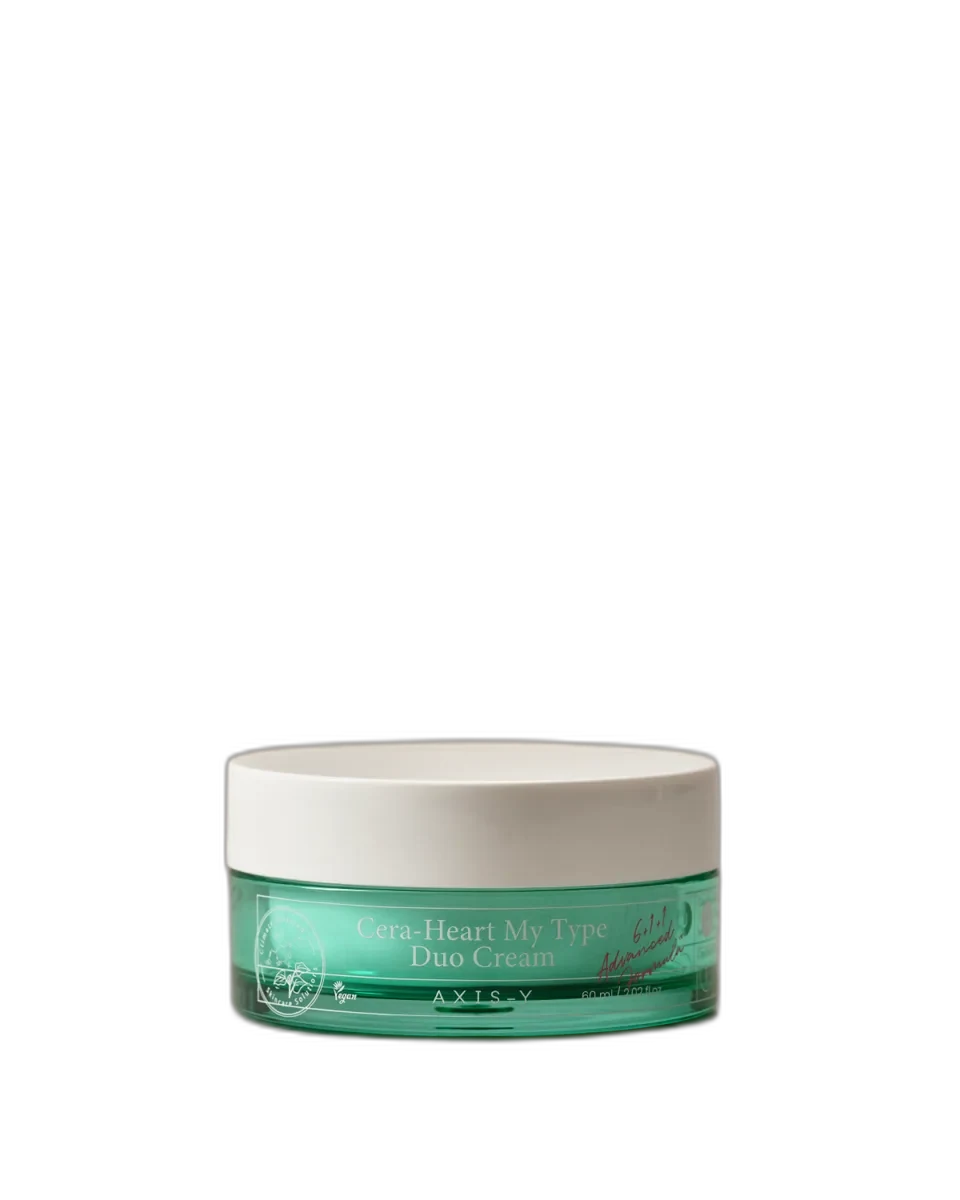
Cera-Heart My Type Duo Cream
Combo Skin Solution
 Verified reviewer
Pros & cons.
- +Genuinely original dual-formula concept that solves combination skin's structural problem
- +Two meaningfully different formulas — T-zone gel and U-zone ceramide cream — in one jar
- +Both formulas are fragrance-free and well-tolerated by sensitive skin
- +Excellent value compared to buying two separate moisturizers
- +Distinctive dual-chamber packaging is practical, not gimmicky
- +Cruelty-free and vegan formulation
- +Houttuynia cordata in T-zone formula provides genuine sebum-control benefit
- −Built specifically for combination skin — not ideal for uniformly dry or oily skin
- −Dual-chamber jar takes up more vanity space than a single jar
- −30ml of each side empties faster than expected with twice-daily use
- −U-zone formula isn't rich enough for very dry cheeks
The full review.
Combination skin often forces a choice: a cream that feels good on cheeks but turns slick on the forehead by 11 a.m., or one that controls the T-zone but leaves the face perimeter tight by evening. Many people end up using two separate moisturizers—a lightweight gel for the T-zone and a thicker cream for the cheeks—as a permanent cosmetic nuisance. This happens because combination skin requires two different functions, and one formula cannot do both well. The Axis-Y Cera-Heart My Type Duo Cream solves this by shipping two different formulas in one jar. It is a rare K-beauty entry that is truly original.
About BrandName
The differentiation between the two sides matters. The T-zone formula uses a humectant-forward base of water, propanediol, glycerin, and sodium hyaluronate. It contains no plant butters, jojoba oil, ceramides, or occlusive wax. This gel-cream structure uses houttuynia cordata extract for sebum control, centella asiatica for calming, and a botanical extract layer (sage, licorice, sorghum) for skin support. Aspergillus ferment provides mild enzymatic activity. It absorbs fast to balance oiliness without stripping skin or adding heavy lipids. The U-zone formula uses the same humectant base but diverges quickly: cetyl ethylhexanoate acts as an ester, jojoba seed oil provides liquid wax emollience, ceramide NP supports the barrier, and microcrystalline wax and candelilla cera provide occlusion. It uses a different botanical cast (portulaca, salicornia, phragmites) to prioritize barrier and hydration over sebum control. This is a real cream, not just a thicker gel.
Texture
The difference is immediate. The T-zone side is light, slippery, and absorbs in seconds without residue. The U-zone side is more cushiony, absorbs slower, and leaves a soft satin finish felt hours later. Apply the T-zone formula to the forehead, nose, and chin, and the U-zone formula to the cheeks and jawline. The result beats any single moisturizer. Your forehead stays matte, your cheeks stay hydrated, and the routine adds ten seconds. For combination skin, this works well.
Scent
Both sides are fragrance-free. Unlike the Biome line, which uses essential oils in every product, the Cera-Heart Duo contains no perfume, no essential oil, and no scent. This makes it a good choice for sensitive or reactive combination skin within the Axis-Y lineup. The dual-chamber jar with two side-by-side compartments feels distinctive, though it takes more vanity space than a single jar.
Who Should Buy
This product targets combination skin specifically. If your whole face is dry, the U-zone formula lacks sufficient richness, and the T-zone formula will feel tight; use the Biome Ultimate Indulging Cream instead. If your whole face is oily, a single lightweight gel-cream is better because you do not need the U-zone richness. The narrow target audience is the main limitation. Also, the 30ml + 30ml format empties faster than a 60ml single cream because you use both sides. Expect one dual jar to last 2-3 months with twice-daily application.
Value
Value is excellent. At roughly $28 for the dual jar, you get two separate moisturizers in one package. Buying a lightweight gel-cream and a richer ceramide cream separately from similar K-beauty brands would cost $40-$50. The 60ml total volume lasts 2-3 months at twice-daily use, costing $9-$14 per month. For combination skin, this is a top value pick in the K-beauty moisturizer category. Final read: a strong recommend for combination skin that wants to stop compromising, though uniformly dry or oily skin should look elsewhere.
Ingredient analysis.
Full INCI list
T-ZONE: Water, Propanediol, Glycerin, Sodium Hyaluronate, Butylene Glycol, Sorbitol, Isohexadecane, Caprylic/Capric Triglyceride, Houttuynia Cordata Extract, Betaine, Centella Asiatica Extract, Glyceryl Stearate, Salvia Officinalis Extract, Glycyrrhiza Glabra Root Extract, Sorghum Bicolor Leaf/Stem Extract, Aspergillus Ferment, Chlorphenesin, Arginine, Acrylates/C10-30 Alkyl Acrylate Crosspolymer, Allantoin, Sorbitan Sesquioleate, Ethylhexylglycerin, Xanthan Gum, Guaiazulene. U-ZONE: Water, Butylene Glycol, Glycerin, Cetyl Ethylhexanoate, Simmondsia Chinensis (Jojoba) Seed Oil, Caprylic/Capric Triglyceride, Isohexadecane, Sodium Hyaluronate, Ceramide NP, Sorbitan Stearate, Glyceryl Stearate, Microcrystalline Wax, Sorbitol, Centella Asiatica Extract, Candelilla Cera, Sorbitan Sesquioleate, Sorghum Bicolor Leaf/Stem Extract, Aspergillus Ferment, Portulaca Oleracea Extract, Salicornia Herbacea Extract, Phragmites Communis Extract, Chlorphenesin, Arginine, Carbomer, Xanthan Gum, Allantoin, Ethylhexylglycerin
Skin match.
The science.
The Science
This cream uses a dual-formula approach based on sebaceous biology: the T-zone (forehead, nose, chin) has higher sebaceous gland density than the U-zone (cheeks, jawline), causing uneven oil production in combination skin. Single-formula moisturizers cannot address this asymmetry because they deliver one lipid load and humectant ratio to the whole face. The Cera-Heart Duo uses two formulas matched to the actual physiology of combination skin.
The U-zone formula uses Ceramide NP, jojoba seed oil, and a structured wax base for barrier lipids. Ceramide NP is a well-established skincare ceramide with published evidence for barrier function support in dry and compromised skin. Jojoba oil is a liquid wax, not a triglyceride oil, and mimics human sebum structure, making it a well-tolerated emollient. Microcrystalline wax and candelilla cera provide structured occlusion and the U-zone's thicker feel.
The T-zone formula uses houttuynia cordata extract for sebum control, which has roots in traditional Korean and Japanese herbal medicine and modern dermatology evidence for anti-inflammatory and sebum-regulating effects. Centella asiatica is the unifying calming ingredient in both formulas and has strong clinical evidence for wound-healing and barrier support. Aspergillus ferment is a fungal-derived ingredient with mild enzymatic activity that provides gentle exfoliation and skin conditioning.
The humectant base in both formulas (glycerin, sodium hyaluronate, butylene glycol, sorbitol) is well-supported by dermatology literature. The botanical extract layers in both formulas have varying levels of individual evidence; most are well-tolerated and contribute to the calming and skin-conditioning profile.
Dermatologist Perspective
Dermatologists find combination skin difficult to formulate for due to asymmetric sebum production and hydration needs across facial zones. Board-certified dermatologists often advise patients with combination skin to use different products on different zones, but few commercial products are as turnkey as the Axis-Y Cera-Heart Duo. The formulation logic — sebum-control botanicals and a humectant-forward gel for the T-zone, ceramides and jojoba for the U-zone — matches combination skin's actual physiology. The fragrance-free profile is a plus. For patients seeking one moisturizer for their entire face, this is one of the more effective targeted solutions in the affordable K-beauty tier.
Where it fits in your routine.
Cleanse, tone, and apply serums first. Use a clean fingertip to scoop the T-zone formula and apply it to your forehead, nose, and chin using gentle, upward motions. Use a different clean fingertip to scoop the U-zone formula and apply it to cheeks, jawline, and dry areas. For in-between areas, mix small amounts of both on a fingertip for a custom-weight application. Use morning and evening; apply broad-spectrum SPF in the morning.
At approximately $28 for the dual jar (60ml total, 30ml of each formula), this product offers high value in the K-beauty moisturizer category. Buying a lightweight T-zone gel and a richer U-zone ceramide cream from comparable brands costs $40-$50 combined. One dual jar lasts 2-3 months with twice-daily use, making the monthly cost $9-$14. This dual-formula approach is uncommon at this price and provides excellent per-month value for combination skin.
True combination skin types often struggle with single-formula moisturizers that fail to balance T-zone oiliness and U-zone dryness. This works for those who want a fragrance-free approach and two zone-specific formulas in one package.
Skip this if you have uniformly dry skin (use the Biome Ultimate Indulging Cream instead) or uniformly oily skin (a single lightweight gel-cream works better). Also skip this if you find dual-application routines tedious and prefer a single-product approach.
Product details.
T-zone: lightweight gel-cream absorbs instantly. U-zone: thicker cream with a soft cushiony finish
Essentially scentless in both formulas
A dual-chamber jar uses a divider to separate two side-by-side compartments — distinctive and practical
The dual-jar approach feels novel on first use — you dip into the lighter T-zone formula on one side and the thicker U-zone formula on the other. Both absorb cleanly without fragrance or stinging. The T-zone gel feels light; the U-zone cream feels more cushioning. This contrast is part of the product's appeal.
2-3 months with twice-daily face application
12 months
All Year
The backstory.
The Cera-Heart Duo Cream emerged from Axis-Y's community-led product development — combination skin users repeatedly told the brand that single-formula moisturizers always compromised one zone or the other. The dual-jar concept was the response, launched in 2021. It's become one of the brand's most distinctive products and has helped Axis-Y stand out in the crowded K-beauty moisturizer category. The 'My Type' branding refers to the idea that different zones of your face are 'different types' of skin.
About Axis-Y
Emerging Brand (2–5 years)Axis-Y launched in 2019. In 2021, they released the Cera-Heart Duo Cream, a dual-formula approach for combination skin. This concept is one of the most original in mid-tier K-beauty. The dual-zone idea is unusual and shows the brand's community-driven product development model.
Common myths.
Adjust the amount to use any moisturizer for combination skin.
Changing the amount of a single formula does not change its texture or lipid load. A heavy cream applied lightly remains a heavy cream; you just use less. Dual-zone formulations use a different approach to the combination-skin problem.
These two formulas in this jar use different thickeners but are basically the same.
The ingredient lists differ significantly. The U-zone formula uses ceramide NP, jojoba oil, and a wax base for occlusion; the T-zone formula replaces these with a lighter humectant-and-botanical base and sebum-control ingredients. This is more than a cosmetic distinction.
FAQ.
How do I apply the two formulas?
Apply the T-zone formula to your forehead, nose, and chin (the typically oilier areas) and the U-zone formula to your cheeks and jawline (the typically drier areas). Most users use a fingertip to apply each formula zone by zone. For in-between areas, mix the two on a fingertip for a custom-weight application.
Is this just a marketing gimmick?
No — the two formulas have different ingredient lists. The U-zone formula has ceramide NP, jojoba oil, and a wax base. The T-zone formula lacks these but uses houttuynia cordata for sebum control. They are different products in one package.
Can I use this with retinol?
Yes — both formulas are fragrance-free and gentle. They layer well as a buffer over a retinoid. Apply the retinoid first, wait 10-15 minutes, then apply the duo cream zone by zone. The U-zone formula helps buffer retinoid dryness on cheeks.
How does this compare to the Biome Ultimate Indulging Cream?
The Biome Ultimate Indulging Cream is one thick formula for dry, mature, or compromised skin across the face. The Cera-Heart Duo uses two formulas for combination skin. Use the Biome cream if your whole face is dry; use the Cera-Heart Duo if your T-zone is oily and your cheeks are dry.
Is it really fragrance-free?
Yes. The Cera-Heart Duo Cream contains no added fragrance or essential oils, unlike the Biome line. This makes it one of the Axis-Y lineup's more sensitive-skin-friendly options.
How long does the dual jar last?
Applying the 30ml + 30ml format twice daily lasts 2-3 months. The T-zone side usually empties faster than the U-zone side because the T-zone covers more facial real estate for combination skin.
Can I use just one side and not the other?
You can, but you're then paying for half a product you're not using. If your skin is uniformly dry, the Biome Ultimate Indulging Cream is a better fit. If your skin is uniformly oily, a single lightweight gel-cream is a better fit. The Cera-Heart Duo's value proposition is specifically for true combination skin.
Community
What the community says.
"Genuinely solves combination skin moisturizer problem"
"Excellent value for two formulas in one package"
"Both formulas are fragrance-free and well-tolerated"
"T-zone formula doesn't feel drying despite being lighter"
"Two-jar packaging takes up vanity space"
"Application requires more thought than a single cream"
"U-zone formula isn't quite rich enough for very dry cheeks"
"30ml of each side empties relatively fast"