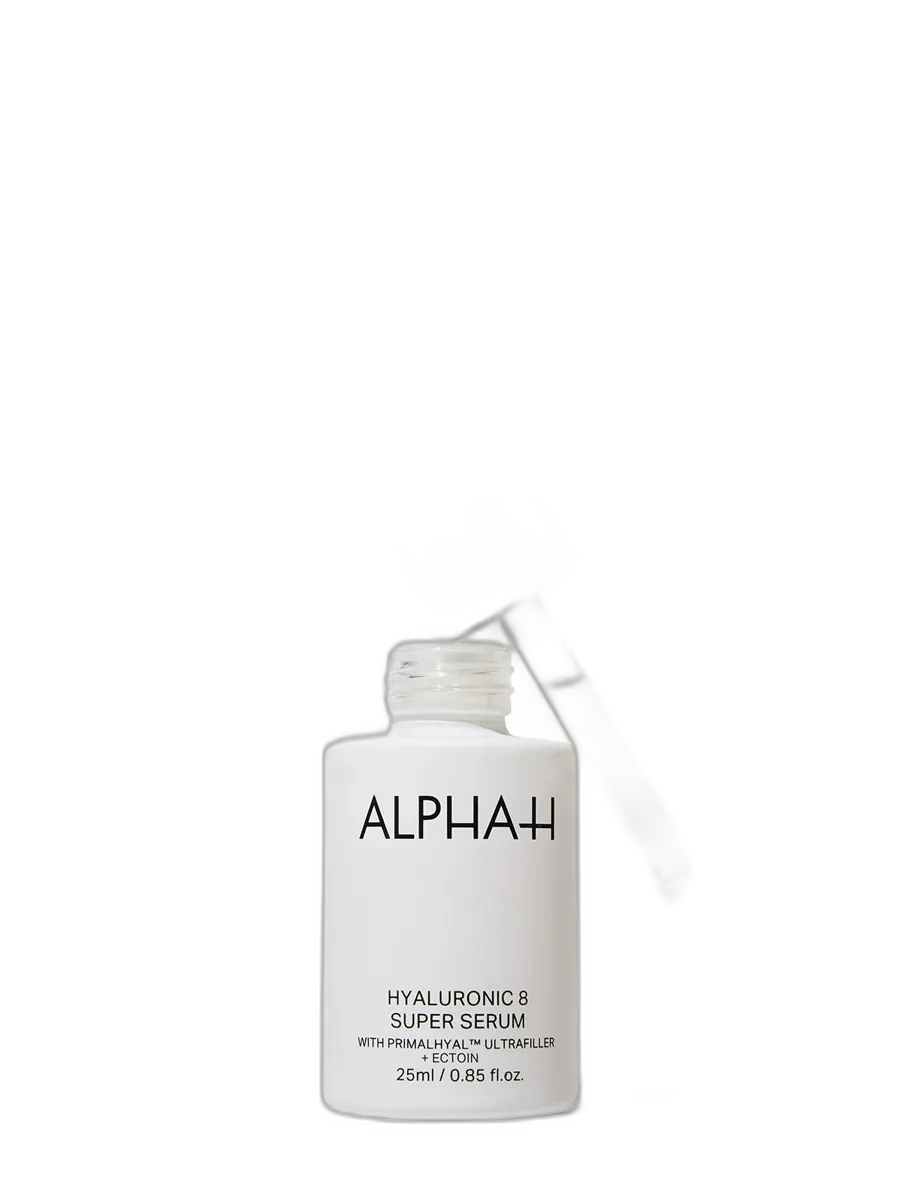
Hyaluronic 8 Super Serum
Layered Hydration MVP
 Verified reviewer
Pros & cons.
- +Eight molecular weights of HA plus polyglutamic acid extend hydration past the typical four-hour window
- +4% niacinamide provides real barrier and sebum-regulation benefit, not just a marketing add
- +Ectoin protects against the dehydration paradox in low-humidity environments
- +Lightweight gel absorbs in under thirty seconds with no tackiness
- +Fragrance-free, alcohol-free, and tolerated by reactive skin from day one
- +Layers well under sunscreen and makeup without pilling
- +Pregnancy and breastfeeding safe across every active ingredient
- +Airless pump packaging protects niacinamide and HA from oxidation
- −Roughly three times the price of comparable drugstore multi-weight HA serums
- −Pump can become inconsistent toward the final fifteen percent of the bottle
- −4% niacinamide may be too active for the most reactive sensitive skin
- −Lacks any meaningful occlusive — must be sealed with moisturizer to perform fully
- −Single 50ml size only — no value-tier larger option for committed users
The full review.
Around 2019, polyglutamic acid started getting the kind of breathless coverage that hyaluronic acid had enjoyed for a decade. Influencers called it the next big thing, brands rushed to bottle it, and the discourse turned into a quiet little arms race over which humectant could hold the most water. Alpha-H — an Australian brand that had spent the previous twenty-five years known almost entirely for its glycolic acid liquids — sidestepped the whole conversation. Instead of picking sides, the formulators just stacked everything that worked into one serum and called it Hyaluronic 8 Super Serum. The result is one of the more genuinely thoughtful hydration serums on the market, and one that quietly demonstrates how much the supporting cast matters. The eight molecular weights of hyaluronic acid get top billing, and they do legitimate work — the higher-weight crosspolymer forms a film on the surface that delivers immediate plumping, while hydrolyzed and acetylated forms penetrate further into the upper epidermis. But the more interesting ingredients are the ones in the middle of the INCI. Sodium polyglutamate (the cosmetic name for polyglutamic acid) holds about four times more water than hyaluronic acid and forms a thin barrier film that slows the rate at which everything underneath evaporates. Ectoin, an extremolyte produced by bacteria living in salt flats and hot springs, protects skin cells from osmotic stress — which sounds abstract until you realize it’s the molecule that prevents the dehydration paradox where HA pulls water out of your dermis in low-humidity environments. Panthenol, allantoin, trehalose, betaine, and sodium PCA fill in the remaining humectant gaps. And then, quietly sitting at the second slot on the INCI, is 4% niacinamide. That’s a meaningful concentration. Niacinamide here isn’t a marketing add — it’s doing barrier work, regulating sebum, and offsetting any minor irritation that the layered humectants might trigger on reactive skin. The texture is impressive given how much active ingredient is packed in. It’s a lightweight, slightly viscous gel that spreads thin, absorbs in under thirty seconds, and leaves no tackiness despite the humectant load. You’ll feel the polyglutamic acid film set within a minute or two — a faint, pleasant tightness that softens as the serum dries down. There’s no fragrance, no essential oils, no alcohol. Sensitive skin will tolerate it from day one. After about a week of twice-daily use, the cumulative effect becomes obvious: skin looks plumper in a sustained way rather than the ephemeral way single-weight HA serums tend to deliver. Fine lines from dehydration soften noticeably. Makeup applies more evenly because the surface texture is smoother. After six to eight weeks the niacinamide contribution becomes visible — pores look slightly more refined, redness calms, and the overall barrier feels less reactive. The honest catch is the price. At around sixty-five dollars for fifty milliliters, this is in the upper-middle tier of hydration serums, and a perfectly competent multi-weight HA serum from a drugstore brand will cost a third as much. The ectoin and polyglutamic acid genuinely justify some of the markup — those ingredients are not cheap raw materials — but you’re also paying for the Alpha-H brand and the airless pump packaging. Whether that’s worth it depends on how much you value the supporting cast and how much your climate punishes single-weight HA. If you live somewhere arid or run heating all winter, the ectoin alone may earn the upgrade. If you’re in humid coastal climates, a simpler serum will probably do most of the same work for less.
Ingredient analysis.
Full INCI list · pH 5.5
Aqua (Water), Niacinamide, Glycerin, Pentylene Glycol, Sodium Hyaluronate, Hydrolyzed Sodium Hyaluronate, Sodium Acetylated Hyaluronate, Hyaluronic Acid, Hydrolyzed Hyaluronic Acid, Sodium Hyaluronate Crosspolymer, Potassium Hyaluronate, Hydrolyzed Glycosaminoglycans, Sodium Polyglutamate, Ectoin, Panthenol, Allantoin, Trehalose, Betaine, Sodium PCA, Hydroxyethylcellulose, Xanthan Gum, Polysorbate 20, Disodium EDTA, Citric Acid, Phenoxyethanol, Ethylhexylglycerin
Skin match.
The science.
The Science
Skin penetration research shows why layering hyaluronic acid molecular weights works. Low-molecular-weight HA fragments below 50 kilodaltons enter the upper epidermis, while higher weights stay on the surface to form a hydrating film. While stacking weights lacks the same clinical evidence as using one optimized form, polyglutamic acid changes the result. This fermentation-derived, water-binding ingredient forms a thin film that formulation studies show slows transepidermal water loss when paired with HA. Ectoin provides a unique evidence base here. Isolated from extremophile bacteria, ectoin stabilizes cell membranes under osmotic stress; topical formulations protect against environmental aggressors and barrier disruption. The 4% niacinamide concentration sits in the established range for barrier function, sebum regulation, and reducing transepidermal water loss—peer-reviewed dermatology research shows consistent results for concentrations between 2% and 5%. Trehalose, allantoin, and panthenol act as soothing humectants and mild barrier supports. This formula's strength lies in combining well-studied ingredients rather than novel chemistry.
Dermatologist Perspective
Dermatologists favor multi-weight hyaluronic acid serums for patients with dehydration, mild barrier compromise, or dry skin from retinoid use. The 4% niacinamide concentration in this formula matches the range clinical reviews cite as effective for barrier function and sebum regulation. Board-certified dermatologists note the dehydration paradox—where HA serums worsen dryness in low-humidity environments—and find that pairing HA with humectant traps like polyglutamic acid or ectoin addresses it. Clinicians often recommend this formula for patients layering one product under retinoid prescriptions and sunscreen without irritation. The fragrance-free, alcohol-free profile makes it suitable for post-procedure use under dermatologist guidance.
Where it fits in your routine.
Apply two to three pumps to clean, slightly damp skin every morning and evening. Pat the serum into your face and neck instead of rubbing; this helps the higher-weight HA forms set into a smooth film. Follow immediately with moisturizer. This step is critical because humectants in dry environments pull moisture from the dermis if they lack an occlusive layer. In the morning, finish with a broad-spectrum SPF 30 or higher. The serum layers well under retinoids in the evening — apply your retinol first, wait one minute, then apply the Alpha-H serum to buffer and hydrate.
At roughly sixty-five dollars for fifty milliliters, this hydration serum sits in the upper-middle tier. A drugstore multi-weight HA serum costs one-third as much and provides about sixty percent of the experience. The premium price pays for the polyglutamic acid, ectoin, and 4% niacinamide combination — these expensive raw materials all work effectively. The upgrade earns its price for dry climates, mature skin, or retinoid users needing a buffering hydration layer. For oily or normal skin in humid environments, a simpler serum works for less. The 50ml-only size misses value — a 100ml option at modest savings would change the math for committed users.
This hydration serum works for dehydrated, mature, or reactive skin needing more than basic HA. It provides a buffering layer for retinoid users, helps in arid or air-conditioned environments where standard HA serums fail, and replaces three separate products for those preferring a single multitasker.
Oily, young, or breakout-prone skin in humid climates can use a simpler drugstore HA serum for equivalent results. Skip this if you are hypersensitive to niacinamide; 4% is a high concentration and can trigger flushing in reactive users.
Product details.
Lightweight, slightly viscous gel spreads thin and absorbs in under 30 seconds
Fragrance-free with a faint clean ingredient smell
An airless pump in a frosted glass bottle protects the niacinamide and HA from oxidation.
The first application feels immediately softening with a faint tightness as the polyglutamic acid film sets. Skin looks visibly plumper within minutes. This pure hydration formula has no purging or adjustment period and works for nearly all skin types from day one.
Approximately 3 months with twice-daily face and neck application
12 months
All Year
The backstory.
Alpha-H built its reputation on glycolic acid in the 1990s, and Hyaluronic 8 was the brand's response to the polyglutamic acid trend that gained traction around 2019-2020. Rather than chase a single trendy molecule, the formulators stacked HA at every available molecular weight and added the supporting humectants needed to keep it stable and effective in Australian climates.
About Alpha-H
Established Brand (5–20 years)Michelle Doherty founded Alpha-H in Australia in 1995. The brand built its reputation on glycolic acid expertise. Alpha-H has nearly three decades of formulation experience and sells at Sephora, Cult Beauty, and Mecca.
Common myths.
More molecular weights of HA always means better hydration.
This works only if the formula includes a humectant trap and barrier support. This serum has both — the polyglutamic acid film and 4% niacinamide keep the HA working after the first hour.
Hyaluronic acid serums are interchangeable.
A $10 single-weight HA gel plumps skin briefly, but pulls moisture from deeper layers in dry conditions. The ectoin and polyglutamic acid in this formula prevent that paradox.
FAQ.
Does this serum contain fragrance?
Hyaluronic 8 Super Serum is fragrance-free. This matters because the 4% niacinamide and dense humectant blend already work hard on the skin; adding fragrance increases irritation potential.
Is this serum safe during pregnancy?
Yes. Every ingredient in this formula — hyaluronic acid, niacinamide, polyglutamic acid, ectoin, panthenol — is safe during pregnancy and breastfeeding. This formula lacks retinoids, salicylic acid, or essential oils.
Why does my hyaluronic acid serum sometimes make my skin feel drier?
Single-weight HA serums cause this in low-humidity environments because HA pulls water from the dermis when air moisture is low. Hyaluronic 8 uses ectoin and polyglutamic acid to trap water and prevent that reverse-hydration effect.
How does Alpha-H Hyaluronic 8 compare to plain hyaluronic acid serums?
The eight HA weights matter less than the supporting ingredients: polyglutamic acid for sustained release, ectoin for osmotic protection, and 4% niacinamide for barrier work. A single-weight HA serum lacks these, so this Alpha-H formula works differently in real-world use.
Can oily skin types use this serum?
Yes. The lightweight texture won't weigh down oily skin, and the niacinamide regulates sebum. The only consideration is price — oily skin types may not need this much hydration and can choose a simpler HA serum.
How long does one bottle last?
Apply twice daily to face and neck for about three months, using two presses per application. The 50ml airless pump dispenses consistently until the last few uses.
---
What the community says.
"Immediately plumps fine lines"
"Layers well under makeup"
"No tackiness despite the humectant load"
"Visible glow after one week"
"Expensive for what is essentially a hydration serum"
"Pump can be inconsistent toward the bottom of the bottle"
"Some users find 4% niacinamide too active for very reactive skin"
People also looked at.