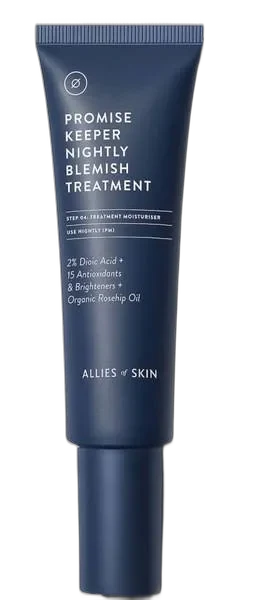
Promise Keeper Nightly Blemish Treatment
Multi-Tasking Acne Treatment
 Verified reviewer
Pros & cons.
- +1.5% salicylic acid plus lactic acid attacks pores and surface texture
- +Sodium ascorbyl phosphate adds anti-acne and brightening dual action
- +Niacinamide and azelaic acid fade post-inflammatory marks while preventing new ones
- +Bakuchiol contributes signaling support without retinoid irritation
- +Soothing centella and panthenol keep the formula tolerable for nightly use
- +Probiotic ferments help maintain barrier resilience under active load
- −Premium price at $89 for 30ml
- −Cannot be used during pregnancy
- −Initial purging phase may bother first-time BHA users
- −Not strong enough on its own for moderate-to-severe cystic acne
The full review.
Acne’s worst part isn’t the breakouts; it’s the aftermath. You clear active lesions, endure weeks of irritation, and adjust your moisturizer for dryness, only to find flat, dark, stubborn marks that linger months after healing. Most acne products ignore this. Salicylic acid clears pores but lacks pigmentation benefits. Benzoyl peroxide kills bacteria but disrupts the barrier. Retinoids help long-term but cause short-term irritation. Most categories treat clearing and fading as separate issues. Allies of Skin’s Promise Keeper Nightly Blemish Treatment is different because it treats both in one bottle.
The formula uses a standard acne serum base: roughly 1.5% salicylic acid as the lead BHA, lactic acid for surface turnover, and a pH around 3.8 to keep actives effective. Salicylic acid works because it is lipid-soluble, penetrates sebum-filled follicles, and clears the cellular debris that causes comedones. Lactic acid smooths the superficial layer where pigmentation sits. This part is standard for any decent BHA serum. The rest is unique.
Niacinamide is high on the INCI to modulate sebum, reinforce the barrier, and inhibit melanosome transfer. Sodium ascorbyl phosphate, a stable vitamin C derivative with data showing anti-acne and antioxidant activity, follows it. Azelaic acid provides anti-inflammatory and antibacterial action against C. acnes, plus tyrosinase inhibition for post-inflammatory pigmentation. Acetyl glucosamine and licorice root extract add brightening pathways. Bakuchiol provides retinol-like signaling without retinoid irritation. The formula then uses centella, bisabolol, allantoin, panthenol, glycerin, sodium hyaluronate, and probiotic ferments to soothe the skin and support the barrier during nightly use. This serum addresses active acne, prevents new lesions, fades old marks, and supports the barrier. It is not a typical BHA serum.
Application is simple. Cleanse, apply 3-4 drops to the face and neck in the evening, follow with moisturizer, and wear sunscreen the next morning. The clear, lightweight serum absorbs in seconds without tackiness. A mild tingle occurs during the first few uses but fades within a week. A short purging phase in the first one to two weeks is possible—this is normal for effective BHA serums as pre-existing congestion reaches the surface—but it is likely less aggressive than benzoyl peroxide or higher-percentage salicylic acid products because the supporting ingredients control inflammation. Users see clearer pores within two weeks, fewer breakouts at four to six weeks, and gradual fading of post-acne marks over the next two months if they stay consistent and use SPF.
Caveats include pregnancy and price. Salicylic acid in leave-on products is generally avoided during pregnancy, and bakuchiol’s pregnancy safety is not yet established, so this is not a pregnancy-friendly serum. For pregnancy, an azelaic acid product is a better fit. At around $89 for 30ml, the price is in the prestige bracket, with no other sizes available. The cost reflects the multi-active formula that replaces two or three separate products. If you already buy a salicylic acid serum, a niacinamide serum, and an azelaic acid product, the math works. For someone with only mild, occasional breakouts, it is overkill.
Who should buy this?
People with persistent low-to-moderate acne and post-inflammatory marks. People who found single-ingredient products like salicylic acid or benzoyl peroxide too harsh or one-dimensional. Users wanting a nightly treatment that protects the barrier. It is not for severe cystic acne, which requires a dermatologist and prescriptions, nor for budget-conscious beginners who could use The Ordinary’s salicylic acid suspension for less. For the right user, it is a top non-prescription combination for clearing and fading.
Ingredient analysis.
Full INCI list · pH 3.8
Water (Aqua), Salicylic Acid, Niacinamide, Lactic Acid, Propanediol, Glycerin, Sodium Ascorbyl Phosphate, 3-O-Ethyl Ascorbic Acid, Azelaic Acid, Acetyl Glucosamine, Bakuchiol, Tetrapeptide-30, Acetyl Tetrapeptide-2, Palmitoyl Tripeptide-1, Centella Asiatica Extract, Glycyrrhiza Glabra (Licorice) Root Extract, Camellia Sinensis (Green Tea) Leaf Extract, Bisabolol, Allantoin, Panthenol, Sodium Hyaluronate, Tocopherol, Glutathione, Lactobacillus Ferment, Bifida Ferment Lysate, Sodium PCA, Trehalose, Xanthan Gum, Sodium Hydroxide, Phenoxyethanol, Ethylhexylglycerin
Skin match.
The science.
The Science
Salicylic acid is one of the most studied topical acne ingredients, with decades of clinical literature supporting its efficacy at concentrations between 0.5 and 2 percent. Its lipid solubility allows it to penetrate sebum-filled pores and clear keratin debris that contributes to comedone formation. Lactic acid is a smaller alpha hydroxy acid that exfoliates the stratum corneum and improves surface texture. Sodium ascorbyl phosphate is a stable vitamin C derivative with published studies suggesting both antioxidant and direct antibacterial activity against C. acnes, making its inclusion in an acne formula deliberate rather than incidental. Azelaic acid is FDA-approved at 15-20% prescription strength for both acne and rosacea, and over-the-counter formulations leverage its anti-inflammatory and tyrosinase-inhibiting activity. Niacinamide has multiple controlled trials supporting its effects on sebum production, barrier function, and post-inflammatory hyperpigmentation. Bakuchiol has a growing body of evidence as a retinol-like signaling ingredient with better tolerance, including small studies suggesting comparable improvements in fine lines and texture without the irritation profile of retinoids. The integration here — combining active acne ingredients with pigmentation modulators and signaling support in one well-tolerated formula — is more difficult to achieve than the individual ingredient list suggests.
Dermatologist Perspective
Dermatologists generally consider salicylic acid one of the foundational over-the-counter acne treatments and frequently recommend it for patients with comedonal acne, blackheads, and oily skin. Board-certified dermatologists often note that combining acne actives with anti-inflammatory and barrier-supporting ingredients can improve both efficacy and tolerance compared to single-active products. Niacinamide and azelaic acid are commonly recommended adjuncts for patients with both acne and post-inflammatory hyperpigmentation, particularly in melanin-rich skin where aggressive clearing treatments can worsen pigmentation. The use of bakuchiol as a retinol alternative is increasingly mentioned in dermatology conversation for patients who want signaling activity without the irritation or pregnancy restrictions of retinoids. Most dermatologists emphasize that any acne treatment requires consistency and patience, and that the outcome depends heavily on combining topical care with non-comedogenic moisturizers and daily SPF.
Where it fits in your routine.
Apply 3-4 drops to clean, dry skin at night before moisturizer. Avoid the immediate eye area. If your skin is new to BHAs, start with three nights per week, then use nightly as tolerated. Always use broad-spectrum SPF 30 or higher in the morning — salicylic acid and the brightening actives in this formula increase photosensitivity. Do not use on the same night as a retinoid, benzoyl peroxide, or physical scrub. Pair with a soothing fragrance-free moisturizer to support the barrier during nightly active use.
At roughly $89 for 30ml, this prestige acne serum consolidates several steps. One bottle replaces a salicylic acid serum, a niacinamide product, and an azelaic acid treatment for active acne and post-inflammatory pigmentation. Buying these separately costs more in total and often causes layering or pilling issues. No other value sizes exist, so the per-ml cost is fixed. The consolidation justifies the price for users with persistent acne and pigmentation. Users with mild occasional breakouts or tight budgets can choose more affordable single-ingredient options.
This nightly serum clears and fades comedonal acne, blackheads, oily skin, and post-inflammatory hyperpigmentation. It works well for users sensitive to single-ingredient BHA products or those with melanin-rich skin where aggressive treatments worsen pigmentation.
Salicylic acid in leave-on products and bakuchiol lack safety data for pregnant or breastfeeding users. People with severe cystic acne need a dermatologist consultation instead of an OTC serum. Budget-focused users can find cheaper single-active options.
Product details.
Lightweight clear serum that absorbs quickly without tackiness
Faint, neutral
Opaque airless pump bottle
Mild tingling on the first few applications is normal. A short purging phase in the first 1-2 weeks is possible as the BHA brings underlying congestion to the surface — this resolves on its own.
Approximately 2-3 months with nightly face use
6 months
All Year
The backstory.
Promise Keeper was one of Allies of Skin's earliest products, launched in 2017. Nicolas Travis built the formula in response to his own struggles with acne and post-inflammatory hyperpigmentation, where most clearing treatments left behind marks the products couldn't fade. Combining acne actives with brightening and soothing ingredients in one bottle was the brand's foundational thesis.
About Allies of Skin
Established Brand (5–20 years)Nicolas Travis founded Allies of Skin in 2016 in Singapore. Promise Keeper was an early launch and independent beauty press recognizes it for combining acne actives with barrier-supporting and brightening ingredients in one nightly treatment.
Common myths.
Stronger BHA percentage equals better acne results.
Salicylic acid efficacy plateaus at 1.5-2%. Higher concentrations mostly increase irritation. This formula uses 1.5% salicylic acid with multiple supporting actives to work better than a higher-percentage standalone.
Vitamin C and salicylic acid can't coexist in one product.
Sodium ascorbyl phosphate stays stable at this serum's pH and has published anti-acne data. This formulation choice is intentional, not a conflict.
FAQ.
Will this purge my skin?
Salicylic acid brings underlying congestion to the surface, which can cause a short purging phase during the first 1-2 weeks. This typically resolves on its own. Scale back frequency if irritation lasts more than 4 weeks.
Can I use this with retinol?
Not on the same night during the first month of use. Once your skin acclimates, you can alternate them — retinol one evening, this serum the next — but stacking on a single night risks over-irritation.
Is this safe during pregnancy?
Avoid leave-on Salicylic acid during pregnancy. Bakuchiol lacks enough pregnancy safety data. Use an azelaic acid serum instead during pregnancy.
Will this fade post-acne marks?
Yes. niacinamide, sodium ascorbyl phosphate, azelaic acid, and licorice extract work together to treat post-inflammatory pigmentation. Consistent use with daily SPF shows visible fading in 4-6 weeks.
Is this drying?
Lower than most BHA serums. The formula uses glycerin, sodium hyaluronate, panthenol, allantoin, centella, and probiotic ferments to offset the drying effects of salicylic and lactic acids.
What the community says.
"Clearer skin within weeks"
"Doesn't dry out the way most BHA serums do"
"Fades post-acne marks visibly"
"Tolerable enough for nightly use"
"Premium price"
"Cannot use during pregnancy"
"Occasional initial purging in the first 2 weeks"
People also looked at.