1A Retinal + Peptides Overnight Mask
Antioxidant Maximalist's Retinoid
 Verified reviewer
Pros & cons.
- +Retinaldehyde delivers retinoid efficacy at lower irritation than retinol
- +13.5% peptide complex is unusually high and well-supported in research
- +Stacked antioxidant complex targets multiple oxidative pathways
- +Functions as a complete final-step treatment without a separate moisturizer
- +Airless tube protects the retinal from oxidation
- +Vegan and cruelty-free with a comprehensive active stack
- +Fragrance is mild enough for most users
- −Premium price is hard to justify if you'd ignore the supporting actives
- −Lavender hybrid oil disqualifies users with lavender sensitivity
- −Maximalist formula will overwhelm sensitive complexions
- −Not pregnancy-safe due to the retinaldehyde
- −Botanical-heavy approach won't appeal to minimalist routines
The full review.
Most luxury skincare brands build retinaldehyde formulas simply: they put a high concentration of retinal in an oxidation-resistant vehicle, add irritation-managing ingredients, and ship it. The retinal is the focus; everything else supports it. Allies of Skin, founded in Singapore in 2016 by Nicolas Travis, rejects this. The brand’s philosophy states no single ingredient should carry an entire formulation, and the 1A Retinal + Peptides Overnight Mask best expresses this. The INCI shows retinal, but it is not at the top. It sits below the peptides—Sederma’s Matrixyl 3000 complex (palmitoyl tripeptide-1 and palmitoyl tetrapeptide-7) plus caprooyl tetrapeptide-3—which Allies of Skin includes at a 13.5% combined concentration, higher than most peptide products disclose. Below the retinal sit pterostilbene, ellagic acid, glutathione, and ergothioneine, four antioxidants that target different oxidative stress pathways and appear in dermatology literature. The formula also contains withania somnifera (ashwagandha) for adaptogenic activity, niacinamide for inflammation and pigmentation, and plant cell extracts called a brightener complex. The ingredient list reads like a research project rather than a commercial product. The texture matches this maximalist approach. The peach-tinted cream comes from an airless tube, melts to a satin finish, and absorbs into a slightly tacky film that disappears within minutes. A faint herbal note comes from the lavender hybrid oil—a small annoyance for those who dislike fragrance and a deal-breaker for those with lavender sensitivity, though most will find it mild. The mask is a leave-on overnight treatment, so you do not need to layer a moisturizer on top. The argan oil, cranberry seed oil, and peptide-stabilizing emulsifiers handle the moisture barrier work. The retinal performs its standard function. After one week of nightly use, most users see a visible glow different from the immediate plumping of a peptide serum; this is the surface-renewal effect of retinoids pushing the cell turnover cycle. Texture changes become more obvious by four to six weeks, and fine line and pigmentation effects compound by twelve weeks of consistent use. Irritation is lower than what users associate with prescription tretinoin and even lower than equivalent-concentration retinol formulas. This matches published research on retinaldehyde: it converts to retinoic acid in one enzymatic step instead of two, allowing retinoid activity at lower concentrations and with a gentler initiation period. The main argument against this product is the price. At around a hundred and five dollars for fifty milliliters, this is one of the more expensive retinoid products on the market. The value depends on the user. If you use the 1A Retinal + Peptides Overnight Mask only as a retinal treatment—ignoring the antioxidant stack, peptides, and niacinamide—you pay a premium for unnecessary ingredients. A bottle of Avène RetrinAL or Medik8 Crystal Retinal provides the same retinaldehyde benefit for half the cost. The math works for users who currently run complex routines: a peptide serum, an antioxidant serum, a niacinamide serum, and a retinoid. Replacing four products with one mask reduces total spend, simplifies the routine, and removes layering conflicts between different actives and vehicles. For those users, the 1A Mask is a reasonable consolidation. Note the lavender hybrid oil. Lavender is a documented contact allergen for many; while the concentration here is low, anyone with a known lavender sensitivity should avoid it. The brand’s use of plant extracts and botanical complexes also means it lacks the minimalism of a Skinceuticals or Paula’s Choice formula. But for maximalist users wanting one product to address aging, pigmentation, oxidative stress, and surface texture, the 1A Mask is a comprehensive option with impressive formulation work. The price is what it is. If it fits your routine and budget, it is a high-quality single-product retinoid treatment.
Ingredient analysis.
Full INCI list
Aqua, Glycerin, Caprylic/Capric Triglyceride, Propanediol, Argania Spinosa Kernel Oil, Sodium Acrylates Copolymer, Hydrolyzed Candida Saitoana Extract, Sodium Stearoyl Glutamate, Albizia Julibrissin Bark Extract, Dimethyl Isosorbide, Galactoarabinan, Palmitoyl Tetrapeptide-7, Palmitoyl Tripeptide-1, Caprooyl Tetrapeptide-3, Cassia Angustifolia Seed Polysaccharide, Sodium Hyaluronate, Oxycoccus Palustris Seed Oil, Rubus Chamaemorus Seed Oil, Niacinamide, Withania Somnifera Root Extract, Citrus Aurantium Dulcis Callus Culture Extract, Retinal, Pterostilbene, Ellagic Acid, Phenyl T-Butylnitrone, Ergothioneine, Glutathione, Mirabilis Jalapa Flower/Leaf/Stem Extract, N-Hydroxysuccinimide, Chrysin, Glutamylamidoethyl Imidazole, Lonicera Caprifolium Flower Extract, Lonicera Japonica Flower Extract, Lavandula Hybrida Oil, Pentylene Glycol, Butylene Glycol, Cyclodextrin, Caprylyl Glycol, Steareth-20, Citric Acid, Xanthan Gum, Dextran, Acetyl Tributyl Citrate, Potassium Sorbate, Phenoxyethanol
Skin match.
The science.
The Science
Retinaldehyde is unique among retinoids because it needs only one enzymatic conversion to become retinoic acid, the bioactive form that binds to nuclear retinoid receptors. Retinol requires two conversions—first to retinaldehyde, then to retinoic acid—and the second step is the rate-limiting reaction. A 1999 study in the British Journal of Dermatology compared 0.05% retinaldehyde to 0.05% retinoic acid and 0.05% retinol over 18 weeks. It found retinaldehyde produced clinical effects similar to retinoic acid but with a tolerability profile closer to retinol, making retinal a "best of both worlds" option. The peptide complex in 1A Mask uses Sederma's Matrixyl 3000, which combines palmitoyl tripeptide-1 and palmitoyl tetrapeptide-7. Both peptides affect extracellular matrix protein synthesis and modulate the inflammatory cascade that degrades collagen. A 2005 study by Sederma's researchers in the International Journal of Cosmetic Science showed improvements in wrinkle depth and skin elasticity over 56 days of twice-daily application; however, the data is industry-sponsored and effect sizes are modest compared to a retinoid alone. Combining peptides with retinaldehyde is a logical strategy because they target aging differently: retinal upregulates cell turnover and collagen synthesis via receptor binding, while peptides signal collagen production through separate fibroblast pathways. The antioxidant complex uses molecules with varying evidence levels. Glutathione has established literature for skin brightening via melanin synthesis inhibition and is a highly studied endogenous antioxidant. Ergothioneine is one of the most stable known antioxidants, with a half-life much longer than vitamins C and E, and recent research explores its role in protecting against photoaging. Pterostilbene is a methylated analog of resveratrol with higher oral and topical bioavailability and antioxidant activity, though dermatology-specific evidence is thinner than for foundational antioxidants.
Dermatologist Perspective
Dermatologists see retinaldehyde as a useful middle ground between prescription tretinoin and over-the-counter retinol, especially for patients who cannot tolerate prescription strength but need more activity than basic retinol. Board-certified dermatologists note that retinal's position in the conversion pathway delivers clinical effects without a prescription, and its lower irritation profile improves long-term compliance compared to tretinoin. The peptide and antioxidant additions in formulas like the 1A Overnight Mask are reasonable adjuncts, though clinicians emphasize that the retinoid component drives most visible effects. As with all retinoids, dermatologists recommend daily broad-spectrum SPF and caution against use during pregnancy or breastfeeding.
Where it fits in your routine.
Apply at night as the final step, after cleansing and any hydrating toners or essences. Use a pea-sized amount for the entire face. Start 2-3 nights per week to test tolerance, then increase use as your skin acclimates — most users reach nightly use within 4-6 weeks. Do not layer a moisturizer over the top unless you have very dry skin in winter; a simple barrier cream works then. Do not combine with other retinoids, AHAs, BHAs, or vitamin C in the same evening. Always use broad-spectrum SPF in the morning — retinoids increase photosensitivity.
At roughly $105 for 50ml, this is a luxury-tier price for a retinoid product, and the value math depends entirely on how you'd otherwise structure your routine. If you'd be stacking a peptide serum, an antioxidant serum, niacinamide, and a separate retinoid, the consolidation argument makes sense — replacing four products with one well-built mask can come out cheaper overall and dramatically simpler. If you'd be using this as a retinal-only product, you're paying a premium for ingredients you'd ignore, and a basic 0.05% retinaldehyde product from Medik8 or Avène at half the price would serve you better. Allies of Skin has accumulated nearly a decade of track record at this point, so the brand premium isn't speculative — it's pricing for a formulation philosophy that genuinely shows up in the INCI.
Users in their late twenties or older who want one product to replace a multi-step anti-aging routine. People seeking retinaldehyde efficacy without the irritation from prescription tretinoin. Anyone whose skin has plateaued on basic retinol and needs more potency.
Pregnant or breastfeeding people. Users with lavender sensitivity. Sensitive or rosacea-prone skin types — the active stack is too aggressive. Budget shoppers using this as a retinal-only product, where a Medik8 or Avène alternative gives the same retinaldehyde benefit for less.
Product details.
A rich peach-tinted cream that melts to a satin emollient finish
Light herbal note from the lavender hybrid oil
50ml airless tube that protects the retinal from oxidation and contamination
Apply a pea-sized amount as the final step at night. The cream melts on contact and leaves a slight tackiness that absorbs in a few minutes. Mild surface dryness may occur during the first week as the retinal kicks in; this is normal retinoid acclimation, not a sign the product fails. Visible glow typically arrives within 7-10 days, and meaningful texture changes happen around the 4-6 week mark.
About 2.5-3 months with twice-weekly use ramping to nightly
12 months
All Year
The backstory.
Allies of Skin was founded in Singapore in 2016 by Nicolas Travis, who built the brand around the philosophy that no single active should have to carry a formulation. The 1A Overnight Mask launched in 2018 as the brand's flagship multitasker, designed to deliver retinal alongside peptides and antioxidants in a leave-on overnight format that doesn't require a separate moisturizer.
About Allies of Skin
Established Brand (5–20 years)Nicolas Travis founded Allies of Skin in Singapore in 2016. The brand sells premium, antioxidant-heavy, multitasking formulations. Independent skincare communities have reviewed Allies of Skin extensively, building a strong track record over its first decade.
Common myths.
Retinal is just a marketing upgrade over retinol.
Retinaldehyde is one biochemical step closer to retinoic acid in the conversion pathway. This means the skin uses one enzymatic conversion instead of two. Studies show it has comparable efficacy to higher-concentration retinol formulations and similar irritation profiles.
Antioxidant-heavy formulas are mostly marketing.
This formula uses glutathione, ergothioneine, pterostilbene, and ellagic acid to target different oxidative stress pathways. Stacking complementary antioxidants works better than using one because skin damage involves multiple distinct radical species.
FAQ.
Is this stronger than a retinol?
Yes. Retinaldehyde converts to retinoic acid in one enzymatic step rather than two. This makes it more potent than equivalent concentrations of retinol. Studies show low-percentage retinal matches the efficacy of 1% retinol with similar tolerability.
Do I need a moisturizer over this?
Most users don't. This mask is a leave-on overnight treatment. It has enough emollients (argan oil, cranberry seed oil, peptide-stabilizing emulsifiers) to work as the final step. Very dry skin types can layer a barrier cream over it in winter.
Can I use this with my morning vitamin C?
Yes — using vitamin C in the morning and this mask at night complements rather than conflicts. Do not use vitamin C and the mask in the same routine. Using them at opposite times of day works to address pigmentation from both directions.
Is it safe during pregnancy?
No. Retinaldehyde is a vitamin A derivative. It follows the same pregnancy and breastfeeding precautions as other retinoids. Most dermatologists suggest switching to bakuchiol or peptide-only alternatives during this time.
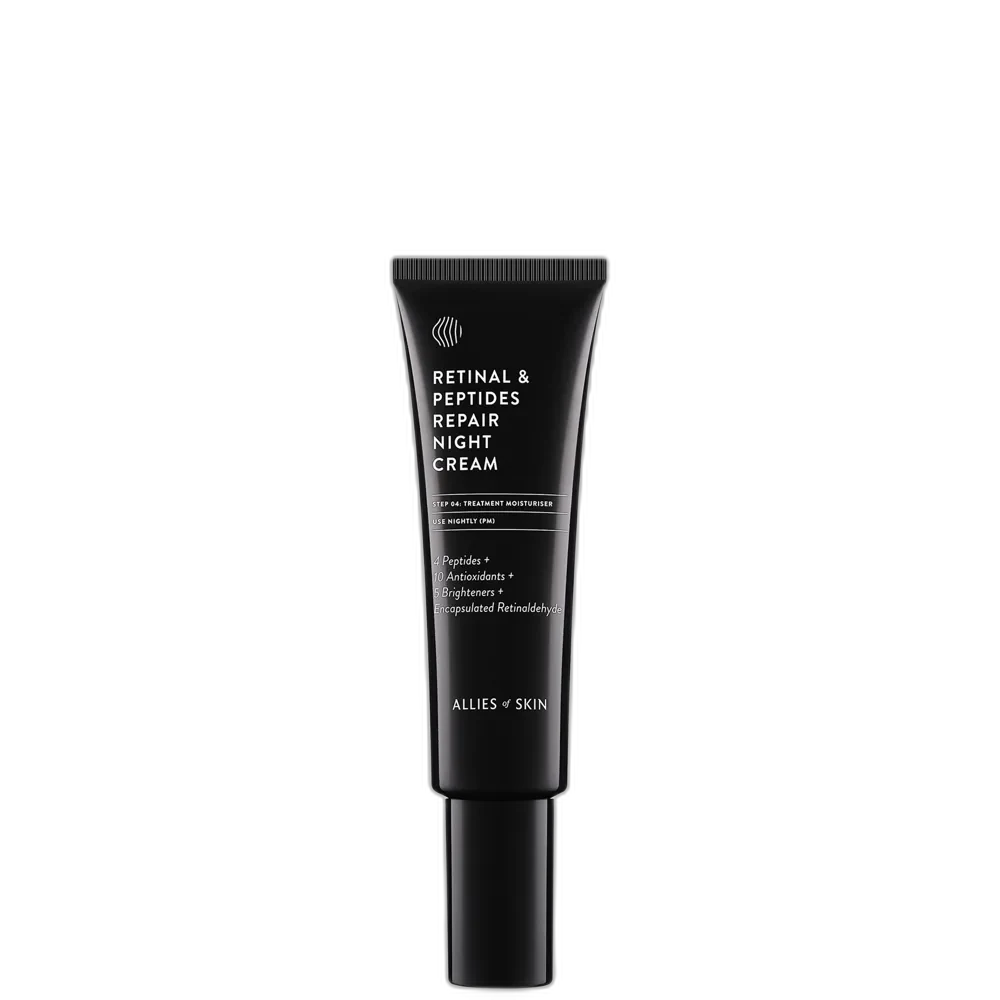
How does this compare to the new Retinal & Peptides Repair Night Cream?
Allies of Skin launched The Repair Night Cream with 0.05% retinal and barrier ceramides. The 1A Overnight Mask is the antioxidant-heavy multitasker. These two products complement each other within the same brand family.
How often should I use this?
Use 2-3 nights per week to test tolerance. Most users can switch to nightly use within 4-6 weeks if no irritation occurs. The formula works without daily use — three nights a week provides meaningful retinal exposure.
Will it make me purge?
Retinoids cause an initial purge in users with active acne because they accelerate the surfacing of clogged pores. If you have congestion, expect 4-6 weeks of mild flares before the purge resolves. Clear skin users rarely experience a purge and instead see normal retinoid dryness.
What the community says.
"Visible glow within a week"
"Less irritating than expected for a retinal"
"Layered antioxidant approach feels comprehensive"
"Fragrance-free version of the brand's signature multitasker"
"Premium price for the size"
"Lavender oil triggers some sensitive users"
"Active stack is overkill for users on a simple routine"
"Tubes can dispense too much product if squeezed enthusiastically"
People also looked at.