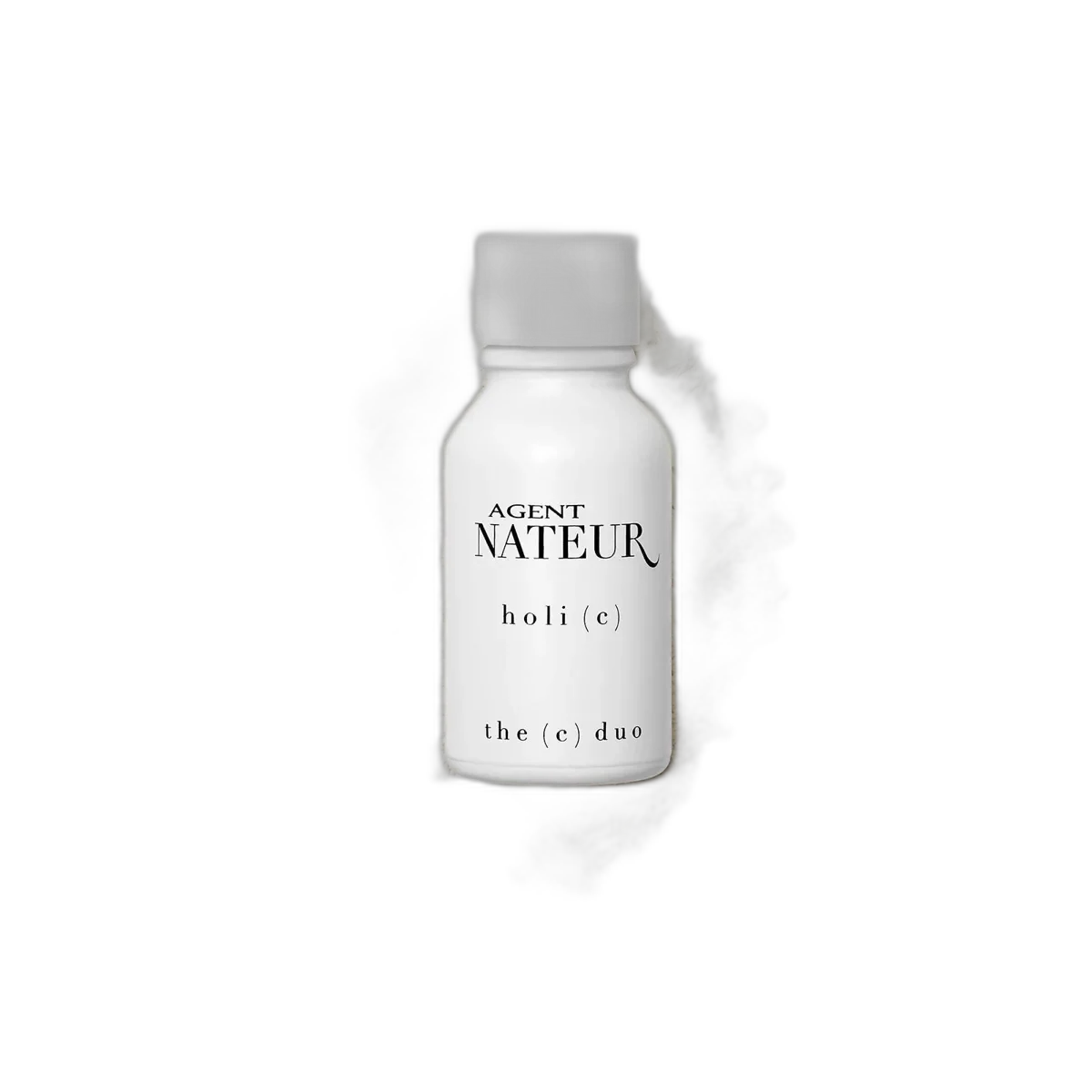
Holi(C) Refining Face Vitamins
Minimalist Vitamin C
 Verified reviewer
Pros & cons.
- +Two-ingredient formula sidesteps oxidation entirely
- +Sodium ascorbyl phosphate is gentler than L-ascorbic acid
- +Tolerable even for sensitive and reactive skin types
- +Daily-use friendly with no tingling or stinging
- +No fragrance, preservatives, or filler ingredients
- +Fresh activation means consistent potency every application
- −Extremely expensive for two raw ingredients in a small jar
- −SAP works more slowly than L-ascorbic acid for visible results
- −Calcium ketogluconate evidence is thinner than marketing implies
- −Activation ritual is fussier than a pump-bottle serum
- −Small jar size doesn't last long with daily use
The full review.
How to Use
Using the product is a small ritual. Shake a tiny amount of powder into your palm or a non-metal dish, spritz it with two or three pumps of water or a hydrating toner, and rub or stir until it forms a thin watery liquid. Pat that liquid onto cleansed skin like a serum. There is no tingle, no warming, and no waiting period — SAP is gentle enough that sensitive skin typically feels nothing. The liquid absorbs within a minute and your skin looks slightly more reflective. That’s it. No rinsing or follow-up sequence is required. Proceed with your moisturizer.
Who Should Buy
Holi(C) rewards a specific buyer: someone who values formulation simplicity over ingredient maximalism, prizes the freshness of every application, and pays a premium for both. For that buyer, the product is thoughtful and well-considered. For everyone else, faster, cheaper, and more comprehensive vitamin C options exist in every direction.
Packaging
The two-ingredient minimalism is a chemistry decision, not a marketing gimmick. Vitamin C is unstable in water; it oxidizes when exposed to air and light and degrades into inactive forms months after being mixed into a serum. Most brands add ferulic acid, tocopherol, and other stabilizers to slow this decay. Agent Nateur’s answer is more elegant: don’t add water. Keeping the vitamin C as a dry powder lets the user activate it fresh every application. Because nothing is dissolved, nothing degrades. Your fiftieth application is as potent as your first.
Common Praise
Results are real. Used daily over six to eight weeks, Holi(C) delivers gradual brightening of skin tone, softening of mild post-inflammatory marks, and a healthier-looking radiance. These results are not dramatic — SAP is not the sledgehammer that fresh L-ascorbic acid is — but they are consistent, well-tolerated, and every application delivers the same dose. Buyers whose previous vitamin C serums browned over time and stopped working will appreciate the difference.
Common Complaints
The limitations are obvious. First is the price. At $135 for a 20g jar of two raw ingredients, this is one of the most expensive ways to get vitamin C onto your face. Sodium ascorbyl phosphate is not an exotic or expensive ingredient; formulary brands sell SAP serums at small fractions of this price. Calcium ketogluconate is also an inexpensive raw material. You pay the premium for the powder format, the brand identity, the ritual, and the radical minimalism. For the right buyer, that combination is worth the cost. For most, the math is hard.
Second, SAP acts slower than L-ascorbic acid. If you need fast hyperpigmentation fading or are treating significant post-inflammatory dark spots, a well-formulated daily L-ascorbic acid serum from a stability-conscious brand will likely deliver faster results. SAP is the patient choice — it works over months, not weeks.
Third, the calcium story is overstated. The brand’s marketing leans on calcium ketogluconate as a clinically tested firming ingredient, but published evidence does not support that framing. Treat it as a pleasant addition rather than the second active you are paying for.
Ingredient analysis.
Full INCI list
Sodium Ascorbyl Phosphate, Calcium Ketogluconate
Skin match.
The science.
The Science
Sodium ascorbyl phosphate uses a different evidence track than L-ascorbic acid. SAP is a phosphate ester of ascorbic acid. It exists as a stable salt in dry form and stays relatively stable in aqueous solution at neutral pH. After topical application, alkaline phosphatase enzymes in the skin cleave the phosphate group. This releases free ascorbic acid to perform vitamin C functions: tyrosinase inhibition, collagen synthesis support, and free radical scavenging. Research shows SAP at concentrations between 1% and 5% reduces hyperpigmentation and improves skin tone over 8-12 weeks of consistent use. It has better tolerability than L-ascorbic acid for sensitive skin types.
The enzymatic conversion step is both SAP's advantage and its limitation. The advantage is stability: SAP does not oxidize as fast as L-ascorbic acid. This means a SAP product retains activity through the bottle's life span—a problem the powder format here makes irrelevant. The limitation is potency: the skin does not convert all applied SAP to free ascorbic acid, and the process is slower than direct delivery of pre-formed L-ascorbic acid. For users who tolerate the pure acid form, L-ascorbic acid generally produces faster and more dramatic results.
Calcium ketogluconate is a calcium salt of 2-ketogluconic acid. Studies show topical calcium helps regulate keratinocyte differentiation as calcium ions manage skin cell maturation from the basal layer to the corneal layer. Disrupted calcium gradients in aging skin may contribute to barrier dysfunction. However, robust published research on calcium ketogluconate as a topical firming or elasticity active is limited. Evaluate the brand's claim of clinical testing for this specific molecule cautiously.
The powder activation format solves vitamin C's stability problem by removing water until the moment of application.
Dermatologist Perspective
Dermatologists recognize sodium ascorbyl phosphate as a legitimate vitamin C derivative with reasonable evidence for brightening and antioxidant activity, especially for patients who cannot tolerate L-ascorbic acid. Board-certified dermatologists note SAP suits sensitive skin, rosacea-prone skin, and patients new to vitamin C who want to avoid the irritation caused by pure ascorbic acid. Dermatologists do not commonly recommend the powder format because most patients prioritize convenience and consistent application, but they may consider it for patients who want freshness or have struggled with oxidized serums. The clinical weight given to calcium ketogluconate in this product's marketing is not reflected in dermatological literature, and dermatologists typically would not recommend this product for firming claims.
Where it fits in your routine.
Use daily or every other day, morning or night. Cleanse skin and pat dry. Put a small amount of powder in your palm or a non-metal dish. Add 2-3 pumps of water or hydrating toner. Rub or stir until it becomes a thin watery liquid. Pat gently onto face, neck, and décolleté. Do not rinse. Apply your usual serums and moisturizer after. In the morning, always use broad-spectrum sunscreen to maintain brightening progress. If you have sensitive skin, do not use with retinoids on the same evening.
At $135 for a small jar of two raw ingredients, Holi(C) has a high price. No larger size exists to lower the cost. Both sodium ascorbyl phosphate and calcium ketogluconate are cheap raw materials. Formulary brands sell SAP-based vitamin C serums for much less, so the brand premium is large. You pay for the powder format, the freshness guarantee, the brand story, and the radical minimalism. The price is intentional for buyers who value those factors. For buyers focused on ingredient cost or vitamin C value per dollar, this product is hard to justify.
Buyers pay a premium for formulation minimalism, freshness, and brand identity. This works best for sensitive or reactive skin types that cannot tolerate L-ascorbic acid, and for anyone whose previous vitamin C serums oxidized and failed.
This works for those prioritizing ingredient cost, people needing fast hyperpigmentation fading, and skincare maximalists wanting a multi-active vitamin C serum with ferulic acid, tocopherol, and supporting ingredients. Pre-formulated daily serums deliver more comprehensive results for less money.%20Refining%20Face%20Vitamins)
Product details.
Fine yellow-tan powder that activates into a thin paste when mixed with water
Faint citrus and green tea note from the powders
Glass jar with screw-top lid that keeps the powder dry and protected from air
The first use feels like a watery essence, not an acid treatment. The sodium ascorbyl phosphate is gentle and does not sting. Skin looks slightly more luminous immediately and brightens more over weeks of use.
About 2-3 months with daily use
12 months
All Year
The backstory.
Founder Jena Covello developed Holi(C) after frustration with the way pre-mixed vitamin C serums oxidize and lose efficacy. The powder format was a deliberate engineering choice to deliver true L-ascorbic acid without preservatives or stabilizers, drawing on traditional apothecary practices.
About Agent Nateur
Established Brand (5–20 years)Jena Covello founded Agent Nateur in 2014. The clean beauty brand relies on influencer endorsements and celebrity testimonials instead of published clinical research. Agent Nateur has a loyal following but does not publish independent efficacy studies of its formulations.
Common myths.
Sodium ascorbyl phosphate is a weaker version of L-ascorbic acid.
SAP is more stable, gentler on the skin, and converts to active vitamin C when it penetrates. It works slower than pure ascorbic acid, but it resists degradation better and suits skin types that cannot tolerate the stronger form.
More ingredients in a vitamin C product increase its effectiveness.
This formula uses only two ingredients to ensure stability. Adding humectants, oils, or stabilizers breaks the powder's shelf-stable structure and reintroduces the oxidation problem this format solves.
FAQ.
Is Holi(C) better than a traditional vitamin C serum?
It uses sodium ascorbyl phosphate, a stable vitamin C derivative, in a powder format that stays inert until activated. This avoids the oxidation problem seen in pre-mixed serums. The trade-off is that sodium ascorbyl phosphate works slower than L-ascorbic acid and the price-per-gram is higher than most vitamin C products.
Can I use Holi(C) with retinol?
Yes, generally. SAP is gentler than L-ascorbic acid and rarely stings. If you have sensitive skin, use them on alternating evenings instead of the same night with retinol.
Is this safe for sensitive skin?
Yes — sodium ascorbyl phosphate is a gentle vitamin C derivative that most sensitive skin types tolerate well. This two-ingredient formula minimizes reactivity from extras like fragrances or extracts.
Why is Holi(C) so expensive?
You pay for the powder format, the clean beauty supply chain, and the brand identity. The ingredients — ascorbic acid, MAP, bromelain, kaolin — cost little individually. Whether the format and brand justify the premium depends on your priorities.
Does it work on dark spots?
Vitamin C has clear evidence for fading hyperpigmentation with consistent use over 6-12 weeks. As a weekly treatment, Holi(C) helps brighten skin, but daily vitamin C serums usually fade spots faster.
What the community says.
"Skin glows after use"
"Solves the oxidized vitamin C problem"
"Activation ritual feels luxurious"
"Steep price for a small jar"
"Stings on sensitive skin"
"Requires patience with the mixing process"
People also looked at.