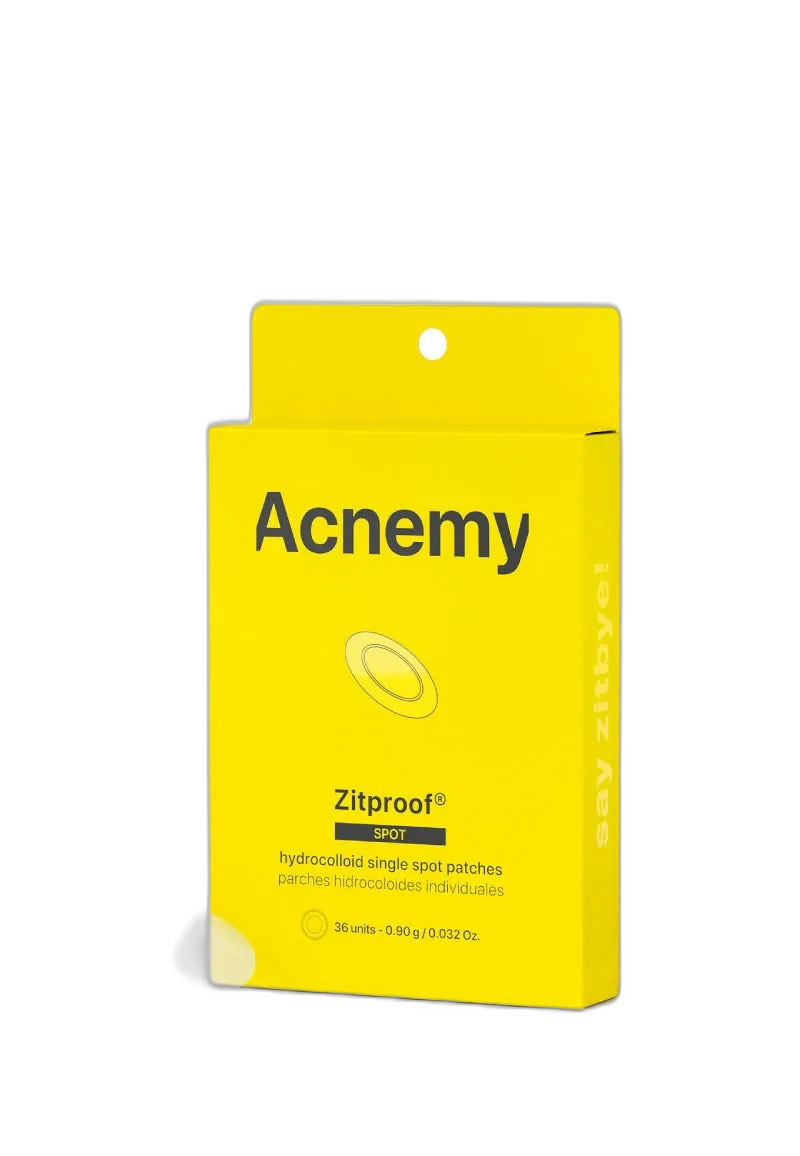
Zitproof Spot Pimple Patches
Medicated Hydrocolloid Hybrid
 Verified reviewer
Pros & cons.
- +Hybrid mechanism delivers absorption plus actives in one application
- +Centella triterpenes offset some of the tea tree irritation potential
- +Salicylic acid targets the follicular plug under sustained occlusion
- +Strong adhesion holds through overnight wear
- +Reasonable per-patch cost compared to premium medicated alternatives
- +Vegan and cruelty-free with a focused ingredient list
- −Tea tree oil is a known contact allergen for some users
- −Salicylic acid disqualifies the patch for pregnancy use
- −Mild stinging on broken skin or reactive complexions
- −More visible under daytime makeup than ultra-thin alternatives
- −Not suitable for fungal acne due to tea tree oil profile
The full review.
About Acnemy
The pimple patch market split into two camps over the last few years. One side uses purist hydrocolloid patches — CosRx, the category originals, and Acnemy’s own additive-free Dryzit format — which rely on a thicker, stickier, medical-grade gel. The other side uses medicated dots. These prioritize delivering active ingredients through the patch matrix via microneedles, infused serums, or both, rather than focusing on absorption. Acnemy’s Zitproof Spot sits in the middle. It uses the absorption-first hydrocolloid base — the cellulose gum and polymer matrix that wicks fluid from a whitehead overnight is the same technology in the brand’s plain patches — but adds three actives to that matrix. Salicylic acid for follicular keratolysis. Tea tree oil for antimicrobial action against C. acnes. And a triplet of centella asiatica triterpenes — asiaticoside, madecassic acid, and asiatic acid — for the anti-inflammatory and wound-healing effect common in K-beauty.
Myth
The formulation logic is smart. Pure hydrocolloid treats the visible spot but ignores the underlying acne process. Pure medicated dots deliver actives but lack the absorption that flattens a whitehead overnight. By embedding actives into the absorbent matrix, Zitproof Spot delivers both effects in one overnight wear, and it succeeds for its target audience.
How to Use
Apply one to a clean, dry whitehead before bed. You may feel a faint warmth or tingle within minutes as the salicylic acid and tea tree oil engage with the skin under occlusion — this is mild and fades quickly for most users. Overnight, the patch absorbs fluid, turning the central area opaque white, while the actives stay in sustained contact with the spot better than any leave-on serum or toner. By morning, the visible flattening matches a plain hydrocolloid patch, but with reduced perimeter redness from the centella and tea tree.
Best for
The dual mechanism is the main reason to choose this over Acnemy’s own Dryzit format. If plain hydrocolloid patches do not do enough — if the spot flattens but redness lingers, or if the same comedone re-emerges weekly — the low-dose salicylic acid in sustained contact with the skin can compound over repeated applications. The salicylic acid is also more targeted than a wash-off product because it stays on the patched area instead of the whole face.
Not ideal for
The tradeoff is irritation potential. Tea tree oil is more bioavailable under occlusion than in a wash-off product, and tea tree is a documented contact allergen for 1-2% of the population. The salicylic acid also increases stinging potential on broken skin. Acnemy uses centella triterpenes to offset this, as they are documented anti-inflammatories, but the offset is not complete. For users with reactive skin, rosacea-adjacent flushing, or contact dermatitis, the additive-free Dryzit patch format is the smarter choice — it uses the same absorption mechanism without the sensitization risk. Pregnancy compatibility also differs. Plain hydrocolloid patches are universally pregnancy-safe because they have no actives. Zitproof Spot is not, due to the salicylic acid. For pregnant or breastfeeding users with hormonal acne, the additive-free patch is the only safe choice in this product family.
Packaging
The price is reasonable. At around twelve dollars for 36 patches, the per-patch cost competes with mass-market alternatives and is lower than premium options like Hero Cosmetics Mighty Patch Original.
Texture
The thickness is moderate — less visible than Acnemy’s plain Dryzit format hydrocolloid but more visible than ultra-thin daytime patches like the original CosRx. Daytime wear under makeup is possible but not ideal. Use these overnight where the dual mechanism can compound over a longer wear time.
Common Praise
As an emerging brand product, Zitproof Spot earns its place in the medicated patch category through the centella triterpene addition. Most medicated patches load actives without considering irritation; Acnemy considers both, resulting in a patch that delivers medicated benefits without the same sensitization penalty. For users with normal-to-resilient skin who want more than a passive bandage on breakouts, this is a reasonable upgrade.
Ingredient analysis.
Full INCI list
Styrene/Isoprene Copolymer, Hydrogenated Poly (C6-20 Olefin), Cellulose Gum, Polyisobutene, Salicylic Acid, Melaleuca Alternifolia (Tea Tree) Leaf Oil, Asiaticoside, Madecassic Acid, Asiatic Acid
Skin match.
The science.
The Science
Zitproof Spot uses three established mechanisms under occlusion. The hydrocolloid matrix uses proven wound-care technology; decades of clinical evidence in dermatology and wound management show it maintains a moist healing environment and absorbs exudate from superficial lesions. Like any hydrocolloid patch, Zitproof Spot flattens whiteheads via capillary action that draws fluid from the lesion into the swelling matrix. Zitproof Spot differs because it embeds actives. Salicylic acid is a beta hydroxy acid with extensive evidence for keratolytic action on the follicular infundibulum, where comedones form. A 2009 study in the Journal of the American Academy of Dermatology found salicylic acid and benzoyl peroxide produced comparable reductions in lesion count over 12 weeks in mild-to-moderate acne, though salicylic acid caused less surface dryness. Applying this molecule under occlusion in a patch is a recent development; small-scale studies on combination acne patches show more benefit than plain hydrocolloid in lesion-by-lesion comparisons. Multiple in vitro studies document tea tree oil's antimicrobial activity against Cutibacterium acnes. A 2007 randomized controlled trial in the Indian Journal of Dermatology showed 5% tea tree oil gel produced comparable improvement to 5% benzoyl peroxide in mild-to-moderate acne over 45 days, but with slower onset. Research on centella asiatica triterpenes — asiaticoside, madecassic acid, and asiatic acid — shows anti-inflammatory and wound-healing effects; a 2016 review in Phytotherapy Research summarized dozens of studies supporting how they modulate fibroblast activity and reduce inflammation. Combining these three actives in one patch is a formulation choice, not a clinically validated synergy, but each component has strong support.
Dermatologist Perspective
Dermatologists generally see medicated pimple patches as a reasonable adjunct for isolated inflammatory lesions, though they note the format works best as a selective tool rather than a primary acne treatment. Board-certified dermatologists often recommend hydrocolloid patches to prevent picking, which drives post-inflammatory hyperpigmentation and scarring. Adding low-dose salicylic acid and tea tree oil to patches like Zitproof Spot is a reasonable enhancement for users with normal skin tolerance. However, clinicians note tea tree oil can cause sensitization with repeated use and recommend additive-free patches for reactive or rosacea-adjacent complexions. Dermatologists emphasize that patches treat symptoms rather than the underlying acne process and recommend pairing them with a proper leave-on regimen.
Where it fits in your routine.
Apply at night to clean, dry skin over an isolated whitehead. Skip serums, moisturizers, and oils on the spot to ensure adhesion. Press the patch gently for a few seconds to seal the edges. Leave on for at least 6 hours, ideally overnight. Remove gently in the morning by lifting one edge; the central area shows opaque white if the patch absorbed fluid. Resume your normal routine over the flattened spot. Do not use leave-on salicylic acid on the same spot, and avoid applying retinoids directly to the patched area that evening.
At around twelve dollars for 36 medicated patches, Zitproof Spot costs about the same as mass-market medicated patch options and slightly more than pure hydrocolloid alternatives. Each patch costs roughly thirty cents. This price covers both absorption and active delivery in one application. Whether the upgrade from a plain hydrocolloid patch is worth it depends on your skin's tolerance and your acne pattern. Users whose breakouts respond to plain absorption get better value from the cheaper additive-free patch. For users with persistently inflamed spots that plain hydrocolloid does not resolve, the medicated upgrade justifies its premium. As an emerging brand, Acnemy competes on formulation thoughtfulness rather than legacy track record, and the price shows fair market positioning rather than a premium reach.
People with normal-to-resilient skin whose breakouts do not resolve with plain hydrocolloid patches. Users wanting a single-step medicated spot treatment without a full salicylic acid leave-on routine. Anyone with acne patterns of persistently inflamed spots that need both drainage and active treatment.
Tea tree oil under occlusion risks sensitization for people with sensitive skin, rosacea, or contact dermatitis. The salicylic acid makes it unsuitable for pregnant or breastfeeding users. People with confirmed fungal acne should avoid it. Users whose breakouts respond to plain hydrocolloid do not need this medicated version.
Product details.
Translucent hydrocolloid patches have a slight tackiness and a mild tea tree scent.
Light tea tree on application, fades within minutes
Resealable foil sachet of 36 patches in mixed sizes
Apply to a clean, dry whitehead. You may feel mild warmth or faint tingling within minutes; the salicylic acid and tea tree oil work under occlusion. Overnight, the patch turns opaque white at the center as it absorbs fluid. By morning, the spot is visibly flatter and redness around the perimeter is reduced.
About 5-6 weeks for someone using 1-2 patches per night during active flares
24 months
All Year
The backstory.
Acnemy added the Zitproof Spot patches to its lineup around 2021 to complement its passive Dryzit drying lotion, giving customers a medicated patch option for users who want the full active treatment without the alcohol base or daytime visibility of the bifasic format. The centella triterpenes were added specifically to offset the sensitization potential of tea tree oil under occlusion.
About Acnemy
Emerging Brand (2–5 years)Acnemy is a Spanish indie brand founded in 2019 that focuses only on acne. Zitproof Spot is its medicated hydrocolloid line, containing salicylic acid, tea tree, and centella asiatica derivatives.
Common myths.
Medicated patches outperform plain hydrocolloid.
Not for everyone. Added actives improve effectiveness on inflamed spots but increase sensitization risk compared to pure hydrocolloid. Users with reactive skin often choose additive-free patches.
Tea tree oil is a 'natural' alternative to harsh acne medications.
Tea tree oil is a contact allergen for many users. It causes delayed irritation that looks like the original breakout. Natural doesn't mean low-risk; it just means the molecule comes from a plant.
FAQ.
What's the difference between Zitproof Spot and Acnemy Dryzit?
Dryzit is Acnemy's bifasic drying lotion; you dab the liquid onto a spot using a cotton swab. Zitproof Spot is a medicated hydrocolloid patch that sticks directly onto a whitehead. Both target whiteheads, but the patch works better for overnight wear while the lotion works better for spots needing an aggressive drying cap.
Can I use Zitproof Spot with retinol?
Yes, but apply retinol to the rest of your face and let it absorb fully before placing the patch. Do not combine the patch's salicylic acid with retinol on the same spot; this causes irritation and does not speed healing.
Are these patches safe during pregnancy?
Not recommended. Zitproof Spot contains salicylic acid and tea tree oil, both of which most dermatologists advise against during pregnancy. For a pregnancy-safe alternative, use additive-free hydrocolloid patches like CosRx or Acnemy's Dryzit drying lotion is also off-limits — try plain hydrocolloid options instead.
Will Zitproof Spot work on cystic acne?
Like all hydrocolloid patches, Zitproof Spot only works on surfaced whiteheads with visible exudate. The salicylic acid and tea tree oil do not penetrate deep enough to treat cystic inflammation. Cysts require an in-office cortisone injection or oral therapy.
Why do my patches sometimes sting?
The tea tree oil and salicylic acid in the matrix cause mild tingling on broken or reactive skin. If the sting is sharp or sustained, remove the patch. Your skin may not tolerate this medicated version; a passive hydrocolloid patch works better.
How long should I wear the patch?
Wear for at least 6 hours, ideally overnight. The hydrocolloid absorbs fluid passively while the actives work during that time. Do not wear for more than 12 hours — the absorbed fluid saturates the matrix and the patch loses adhesion.
What the community says.
"Visible flattening overnight"
"Active ingredients tackle redness as well as fluid"
"Strong adhesion through the night"
"Centella balances out the tea tree irritation"
"Tea tree scent on application"
"Mild stinging on broken skin"
"Not as invisible as ultra-thin patches under makeup"
People also looked at.