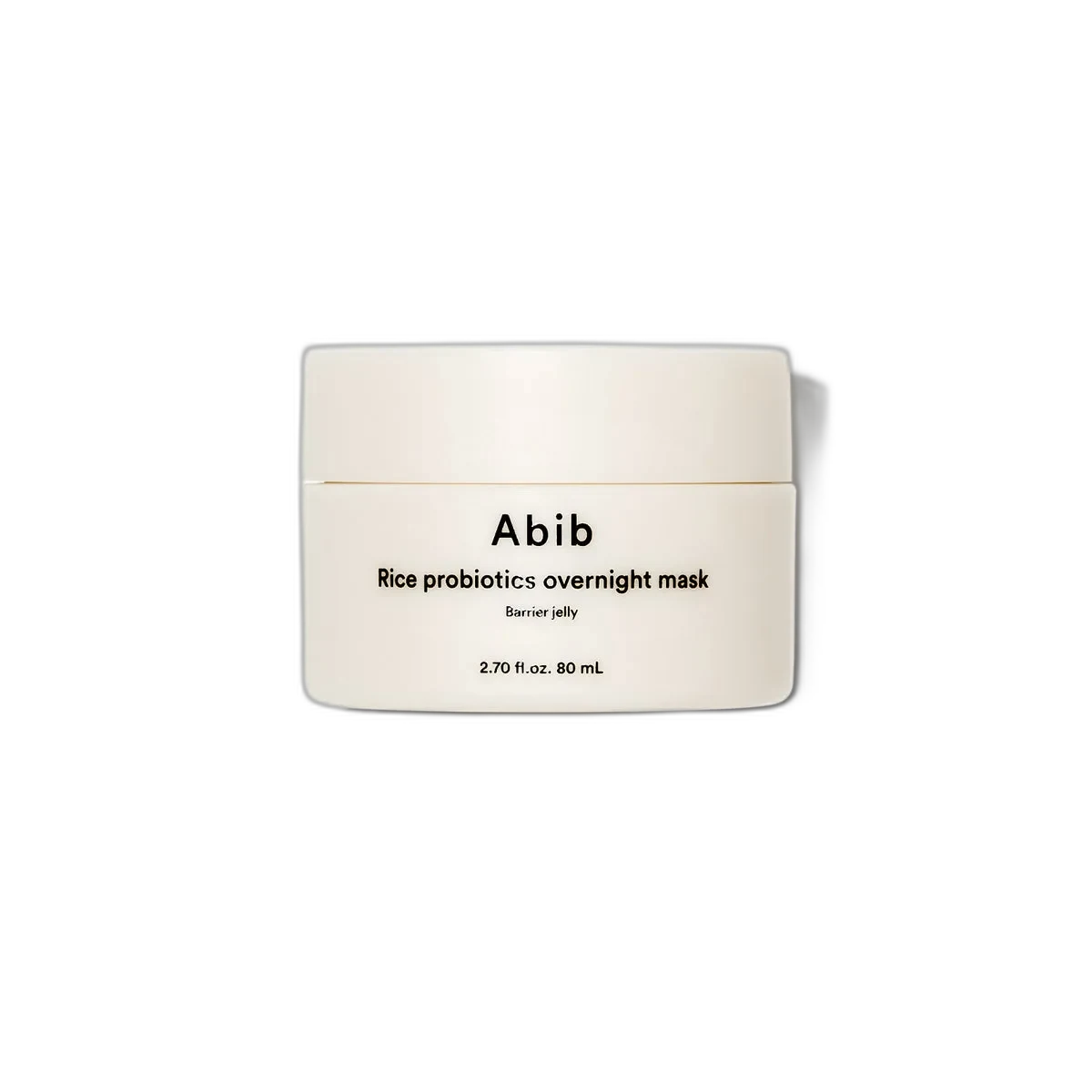
Rice Probiotics Overnight Mask Barrier Jelly
K-Beauty Cult Favorite
 Verified reviewer
Pros & cons.
- +Layered rice ferment and probiotic filtrate inclusion is meaningful, not just marketing
- +Contains MFDS-approved adenosine for genuine fine-line support
- +Fragrance-free and well-tolerated by sensitive skin
- +Distinctive jelly texture forms a light gel film instead of an occlusive seal
- +Reasonable $28 price for 80ml
- +Layers well over serums, moisturizers, or retinol as a buffer step
- −Jelly texture is polarizing
- −Not rich enough for very dry winter skin
- −Minimal supporting actives beyond the rice story
- −Jar packaging isn't ideal for ferment stability
- −Can pill if layered over heavy silicone moisturizers
The full review.
Long before Korean skincare became a global aesthetic category, Korean women were washing their faces with rice water. Rice bran contains gamma-oryzanol, ferulic acid, and phytic acid — compounds with real, if modest, brightening and antioxidant activity — and centuries of empirical use had established rice as one of the cornerstone ingredients in traditional Asian skin care. The move from rice water to rice extract to rice ferment is essentially a modernization of a very old practice, scaling it up through biotechnology while preserving the ingredient identity. Abib’s Barrier Jelly is one of the cleaner modern translations of that tradition, and it’s a useful lens for thinking about what the product does and doesn’t do.
The formula is built around a layered rice story. You get unfermented rice bran extract for the classic rice-water benefits — antioxidants and humectants that have been known to Korean skincare for generations. You also get lactobacillus-fermented rice ferment and saccharomyces-fermented rice bran ferment, both of which apply different bacterial or yeast cultures to rice and break down the starches and proteins into smaller, more skin-accessible molecules: amino acids, small peptides, and metabolites that the unfermented rice extract doesn’t deliver. Fermentation is how you amplify the benefits of a traditional ingredient without changing its identity, and it’s why the ferment-heavy wing of K-beauty consistently produces formulas that feel more active than their simple ingredient lists suggest.
The second pillar of the formula is adenosine, which is worth explaining. In Korea, skincare actives that appear on labels with specific anti-wrinkle or brightening claims must go through the Ministry of Food and Drug Safety’s functional cosmetic approval process, which requires clinical evidence. Adenosine is one of a small set of ingredients that have cleared that process for anti-wrinkle efficacy at 0.04% concentrations. Its presence in the Abib Barrier Jelly is what legitimately lets the product claim fine-line support, not just hydration — and the concentration is almost certainly at or near the MFDS-approved 0.04% threshold.
The texture is the first thing anyone notices and the reason this mask went viral. When you open the jar, you’re looking at a translucent, slightly bouncy jelly that holds its shape if you poke it — closer to an agar dessert than a cream. Scoop out a small amount and press it onto the skin and it breaks down into a thin, slippery gel film that absorbs within a minute and leaves almost no residue. The bounce comes from glyceryl polymethacrylate and ammonium acryloyldimethyltaurate/VP copolymer, a pair of film-forming polymers that create the distinctive rheology. It’s a formulation choice that serves a purpose beyond novelty — the jelly structure helps hold the humectants and ferments in contact with the skin through the night without an occlusive seal that would make the formula feel heavy.
The fragrance-free nature of the formula is worth noting because it’s rare in the overnight mask category. Most sleeping masks lean into aromatherapy — Laneige’s iconic water sleeping mask has a distinctive fragrance, as do products from Glow Recipe, Farmacy, and most of the mid-tier K-beauty space. Abib strips that out entirely. There’s no parfum, no essential oils, no botanical extracts with fragrance-active compounds. For sensitive, rosacea-prone, or fragrance-reactive skin, this is a meaningful distinction. You get the sensory experience of the jelly texture without the ingredient load that makes most overnight masks off-limits for reactive skin.
The honest limitations are worth naming. The formula is pretty short, which is both a feature and a constraint. Beyond the rice ferments and adenosine, you’re not getting meaningful concentrations of peptides, niacinamide, ceramides, or other barrier-building actives — the jelly is doing hydration and gentle rice-ferment support, not multi-pathway anti-aging work. For someone looking for an all-in-one overnight treatment that also delivers retinoids, vitamin C, or aggressive brightening, this isn’t the right product. It’s a supportive final step, not a standalone treatment.
The texture is also polarizing in practice. Users who love the jelly tend to love it intensely — the bounce is satisfying, the film is unobtrusive, and the lack of fragrance feels refreshing after a category dominated by scent. Users who dislike it usually cite the same properties: the slipperiness feels odd, the lightweight film doesn’t feel substantial enough to qualify as ‘overnight treatment,’ and the absence of fragrance makes it feel medical rather than indulgent. Neither reaction is wrong. It depends on what you want a sleeping mask to feel like.
At twenty-eight dollars for 80ml, the mask is priced in the middle of the K-beauty sleeping mask range — comparable to Laneige, cheaper than Glow Recipe, more expensive than COSRX. The value math is reasonable. You’re paying for a distinctive texture, a meaningful ferment-and-adenosine inclusion, and the fragrance-free formulation, all of which are legitimate features. If your skin responds to rice ferments and you want a fragrance-free overnight step, this is one of the best options in the category. If you want a richer emollient overnight seal or fragrance-as-feature, look elsewhere.
Ingredient analysis.
Full INCI list
Water, Dipropylene Glycol, Glycerin, Glyceryl Polymethacrylate, Lactobacillus/Rice Ferment, 1,2-Hexanediol, Diglycerin, Ammonium Acryloyldimethyltaurate/VP Copolymer, Oryza Sativa (Rice) Bran Extract, Acrylates/C10-30 Alkyl Acrylate Crosspolymer, Tromethamine, Saccharomyces/Rice Bran Ferment, Ethylhexylglycerin, Adenosine, Sodium Hyaluronate, Allantoin, Disodium EDTA
Skin match.
The science.
The Science
The rice ferment story in this formula combines two complementary approaches: unfermented rice bran extract and two ferment products derived from rice. Unfermented rice bran contains gamma-oryzanol, ferulic acid, phytic acid, tocopherols, and inositol, several of which have research support for antioxidant, mild brightening, and barrier-supporting activity. Ferulic acid in particular is a well-studied antioxidant that has been shown to stabilize vitamin C and contribute to UV protection at topical concentrations.
The lactobacillus/rice ferment and saccharomyces/rice bran ferment apply different microbial cultures to break down rice starches, proteins, and cell wall components into smaller molecules. The resulting ferment filtrate contains amino acids, small peptides, organic acids, and ferment metabolites that are more bioavailable than the parent ingredients. Research on similar ferment filtrates has explored barrier support, humectant activity, and gentle exfoliation from naturally occurring organic acids, though clinical evidence specific to rice ferments is less extensive than for the better-studied galactomyces ferment filtrate.
Adenosine is the formula's standout clinically-backed active. Research conducted for Korean MFDS functional cosmetic approval has shown that topical adenosine at 0.04% concentrations demonstrates measurable anti-wrinkle effects over 12 weeks of use. The mechanism involves fibroblast proliferation and collagen synthesis stimulation, and adenosine has a favorable safety profile with minimal irritation risk across skin types. Its inclusion in the Abib Barrier Jelly at an MFDS-compliant concentration means this mask legitimately supports fine-line reduction, not just hydration.
The humectant backbone — glycerin, dipropylene glycol, diglycerin, and sodium hyaluronate — is classical and well-supported. Glycerin is among the most extensively studied humectants in dermatology, with decades of evidence for barrier improvement and water retention in the stratum corneum. The polymer matrix formed by glyceryl polymethacrylate and the acrylate copolymers creates a thin, breathable film that holds the humectants in close contact with the skin surface overnight without the occlusive seal of a heavy cream or petrolatum.
Dermatologist Perspective
Dermatologists generally view Abib's Barrier Jelly favorably as a gentle, well-tolerated overnight hydrator appropriate for a wide range of skin types. Board-certified dermatologists note that the fragrance-free formulation and short ingredient list make it a reasonable recommendation for sensitive, rosacea-prone, or compromised-barrier skin, and that the adenosine inclusion provides legitimate anti-wrinkle support beyond pure hydration. Some dermatologists use overnight masks like this as a retinoid buffer for patients experiencing irritation from active treatments — layering the mask as a final step can reduce retinoid-induced dryness and discomfort without interfering with the retinoid's action.
Guidance
Where it fits in your routine.
Apply this as the final PM step, after serums and moisturizer. Use a small dime-sized amount per face; press and tap to absorb instead of rubbing. Do not rinse off — leave it on overnight and cleanse normally in the morning. Use it nightly or alternate with heavier moisturizers based on season and skin needs. Use the included spatula to maintain hygiene.
At $28 for 80ml, this mask sits in the mid-range of the K-beauty sleeping mask category. It costs less than Glow Recipe Plum Plump or Drunk Elephant F-Balm, matches Laneige Water Sleeping Mask, and costs slightly more than COSRX Ultimate Moisturizing Honey Overnight Mask. The value works for the right buyer: a fragrance-free formulation, rice ferment and adenosine, and a texture that builds a loyal customer base. It is not the cheapest option in the category, but the price is competitive for the results.
Sensitive, dehydrated, and compromised-barrier skin types wanting a fragrance-free overnight mask with active ingredients. K-beauty enthusiasts interested in rice ferment formulations. Retinol users needing a gentle buffer step. Anyone seeking a sleeping mask texture that differs from the typical gel-cream format.
Very dry winter skin may need a thicker overnight emollient. Users who want fragrance in their sleeping masks will find this formulation underwhelming. Budget-conscious shoppers can find simpler hydrating overnight products for less, though they lack the rice ferment story.
Product details.
It is scentless, with a faint rice-starch smell that disappears on contact.
White plastic jar with a spatula. Jar packaging is less ideal than a tube for ferments, but the formula is stable. Finish dewynon-greasylightweight What to Expect on First Use The jelly texture is unusual — it holds its shape in the jar like a translucent pudding and breaks into a gel film when pressed onto the skin. The first application feels slippery and cool, then sets into a thin dewy film. No tingle, no fragrance, and no transfer onto pillowcases overnight. Expect visibly plumper, softer skin from night one. How Long It Lasts About 2-3 months using a dime-sized dose every night. Period After Opening 12 months
All Year
The backstory.
Abib launched in 2016 as part of the minimal-ingredient wave in K-beauty, and the brand gained mainstream US visibility through the viral Heartleaf Spot Pad around 2021. The Barrier Jelly followed as part of Abib's rice-probiotics line, leaning into the longtime Korean skincare tradition of rice as a brightening and softening ingredient. The bouncy jelly texture was engineered to feel distinctive from the increasingly crowded sleeping mask category.
About Abib
Emerging Brand (2–5 years)Abib is a Korean skincare brand founded in 2016. It focuses on minimal ingredients and skin barrier health. The brand gained US visibility around 2021 via the viral Heartleaf Spot Pad and rice-fermented products like this overnight mask, though its clinical validation track record is short.
Common myths.
Probiotic skincare means live bacteria on your skin.
Lactobacillus/rice ferment is a ferment filtrate. It contains rice fermentation byproducts like peptides, amino acids, and small sugars. It does not contain live bacteria. This uses fermentation biotechnology rather than a topical probiotic.
Sleeping masks should feel occlusive and heavy to work.
The Abib jelly is lightweight and breathable. It forms a thin gel film instead of a sealing occlusive layer. Humectants and ferments in the formula provide hydration, not a heavy occlusive that traps water.
FAQ.
What does the Abib Rice Probiotics Overnight Mask do?
This fragrance-free sleeping mask hydrates and supports the skin barrier overnight. The formula uses rice ferments and probiotic filtrates to provide humectant, amino acid, and soothing effects alongside adenosine, a Korean MFDS-approved anti-wrinkle active. The bouncy jelly texture forms a lightweight gel film that locks in your PM routine.
How is this different from the Laneige Water Sleeping Mask?
Laneige's sleeping mask has fragrance and uses an emollient gel-cream base with brightening actives. Abib is fragrance-free, has a jelly texture, and uses rice ferments and adenosine instead of the Laneige squalane-and-vitamin blend. Abib works better for sensitive or fragrance-avoiding skin; Laneige works better for dry skin needing a thicker overnight seal.
Is this mask safe for sensitive skin?
Yes — it is fragrance-free, alcohol-free, and lacks known common sensitizers. The ingredient list is short, focusing on hydration, soothing, and rice ferments. It is one of the safer K-beauty overnight masks for reactive and rosacea-prone skin.
Can I use this mask every night?
Yes, this is for nightly use as your final PM routine step. Some users alternate nights with heavier moisturizers based on season and skin needs.
Do I need to rinse it off in the morning?
No — it is a leave-on overnight mask. Just cleanse your face in the morning as usual.
Will this help with acne or clogged pores?
Not directly—this formula hydrates and supports the barrier rather than treating acne. However, some acne-prone users find that a hydrated, supported barrier reduces reactive oil production and inflammation, which indirectly helps mild acne.
Can I layer this over retinol?
Yes, many users use it as a buffer to reduce retinol irritation. Apply your retinol first, let it absorb, apply moisturizer, then seal with a thin layer of the Abib jelly as the final step.
What the community says.
"Unique bouncy jelly texture"
"Wakes up with visibly plumper skin"
"Fragrance-free and gentle enough for sensitive skin"
"Doesn't transfer onto pillowcase"
"Reasonable price for the size"
"Jelly texture is polarizing — some dislike the slip"
"Doesn't feel emollient enough for very dry winter skin"
"Can pill over heavier moisturizers"
"Active concentration beyond rice ferments is modest"
People also looked at.