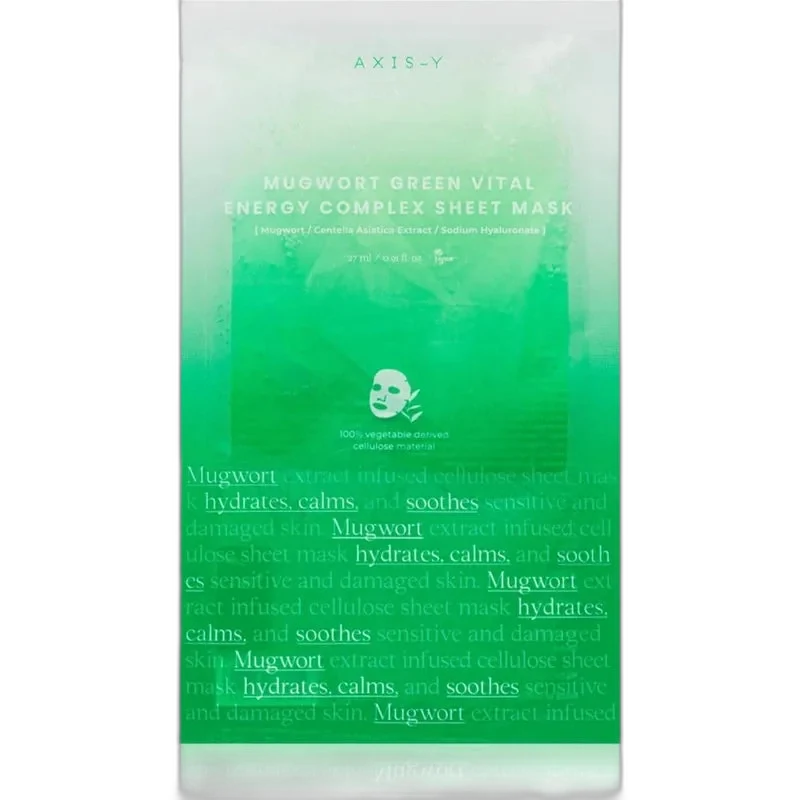
Mugwort Green Vital Energy Complex Sheet Mask
Mugwort-Led Calming Mask
 Verified reviewer
Pros & cons.
- +Mugwort at the top of the INCI as a real lead ingredient
- +Multi-plant calming stack including centella, heartleaf, and green tea
- +Fragrance-free and alcohol-free
- +Cooling and visible redness reduction during wear
- +Well-saturated sheet with enough essence for face and neck
- +Fungal-acne safe formulation
- −More expensive than basic hydration sheet masks
- −Short-contact format limits long-term effect
- −Sheet material slightly stiff before application
- −Mugwort's topical evidence is less robust than centella's
The full review.
Open the foil pouch and you notice a plant scent instead of perfume. Mugwort — Artemisia princeps — has a faint green, vegetal, tea-like note. This note is absent from the centella-and-snail-mucin crowd of mainstream K-beauty sheet masks. Axis-Y chose this as the lead ingredient. Most calming sheet masks use centella because Western skincare recognizes it. Mugwort is the older Korean pharmacy choice; it has long been a fixture in traditional medicine for reactive and inflamed skin. Placing it at the top of the INCI — ahead of water, which is unusual for a sheet mask essence — shows a formulation commitment rather than a brand-story flourish.
The supporting cast is dense. Centella asiatica extract and isolated madecassoside both appear, so centella provides conventional calming reinforcement rather than the lead. Heartleaf (Houttuynia cordata) is a third plant with overlapping but distinct anti-inflammatory phytochemistry. Camellia sinensis — green tea — rounds out the botanical stack with mild antioxidant properties. Panthenol and allantoin provide the conventional soothing layer. A modest niacinamide presence adds subtle brightening and barrier support, which causes the even-toned look most users report the morning after use. Sodium hyaluronate handles surface hydration. The formula is fragrance-free and alcohol-free. This matters because readers who need a calming mask often react to conventional sheet mask essences.
The sheet is well-saturated. It uses a cotton-blend material that feels slightly stiff at first but softens and drapes closely once on the face. The fit works for average face shapes — the eye and mouth cutouts are in reasonable places — though it won’t be perfect for everyone. During the first few minutes, cooling and visible reduction of flushing are the most immediate effects. By fifteen or twenty minutes, the skin looks notably calmer and more evenly toned. Pat the leftover essence into the neck, chest, and hands instead of wiping it off.
Here is what a sheet mask can and cannot do. Contact time is short — twenty minutes maximum — and the actives arrive in a watery vehicle that leaves the skin once the sheet is removed. This format delivers immediate cooling, short-term hydration, and visible calming of reactive skin. It cannot rebuild a compromised barrier, fade hyperpigmentation, or replace a daily leave-on routine. Use it once or twice a week alongside a full routine. It is a reasonable tool for maintaining calm on reactive and rosacea-prone skin, especially during flare-ups, after long flights, or after in-office procedures if a provider clears it.
Value is fair-to-good depending on how you buy. Four dollars per single sheet is standard for a mid-tier K-beauty calming mask, though dedicated hydration masks from other brands cost two to three dollars per sheet. You pay a premium for the mugwort lead and the fragrance-free formulation; these are real features, not marketing decoration. Packs of five or ten lower the per-sheet price modestly. If you use a sheet mask as a weekly reset, this mask earns its higher per-unit cost through a more thoughtful formulation than bargain options. If you mask daily, basic hydration masks are more cost-effective; save this one for flare-up days.
Ingredient analysis.
Full INCI list · pH 5.5
Artemisia Princeps Leaf Extract, Water, Dipropylene Glycol, Glycerin, 1,2-Hexanediol, Propanediol, Betaine, Niacinamide, Panthenol, Allantoin, Sodium Hyaluronate, Centella Asiatica Extract, Houttuynia Cordata Extract, Camellia Sinensis Leaf Extract, Ulmus Davidiana Root Extract, Adenosine, Madecassoside, Hydrogenated Lecithin, Carbomer, Tromethamine, Xanthan Gum, Tocopherol, Disodium EDTA, Ethylhexylglycerin
Skin match.
The science.
The Science
Mugwort's calming effect relies on research into Artemisia princeps and related Artemisia species. Studies in Journal of Ethnopharmacology and Korean dermatology journals show Artemisia princeps extracts contain flavonoids and sesquiterpene lactones with anti-inflammatory activity in vitro and in animal models. Clinical data for topical human use is thinner than the centella literature; treat it as emerging rather than established, despite a long, consistent record in Korean medicine. Centella asiatica has more robust calming evidence. Multiple reviews, including work in Postepy Dermatologii i Alergologii, establish madecassoside and asiaticoside as wound-healing and anti-inflammatory actives with clinical support for barrier function and reactive skin. Korean dermatology literature, including studies in the Journal of Korean Medical Science, explores the anti-inflammatory and antibacterial activity of Heartleaf (Houttuynia cordata) in skin contexts. Using three plant calming actives in a fragrance-free vehicle targets inflammation through multiple overlapping pathways. The short-contact sheet mask format delivers immediate calming and hydration rather than long-term change.
References
- Centella asiatica in cosmetology — Postepy Dermatologii i Alergologii (2013)
Dermatologist Perspective
Dermatologists view sheet masks as adjunct treatments for calming and hydration, not primary interventions. Board-certified dermatologists note fragrance-free calming masks help patients with rosacea, post-procedure recovery, and reactive skin. Specific botanical ingredients matter less than avoiding fragrance and alcohol. Clinicians typically recommend patch-testing a new mask on the inner arm before full-face application for patients prone to contact dermatitis. Do not use sheet masks immediately after in-office procedures without the treating provider's approval. For daily barrier support, dermatologists emphasize that a well-formulated leave-on cream is more important than a weekly sheet mask, though both fit in a complete routine.
Where it fits in your routine.
Apply to clean skin after a hydrating toner. Unfold the sheet from the sachet and align it with the eye, nose, and mouth cutouts. Press it gently against the face for full contact. Leave on for 15-20 minutes. Do not leave it on longer, as a drying sheet pulls moisture out. Remove the sheet and pat the leftover essence into the skin, neck, and décolletage. Use a lightweight serum and moisturizer next. Use once or twice a week for maintenance, or more often during reactive flare-ups.
At roughly four dollars per single sheet, this mask is a mid-tier K-beauty calming option. Basic hydration sheet masks cost two to three dollars per sheet. This premium exists because of the mugwort lead and fragrance-free formulation for readers who need those features. Multi-packs of five or ten lower the per-unit cost slightly. This offers reasonable value for weekly flare-up use; for daily masking, cheaper generic hydration sheets cost less, leaving this for reactive days. The other-sizes-available status is real — the same mask is sold in pack formats.
This fragrance-free calming mask uses a multi-plant formulation for sensitive, reactive, rosacea-prone, or post-procedure skin. Use it to reset occasional flare-ups instead of as a daily treatment.
This sheet mask is a calming tool, not for aggressive brightening or exfoliating results. Daily users on a tight budget will find cheaper generic hydration sheets more practical.
Product details.
A watery, slightly viscous essence soaks a cotton-blend sheet and leaves a neutral, non-sticky finish after removal.
No added fragrance; mugwort provides a faint green vegetal note that fades quickly.
Each sheet comes in an individual foil sachet. Buy them as singles or in packs of five or ten.
The sheet provides a cooling sensation upon application and visibly reduces flushing within five minutes. A full twenty-minute session leaves skin soft and evenly toned without tingling or stinging.
One single-use sheet per session; pack of five gives five uses.
24 months
All Year
The backstory.
Axis-Y launched this mask in 2021 as a fragrance-free calming option in response to requests from sensitive-skin users. The mugwort lead was chosen because Artemisia princeps has been used for centuries in Korean traditional medicine for reactive and irritated skin, and contemporary Korean pharmacy formulations have revived it as a primary active.
About Axis-Y
Emerging Brand (2–5 years)Axis-Y is a Korean-Singaporean indie brand that uses transparent formulation practices. It launched in 2018 and builds credibility with ingredient-forward marketing, though long-term independent clinical data on its products is limited.
Common myths.
A sheet mask can replace a serum or moisturizer.
Sheet masks are short-contact treatments, not replacements for daily leave-on products. They supplement calming and hydration, usually once or twice a week.
You should leave sheet masks on until they dry.
Remove the mask at 15-20 minutes while the sheet is still damp. Leaving a dried sheet on pulls moisture out of the skin.
FAQ.
How often should I use this mask?
Use this one to two times per week for maintenance. Sensitive or post-procedure skin tolerates more frequent use — up to every other day during flare-ups — because the formula is fragrance-free and non-irritating.
Can I use this on a sunburn?
Cooling and calming effects provide temporary relief for mild sunburn. For moderate to severe sunburn with blistering, see a doctor and use products specifically indicated for burn care.
Is there enough essence for the neck and decolletage?
Yes — the sheet is well-saturated. Use the leftover essence in the sachet on your neck, chest, and hands.
Is this mask fragrance-free?
This formula has no added fragrance. The faint green vegetal note comes from the mugwort extract and disappears within a minute of application.
How is mugwort different from centella?
Both are anti-inflammatory plant extracts, but mugwort (Artemisia princeps) and centella (Centella asiatica) have different phytochemical profiles. Korean traditional medicine uses mugwort for reactive skin, while Western skincare favors centella. Using both provides broader calming coverage than using either alone.
Can I use this if I have acne?
Yes — the formula is fungal-acne safe. The mugwort/heartleaf combination has traditional use for acne-adjacent issues. It does not treat active breakouts, but it calms surrounding inflammation.
What the community says.
"Cooling and calming on flushed skin"
"Well-saturated sheet"
"Fragrance-free"
"Good fit on most face shapes"
"Essence can drip during long wear"
"More expensive than basic hydration masks"
"No immediate dramatic results — subtle"
"Sheet material slightly stiff at first"
Featured in.
People also looked at.