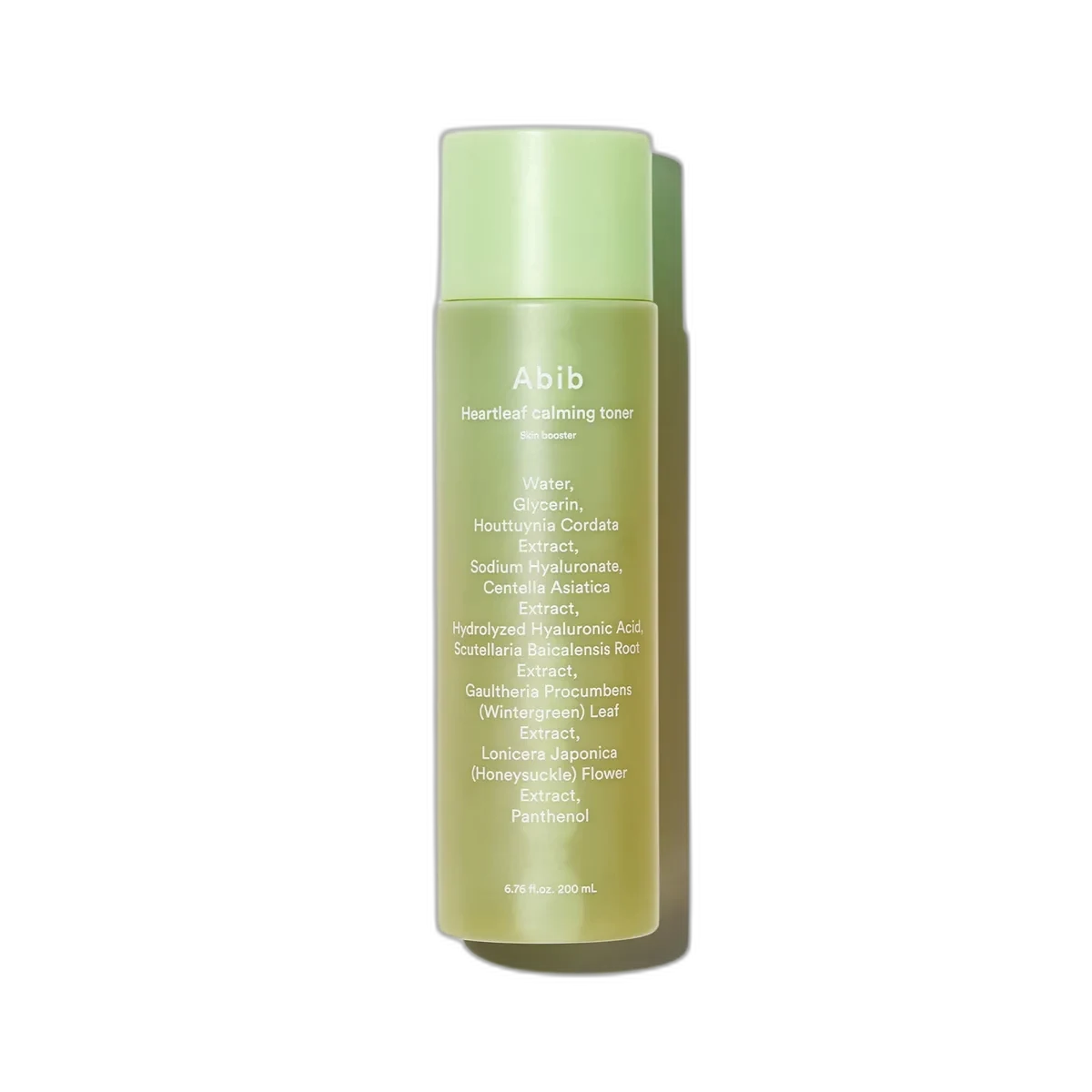
Heartleaf Calming Toner Skin Booster
K-Beauty Calming Toner MVP
 Verified reviewer
Pros & cons.
- +80% Houttuynia cordata extract base does real anti-inflammatory work
- +Stacks heartleaf with full centella TECA complex for parallel calming pathways
- +Niacinamide content meaningfully fades post-acne marks over time
- +Polyglutamic acid plus multi-weight HA delivers essence-level hydration
- +Lightweight watery texture layers cleanly with serums and treatments
- +Generous 200ml bottle at a fair price point
- +Fragrance-free and well-tolerated by reactive skin
- −Not hydrating enough as a standalone for very dry skin
- −Bottle design without a controlled-flow cap is wasteful
- −Faint natural herbal note may be unfamiliar to some users
- −Heartleaf has thinner published clinical evidence than centella
The full review.
Texture
The texture is watery and absorbs in seconds, allowing serum layering without waiting. Polyglutamic acid adds enough body so it feels more substantial than plain water.
Scent
The product is fragrance-free, but the high heartleaf extract concentration leaves a faint, natural herbal note that some users find unfamiliar.
Packaging
The screw cap design can cause waste. Pour the liquid into your hands or onto a cotton pad instead of tilting the bottle directly onto your face.
Common Praise
Reactive or active-acne skin shows calming effects within days. Redness around breakouts decreases, irritation drops, and skin feels cushioned but not slick. After 4-6 weeks of consistent twice-daily use, niacinamide helps modestly fade post-inflammatory marks, meeting the goals of an acne-prone daily toner.
Common Complaints
The toner has limits: it is not a heavy-duty hydration product. Very dry skin needs a richer cream or two to three layers of the toner for moisture.
Ingredient analysis.
Full INCI list · pH 5.5
Houttuynia Cordata Extract (80%), Water, Butylene Glycol, Glycerin, 1,2-Hexanediol, Niacinamide, Panthenol, Allantoin, Sodium Hyaluronate, Hydrolyzed Hyaluronic Acid, Madecassoside, Centella Asiatica Extract, Asiaticoside, Madecassic Acid, Asiatic Acid, Polyglutamic Acid, Trehalose, Betaine, Caprylyl Glycol, Ethylhexylglycerin, Disodium EDTA, Xanthan Gum
Skin match.
The science.
The Science
The interesting question with this formula is whether heartleaf actually deserves the spotlight Abib gives it, and the published evidence base is genuinely promising even if it's thinner than centella's. Houttuynia cordata has a documented profile of flavonoids — quercitrin, isoquercitrin, hyperoside, and rutin — with research demonstrating anti-inflammatory activity through inhibition of pro-inflammatory cytokines and antimicrobial action against several bacterial strains relevant to acne. The plant has been used in traditional East Asian medicine for centuries, and modern research has begun characterizing its mechanism in skin contexts, though the clinical-trial volume is still well below centella's. Where this formula gets clever is that it doesn't ask heartleaf to do the work alone. Layering it with the four-component TECA centella complex gives the toner two parallel anti-inflammatory pathways: the heartleaf flavonoids and the centella terpenoids work through different mechanisms and target slightly different inflammatory mediators, so the combination produces broader coverage than either ingredient alone. The niacinamide contribution is the most clinically supported piece of the formula — multiple double-blind studies demonstrate niacinamide at 2-5% improves barrier function, modestly reduces post-inflammatory pigmentation, and supports overall skin tone evenness. Polyglutamic acid is a fermentation-derived humectant with research showing it holds significantly more water than hyaluronic acid by weight, and combined with the multi-molecular-weight HA stack, the toner delivers hydration at multiple depths of the stratum corneum. The integrated logic — anti-inflammatory base, supporting actives, multi-weight hydration — is what justifies treating this as more than a simple botanical toner.
Dermatologist Perspective
Dermatologists generally view heartleaf as an emerging but credible calming botanical with mechanisms that overlap usefully with the more established centella platform. Board-certified dermatologists often recommend essence-toners that combine multiple anti-inflammatory ingredients with niacinamide and humectants for patients with mild to moderate acne or reactive skin, which is essentially the profile Abib's toner hits. The standard derm advice with this kind of product is to incorporate it as a daily preparatory step rather than expecting it to replace a prescription acne treatment, and to give the formula 4-6 weeks of consistent use before judging its effect on persistent redness or post-inflammatory marks.
Where it fits in your routine.
After cleansing, dispense a small amount into your palm and pat into damp skin, or soak a cotton pad and sweep it across the face and neck. Apply 2-3 layers for more hydration on dry days. Follow with serum and moisturizer. Use morning and evening as your standard toner step. For active acne or post-procedure recovery, soak a cotton pad and use as a 5-minute compress on inflamed areas.
At about twenty-two dollars for 200ml, this toner hits the K-beauty value-for-formulation sweet spot. The ingredient density — 80% heartleaf base, full centella complex, niacinamide, panthenol, polyglutamic acid, multi-weight HA — exceeds what most Western brands offer at twice the price. The bottle lasts several months with twice-daily use. Compared to other calming toners in the K-beauty market, it offers high value: it costs less than premium cica essences from luxury K-beauty brands and has more ingredients than basic drugstore toners.
People with sensitive, acne-prone, or reactive skin want a calming daily toner with real ingredient depth at a reasonable price. It works well for users seeking a centella alternative or those layering multiple anti-inflammatory actives in one step.
If you have very dry, dehydrated skin and want a thicker toner for heavy moisture, this essence-light format feels too thin without layering. If you dislike natural herbal scents or want odorless formulations, the faint heartleaf note may bother you.
Product details.
Watery essence-toner with slight viscosity from the polyglutamic acid
Mild, slightly herbal natural note from the heartleaf base
200ml clear plastic bottle with a screw cap
It feels like a watery essence on application. The texture is light enough to layer multiple times but has enough body to remain on the skin. Within a few minutes, the skin looks less red and more cushioned. Most users see a meaningful reduction in active acne redness within the first week.
About 2-3 months at twice-daily face and neck use
12 months
All Year
The backstory.
Abib introduced its Heartleaf line in 2021 as a deliberate centella alternative for the Korean and global market, betting that Houttuynia cordata could carry an entire range. The toner became the brand's breakout product on Olive Young and was one of the first heartleaf-led K-beauty launches to gain real Western reviewer attention.
About Abib
Emerging Brand (2–5 years)Abib launched in 2017. Its global K-beauty profile relies on the Heartleaf line, which uses Houttuynia cordata as a centella alternative. The line has consistent reviews on Olive Young, Yesstyle, and Amazon and is widely cited by K-beauty reviewers, though it has less independent dermatology validation than legacy Korean houses.
Common myths.
Heartleaf and centella are basically the same ingredient.
Both have anti-inflammatory and antimicrobial properties but belong to different plant families with unique flavonoid profiles. Heartleaf contains quercitrin and isoquercitrin; centella contains the TECA terpenoids. Using both provides broader calming coverage than using either alone.
Toners only provide hydration and do not treat specific concerns.
This essence-toner delivers high concentrations of actives in a thin, easy-to-layer format. With 80% heartleaf and full centella support, it provides anti-inflammatory effects, not just hydration.
FAQ.
What is heartleaf and how is it different from centella?
Heartleaf, or Houttuynia cordata, is a Northeast Asian plant. Flavonoids like quercitrin give it anti-inflammatory and antimicrobial properties. Centella asiatica is a different plant used in K-beauty cica products; its active profile relies on TECA terpenoids. While both soothe skin, they are not the same ingredient — this toner uses both for complementary action.
Will this toner help with acne?
It's not a treatment for active cystic acne, but the heartleaf-centella combination calms the inflammation and redness around active breakouts, and the niacinamide content modestly fades post-inflammatory marks over time. Most users with mild to moderate acne see calmer-looking skin within 4-6 weeks of consistent use.
Can I use it after retinol or exfoliating acids?
Yes — its calming and barrier-supporting profile buffers retinol or acid irritation. Apply it after cleansing and before your retinol or acid treatment, or use it as a recovery step when your skin feels reactive.
Is it heavy enough for dry skin?
This toner calms and lightly hydrates instead of providing deep moisture. If you have very dry skin, apply 2-3 layers and follow with a thicker cream. The polyglutamic acid and HA combination adds more humectant depth than a basic toner, but the texture remains essence-light.
Does it have any fragrance?
The toner has no added fragrance or essential oils. A high concentration of heartleaf extract leaves a faint natural herbal note, but the formula lacks synthetic perfume. This makes it suitable for most fragrance-sensitive users.
What the community says.
"Visibly calms redness and active breakouts"
"Lightweight but hydrating"
"Layers cleanly with everything else"
"Big 200ml bottle for the price"
"Bottle design without a flip cap can be wasteful"
"Some users want a stronger cooling sensation"
"Faint herbal scent though it's technically fragrance-free"