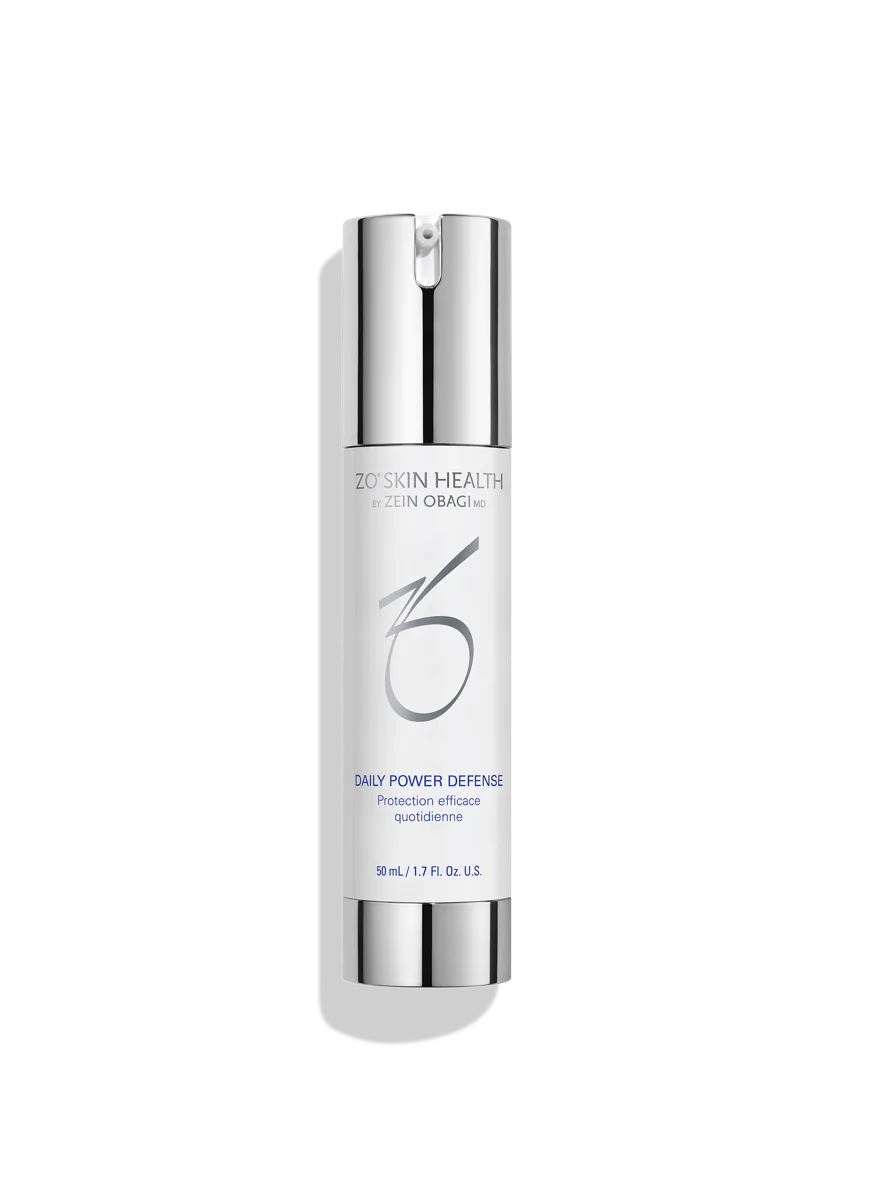
Daily Power Defense
Derm Office Staple
 Verified reviewer
Pros & cons.
- +Encapsulated retinol gentle enough for true twice-daily use
- +Sophisticated three-ceramide and cholesterol lipid system
- +ZO's distinctive DNA repair enzyme blend with published in vitro data
- +Silky silicone texture that layers well under sunscreen and makeup
- +Minimal flaking or visible peeling compared to stronger retinoids
- +Backed by nearly two decades of in-office clinical use
- +Airless pump packaging protects the photosensitive retinol payload
- −Premium dermatology-channel pricing for a 1 oz bottle
- −Contains added fragrance that's hard to justify in 2026
- −Not pregnancy or breastfeeding safe due to retinol content
- −Can cause pilling under heavy mineral sunscreens if rushed
- −Sold mainly through doctor offices, harder to source online
The full review.
You will hear Daily Power Defense mentioned in almost any U.S. dermatology office that sells skincare. Front desks reorder the bottle automatically, aestheticians use it on themselves between facials, and dermatologists slip it into the bags of patients struggling with tretinoin. This insider status defines the serum, as ZO Skin Health avoids television ads, TikTok seeding, and direct-to-consumer sales. Daily Power Defense built its reputation slowly: by working on actual patients in clinical hands for almost twenty years.
The formula layers modes of action without interference. An encapsulated retinol performs the headline work—the concentration is undisclosed, but low enough for ZO to recommend morning and night use. Encapsulation is key. Free retinol oxidizes fast, irritates heavily, and spikes rather than drips into the skin. By wrapping the molecule in a silicone-and-cyclomethicone matrix, ZO slows release so surrounding antioxidants and lipids can soothe the skin in parallel. This makes the retinol behave like a daily serum instead of a periodic treatment.
Beneath the retinol, one of the most thoughtful ceramide systems in any serum exists. Ceramide 1, ceramide 3, and ceramide 6 II join cholesterol and phytosphingosine to mimic the actual lipid ratio of healthy stratum corneum. Anyone using a single-ceramide drugstore moisturizer with a retinoid knows the difference between “has ceramides” and “has the ceramides your skin needs.” Daily Power Defense falls into the second category, helping most patients tolerate the retinol better than stronger options.
ZO also includes its signature DNA repair enzyme blend: plankton extract, micrococcus lysate, and Arabidopsis thaliana extract. These ingredients are more than biotech theater when you consider the literature on photolyase and endonuclease activity in topical formulations. While no topical “reverses sun damage” as ZO marketing implies, the published in vitro data on these specific extracts is more substantive than average antioxidant claims. In a serum used daily under sunscreen, targeting cumulative UV damage at the cellular level is more than window dressing.
The texture makes the serum feel expensive, nearly justifying the price. Cyclopentasiloxane and dimethicone crosspolymer provide a blur-primer glide; it disappears into skin without typical retinol residue and works with most sunscreens. A small minority of users experience pilling—usually when layering under heavy mineral SPF too quickly—which a 60-second wait between layers fixes.
There are limitations. First, the fragrance. There is no reason for a 2026 retinol serum at this price to contain added perfume, especially since ZO is reformulating other products without it. Sensitive skin and rosacea patients should use caution, and users with active barrier compromise should fix the barrier before using this. The $160 price for one ounce is also a sticking point, as direct-to-consumer brands offer similar ingredient stacks for $60-80. You pay for the encapsulation system, the lipid ratio, in-office distribution, and twenty years of derm-chair credibility.
Value-wise, this product sits in an awkward spot. It is better-formulated than most $60 retinol serums, but not three times better as the price implies. If a dermatologist recommends it and lower-priced options failed you, Daily Power Defense will likely deliver. If you are shopping without guidance and your skin is not reactive to standard retinols, you can reach 80% of the result for half the money. ZO built something that works, then priced it for customers willing to pay.
Ingredient analysis.
Full INCI list
Cyclopentasiloxane, Dimethicone Crosspolymer, Dimethicone, Glycerin, Phenyl Trimethicone, Butylene Glycol, Cetyl PEG/PPG-10/1 Dimethicone, Sodium Chloride, Tocopheryl Acetate, Retinol, Ceramide 6 II, Ceramide 1, Ceramide 3, Phytosphingosine, Cholesterol, Sodium Lauroyl Lactylate, Carbomer, Xanthan Gum, Plankton Extract, Enteromorpha Compressa Extract, Caffeine, Zingiber Officinale (Ginger) Root Extract, Vaccinium Myrtillus Fruit Extract, Saccharomyces Cerevisiae Extract, Micrococcus Lysate, Lactobacillus Ferment, Arabidopsis Thaliana Extract, Bifida Ferment Lysate, Glycine Soja (Soybean) Sterols, Lecithin, Disodium EDTA, Phenoxyethanol, Ethylhexylglycerin, Fragrance
Skin match.
The science.
The Science
Daily Power Defense uses two established lines of evidence for its retinol. First, topical retinoids increase epidermal turnover, normalize keratinization, and stimulate procollagen synthesis—a dermatological consensus backed by decades of studies on retinol, retinaldehyde, and tretinoin. Second, formulation literature shows encapsulation systems for retinol reduce TEWL spikes and clinical irritation while preserving efficacy; this is why ZO and most modern retinol formulators avoid free retinol. The DNA repair enzyme blend offers more interesting evidence. Studies on photolyase from plankton and endonuclease activity from Micrococcus lysate focus on UV-induced cyclobutane pyrimidine dimers—the specific DNA lesions that drive photoaging and skin cancer risk. An early 2000s paper in the Journal of Investigative Dermatology reported lower actinic damage markers in patients using topical photolyase under controlled conditions, and follow-up work studied similar enzymes in xeroderma pigmentosum populations. This does not mean the serum 'repairs' visible damage alone, and in vivo evidence is thinner than in vitro evidence, but the mechanistic plausibility exists. The ceramide-cholesterol-phytosphingosine system follows the work of Peter Elias and colleagues, whose research proved that topical physiological lipid mixtures support stratum corneum repair better than single-lipid formulas. Daily Power Defense uses that finding in its base, which explains its high tolerability.
Dermatologist Perspective
Board-certified dermatologists often prescribe Daily Power Defense as a daily anchor for patients who need consistent retinoid exposure but cannot tolerate prescription tretinoin. They use it to bridge sensitive patients off harsher retinoids during barrier compromise and as a maintenance product between laser, microneedling, and chemical peel sessions. Dermatologists like the ceramide ratio because it stabilizes barrier function while the retinol works; many in-office protocols pair it with a vitamin C serum in the morning and a stronger retinoid at night. The fragrance addition is a common complaint among dermatologists, so they route patients with rosacea or fragrance sensitivity to a different ZO option or a different brand. As with any retinoid, dermatologists advise stopping use during pregnancy and breastfeeding and pairing daily use with broad-spectrum sunscreen.
Where it fits in your routine.
Apply one to two pumps to clean, dry skin after water-based serums and before moisturizer, morning and night. ZO's protocol requires use on the entire face, neck, and upper chest. In the AM, follow with a broad-spectrum SPF 30 or higher — retinoids require this. Wait 60 seconds between layers to prevent pilling, especially under heavier mineral sunscreens. New users with sensitive skin should use it every other night for the first two weeks, then move to twice daily. Stop use 5-7 days before any in-office resurfacing procedure and resume once the dermatologist clears it. Always store in the original airless pump container away from heat and direct light.
Daily Power Defense costs $190 for 1.7 oz (a smaller travel size is around $117), matching its dermatology-channel positioning. The formula uses sophisticated ingredients: encapsulated retinol, three ceramides, cholesterol, phytosphingosine, and ZO's DNA repair enzyme blend. Its texture is more refined than most direct-to-consumer competitors. However, a similar daily retinol-plus-barrier routine using a Skinceuticals or PCA serum and a quality ceramide moisturizer costs closer to $100 total. The premium price covers the encapsulation system, in-office distribution, and fifteen-plus years of brand credibility. The price is defensible for patients whose dermatologist actively recommends it. For shoppers without that endorsement, less expensive options provide similar results.
Patients want a credible daily retinol that protects their barrier and already use the ZO system with a dermatologist. This works best for normal, combination, and resilient oily skin types targeting fine lines, sun spots, and texture without using prescription tretinoin.
Avoid this product if you have active rosacea, fragrance sensitivity, or a compromised barrier — at least until your skin calms. Pregnant or breastfeeding users should not use this product. For a clean, fragrance-free retinol stack, Skinceuticals, Naturium, or The Ordinary offer better value for bargain hunters.
Product details.
Silky, weightless silicone serum that blurs across the skin like a primer.
Light, slightly powdery fragrance from the added perfume.
Opaque airless pump bottle protects the photosensitive retinol payload.
The silicone matrix gives most users an immediate blur-and-smooth effect. Users may feel mild tingling or dryness during the first 1-2 weeks as skin adjusts to the encapsulated retinol; visible flaking is uncommon at this strength.
One 1.7 oz bottle lasts roughly 3-4 months with twice-daily face and neck use; a travel size is also available.
12 months
All Year
The backstory.
Dr. Zein Obagi built ZO Skin Health in 2007 around the idea that healthy skin is a year-round project, not a series of in-office events. Daily Power Defense was developed as the 'every day, everyone' anchor of his Daily Skincare Program — gentle enough to use morning and night, loaded enough to actually do something between facials and laser sessions.
About ZO Skin Health
Established Brand (5–20 years)Dr. Zein Obagi, a board-certified dermatologist with decades of clinical practice, founded ZO Skin Health in 2007. Dermatology offices and medspas sell the brand, and many formulas were developed with in-office protocols.
Common myths.
DNA repair enzymes can reverse existing sun damage.
The plankton, micrococcus and Arabidopsis extracts in this serum have published in vitro evidence for supporting cellular repair pathways, but no topical product 'reverses' sun damage. They support your skin's existing response to daily UV stress.
Since it has retinol, you can skip other retinol products in your routine.
This retinol concentration is low so users can apply it twice daily. Patients who tolerate stronger retinoids often layer Daily Power Defense in the AM and a higher-strength ZO retinol or prescription tretinoin at night.
What the community says.
"Smoother texture within weeks"
"Non-greasy silicone glide"
"Tolerable as a daily retinol"
"Fades sun spots over time"
"Expensive at $190 for a single bottle"
"Contains fragrance"
"Some pilling under makeup"
"Not available at standard retail"
People also looked at.