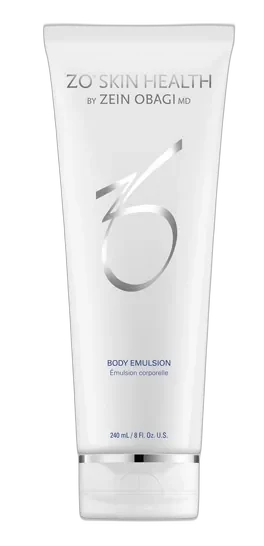
Body Emulsion
Retinol For Your Body
 Verified reviewer
Pros & cons.
- +Calibrated retinol percentage genuinely treats body skin photoaging
- +Urea and petrolatum address texture and dryness simultaneously
- +Colloidal oat and ferment buffer the retinol irritation across large surface area
- +Fragrance-free formulation appropriate for body-wide application
- +Velvety, fast-absorbing texture works under clothes immediately
- +Opaque pump packaging protects the retinol from light degradation
- +Visible texture and crepiness improvement at 4-8 weeks
- +Long shelf life when used strategically on concern areas only
- −Premium price point at $110 for 8 oz is steep for body care
- −Not safe during pregnancy or breastfeeding
- −Only available through dermatologist offices and authorized professional retailers
- −Initial 1-2 week adjustment period with mild dryness or flaking is common
- −Not the right pick for very oily body skin or strict ingredient minimalists
The full review.
Most bathrooms contain a facial moisturizer that costs more than a body moisturizer. This pattern is universal. People spend $80 on a 1.7oz jar of facial cream and then use a $9 bottle of cocoa-butter body lotion, ignoring that the same biology applies to both. Body skin shows photoaging on the décolletage where the sun hits it. Hands wrinkle and develop dark spots faster than expected. Upper arms and shins develop crepiness that hydration alone cannot fix. Forearm skin, especially in those without daily SPF habits, accumulates dyspigmentation identical to the dyspigmentation on the cheeks. Body skin ages; people just ignore it due to habit.
Dr. Zein Obagi built Body Emulsion for those who notice these changes. Body Emulsion is one of the few body lotions with a meaningful retinoid component. Most ‘retinol body cream’ options use homeopathic levels of retinyl palmitate for marketing or use fragrances to prioritize sensory experience over results. Body Emulsion is different. The retinol is real, the percentage is calibrated for body application (likely 0.1-0.3% based on its INCI position), and the supporting ingredients make a body retinoid usable across large surface areas without the dryness or irritation that causes most people to quit after a week.
The formulation craft shows in the supporting ingredients. Urea acts as a keratolytic and humectant, targeting the rough patches on shins, elbows, and upper arms. Urea also complements the retinol by improving penetration of subsequent actives. Petrolatum sits high on the INCI as the occlusive backbone, locking in humectants and preventing the transepidermal water loss that makes body skin look dull and feel rough. Colloidal oat (listed as oat kernel flour) adds an anti-inflammatory layer to buffer the retinol’s irritation potential, which is vital when applying an active over a large surface area. Saccharomyces ferment lysate adds B vitamins and amino acids in a yeast-fermented matrix; this is unusual for a Western body lotion and aids the recovery side of the resurfacing-and-recovery balance. Glycerin and dimethicone provide the basics. The architecture provides active treatment without causing dry, flaky body skin.
The sensory experience makes this a viable daily product. The emulsion is thick but absorbs fast for its petrolatum content. There is no greasy film to wait through before dressing, which often stops people from using body retinoids. It is fragrance-free, which is appropriate for large surface areas, and the velvety, non-tacky finish allows for immediate application under clothes. The opaque pump bottle protects the retinol from light degradation.
Consistent nightly use shows results over a few months. Most users report softer, smoother skin within the first week as urea and petrolatum work before the retinol remodels the skin. Texture and crepiness improve at the four-to-eight-week mark, especially on the décolletage and upper arms where photoaging is concentrated. Full benefits—pigmentation improvement, even tone, and the smoother quality retinoids give facial skin—typically take twelve to sixteen weeks. This is a long-game product, not a quick fix. Users who quit after two weeks miss the work the retinoid does.
The limitations are clear. Price is the primary issue. One hundred and ten dollars for an 8oz body lotion is high, especially since most consumers expect drugstore prices for body care. The value depends on whether you use this as an active treatment for a specific concern (justifying the cost like a serum) or as a daily moisturizer (making it overpriced). Many users apply it strategically to areas of concern rather than head-to-toe, which makes the bottle last four to five months and lowers the monthly cost. Second, retinol and retinyl palmitate are contraindicated during pregnancy. Third, the dermatology-channel distribution means you cannot buy it at Sephora; you must use a derm office or an authorized professional retailer. Finally, retinol body adjustment is real. New users may experience mild flaking or dryness in the first week or two. The brand could better communicate an every-other-night ramp-up approach for first-timers.
Body Emulsion occupies a rare category. Few body lotions deliver retinoid treatment at meaningful percentages with ingredients designed to make the experience tolerable across the body. For those seeing aging patterns on the décolletage, hands, or arms and wanting an active-driven approach like they use on their face, this product takes the task seriously. Whether it is worth the price depends on your priorities. For many users, it is a justified spend.
Formula
Ingredient analysis.
Full INCI list
Aqua/Water/Eau, Glycerin, Caprylic/Capric Triglyceride, Petrolatum, Distearyldimonium Chloride, Butylene Glycol, Cetyl Alcohol, PEG-100 Stearate, Glyceryl Stearate, Dimethicone, Avena Sativa (Oat) Kernel Flour, Polymethyl Methacrylate, Isopropyl Palmitate, Urea, Arachidyl Alcohol, Behenyl Alcohol, Panthenyl Triacetate, C12-15 Alkyl Benzoate, Ethyl Linoleate, Tocopheryl Acetate, Saccharomyces Ferment Lysate Filtrate, Disodium EDTA, Acetyl Tyrosine, Oleyl Alcohol, Phospholipids, Retinol, Proline, Ubiquinone, Adenosine Triphosphate, Hydrolyzed Vegetable Protein, Ascorbic Acid, Retinyl Palmitate, Tocopherol, Phenoxyethanol.
Skin match.
The science.
The Science
The clinical case for topical retinoids on body skin parallels the case for retinoids on facial skin. The dermatology literature has documented retinoid benefits in collagen synthesis, photoaging mitigation, pigmentation reduction, and improved skin turnover for over four decades, beginning with Albert Kligman's foundational tretinoin research in the 1980s. While most published clinical research has focused on facial application, the underlying biology applies to body skin as well — body skin contains the same retinoid receptors, the same fibroblasts capable of collagen synthesis, and shows the same photoaging changes when chronically sun-exposed. The decision to formulate a body retinoid is more a question of practical delivery (concentration, irritation buffering, consumer compliance) than a question of whether the mechanism applies.
Urea has substantial research support as both a humectant and a keratolytic, with documented efficacy in conditions like xerosis, ichthyosis, and keratosis pilaris. The combination of urea with topical retinoids is mechanistically sensible because urea both improves the penetration of subsequent topicals and contributes its own keratolytic action — a combined approach that can reduce the percentage of retinoid needed for visible benefit. Petrolatum is one of the most extensively studied occlusive ingredients in dermatology, with consistent evidence for its role in reducing transepidermal water loss and supporting barrier recovery.
Colloidal oat (oat kernel flour or oat colloidal) has FDA-recognized status as a skin protectant and has documented anti-inflammatory activity through avenanthramide compounds. Its inclusion in retinoid formulations is appropriate because it specifically buffers the inflammatory response that retinoids can trigger. Saccharomyces ferment lysate filtrate is a yeast-derived ingredient that has been studied for its content of B vitamins, amino acids, and minor peptides — its evidence base is less robust than the other ingredients in this formula but it has growing support in barrier function and skin recovery research.
The combination logic — retinoid plus humectant-keratolytic plus occlusive plus anti-inflammatory plus recovery support — mirrors the formulation approach used in facial retinoid products designed for sensitive or new-to-retinoid users, scaled up for body application.
Dermatologist Perspective
Dermatologists generally support the application of retinoids to body skin for patients addressing photoaging, crepiness, or hyperpigmentation in areas like the décolletage, hands, and forearms. Board-certified dermatologists who use ZO Skin Health in their practices typically recommend Body Emulsion to patients who have established a facial retinoid routine and want to extend the same benefits to their body. The most common dermatologist guidance is to start every other night for the first 1-2 weeks, ramp up gradually based on tolerance, and pair the regimen with consistent body sunscreen on exposed areas. Pregnancy is a clear contraindication, and patients with eczema or compromised barrier function are usually advised to address those issues first before adding a body retinoid.
Where it fits in your routine.
Apply at night to clean, dry body skin. Target areas with visible photoaging or texture concerns: décolletage, neck, upper arms, forearms, hands, knees, and shins. New body retinoid users should start every other night for the first 1-2 weeks, then increase to nightly as tolerated. Use a body sunscreen on these same areas during the day; retinoid use without sun protection is wasted effort. Pair with a ceramide-based body cream during winter months if you experience dryness. Do not layer with other body retinoids or AHAs, and skip use during pregnancy or breastfeeding.
At $110 for 8 oz, this is luxury body care. Value depends on use. As a daily full-body moisturizer, it is hard to justify against drugstore alternatives. As a targeted treatment for body photoaging on specific areas (décolletage, hands, arms), it acts more like a facial serum than a body lotion. Strategic use brings the per-month cost to roughly $25-30. Cheaper retinol body lotions exist—Naturium Retinol Body Lotion at around $20 and Paula's Choice Retinol Skin-Smoothing Body Treatment at around $30—but they have simpler ingredients. ZO's premium price reflects its formulation complexity and dermatology-channel distribution. It is worth it for people wanting clinical-grade body retinoid care, but not for casual users.
This is for anyone with visible body skin photoaging, crepiness, hyperpigmentation, or keratosis pilaris who wants a clinical-grade retinoid treatment for body skin. Users must commit to nightly use and daily SPF. It works best for people who already use facial retinoids and understand the long-game timeline.
Skip this if you are pregnant or breastfeeding, have eczema or a compromised barrier function, or have very oily body skin. Also skip if you won't use daily body sunscreen. Do not use this as a casual daily moisturizer — drugstore options do that for a tenth of the price.
Product details.
Thick, white emulsion that absorbs faster than the petrolatum content suggests.
Fragrance-free
Plastic pump bottle, opaque to protect the retinol from light degradation
The first applications feel thick but absorb fast. Some users see mild dryness or flaking on retinol-naive body skin during the first 1-2 weeks — this is normal adjustment and resolves with continued use. There is no tingling or purging.
Use nightly on the full body for 3-4 months, or longer if applying to specific concern areas.
12 months
All Year
The backstory.
Dr. Zein Obagi launched ZO Skin Health in 2007 as a sold-through-derms-only line, and Body Emulsion was developed as an extension of his clinical philosophy that body skin shouldn't be neglected just because most consumers stop at the jawline. The product has been a fixture in cosmetic dermatology offices for over a decade, particularly recommended for patients addressing décolletage and arm photoaging.
About ZO Skin Health
Established Brand (5–20 years)Dr. Zein Obagi, a board-certified dermatologist who created the original Obagi Medical line, founded ZO Skin Health in 2007. Professional channel positioning means dermatologist offices sell these formulations instead of retail stores.
FAQ.
How much retinol is in this lotion?
ZO does not disclose the exact percentage. Based on its INCI position and the brand's formulation philosophy, the concentration is low for body application—likely 0.1-0.3%. This amount is active yet gentle for larger surface areas.
Where should I apply it?
Apply to areas with visible sun damage or crepiness: décolletage, neck (lower portion below the jaw), upper arms and forearms, hands, knees, shins, and other photoaging sites. Skip the lower back or thighs unless you have specific concerns there.
Is it pregnancy-safe?
No — do not use retinol or retinyl palmitate during pregnancy or breastfeeding. Use a fragrance-free body lotion with ceramides and glycerin during pregnancy, then resume retinoid body care after.
Will it cause peeling on my body?
You may see mild dryness or flaking during the first 1-2 weeks as skin adjusts, especially if you have not used retinoid body care before. Apply every other night at first, then increase to nightly. The oat and urea in the formula buffer irritation, but body retinoid adjustment is real.
Do I need to wear sunscreen on my body if I use this?
Yes, on any areas exposed to sun. Retinol increases UV sensitivity. Treating body photoaging fails if you do not protect against further damage. Use a body sunscreen on hands, arms, and décolletage during the day.
Why is it so expensive?
You pay for the active formulation (most body lotions lack meaningful retinol concentrations), dermatology-channel distribution, and brand cachet. Whether it is worth $110 depends on your desire to treat body skin like facial skin and if cheaper retinol body alternatives worked for you.
Can I use this on keratosis pilaris?
Yes — urea and retinol work well for KP. Apply it regularly to the upper arms or thighs where bumps appear. Expect improvement within 4-8 weeks.
What the community says.
"Visible improvement in crepey skin"
"Smooths upper-arm texture"
"Doesn't feel greasy despite the petrolatum"
"Fragrance-free"
"Very expensive for a body lotion"
"Pump can clog"
"Initial dryness as skin adjusts to the retinol"