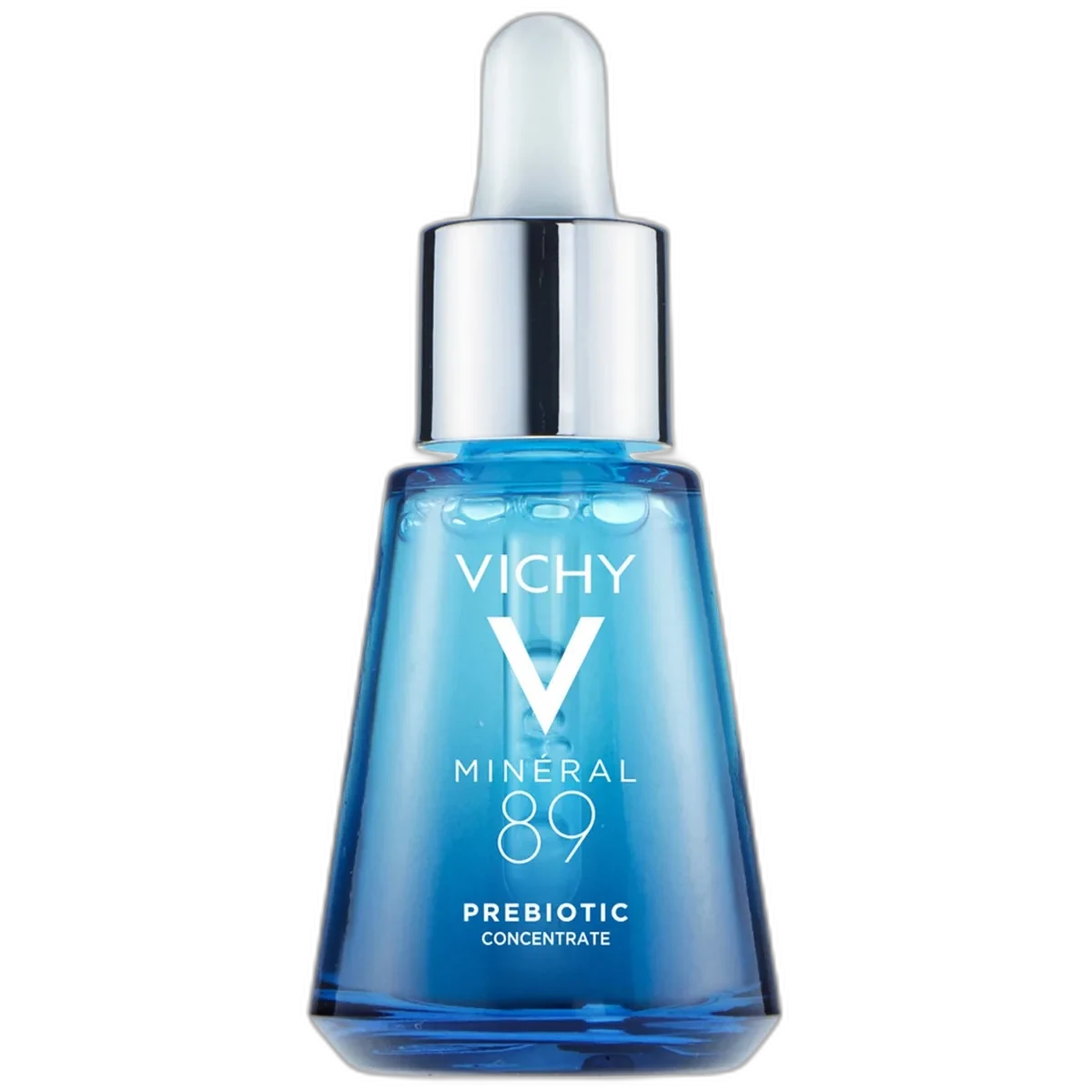
Minéral 89 Prebiotic Recovery & Defense Concentrate
Retinoid Recovery Companion
 Verified reviewer
Pros & cons.
- +Three peer-reviewed clinical studies validate the specific finished formula, not just individual ingredients
- +Reduces retinoid-induced erythema by 70% over 84 days — clinically measured, not just claimed
- +Only 17 ingredients, minimizing the risk of sensitization for reactive skin
- +Fragrance-free, ophthalmologist-tested formula safe for the most sensitive skin types
- +Microbiome-first approach to barrier repair offers a genuine alternative to ceramide-based products
- +4% niacinamide at a concentration effective for barrier support without flushing risk
- +Clinical evidence for rosacea improvement — one of few OTC serums with this specific validation
- −Faint ferment scent may bother very scent-sensitive users despite being fragrance-free
- −Only available in one 30 mL size with no larger economy option
- −Results are gradual — not a fast-acting product for most concerns beyond immediate soothing
- −Easily confused with the original Minéral 89 Booster when purchasing online
The full review.
There is an unspoken assumption in skincare that more ingredients equal more sophistication. Longer INCI lists suggest a more complex, more carefully engineered product. Vichy’s Minéral 89 Prebiotic Recovery and Defense Concentrate challenges that assumption with seventeen ingredients and three peer-reviewed clinical studies — a ratio of science-to-ingredient that most serums with forty-line INCI lists cannot match.
The product was born from a deceptively simple insight: the skin barrier is not just a structural wall of lipids. It is an ecosystem. Most barrier repair products approach the problem architecturally — here are some ceramides, here are some fatty acids, let us rebuild the mortar between your skin cells. This concentrate takes the opposite approach, asking: what if you supported the biological community that maintains the barrier in the first place?
That community is the skin microbiome, and the ingredient responsible for supporting it is Vitreoscilla Ferment — a postbiotic lysate of bacteria cultured in Vichy’s own Volcanic Mineralizing Water. This is not a generic probiotic dusted into the formula for label appeal. L’Oréal’s research team specifically grew Vitreoscilla filiformis, a bacterium naturally found in thermal spring environments, in Vichy’s mineral-rich water to create a proprietary fraction. The process matters because the mineral composition of the culture medium influences the metabolites the bacteria produce, making this lysate compositionally distinct from vitreoscilla ferment cultured in standard growth media.
The clinical evidence is where this product separates from the field. A study published in Clinical, Cosmetic and Investigational Dermatology in 2023 tested the concentrate as an adjunct to topical retinoid therapy on 38 women over 84 days. The results: erythema reduced 48.1% at 28 days and 70% at 84 days. Retinoid irritation symptoms dropped 63-80%. If you have ever abandoned a retinol product because the redness and peeling were unbearable, those numbers are significant. This is not a product claiming to ‘soothe.’ It is a product with peer-reviewed data showing exactly how much it soothes, measured with clinical instruments.
A separate randomized, controlled study on rosacea subjects — perhaps the most demanding test case for a barrier repair product — showed significant improvement in rosacea-associated erythema after 30 days. Hydration increased 31-35%. Transepidermal water loss decreased 11-12%. Even Demodex density was significantly reduced. For a product without any anti-parasitic ingredients, that last finding suggests the microbiome support alone creates conditions less hospitable to the mites associated with rosacea.
The niacinamide at 4% provides the structural side of barrier repair that the microbiome approach does not directly address — supporting ceramide synthesis, reducing inflammation, and decreasing transepidermal water loss through its own well-established mechanisms. It sits second in the ingredient list at a concentration meaningful enough to work but moderate enough to avoid the flushing that some users experience with higher niacinamide percentages.
Texturally, this is a milky, lightweight concentrate — thicker than a water-based serum but lighter than a lotion. It absorbs within thirty seconds, leaves no residue, and layers invisibly under any other product. The fragrance-free formula has a very faint ferment note that some users detect but that disappears almost immediately. It is the kind of product that does nothing to announce its presence — no tingle, no cooling sensation, no visible sheen. You apply it, and it gets to work without fanfare.
The packaging is a glass bottle with a pipette dropper, consistent with the Minéral 89 line aesthetic. Two to three drops covers the entire face. At that dosage, the 30 mL bottle lasts roughly two to three months, which puts the monthly cost at around $12-17. For a clinically validated barrier repair serum, that is competitive.
Honesty about limitations: this is not a fast-acting product for most concerns beyond immediate soothing. The radiance and texture improvements develop gradually over weeks, and users expecting dramatic overnight transformation will be disappointed. The 30 mL single-size offering means no economy option for those who want to use it long-term. And while the clinical data is impressive, 300-500 reviews across retailers means the real-world feedback pool is smaller than category leaders.
Vichy’s choice to invest in three clinical studies for a $35 serum reveals something about the brand’s priorities. Most pharmacy-brand products rely on ingredient-level evidence — the research behind niacinamide, the research behind hyaluronic acid — rather than testing the specific finished formula. This product has both: well-established ingredient evidence and product-specific clinical validation. That dual layer of evidence, wrapped in a formula so clean it could be used on rosacea-affected skin, makes this one of the most scientifically credible barrier repair serums at any price point.
Formula
Ingredient analysis.
Full INCI list
Aqua/Water, Niacinamide, Propanediol, PEG/PPG/Polybutylene Glycol-8/5/3 Glycerin, Glycerin, Methyl Gluceth-20, PEG-60 Hydrogenated Castor Oil, Carbomer, Sodium Hyaluronate, Tocopherol, Hydroxyacetophenone, Citric Acid, Vitreoscilla Ferment, Caprylyl Glycol, Biosaccharide Gum-1, Maltodextrin, Butylene Glycol
Skin match.
The science.
The Science
This product has more peer-reviewed research than most pharmacy-brand serums. Three studies in Clinical, Cosmetic and Investigational Dermatology in 2023 examined different parts of the formula's efficacy.
The retinoid adjunct study tested the concentrate on 38 women aged 44-60 over 84 days with topical retinoid therapy. Compared to retinoid-only controls, erythema dropped 48.1% at day 28 and 70% at day 84. Retinoid-associated irritation symptoms (burning, stinging, dryness) fell 63-80%, and hydration rose 11.46%. This peer-reviewed evidence validates the product as a companion to retinoid therapy—a claim few OTC products make.
The rosacea study used a split-face, randomized, controlled design on 20 subjects over 30 days. The treated side showed statistically significant erythema improvement (p<0.001 at Day 30), a 31-35% hydration increase, and an 11-12% decrease in transepidermal water loss. Demodex mite density also fell significantly, suggesting improved microbiome health creates conditions less favorable to the mites linked to rosacea pathogenesis.
The UV/ozone ex vivo study shows the formula prevents UV and ozone-induced degradation of barrier proteins filaggrin and involucrin, suppresses oxidative stress markers (4-HNE), and reduces inflammatory markers (COX-2, ASC). This provides mechanistic evidence for the product's 'Defense' positioning, showing it protects the barrier at a molecular level against environmental stressors beyond what sunscreen alone addresses.
References
- Benefits of the Dermocosmetic Mineral 89 Probiotic Fractions Adjunct to Topical Retinoids for Anti-Aging Benefits — Clinical, Cosmetic and Investigational Dermatology (2023)
- A Randomized, Controlled Clinical Trial of a Dermocosmetic Containing Vichy Volcanic Mineralizing Water and Probiotic Fractions in Subjects with Rosacea — Clinical, Cosmetic and Investigational Dermatology (2023)
- Topical Application of M89PF Containing Vichy Mineralising Water and Probiotic Fractions Prevents Cutaneous Damage Induced by Exposure to UV and O3 — Clinical, Cosmetic and Investigational Dermatology (2023)
Dermatologist Perspective
Dermatologists recognize the skin microbiome as a key factor in barrier health, and this product aligns with that view. Board-certified dermatologists often recommend it as an adjunct to retinoid therapy; the published 70% erythema reduction provides more evidence than most OTC product recommendations. Dermatologists treating rosacea note that the randomized controlled trial data on rosacea-associated erythema adds clinical credibility beyond typical cosmetic claims. The minimalist, fragrance-free formula is a common recommendation for post-procedure recovery and for patients transitioning to active ingredients who need barrier support.
Where it fits in your routine.
Apply 2-3 drops to cleansed skin every morning and evening as your first serum step. Wait 30-60 seconds for absorption before layering other products. To use as a retinoid buffer: apply before your retinoid to reduce irritation, or mix 2-3 drops directly with your retinol serum. Use moisturizer and sunscreen in the morning. For compromised or post-procedure skin, use it as the primary treatment serum with a gentle moisturizer until the barrier recovers.
At $34.99 for 30 mL, this concentrate costs as much as mid-range pharmacy-brand serums. The value is high because it has three peer-reviewed clinical studies; most products at this price rely on ingredient-level evidence instead of validating the finished formula. Using 2-3 drops twice daily makes the bottle last 2-3 months, costing roughly $12-17 per month. No larger economy size exists. For a clinically validated barrier repair serum with published rosacea and retinoid-tolerance data, the price-to-evidence ratio leads the category. Vichy's legacy and L'Oréal's research investment show in the clinical evidence, not just the brand name.
This works for anyone with a compromised, reactive, or sensitized skin barrier—caused by over-exfoliation, retinoid adjustment, environmental stress, or conditions like rosacea. It is a useful retinoid companion for building active tolerance. It also suits anyone seeking a minimalist, clinically validated approach to barrier repair.
People with healthy skin barriers seeking anti-aging or brightening benefits get more from targeted treatments. This product focuses on recovery and maintenance, not aggressive correction. If your barrier is healthy and you want visible anti-aging results, other serums in the Vichy range work better.
Product details.
Fragrance-free. Natural ferment ingredients create a faint, neutral scent. Some users notice a mild ferment note that disappears seconds after application.
The Minéral 89 line uses a glass bottle with a pipette/dropper dispenser and a clean, clinical aesthetic. The dropper enables precise 2-3 drop dosing. This design is hygienic and protects the formula's active ingredients. Finish lightweightnaturaldewy
It soothes irritated or compromised skin immediately. It does not tingle or sting, even on skin that is red or reactive from retinoid use. Hydration shows after the first application, and a subtle radiance boost appears within the first few days. Users transitioning from harsher actives often describe a 'relief' sensation.
2-3 months with twice-daily application at 2-3 drops per use
6 months
All Year
The backstory.
Born from the observation that the skin's microbiome plays a critical role in barrier function, this concentrate was developed as the 'recovery' extension of Vichy's Minéral 89 line. L'Oréal's research team cultured Vitreoscilla filiformis — a bacterium naturally found in thermal spring environments — in Vichy's own volcanic water, creating a proprietary postbiotic fraction. Three clinical studies published in 2023 validated its efficacy for rosacea, retinoid tolerance, and environmental protection.
About Vichy
Legacy Brand (20+ years)Vichy launched in 1931 near the Vichy, France thermal springs and belongs to L'Oréal's Dermatological Beauty division. This specific product has three peer-reviewed clinical studies in Clinical, Cosmetic and Investigational Dermatology (2023), which is rare for a pharmacy-brand serum.
Common myths.
Barrier repair requires ceramides and lipid replacement
This product uses an alternative approach: it supports the skin's microbiome to strengthen barrier function biologically. Clinical data shows it reduces transepidermal water loss by 11-12% and prevents degradation of barrier proteins (filaggrin, involucrin) under environmental stress, without using ceramides.
Probiotic skincare needs live bacteria to work
This formula uses a postbiotic — a non-living bacterial lysate (Vitreoscilla Ferment) — which is more stable and effective in cosmetics than live bacteria. The lysate provides cell signaling molecules and metabolites that benefit the skin without the stability issues of keeping live cultures viable in a bottle.
FAQ.
What is Vitreoscilla Ferment in Vichy Prebiotic?
This postbiotic is a non-living lysate of Vitreoscilla filiformis bacteria cultured in Vichy's Volcanic Mineralizing Water. This proprietary fraction works differently than generic probiotics; it supports the skin's microbiome to strengthen barrier function. Clinical evidence shows it improves rosacea-associated redness and retinoid tolerance.
Is Vichy Minéral 89 Prebiotic good for rosacea?
Clinical evidence confirms this. A randomized, controlled study in Clinical, Cosmetic and Investigational Dermatology shows significant improvement in rosacea-associated erythema after 30 days. The formula also increases hydration by 31-35% and decreases transepidermal water loss by 11-12% — both benefits for rosacea-affected skin.
How is this different from the original Vichy Minéral 89?
The original Minéral 89 is a hyaluronic acid-based hydrating booster. This Prebiotic version uses 4% niacinamide and 5% vitreoscilla ferment to repair the barrier and support the microbiome. It targets stressed, compromised, or reactive skin instead of general hydration, and has clinical evidence for rosacea and retinoid tolerance.
Is Vichy Prebiotic Concentrate safe during pregnancy?
Yes — the formula lacks retinoids, salicylic acid, or other pregnancy-contraindicated ingredients. Niacinamide, hyaluronic acid, glycerin, and vitamin E are safe for topical use during pregnancy. The product is fragrance-free and hypoallergenic, so it is a gentle choice during pregnancy.
Does Vichy Prebiotic Concentrate smell bad?
The formula is fragrance-free, though some users notice a faint ferment scent from the vitreoscilla lysate ingredient. This scent is mild and disappears seconds after application. Most users find it unnoticeable once absorbed.
Community
What the community says.
"Noticeably soothes and calms reactive, sensitive, or retinoid-irritated skin"
"Lightweight, non-greasy texture absorbs quickly without residue"
"Visible radiance and glow improvement within the first few weeks"
"Fragrance-free formula works well for even highly sensitive skin types"
"Excellent retinoid companion — reduces redness and irritation from actives"
"Layers well under other products and makeup without interference"
"Faint ferment smell from the vitreoscilla lysate despite being fragrance-free"
"Only available in one 30 mL size with no larger economy option"
"Results are gradual and subtle rather than dramatic or immediate"
"Easy to confuse with the original Minéral 89 Booster when purchasing"
Featured in.
People also looked at.