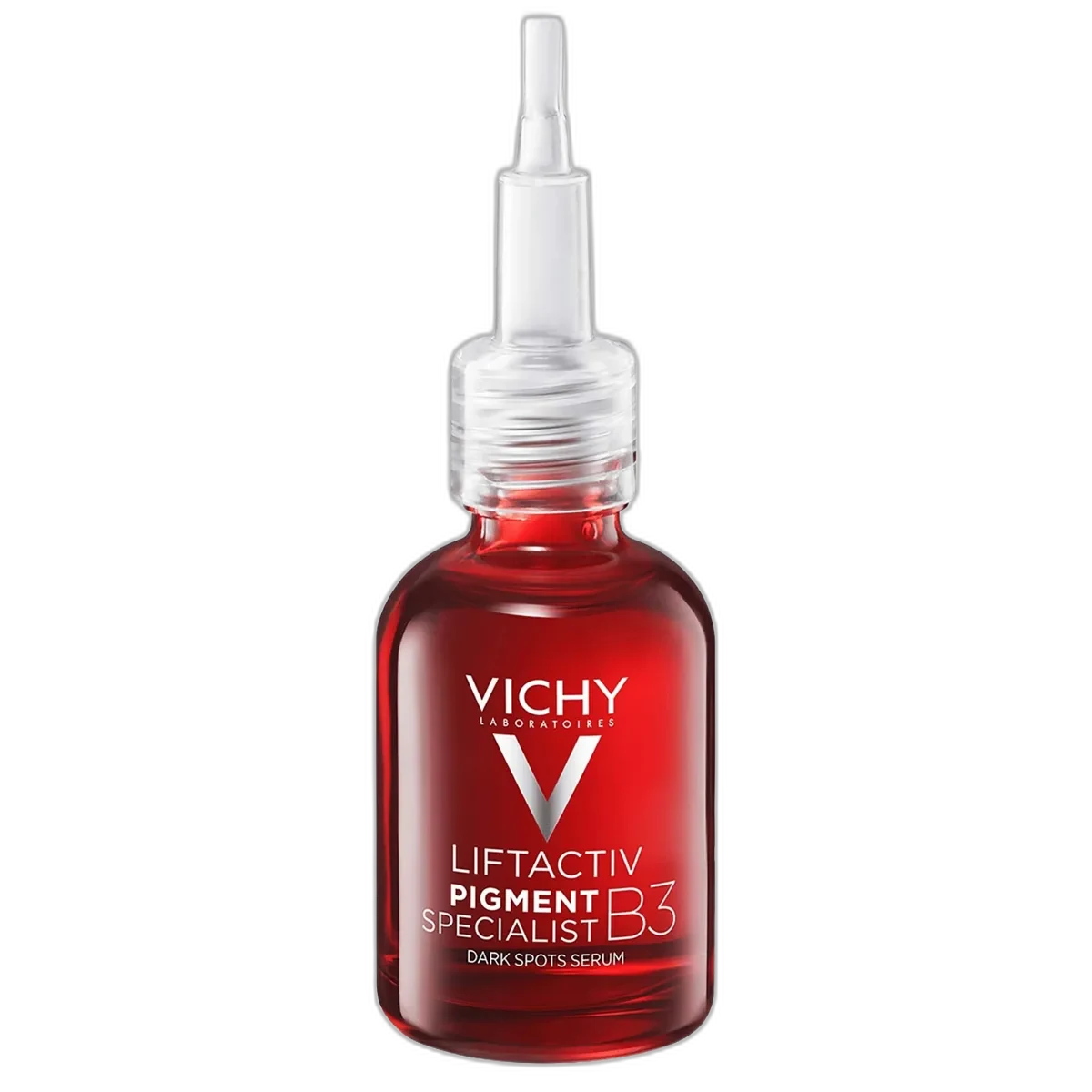
LiftActiv B3 Dark Spot Serum
Next-Gen Brightening Pioneer
 Verified reviewer
Pros & cons.
- +Patented Melasyl molecule targets melanin at a stage no other cosmetic ingredient addresses
- +Five-pathway approach to hyperpigmentation covers prevention, interception, and removal simultaneously
- +Lightweight, fast-absorbing texture layers effortlessly under moisturizer and sunscreen
- +Fragrance-free formula with built-in soothing agents makes it accessible to sensitive skin
- +Backed by 18 years of L'Oréal R&D and 121 supporting studies for the key active
- +Effective at preventing new dark spots from forming, not just treating existing ones
- +8% niacinamide concentration provides barrier support and sebum regulation beyond brightening
- −Precision dose applicator requires a twist-and-squeeze motion that feels fiddly compared to standard droppers
- −Not hydrating enough to function without a follow-up moisturizer, even for oily skin
- −Limited effectiveness on deep hormonal melasma — works best on UV and post-inflammatory marks
- −Only available in one 30 mL size with no larger economy option
- −Contains glycolic acid, requiring strict daily sunscreen use to avoid counterproductive UV damage
The full review.
Most dark spot serums are variations on a theme: take a tyrosinase inhibitor, add some niacinamide, sprinkle in vitamin C, and call it innovation. Vichy’s LiftActiv B3 does something genuinely different, and the story behind it matters. L’Oréal’s research team spent 18 years — the kind of timeline usually reserved for pharmaceutical drug development — screening 100,000 molecules to find one that could intercept melanin formation at a stage no cosmetic ingredient had previously targeted. That molecule is Melasyl, and this serum is its flagship vehicle.
The science is worth understanding because it explains why this product works differently than everything else in your medicine cabinet. Traditional brightening ingredients — hydroquinone, arbutin, kojic acid — work by inhibiting tyrosinase, the enzyme that kicks off melanin production. Melasyl ignores tyrosinase entirely. Instead, it captures dopaquinone, DHI, and DHICA — the intermediate compounds that form after tyrosinase has done its work but before they polymerize into the visible pigment you see as a dark spot. It is, essentially, an interceptor operating at a checkpoint that other ingredients do not address.
But Vichy did not build a one-trick formula. The 8% niacinamide blocks melanosome transfer — preventing the melanin that does form from reaching the skin’s surface cells. Tranexamic acid quiets the inflammatory signals that trigger overproduction in the first place. Glycolic acid at roughly 1.5% accelerates the shedding of cells that are already pigmented. Ascorbyl glucoside provides antioxidant coverage and mild tyrosinase inhibition. That is five distinct mechanisms working on the same problem from different angles, and it is the kind of multi-pathway formulation strategy that dermatologists have been advocating for years.
Texture
The texture is almost startlingly lightweight — more reminiscent of a watery essence than a traditional serum. It disappears into skin within seconds, leaving nothing tacky, nothing filmy, just skin that feels marginally smoother. The precision dose applicator, a burgundy glass bottle that you flip and squeeze, is more clinical than elegant. Some users find the dispensing mechanism fiddly, requiring a twist-and-squeeze motion that lacks the satisfying click of a standard dropper. It is a minor ergonomic annoyance in an otherwise well-considered product.
Scent
Fragrance-free is the right call for a product targeting hyperpigmentation — the population dealing with dark spots skews toward post-inflammatory sensitivity, melasma sufferers, and post-procedure skin, none of whom need added irritants. The inclusion of dipotassium glycyrrhizate and allantoin as soothing agents shows formulation thoughtfulness. These ingredients are not decoration. They actively buffer the glycolic acid, keeping the formula accessible to sensitive skin types who would otherwise need to avoid chemical exfoliants.
Real-world performance aligns with the clinical data, though with appropriate caveats. Surface-level sunspots and post-acne marks respond well within four to six weeks. Users consistently report a general brightening effect — that hard-to-define radiance improvement — even before individual spots fade. The formula excels at preventing new spots from darkening, which is arguably more valuable than treating existing ones. Where it falls short is deep, hormonal melasma. If your hyperpigmentation is driven by hormonal fluctuations rather than UV damage, this serum will help at the margins but will not replace prescription-strength interventions.
At $45 for one ounce, this is premium pharmacy-brand territory — well above the CeraVe and Cetaphil price bracket but below the luxury tier. The price reflects 18 years of Melasyl development and a genuine intellectual property advantage. You are not paying for fragrance, packaging theater, or a celebrity endorsement. You are paying for a molecule that literally does something nothing else on the market can do. Whether that premium is worth it depends on how stubborn your dark spots are. For sunspots and post-inflammatory marks, this is one of the most scientifically credible options under $50.
The 30 mL bottle lasts roughly two to three months at the recommended three-to-five drops twice daily, which brings the effective monthly cost to around $15-22. That is reasonable for a targeted treatment serum, and the absence of alternative sizes means you are locked into the standard bottle.
Vichy’s nine decades of pharmacy-brand credibility and L’Oréal’s research infrastructure lend this product a level of scientific backing that most competitors cannot match. This is not a serum that went viral on TikTok and then scrambled to justify its claims. It is a serum that spent nearly two decades in development, went through 121 studies, and arrived on shelves with its homework already done.
Ingredient analysis.
Full INCI list
Aqua/Water/Eau, Niacinamide, Butylene Glycol, Hydroxyethylpiperazine Ethane Sulfonic Acid, Glycerin, Pentylene Glycol, Propanediol, Hydroxyethyl Urea, Glycolic Acid, Arginine, Tranexamic Acid, Hydrolyzed Rice Protein, Allantoin, Citric Acid, Cystoseira Tamariscifolia Extract, Sodium Hydroxide, Trisodium Ethylenediamine Disuccinate, 2-Mercaptonicotinoyl Glycine, Ascorbyl Glucoside, Dipotassium Glycyrrhizate, Caprylyl Glycol, Xanthan Gum, CI 16035/Red 40
Skin match.
The science.
The Science
Melasyl (2-Mercaptonicotinoyl Glycine) is the standout ingredient. L'Oréal developed this molecule by screening 100,000 candidates, narrowing them to 23, and selecting one. Melasyl works differently than other brightening agents: it captures melanin precursors — specifically dopaquinone, DHI (5,6-dihydroxyindole), and DHICA (5,6-dihydroxyindole-2-carboxylic acid) — before they polymerize into eumelanin or pheomelanin. L'Oréal Research in vivo studies show topical Melasyl application prevents UV-induced skin darkening and delays tanning. This confirms it works by intercepting precursors rather than through tyrosinase inhibition.
The niacinamide uses a well-established mechanism. A landmark study by Hakozaki et al. in the British Journal of Dermatology (2002) showed that 5% niacinamide significantly reduced hyperpigmentation and inhibited melanosome transfer from melanocytes to keratinocytes in a double-blind, randomized trial. This serum uses 8%, which exceeds that clinically validated threshold.
Applying tranexamic acid evidence to topical use, Shin et al. published a randomized, double-blind, vehicle-controlled trial in 2013 (Skin Research and Technology). The study showed a topical combination of niacinamide and tranexamic acid significantly reduced melanin index scores in 42 subjects at 4 and 8 weeks. This directly relates to the B3 serum's formulation, which pairs both ingredients.
The glycolic acid at approximately 1.5% has two purposes: it accelerates desquamation of pigmented corneocytes and improves penetration of the other actives. At this concentration, it stays below the irritation threshold in clinical literature while still providing meaningful exfoliation. This formulation choice prioritizes long-term compliance over aggressive single-use results.
References
- The effect of niacinamide on reducing skin pigmentation and suppression of melanosome transfer — British Journal of Dermatology (2002)
- Reduction in facial hyperpigmentation after treatment with a combination of topical niacinamide and tranexamic acid: a randomized, double-blind, vehicle-controlled trial — Skin Research and Technology (2013)
Dermatologist Perspective
Dermatologists often recommend multi-target approaches to hyperpigmentation, and this formula follows that clinical philosophy. Board-certified dermatologists note that combining ingredients that work at different melanin pathway stages — tyrosinase inhibition, melanosome transfer blockade, precursor interception, and accelerated cell turnover — produces better outcomes than single-agent treatments. Dermatologists value the inclusion of tranexamic acid for its anti-inflammatory properties, which address post-inflammatory hyperpigmentation triggers. Dermatologists tell patients that topical brightening treatments require 8-12 weeks of consistent use to show efficacy, and that daily broad-spectrum sunscreen is non-negotiable during treatment. This product is frequently recommended as a maintenance treatment after in-office procedures like chemical peels or laser therapy for pigmentation.
Where it fits in your routine.
Apply 3-5 drops to clean, dry skin every morning and evening. Turn the precision dose applicator upside down and squeeze the base to dispense. Spread the liquid evenly over the face and neck, targeting discoloration. Let it absorb for 30-60 seconds before applying moisturizer. In the morning, use broad-spectrum SPF 30 or higher. The glycolic acid in this formula increases photosensitivity, and UV protection is essential when treating hyperpigmentation. Layer under hyaluronic acid serums if you need more hydration.
At $45 for 30 mL, this serum costs more than most pharmacy brands but stays well below the $80-150 luxury and clinical brands for similar targeted serums. The Melasyl molecule justifies the cost; this ingredient is exclusive to L'Oréal brands and is actual intellectual property, not just marketing. One bottle lasts about 2-3 months, making the monthly cost roughly $15-22. No larger economy size exists. The price-to-innovation ratio is strong for a serum with 18 years of research and a patented active unavailable elsewhere. Vichy's nine decades of dermatological credibility as a French pharmacy brand also adds value.
Choose this if you have sunspots, post-inflammatory hyperpigmentation, or skin dullness and want a scientifically rigorous, multi-pathway brightening approach. It suits users seeking pharmacy-brand reliability with a unique innovation advantage no competitor currently offers.
People with deep hormonal melasma should manage expectations — this helps slightly but won't replace prescription treatments. Anyone with very reactive skin who cannot tolerate even low-concentration glycolic acid should patch test carefully or find AHA-free alternatives.
Product details.
This lightweight, watery-gel serum feels like a refined toner. It spreads easily and absorbs in seconds without leaving sticky or tacky residue.
Fragrance-free with virtually no detectable scent.
Dark burgundy glass bottle with a precision dose applicator. To dispense, turn the applicator upside down and squeeze the base gently. The design is clinical and sleek, but the dispensing action takes practice.
Most users see subtle brightening and smoother texture after the first few applications. Most skin types experience no significant tingling or adjustment period, though those sensitive to glycolic acid may feel mild warmth initially. True dark spot fading starts around week 3-4.
2-3 months with twice-daily facial application at 3-5 drops per use
12 months
All Year
The backstory.
Vichy launched the original B3 serum in 2022 as a niacinamide-forward dark spot treatment. In 2024, it was reformulated to include Melasyl, the culmination of L'Oréal's 18-year, 121-study research program that screened 100,000 molecules to find one that could capture melanin precursors before they become visible pigment — a mechanism no other cosmetic ingredient replicates.
About Vichy
Legacy Brand (20+ years)Vichy launched in 1931 near the thermal springs of Vichy, France, under L'Oréal's Dermatological Beauty division. Dermatologists develop the brand's formulations and clinical testing backs them. Peer-reviewed research includes the brand's Mineralizing Thermal Water.
Common myths.
Niacinamide and vitamin C do not work in the same formula.
This claim is false — instability only affects pure L-ascorbic acid at high temperatures. This serum uses ascorbyl glucoside, a stable vitamin C derivative that works with niacinamide without affecting efficacy.
Dark spot serums work by bleaching the skin
This formula does not bleach anything. Melasyl captures melanin precursors before they turn into pigment, niacinamide blocks pigment transfer, and glycolic acid speeds up the removal of already-pigmented cells. It works by interception, not bleaching.
FAQ.
How long does it take Vichy LiftActiv B3 to fade dark spots?
Most users see initial brightening in 1-2 weeks. Surface-level dark spots fade visibly at 4-6 weeks. Deeper hyperpigmentation needs 8-12 weeks of consistent twice-daily use. The multi-active formula works through several pathways at once, but melanin turnover takes time.
Can I use Vichy LiftActiv B3 serum with retinol?
Yes, but introduce it carefully. This serum contains glycolic acid, so pairing it with retinol increases exfoliation. Start by alternating — B3 serum in the morning and retinol at night — and check for irritation before using both in the same routine.
Is Vichy LiftActiv B3 safe for sensitive skin?
The formula is dermatologist-tested, allergy-tested, and fragrance-free. It uses allantoin and dipotassium glycyrrhizate to buffer the glycolic acid. Most sensitive skin types tolerate it well, but a patch test is recommended if you are reactive to AHAs.
Does Vichy LiftActiv B3 work on melasma?
The tranexamic acid and Melasyl content helps with mild melasma and surface-level discoloration. Deep hormonal melasma often needs prescription-strength treatments. This serum works best for maintenance alongside professional melasma management.
What is Melasyl in Vichy B3 serum?
Melasyl (2-Mercaptonicotinoyl Glycine) is L'Oréal's patented molecule, born from 18 years of research. While traditional brightening ingredients inhibit tyrosinase, Melasyl captures melanin precursors — dopaquinone, DHI, and DHICA — before they polymerize into visible pigment. This targets a step in melanin formation that was previously unaddressed.
Do I need to wear sunscreen with Vichy B3 serum?
This serum contains glycolic acid, which increases photosensitivity. Since you are treating hyperpigmentation, UV exposure is the primary trigger for dark spot formation. Using this serum without daily SPF 30+ undermines its effectiveness.
Is Vichy LiftActiv B3 the same as the original formula?
Not quite. The 2024 reformulation increases niacinamide from 5% to 8% and adds Melasyl (0.5%), L'Oréal's patented melanin-intercepting molecule, plus Cystoseira Tamariscifolia extract. The core philosophy remains, but the current version is more potent.
Community ---
What the community says.
"Visibly fades dark spots within 4-8 weeks of consistent use"
"Lightweight, non-sticky texture absorbs quickly without residue"
"Gentle enough for sensitive skin despite multiple actives"
"Noticeable improvement in overall skin radiance and evenness"
"Fragrance-free formula with no detectable scent"
"Precision dose applicator requires screw/unscrew motion that feels fiddly"
"Not hydrating enough to use without a follow-up moisturizer"
"Results on deep or hormonal melasma are limited"
"Takes 4+ weeks to see meaningful results — patience required"
Featured in.
People also looked at.