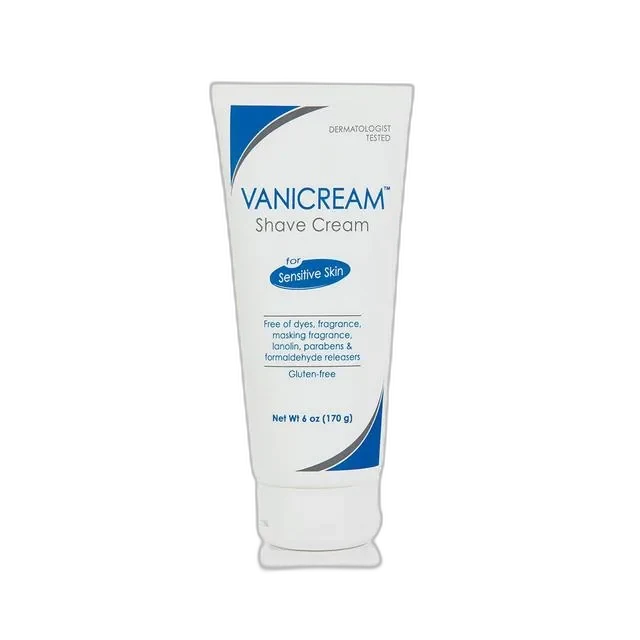
Shave Cream
Sensitive Skin MVP
 Verified reviewer
Pros & cons.
- +Non-lathering formula provides lubrication without the surfactants that strip skin's natural oils
- +Panthenol actively supports skin repair of micro-abrasions caused by shaving
- +Fragrance-free, alcohol-free, and menthol-free for zero irritation triggers
- +Only 14 ingredients with no common contact allergens in the formula
- +Rinses clean without heavy residue while leaving skin conditioned
- +Visible cream layer helps track shaving progress, reducing unnecessary repeat passes
- +Suitable for face, neck, legs, and body with rosacea or eczema
- −Non-lathering texture feels unfamiliar and may be off-putting for traditional shave cream users
- −Six-ounce tube depletes quickly with large-area shaving like legs
- −Priced higher per ounce than mainstream drugstore shaving creams
- −Not widely stocked in physical stores — often requires online ordering
- −No special fragrance or sensory experience for those who enjoy their shaving ritual
The full review.
Walk down the shaving aisle of any drugstore and you’ll be assaulted by menthol. Cool Breeze. Arctic Blast. Mountain Fresh. The entire category operates on the assumption that shaving should feel like sticking your face into a glacier. For people with sensitive skin, rosacea, or eczema, this sensory assault isn’t invigorating — it’s inflammatory.
Vanicream’s Shave Cream enters this market like a librarian at a rock concert. It doesn’t foam. It doesn’t tingle. It doesn’t smell like anything. It applies as a thin white cream, provides lubrication through emollients instead of surfactant-generated lather, and rinses clean. The entire experience is so unremarkable that it’s remarkable.
The fourteen-ingredient formula reads like a Vanicream product should: functional, minimal, and deliberate. Stearic acid is the primary lubricant, creating the slip layer between blade and skin. Glycerin provides humectant hydration during the shave, counteracting the barrier disruption that razor contact inherently causes. Panthenol — provitamin B5 — delivers genuine anti-inflammatory and skin-repair benefits that the menthol in conventional shave creams only pretends to provide. Caprylic/capric triglyceride adds a lightweight emollient layer that helps the cream rinse clean while leaving skin conditioned.
The non-lathering aspect deserves discussion because it trips up nearly every first-time user. We’ve been conditioned to associate foam with effectiveness — if it’s not bubbling, it’s not working. This is marketing legacy, not science. Lather is generated by surfactants, and surfactants can strip skin of its natural oils. By skipping the foam entirely, Vanicream’s formula maintains the skin’s lipid barrier during shaving rather than dismantling it. The cream provides slip through its emollient base, and the thin visible layer actually offers a practical advantage: you can see exactly where you’ve already shaved, reducing unnecessary repeat passes that cause irritation.
The panthenol inclusion is a thoughtful touch that elevates this beyond a simple lubricant. Research published in the Journal of Dermatological Treatment (Proksch et al., 2017) documented panthenol’s ability to accelerate epidermal regeneration, improve skin hydration, and reduce inflammation. When you shave, you’re creating thousands of micro-abrasions across the skin surface. Having an ingredient that actively supports repair of those micro-wounds — rather than a menthol coolant that merely masks the sensation — is a meaningful formulation choice.
The texture takes getting used to. If you’re coming from canned foam or even a traditional lathering cream, the non-foaming consistency feels like you’re applying a moisturizer and then running a razor through it. Which is, in a sense, exactly what you’re doing. The cream spreads easily, provides adequate slip for a comfortable shave, and rinses without leaving a heavy residue. Skin feels soft and calm afterward — no tightness, no sting, no urgency to apply a soothing aftershave.
Value is moderate. At around ten dollars for six ounces, this is pricier per ounce than a can of Barbasol, and the tube depletes noticeably faster when used for large areas like legs. For daily facial shaving, a tube lasts two to three months, which is reasonable. For full-body shaving, you’ll go through product more quickly, and the cost starts to add up.
Availability remains a minor friction point. While Vanicream’s moisturizers are widely stocked at Target, Walgreens, and CVS, the Shave Cream is less consistently available in physical stores. Online ordering through Amazon, the Vanicream website, or pharmacy retailers is often the most reliable route.
Vanicream Shave Cream does exactly one thing: it lets you shave without irritating your skin. It won’t make shaving enjoyable — that’s not the point. It makes shaving survivable for skin that has been punished by every other product in the category. For the eczema patient who dreads every shave, the rosacea sufferer whose face flushes from menthol, or the contact allergy patient who reacts to the fragrance in every conventional option, this cream is a quiet relief.
Formula
Texture
The texture takes getting used to. If you’re coming from canned foam or even a traditional lathering cream, the non-foaming consistency feels like you’re applying a moisturizer and then running a razor through it. Which is, in a sense, exactly what you’re doing. The cream spreads easily, provides adequate slip for a comfortable shave, and rinses without leaving a heavy residue. Skin feels soft and calm afterward — no tightness, no sting, no urgency to apply a soothing aftershave.
Scent
It doesn’t smell like anything.
Common Praise
Vanicream Shave Cream does exactly one thing: it lets you shave without irritating your skin. It won’t make shaving enjoyable — that’s not the point. It makes shaving survivable for skin that has been punished by every other product in the category. For the eczema patient who dreads every shave, the rosacea sufferer whose face flushes from menthol, or the contact allergy patient who reacts to the fragrance in every conventional option, this cream is a quiet relief.
Common Complaints
Availability remains a minor friction point. While Vanicream’s moisturizers are widely stocked at Target, Walgreens, and CVS, the Shave Cream is less consistently available in physical stores. Online ordering through Amazon, the Vanicream website, or pharmacy retailers is often the most reliable route.
Best for
For the eczema patient who dreads every shave, the rosacea sufferer whose face flushes from menthol, or the contact allergy patient who reacts to the fragrance in every conventional option, this cream is a quiet relief.
Ingredient analysis.
Full INCI list
Purified Water, Stearic Acid, Glycerin, Caprylic/Capric Triglyceride, Hydrogenated Polydecene, Panthenol, PEG-12 Dimethicone, 1,2-Hexanediol, Titanium Dioxide, Sodium Polyacrylate, Caprylyl Glycol, Sodium Hydroxide, Isopropyl Titanium Triisostearate, Disodium EDTA
Skin match.
The science.
The Science
This formula targets shaving at the barrier level, not the sensory level. A 2023 study in PMC used an in vitro model to show that shaving disrupts the barrier significantly. Formulations with emollients and glycerin repair barrier function within one hour after shaving. This makes Vanicream's glycerin-and-emollient approach evidence-aligned.
Clinical literature supports the use of Panthenol. A 70th-anniversary review in the Journal of Dermatological Treatment (Proksch et al., 2017) shows dexpanthenol stimulates epidermal proliferation, supports wound healing, and improves skin hydration. A 2020 study in Pharmaceuticals (Heise et al.) studied dexpanthenol in post-procedure wound healing; it found faster tissue repair and less erythema, which applies to shaving micro-trauma.
Research in the British Journal of Dermatology (Fluhr et al., 2008) shows Glycerin works as a humectant during shaving. Glycerol improves stratum corneum hydration, barrier function, and mechanical properties via mechanisms like aquaporin-mediated water transport. Keeping skin hydrated during the mechanical stress of shaving prevents the barrier compromise that causes razor burn and irritation.
References
- Topical use of dexpanthenol: a 70th anniversary article — Journal of Dermatological Treatment (2017)
- Dexpanthenol in Wound Healing after Medical and Cosmetic Interventions — Pharmaceuticals (2020)
- Glycerol and the skin: holistic approach to its origin and functions — British Journal of Dermatology (2008)
Dermatologist Perspective
Dermatologists recommend fragrance-free, non-irritating shave products for patients with rosacea, eczema, and contact dermatitis. In these conditions, menthol, alcohol, and fragrance in conventional shave products trigger flares and prolong inflammation. Board-certified dermatologists note that shaving's mechanical trauma temporarily compromises the skin barrier, so freshly shaved skin absorbs irritants more easily. A shave cream with panthenol and glycerin supports barrier recovery during this window instead of using sensory additives. Dermatologists also prefer the non-lathering format because it avoids surfactants that strip barrier lipids during shaving.
Where it fits in your routine.
Wet skin with warm water. Apply a thin, even layer of cream to the area you shave; do not build a lather. Shave in the direction of hair growth with a clean, sharp razor. Rinse with cool water and pat dry. Immediately use a fragrance-free moisturizer like Vanicream Moisturizing Cream or Lotion. Do not use alcohol-based aftershaves or products with fragrance on freshly shaved skin.
At about ten dollars for six ounces, the price is moderate. It costs more per ounce than mass-market shave creams but stays reasonable for a specialty sensitive-skin product. One tube lasts two to three months with daily facial shaving, costing around four dollars per month. Full-body shaving increases the cost proportionally. The value is highest for users who react to multiple shave products; for them, the premium over drugstore alternatives prevents irritation and post-shave inflammation.
This works for sensitive, eczema-prone, or rosacea-affected skin that reacts to conventional shave products with razor burn, irritation, or allergic reactions. It also suits patients undergoing dermatological treatments that sensitize the skin, and anyone wanting a clean shave cream without fragrance, menthol, or unnecessary additives.
If you want a thick lather, menthol cooling, or the scent of a traditional shave cream, this product fails. Users without skin sensitivities may prefer feature-rich shave products that offer more grooming benefits.
Product details.
This thick, opaque white cream has a smooth, non-lathering consistency. It spreads easily into a thin protective layer without foaming. It is slightly thicker than a typical shave gel but lighter than a balm.
It is unscented—no fragrance, essential oils, or botanical extracts. Some users notice a faint, neutral cream base note that vanishes immediately.
White squeeze tube with a flip-top cap. The clean, clinical design matches the Vanicream pharmacy-brand aesthetic. The 6 oz tube is the standard size; a 2.5 oz travel option also exists.
The non-lathering texture feels different if you use foaming shave creams. The cream applies as a thin, visible white layer that provides slip without bubbles. You get a smooth, comfortable shave with no tingling or stinging. Skin feels softer immediately after rinsing.
2-3 months with daily facial shaving; 3-6 weeks with regular full-leg shaving
12 months
All Year
The backstory.
Born from the same philosophy that launched Vanicream in 1975 — pharmacists working with dermatologists to create products for patients who reacted to everything else. The Shave Cream extends that mission to a category where fragrance, menthol, and alcohol are near-universal, giving sensitive and allergy-prone skin a genuinely irritant-free option for shaving.
About Vanicream
Legacy Brand (20+ years)Pharmacists at Pharmaceutical Specialties, Inc. developed Vanicream in 1975 with Rochester, Minnesota dermatologists. Vanicream is the #1 dermatologist-recommended brand for sensitive skin (IQVIA ProVoice Survey 2024) and uses an FDA-inspected facility to meet pharmaceutical-grade standards.
Common myths.
Shave cream needs to lather to be effective.
Lather is mostly cosmetic; it signals "product is working" but does not improve razor glide. This non-lathering formula uses stearic acid and emollients to provide lubrication, creating a physical slip layer between the blade and skin. Clinical evidence shows barrier protection during shaving matters more than foam production.
Menthol and cooling agents in shave products soothe razor burn.
Menthol creates a cooling sensation by activating nerve receptors, not through anti-inflammatory action. For sensitive skin, menthol acts as an irritant and worsens post-shave inflammation. Panthenol, used in this formula, provides anti-inflammatory and skin-repair benefits without sensory irritation.
FAQ.
Why doesn't Vanicream Shave Cream lather?
This formula does not lather by design. Stearic acid and emollients like caprylic/capric triglyceride provide lubrication, creating a physical slip layer between the razor and skin. Foam is mostly cosmetic and does not improve shave quality. The emollient approach provides more consistent blade glide and better skin protection during shaving.
Can I use Vanicream Shave Cream on my legs?
Yes — it works well for leg shaving, but the 6 oz tube runs out faster on larger surface areas. Apply a thin, even layer to wet skin. The non-lathering texture shows where you've already shaved, which reduces missed spots and repeat passes that cause irritation.
Is Vanicream Shave Cream safe for use with rosacea?
Yes — the formula has no fragrance, menthol, alcohol, or other common rosacea triggers. Panthenol provides anti-inflammatory benefits to minimize post-shave flushing in rosacea-prone skin. Many dermatologists recommend fragrance-free shave products like this for rosacea patients who shave.
Can Vanicream Shave Cream be used with an electric razor?
This cream works for wet shaving with manual razors. The emollient formula provides the blade glide required for razor-to-skin contact. Electric razors work best on dry skin or with products designed for electric shaving.
What should I apply after shaving with Vanicream Shave Cream?
Use a fragrance-free moisturizer to help barrier recovery. The Vanicream Moisturizing Cream or Lotion works well because both use the same hypoallergenic philosophy. Avoid aftershaves with alcohol or fragrance; these sting and irritate freshly shaved skin. ---
What the community says.
"Gentle enough for extremely sensitive and allergy-prone skin"
"Provides a close, smooth shave without irritation or razor burn"
"Truly fragrance-free with no lingering scent"
"Leaves skin feeling soft and moisturized after shaving"
"Minimal, clean 14-ingredient list with no common irritants"
"A little goes a long way for facial shaving"
"Non-lathering formula feels unusual compared to traditional shave creams"
"Tube depletes quickly when used for large areas like legs"
"Higher price per ounce than mainstream drugstore shaving creams"
"Not widely stocked in stores — often requires online ordering"
"Some users detect a faint neutral base note despite being fragrance-free"