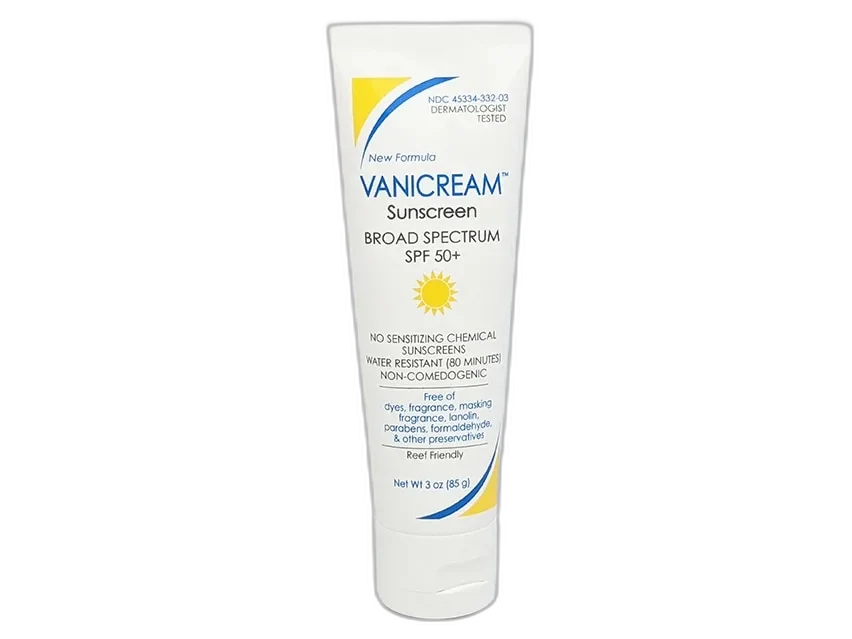
Mineral Sunscreen SPF 50+
Derm Office Staple
 Verified reviewer
Pros & cons.
- +Zinc-oxide-only formula with zero botanical extracts, fragrances, or preservatives
- +National Eczema Association Seal of Acceptance validates sensitive-skin safety
- +SPF 50+ with 80-minute water resistance — serious protection for outdoor activities
- +Allantoin provides additional soothing beyond zinc oxide's inherent anti-inflammatory properties
- +Approximately $16 for 3 oz — excellent value for a sensitive-skin mineral sunscreen
- +Developed by a pharmaceutical manufacturer with FDA inspection and 45+ years of dermatologist trust
- −Noticeable white cast that's significant on medium to deep skin tones
- −Thick texture requires warming and patience to apply evenly
- −Can feel drying and tight by midday without robust moisturizer underneath
- −Not cruelty-free certified, which may matter to some consumers
- −Cosmetic elegance is clearly secondary to formula safety — this won't feel luxurious
The full review.
Many people reach a point in their skincare where they stop seeking excitement and start seeking the least offensive option. This happens when over-exfoliation destroys the skin barrier, after a chemical peel, or when eczema makes everything sting. In these moments, dermatologists use Vanicream.
This sunscreen follows Vanicream’s founding philosophy: make products with the fewest possible ingredients that could cause a reaction. It contains no botanical extracts that act as potential allergens. There is no fragrance, not even ‘naturally derived’ ones. It uses self-preserving formulation technology instead of preservatives. There are no dyes or essential oils. It uses zinc oxide in a delivery vehicle designed to be invisible to your immune system.
The 12% zinc oxide provides SPF 50+ broad-spectrum protection. This concentration achieves higher SPF than many sunscreens using twice as much zinc because the formula optimizes particle dispersion. Zinc oxide is the gold standard mineral UV filter because it protects evenly across UVB, UVA II, and UVA I wavelengths without degrading in sunlight. For sensitive skin, its anti-inflammatory properties help calm the skin it protects.
The formula is unusual beyond its minimalism. Allantoin, an FDA-recognized skin protectant, provides more soothing than zinc oxide alone. Squalane—the stable, hydrogenated version, not squalene—adds lightweight emollience without comedogenic risk. The silicone crosspolymer helps zinc oxide particles disperse evenly and aids the set-and-wear behavior. These are the only functional skin-benefit ingredients; everything else is an emulsifier or vehicle component.
The National Eczema Association Seal of Acceptance requires a rigorous ingredient review to ensure the formula lacks common irritants and allergens. Vanicream earned this seal because this formula is genuinely stripped-back. If you usually count botanical extracts, essential oils, and fragrances on sunscreen labels, this ingredient list is a breath of fresh air.
The reality: this is not an elegant sunscreen. The texture is thick—noticeably thicker than most facial sunscreens. You must warm it between your palms before application, and spreading it evenly requires patience and technique. The white cast is present. On fair skin, it fades to a barely-there sheen within minutes. On medium-to-deep skin tones, it remains visible. This product trades cosmetic elegance for universal safety.
Some users report the sunscreen feels drying as the day progresses. While it contains squalane, the matte finish from zinc oxide and silicone can leave skin feeling tight, especially without moisturizer underneath. Using a good hydrating layer before application solves this, even if the product’s simplicity suggests you shouldn’t need it.
The water resistance is 80 minutes, the maximum allowed claim. This makes it suitable for outdoor activities, swimming, and sweating, where many sensitive-skin sunscreens fail. At approximately $16 for 3 ounces, it costs significantly less than comparable sensitive-skin mineral sunscreens from brands like EltaMD or La Roche-Posay.
Vanicream does not use before-and-after photos or influencer partnerships. They market in dermatology offices, where physicians give samples to patients with atopic dermatitis, contact allergies, and post-surgical skin. This product serves people for whom a sunscreen’s primary job is to not make things worse. It does that job better than almost anything else on the market.
Formula
Ingredient analysis.
Full INCI list
Active Ingredient: Zinc Oxide 12%. Inactive Ingredients: Allantoin, Butyloctyl Salicylate, C12-15 Alkyl Benzoate, Caprylyl Glycol, Dimethiconol/Propylsilsesquioxane/Silicate Crosspolymer, Glyceryl Behenate, Glyceryl Dibehenate, Glyceryl Stearate, Isodecyl Salicylate, Isopropyl Isostearate, Lecithin, Neopentyl Glycol Diheptanoate, 1,2-Hexanediol, Polyester-7, Polyglyceryl-3 Polyricinoleate, Propanediol, Silica Silylate, Sodium Chloride, Squalane, Tribehenin, Tridecyl Salicylate, Water
Skin match.
The science.
The Science
Zinc oxide provides well-characterized broad-spectrum UV protection. While organic (chemical) UV filters absorb UV radiation, zinc oxide reflects and scatters photons across the entire UV spectrum — UVB (290-320nm), UVA II (320-340nm), and UVA I (340-400nm). This uniform protection profile is unique; most chemical filters protect only specific wavelength ranges. A 2019 review in the Journal of the American Academy of Dermatology confirmed zinc oxide as one of only two mineral UV filters with established broad-spectrum efficacy.
The preservative-free formulation uses hurdle technology. Multiple factors individually do not prevent microbial growth, but together they create an environment hostile to bacteria, yeast, and mold. This includes controlled water activity, specific emulsifier selection, and the antimicrobial properties of some vehicle ingredients. This approach removes the need for traditional preservatives like parabens, phenoxyethanol, or methylisothiazolinone, which are common contact allergens in patch testing studies.
Allantoin's skin-soothing properties come from its long history in wound healing and dermatological applications. It promotes cell proliferation and reduces irritation from chemical and physical stressors. In a sunscreen context, allantoin addresses the background inflammation UV exposure causes even with adequate SPF protection.
The formula's 80-minute water resistance meets the FDA's highest allowable claim for sunscreens. This comes from combining water-insoluble zinc oxide particles with the silicone-based dispersion system that keeps the UV filter on the skin during water exposure.
Dermatologist Perspective
Vanicream Mineral Sunscreen is nearly unique in dermatological practice. It is the sunscreen recommended for the most sensitive patients — those with active eczema flares, contact dermatitis, multiple chemical sensitivities, or freshly treated skin. Board-certified dermatologists frequently prescribe this because it lacks the long list of potential irritants and allergens found in most commercial sunscreens. Dermatology practices often stock Vanicream products for post-procedure skin; patients often use this sunscreen first after laser treatments or surgical procedures. The National Eczema Association seal provides clinical validation that the formula meets established allergen and irritant standards.
Where it fits in your routine.
Squeeze a quarter-sized amount onto your palm and warm it between hands for 10-15 seconds. Press and pat onto the face and neck. Use thin layers instead of one thick layer. Apply at least 15 minutes before sun exposure. Reapply every 2 hours, or after swimming or heavy sweating. Applying over a hydrating moisturizer improves spreadability and reduces drying.
At approximately $16 for 3 ounces, Vanicream offers high value among sensitive-skin mineral sunscreens. EltaMD products cost $35-40 for similar sizes, and La Roche-Posay mineral options cost $30-35. The 3 oz tube provides nearly double the product of many facial sunscreens at half the price. Vanicream has a National Eczema Association seal and uses pharmaceutical-grade manufacturing standards.
People with sensitive, eczema-prone, or reactive skin who need a sunscreen that avoids irritation. It works for post-procedure sun protection, contact allergy patients, and anyone who reacted to multiple sunscreens.
People who want cosmetic elegance, no white cast, or have deeper skin tones where a cast is unacceptable will find this unsuitable. It also fails oily skin types needing a lightweight, non-drying formula.
Product details.
Thick, dense cream. Warm it between your palms before application. It spreads with effort but sets to a matte-ish finish. It is functional, not elegant.
No fragrance. This is a rare sunscreen with zero scent — it has no product smell.
White squeeze tube with a screw cap. Simple, functional, no-frills packaging matches the Vanicream brand aesthetic. The 3 oz size is large for a facial sunscreen.
The texture is thick. This is not a squeeze-and-spread sunscreen; warm it between palms and press it onto skin in sections. It leaves a white cast that varies by skin tone. It causes zero stinging or irritation, even on reactive skin. It sets to a slightly dry, matte-adjacent finish within a few minutes.
2-3 months with daily face and neck application
12 months
All Year
The backstory.
Vanicream was born when Rochester, Minnesota dermatologists asked two local pharmacists to create skincare products stripped of the allergens and irritants found in commercial products. That was 1975. This sunscreen continues that founding mission — it's designed for the patients whom everything else irritates. The 2021 reformulation improved the texture from the original version, though cosmetic elegance remains secondary to universal tolerance.
About Vanicream
Legacy Brand (20+ years)Rochester, Minnesota pharmacists developed Vanicream in 1975. They acted on dermatologist suggestions for better sensitive skin products. Pharmaceutical Specialties Inc. (PSI) is an FDA-inspected, licensed pharmaceutical manufacturer. This gives Vanicream clinical credibility rare among drugstore brands.
Common myths.
SPF 50+ mineral sunscreens need multiple UV filters
This formula reaches SPF 50+ using only 12% zinc oxide. Particle size optimization and dispersion technology drive this result—how evenly and densely the zinc oxide particles cover the skin matters as much as the raw concentration.
Preservative-free means the product spoils quickly
Vanicream uses a self-preserving formulation strategy — the combination of specific ingredients and the formula's water activity level create an environment hostile to microbial growth without traditional preservatives like parabens or phenoxyethanol.
What the community says.
"Dermatologist-recommended and genuinely gentle on reactive skin"
"No fragrance, no botanicals — truly free of irritants"
"Excellent water resistance for outdoor activities"
"Affordable compared to other sensitive-skin sunscreens"
"Noticeable white cast, especially on medium to deep skin tones"
"Thick texture can feel drying as the day progresses"
"Skin feels tight by midday without adequate moisturizer underneath"
"Difficult to spread evenly without warming between hands first"
People also looked at.