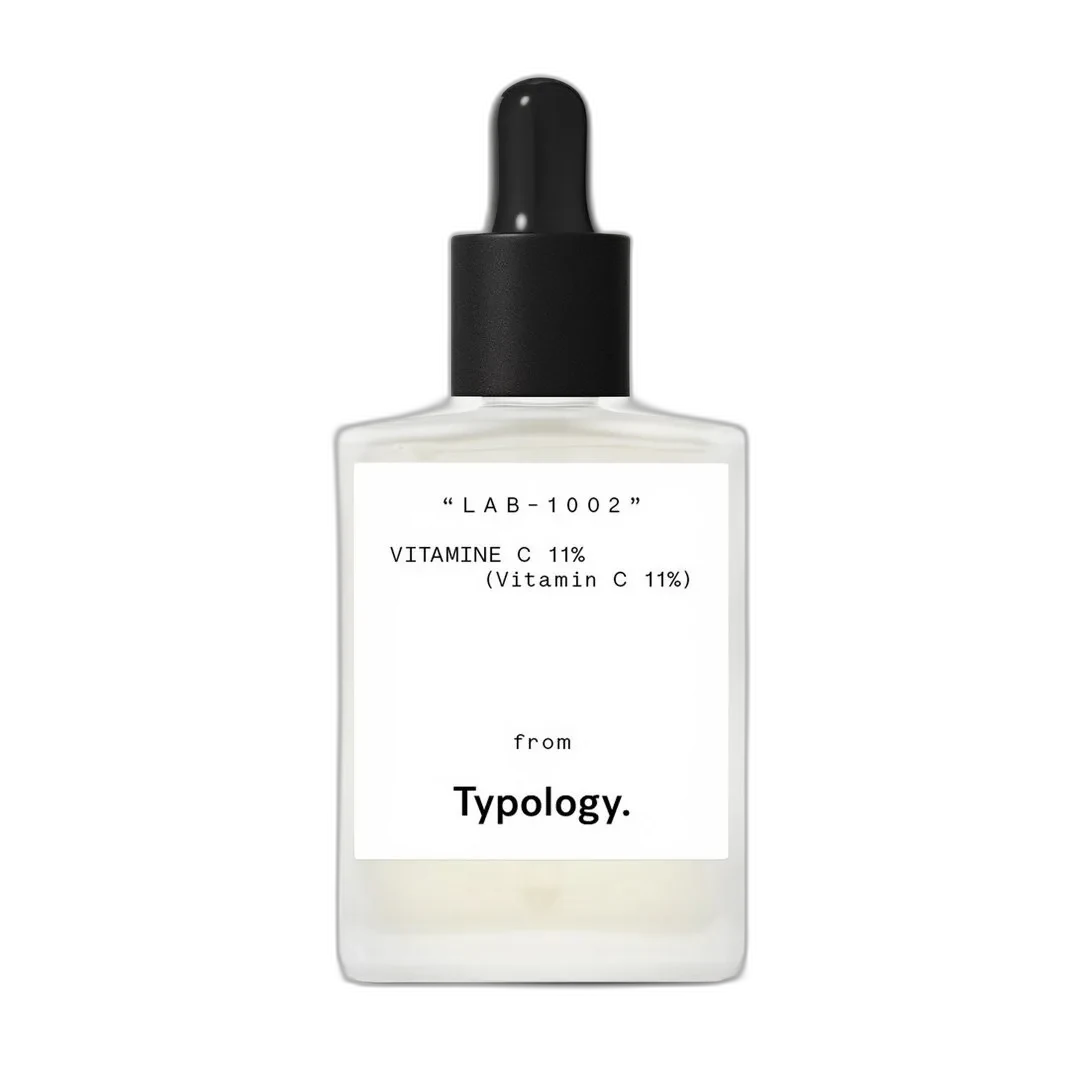
Vitamin C Serum 11%
Vitamin C for Acne-Prone Skin
 Verified reviewer
Pros & cons.
- +11% sodium ascorbyl phosphate has documented anti-acne effects
- +Near-neutral pH eliminates stinging and flushing
- +Stable formulation that doesn't oxidize quickly
- +Pairs cleanly with niacinamide, BHA, and retinoids
- +Fragrance-free, fungal-acne safe, pregnancy-safe
- +Phytic acid and silk tree extract add layered brightening
- +Suitable for sensitive and reactive skin
- −Less potent than L-ascorbic acid for hyperpigmentation
- −Sodium benzoate may bother extremely sensitive skin
- −Slower brightening timeline than L-AA serums
- −Not the strongest pick for stubborn melasma or deep marks
The full review.
About Typology
Ning Li, the founder of Made.com, launched Typology in 2019 to bring French-pharmacy minimalism to direct-to-consumer skincare.
Myth
Ask ten people to name a vitamin C serum and they’ll all describe the same product — a low-pH L-ascorbic acid formula that stings on application, oxidizes quickly in the bottle, and is the gold standard for brightening dull skin and fading dark spots.
Reality
That product exists, it works for the right user, and brands like SkinCeuticals built their reputation on a properly formulated version of it. But the consumer conversation about vitamin C misses a fact: sodium ascorbyl phosphate is another form of vitamin C, and unlike L-ascorbic acid, it has published clinical data for treating active acne. Multiple studies show that topical 5-10% SAP reduces inflammatory acne lesion counts, partly through direct antibacterial action against Cutibacterium acnes and partly through other mechanisms still being characterized. No other common vitamin C derivative has this acne-specific evidence. Almost nobody talks about it.
Texture
The serum is a thin water-gel that absorbs in seconds without residue or tackiness.
Scent
There is no fragrance to mask or compete with, and no nutty undertone like the brand’s hazelnut-based bakuchiol serum.
Packaging
The whole catalog uses short ingredient lists, transparent labeling, and active doses at the upper end of what is useful rather than inflated for marketing. The 11% SAP serum follows this approach — high enough to be clinically meaningful, low enough to remain gentle, and free of the fragrances and fillers that complicate most vitamin C formulations.
Best for
This serum is a more thoughtful choice than the brand’s 15% version for oily, combination, and normal skin dealing with both active breakouts and dullness or post-acne marks — a common skin concern combination in adults with hormonal acne. It is not the gold-standard L-AA option for pigmentation correction, but it is one of the only vitamin C serums on the market that earns a place in an acne-focused routine.
Works for
For anyone who found L-AA serums uncomfortable, this is the alternative that feels good to use every morning.
Not ideal for
SAP is less potent than L-ascorbic acid for brightening — if your primary concern is significant melasma, deep sun damage, or established hyperpigmentation, a properly formulated 15% L-AA serum works faster and reaches further. The brightening ceiling is real.
Common Praise
The brightening effect is gradual and gentle — expect subtle radiance improvements within two weeks, more visible tone evening at six to eight weeks, and meaningful fading of mild post-inflammatory hyperpigmentation by twelve weeks. The acne-related effects appear faster. Most users notice fewer new breakouts within three to four weeks, less inflammation in active lesions, and reduced post-acne mark formation. The combination of SAP’s antibacterial action, the gentle exfoliating effect of phytic acid, and the absence of pore-clogging ingredients makes this one of the more thoughtful vitamin C serums for breakout-prone skin.
Common Complaints
The sodium benzoate in the preservative system can occasionally bother reactive skin, though it is a well-tolerated cosmetic preservative for most users. While the formulation is clean, it is not as minimalist as Typology’s three-ingredient oil serums.
Pairs Well With
SAP layers cleanly with niacinamide, salicylic acid, retinoids, and benzoyl peroxide without pH conflicts or stability issues. No oils, fatty alcohols, or silicones interfere with active treatments layered above it. Fungal-acne sufferers can use it without triggering Malassezia. Sensitive skin tolerates it where L-AA causes flushing. It is as universally compatible as a vitamin C serum gets.
Conflicts With
N/A
AM routine
Application is uneventful. The serum is a thin water-gel that absorbs in seconds without residue or tackiness. There is no tingling, warmth, or flushing — sodium ascorbyl phosphate works at a near-neutral pH around 6.5, which is closer to skin’s natural pH than the 3.0 needed for L-ascorbic acid.
PM routine
N/A
Ingredient analysis.
Full INCI list · pH 6.5
Aqua/Water, Sodium Ascorbyl Phosphate, Propanediol, Albizia Julibrissin Bark Extract, Glycerin, Citric Acid, 1,2-Hexanediol, Caprylyl Glycol, Xanthan Gum, Carrageenan, Evodia Rutaecarpa Fruit Extract, Phytic Acid, Sodium Benzoate, Tropolone
Skin match.
The science.
The Science
Sodium ascorbyl phosphate (SAP) is a phosphate ester of ascorbic acid. It converts to L-ascorbic acid in the skin through enzymatic hydrolysis. Unlike pure L-AA, SAP stays stable at near-neutral pH and resists oxidation in the bottle, avoiding the stability issues common in most vitamin C formulations. A 2008 study in the Journal of Cosmetic Science by Klock et al. shows that 5% SAP reduces inflammatory acne lesions over twelve weeks of treatment. The authors link this to antibacterial activity against Cutibacterium acnes and reduced inflammatory cytokines. This anti-acne activity is mostly unique to SAP among common vitamin C derivatives. The 11% concentration in this serum exceeds the 5% range generally studied as the minimum dose. Phytic acid in the formulation adds brightening by chelating free metal ions in melanogenesis and helps protect the vitamin C from oxidation. Albizia julibrissin bark extract inhibits advanced glycation end products in the skin, which cause the yellow-sallow tone in photoaged skin, though independent clinical data is limited. The minimal preservative system avoids parabens and methylisothiazolinones that can sensitize skin. Removing fragrance, essential oils, and fatty alcohols reduces irritation variables. Compared to a properly formulated 15% L-ascorbic acid + ferulic acid serum, this formulation is less potent for pure brightening but offers documented anti-acne effects.
References
- Sodium ascorbyl phosphate shows in vitro and in vivo efficacy in the prevention and treatment of acne vulgaris — International Journal of Cosmetic Science (2008)
Dermatologist Perspective
Dermatologists recognize sodium ascorbyl phosphate as one of the few vitamin C derivatives with published evidence for treating active acne, alongside its antioxidant and brightening effects. Board-certified dermatologists note that SAP's stability at near-neutral pH makes it a more comfortable option for sensitive or breakout-prone patients who cannot tolerate L-ascorbic acid serums. The 11% concentration in this serum exceeds the minimum studied effective dose. Dermatologists generally regard L-ascorbic acid as more potent for established hyperpigmentation, sun damage, and melasma, so they likely recommend SAP-based serums for patients with concurrent acne or L-AA sensitivity. The clean preservative system and absence of fragrance make this serum a frequent recommendation for patients with multiple sensitivities.
Guidance
Where it fits in your routine.
Apply to clean skin in the morning. Press three to four drops into the face and neck after cleansing. Use moisturizer and SPF 50 next — vitamin C works best with sunscreen for layered photoprotection. It is compatible with niacinamide, salicylic acid, retinoids, and most other actives. Storage is easy; SAP does not need refrigeration or special handling and stays stable through the full PAO.
At $30 for 30ml, this serum costs mid-market for derivative-based vitamin C — slightly less than Typology's 15% version and much less than department-store SAP serums. Daily morning use lasts about three to four months, costing roughly $8-10 per month for a clinically meaningful 11% concentration in a clean formula. This specific formulation has no larger sizes available. Value depends on your goal: as a vitamin C with anti-acne benefits, it is well-priced; as a pure brightening serum, it competes with cheaper L-AA alternatives that work faster on pigmentation.
Oily, combination, and normal skin types with active breakouts, dullness, or post-acne marks use this. It suits sensitive skin that cannot tolerate L-ascorbic acid and anyone wanting a vitamin C serum for an acne-focused routine.
Use a properly formulated L-ascorbic acid serum or prescription tyrosinase inhibitor for stubborn hyperpigmentation, melasma, or deep sun damage. Skip this if you want the most potent brightening option and tolerate L-AA without irritation.
Product details.
Lightweight water serum that absorbs quickly with no residue.
Completely fragrance-free.
Amber glass dropper bottle in Typology's minimalist apothecary style.
The SAP-based formula has a near-neutral pH and causes no tingling or warmth on application. It is gentle from day one. Subtle radiance shows within two weeks; acne-targeting effects build over four to six weeks of consistent use.
About 3-4 months with daily morning use.
6 months
All Year
The backstory.
Typology launched the 11% Radiance Serum in 2020 as its original vitamin C formulation, choosing sodium ascorbyl phosphate specifically for its stability advantages and the published research on its anti-acne effects. The brand later expanded the line with a 15% dual-derivative version, but the SAP-based serum remains a distinct option for breakout-prone users.
About Typology
Emerging Brand (2–5 years)Typology launched in 2019 as a French direct-to-consumer brand focused on minimalist active formulas. The 11% Radiance Serum predates the current 15% complex version and shows the brand's preference for stable derivatives over L-ascorbic acid.
Common myths.
All vitamin C serums work the same way.
Vitamin C forms work through different mechanisms. Sodium ascorbyl phosphate targets acne bacteria and sebum production, a benefit L-ascorbic acid and most other derivatives lack.
Vitamin C makes acne worse because it's an acid.
SAP at a near-neutral pH is a gentle form of vitamin C and shows acne improvement in studies. Acidity concerns mostly apply to L-ascorbic acid at pH 3.
FAQ.
How does Typology's 11% serum differ from the 15% version?
The 11% uses sodium ascorbyl phosphate, which has documented anti-acne effects and is gentler. The 15% version uses ethyl ascorbic acid and ascorbyl glucoside for stronger brightening. The 11% is better for breakout-prone skin; the 15% is better for general antioxidant defense and tone.
Does sodium ascorbyl phosphate actually help acne?
Yes — multiple published studies show 5-10% SAP reduces acne lesion counts and inflammation. It works via direct antibacterial action against C. acnes. It is one of the few vitamin C forms with this benefit.
Can I use this with niacinamide?
Yes — they pair well. Niacinamide regulates sebum and reduces marks; SAP targets bacteria and brightens. Use them in the same morning routine without conflict.
Is it safe during pregnancy?
Yes — sodium ascorbyl phosphate is pregnancy-safe, as is the rest of the formula.
Will this serum oxidize and turn brown?
SAP costs far less than L-ascorbic acid serums. SAP is a highly stable vitamin C form and stays active in standard amber glass packaging through the full PAO.
Should I use this morning or night?
Morning is best. Vitamin C provides daytime antioxidant defense against UV-generated free radicals and works with sunscreen as a layered photoprotection strategy.
Will it help fade post-acne marks?
Yes, gradually. SAP and phytic acid fade mild post-inflammatory hyperpigmentation in 8-12 weeks. Deeper or older marks require stronger treatment.
Community
What the community says.
"No stinging or burning"
"Helps with breakouts and brightness"
"Stable and doesn't oxidize"
"Clean ingredient list"
"Slower brightening than L-AA serums"
"Sodium benzoate may bother very reactive skin"
People also looked at.