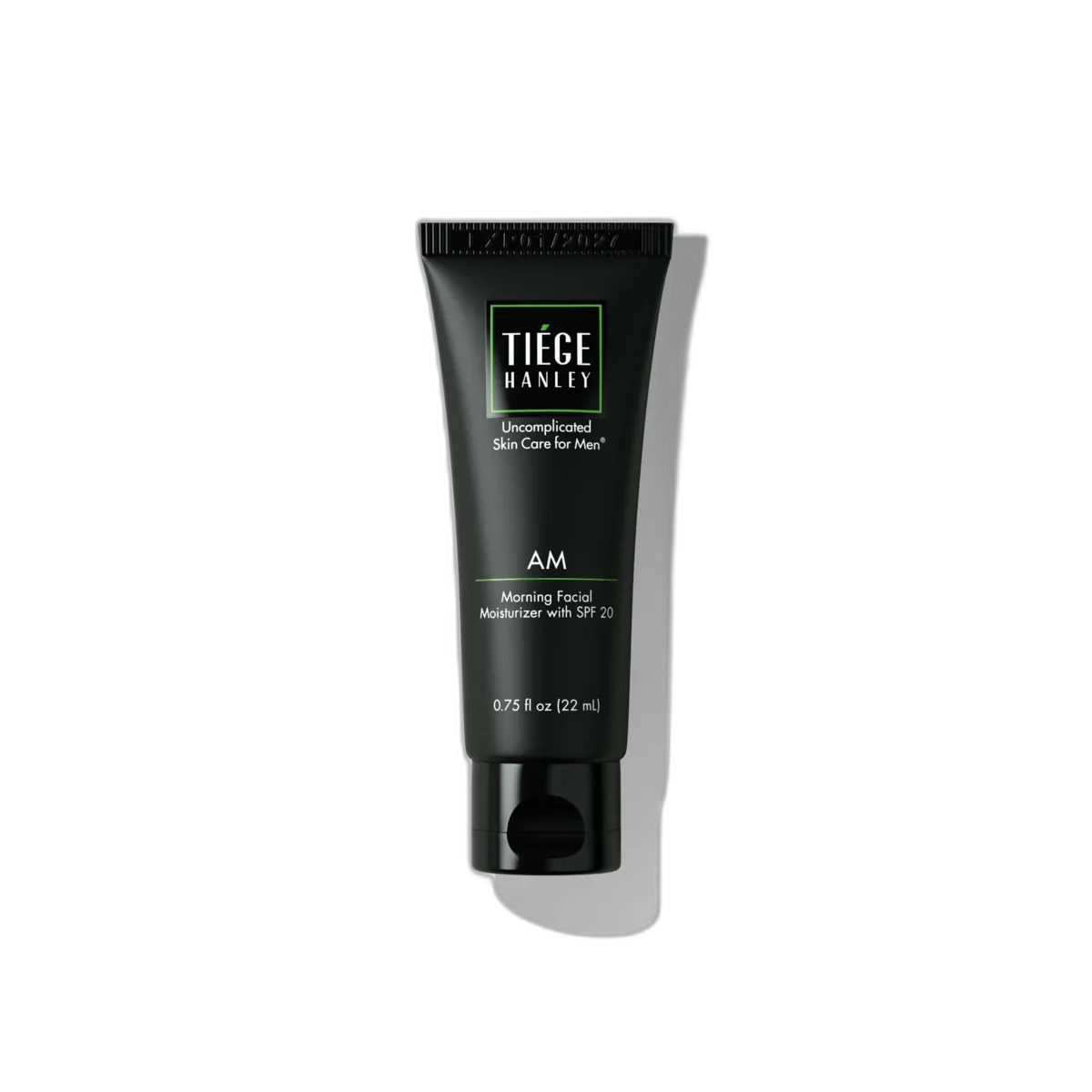
AM Moisturizer with SPF 20
Beginner-Friendly Pick
 Verified reviewer
Pros & cons.
- +Lightweight, matte finish that feels invisible — eliminates the primary reason men avoid SPF
- +Zero white cast from chemical sunscreen filters works on all skin tones
- +Absorbs in seconds, creating no friction in a minimal morning routine
- +Combines moisturizer and SPF in one step, reducing barrier to daily use
- +Subscription pricing at $27.20 offers reasonable value for a combined product
- +Glycerin provides reliable, proven hydration throughout the day
- +Cruelty-free certification aligns with ethical purchasing preferences
- −SPF 20 falls below the dermatologist-recommended minimum of SPF 30
- −Lavender and rosemary essential oils add irritation risk with no skincare benefit
- −No advanced skincare actives — glycerin and silicone are the entire moisturizing story
- −Marketed key ingredients like calendula appear at likely trace concentrations
- −Contains octinoxate, a chemical filter with environmental concerns regarding coral reefs
- −Premium pricing for a basic formulation — comparable drugstore options cost significantly less
The full review.
Aaron Marino built a YouTube empire teaching millions of men that caring about your appearance is not a character flaw. When he co-founded Tiege Hanley, the brand’s entire thesis was behavioral: men will do skincare if you make it simple enough. The AM Moisturizer with SPF 20 is perhaps the purest expression of that philosophy — a single product that answers two questions at once, because asking the average man to apply both a moisturizer and a sunscreen is apparently a bridge too far.
And honestly? For that specific purpose, this product works. The texture is genuinely impressive for a combination SPF moisturizer. It goes on lightweight, absorbs in seconds, leaves zero white cast, and finishes matte. If your previous experience with sunscreen involved a thick, greasy, ghost-face-inducing cream that made you look like you were auditioning for a mime troupe, this will feel like a revelation. The cyclopentasiloxane base gives it that effortless silicone slip, and the overall experience is closer to wearing nothing than wearing sunscreen.
The SPF system uses three chemical filters: octinoxate at 5.5% handles the UVB side, avobenzone at 2.2% covers UVA, and octocrylene at 2.0% plays a dual role as both a UVB absorber and a stabilizer for the notoriously photolabile avobenzone. This is a well-understood sunscreen chemistry combination that has been used for decades. It works. The question is whether SPF 20 is enough.
The honest answer is: it depends on your life. For a man whose daily sun exposure consists of walking to his car, sitting in an office, and walking back to his car, SPF 20 provides meaningful protection. It blocks roughly 95% of UVB rays, which is nothing to dismiss. But dermatologists universally recommend SPF 30 as the minimum daily protection, and SPF 20 falls measurably short of that standard. If you spend any significant time outdoors — weekend hikes, outdoor lunches, coaching your kid’s soccer practice — you need something stronger. Tiege Hanley chose SPF 20 because higher SPF formulations are harder to make lightweight and matte, and they knew their audience would reject anything that felt heavy. It is a calculated compromise between ideal protection and real-world compliance.
The moisturizing component is simple: glycerin does the hydrating, the silicone base seals it in, and that is essentially the story. Glycerin is a proven, effective humectant — no complaints there. But if you are looking for sophisticated skincare actives, you will not find them here. There are no peptides, no niacinamide, no vitamin C, no hyaluronic acid. Calendula flower extract and plantain leaf extract appear near the bottom of the INCI list, almost certainly at concentrations too low to deliver meaningful benefits. The Dermatology Review has noted this pattern across Tiege Hanley products — ingredients that are highlighted in marketing but present at trace levels.
The inclusion of lavender oil and rosemary leaf oil is the formula’s most puzzling choice. Both are known skin sensitizers with no meaningful skincare benefit at cosmetic concentrations. They add a subtle herbal scent, which is pleasant, but fragrance could have been achieved without using essential oils that dermatologists routinely flag as irritation risks. For a product marketed as safe for sensitive skin, this is a contradiction.
In terms of daily use, the moisturizer performs adequately. It keeps skin feeling hydrated without midday oiliness, the matte finish persists for several hours, and it does not pill or separate under other products unless you layer aggressively. The 2.5-ounce tube lasts roughly two to three months with daily use, making the per-day cost around thirty-five to fifty cents — reasonable for a combined moisturizer and SPF.
The value question gets more complicated when you zoom out. At thirty-two dollars standalone (or twenty-seven dollars on subscription), this is not a budget product. Comparable SPF moisturizers from drugstore brands offer similar or better formulations — often with higher SPF, more hydrating ingredients, and no essential oils — at half the price. What Tiege Hanley charges a premium for is not ingredients. It is the system, the simplicity, and the masculine-coded branding that makes men feel comfortable buying skincare.
And there is genuine value in that behavioral nudge. A thirty-two-dollar SPF moisturizer that a man actually uses every day provides infinitely more sun protection than a fifteen-dollar one that sits in a drawer because the packaging felt too feminine or the routine felt too complicated. Tiege Hanley understands its audience deeply — these are not skincare enthusiasts comparison-shopping INCI lists. These are men taking their first step toward not ignoring their face.
As a product evaluated on its ingredients alone, this is a C-plus moisturizer with suboptimal SPF and unnecessary essential oils. As a behavioral intervention that gets a historically sunscreen-resistant demographic to wear daily sun protection, it is quietly effective. The question is which lens matters more to you.
Formula
Ingredient analysis.
Full INCI list
Active Ingredients: Octinoxate 5.5%, Avobenzone 2.2%, Octocrylene 2.0%. Inactive Ingredients: Aqua, Isodecyl Neopentanoate, Cyclopentasiloxane, Bis-PEG-12 Dimethicone Beeswax, Glycerin, Glyceryl Stearate, PEG-100 Stearate, Phenoxyethanol, Caprylyl Glycol, Sodium Hydroxide, Hydroxypropyl Starch Phosphate, C18-38 Alkyl Hydroxystearoyl Stearate, Sodium Acrylate/Sodium Acryloyldimethyl Taurate Copolymer, Isohexadecane, Polysorbate 80, Calendula Officinalis Flower Extract, Plantago Major Leaf Extract, Carbomer, Disodium EDTA, Lavandula Officinalis (Lavender) Oil, Rosmarinus Officinalis (Rosemary) Leaf Oil
Skin match.
The science.
The Science
This formula uses three well-characterized chemical UV filters. Avobenzone (butyl methoxydibenzoylmethane) at 2.2% provides broad UVA protection, absorbing in the 310-400nm range linked to photoaging and melanoma risk. Avobenzone is photolabile; it degrades quickly under UV light and loses up to 90% of its protection within an hour without stabilization. Octocrylene at 2.0% acts as a UVB absorber and photostabilizer for avobenzone, a pairing proven in multiple photostability studies.
Octinoxate (ethylhexyl methoxycinnamate) at 5.5% is the main UVB filter, absorbing in the 280-320nm range. Octinoxate faces scrutiny for potential endocrine-disrupting properties. A 2019 FDA study in JAMA found that octinoxate absorbs through the skin at levels above the FDA's threshold, though researchers are still investigating the clinical significance. Hawaii and Key West banned octinoxate in sunscreens to protect coral reefs from bleaching.
Regarding SPF level, a 2012 analysis in the Journal of the American Academy of Dermatology shows SPF 15 blocks about 93% of UVB rays, SPF 30 blocks 97%, and SPF 50 blocks 98%. The gap between SPF 20 and SPF 30 is small in labs but matters more in real-world use, as most people apply less than the tested 2 mg/cm². Under-application lowers the real-world SPF, so a higher labeled SPF provides a useful safety margin.
References
- Effect of Sunscreen Application Under Maximal Use Conditions on Plasma Concentration of Sunscreen Active Ingredients — JAMA (2019)
Dermatologist Perspective
Board-certified dermatologists agree any SPF is better than none, but they recommend SPF 30 as the daily minimum. The chemical filter combination in this product — avobenzone stabilized by octocrylene, plus octinoxate — provides broad-spectrum protection, though at a lower level than dermatologists ideally prescribe. Dermatologists often worry about lavender oil and rosemary oil in skincare, as both contain compounds (linalool, 1,8-cineole) that can cause contact sensitization through repeated daily use. For men who would otherwise wear no sun protection, dermatologists generally see a product like this as a net positive — consistent, imperfect protection beats perfect protection left unused in a medicine cabinet.
Where it fits in your routine.
Apply a nickel-sized amount to clean, dry skin every morning after washing your face. Spread it evenly over your forehead, nose, cheeks, chin, and neck. Wait one minute for absorption before applying other products. Use daily, even on cloudy days or when staying indoors, because UVA rays penetrate windows and clouds. Reapply this product or layer a dedicated SPF 30+ sunscreen on top if you stay outdoors for more than two hours.
At $32 standalone or $27.20 on subscription, this is priced at a premium relative to its ingredient quality. Comparable SPF moisturizers from CeraVe, Cetaphil, and Neutrogena offer SPF 30, more hydrating actives (niacinamide, hyaluronic acid, ceramides), and fragrance-free formulations at $12-18. The premium buys you the Tiege Hanley system experience, the masculine branding, and the behavioral nudge of a simplified routine. For men who would not otherwise buy skincare, that premium may be worth paying. For ingredient-savvy consumers, the value proposition is thin.
Men new to skincare wanting a simple morning routine — wash face, apply this, done — will find this ideal. It works for those who avoid sunscreen due to greasiness, white cast, or complex multi-step routines. If the goal is daily SPF, this removes every excuse.
Consumers seeking SPF 30+ protection and active ingredients in a moisturizer can find better options for less. People with sensitive or reactive skin should avoid the lavender and rosemary essential oils. Anyone with extended daily sun exposure needs a higher SPF product for primary protection.
Product details.
This lightweight, fast-absorbing lotion has a silicone-smooth finish. It leaves no white cast and makes skin feel matte, not greasy.
Lavender and rosemary essential oils provide a subtle herbal scent. It is present but not overpowering.
Tiege Hanley uses a simple squeeze tube in its minimalist packaging. The functional, masculine-coded design fits the brand's target demographic.
It applies smoothly and absorbs in seconds. There is no white cast or heavy sunscreen feel. Skin feels hydrated but not oily—an effortless finish that gets sunscreen-resistant men to use it daily. The lavender-rosemary scent is subtle and fades fast.
2-3 months with daily morning use
12 months
All Year
The backstory.
Tiege Hanley was built on the insight that most men do not avoid skincare because they do not care, but because the multi-step routines and overwhelming product options feel inaccessible. Co-founded with YouTube creator Aaron Marino, the brand designed system-based routines where each product has a clear role. The AM Moisturizer exists to answer a single question: what do I put on my face in the morning? By bundling hydration and sun protection into one step, it reduces the barrier to entry for the demographic least likely to wear daily SPF.
About Tiege Hanley
Established Brand (5–20 years)Kelley Thornton and Rob Hoxie co-founded Tiege Hanley in 2016, alongside co-founder and brand ambassador Aaron Marino (Alpha M.). The brand uses system-based routines to simplify men's skincare. While men new to skincare like the brand, independent dermatological reviewers note that some marketed 'key' ingredients have very low concentrations.
Common myths.
SPF 20 provides adequate daily sun protection.
Dermatologists recommend SPF 30 as the daily minimum. SPF 20 blocks about 95% of UVB rays, while SPF 30 blocks 97%. SPF 20 provides reasonable protection for brief incidental exposure like commuting or quick errands. It falls short for extended outdoor time. This product is better than no sunscreen, but it is not your only SPF for a day at the beach.
Men's skin needs different ingredients than women's skin.
Men's skin is often thicker and produces more sebum because of higher testosterone levels, but the core ingredients that hydrate, protect, and repair skin work the same for all genders. This moisturizer's formulation is not unique to male skin — the brand just uses packaging and marketing to reach men who avoid traditionally feminine-coded brands.
FAQ.
Is Tiege Hanley AM Moisturizer SPF 20 enough sun protection?
SPF 20 gives about 95% UVB protection. This works for short daily exposure like commuting or running errands. Dermatologists recommend SPF 30 as the minimum standard. Use a dedicated SPF 30+ sunscreen over or instead of this product for extended outdoor activities.
Can I use Tiege Hanley AM Moisturizer if I have sensitive skin?
This formula contains lavender oil and rosemary leaf oil, both known skin sensitizers. It uses avobenzone and octinoxate as chemical sunscreen filters, which some sensitive skin types react to. If you have reactive skin, patch test on your jawline for a few days before daily use.
Is Tiege Hanley AM Moisturizer worth the price?
At $32 for 2.5 oz ($27.20 on subscription), the price is moderate for a combined moisturizer-SPF. The formula is functional and basic, using glycerin for hydration, chemical SPF filters, and a silicone base. Comparable drugstore SPF moisturizers have similar ingredient quality for less money, but Tiege Hanley works because its simple system gets men who skip SPF to use it.
Does Tiege Hanley AM Moisturizer leave a white cast?
No — this product uses chemical sunscreen filters (avobenzone, octinoxate, octocrylene) instead of physical/mineral filters. Chemical filters absorb UV rays instead of reflecting them. They apply transparently and leave no white cast on any skin tone.
Can women use Tiege Hanley AM Moisturizer?
The formulation is not gender-specific. Glycerin, chemical SPF filters, and silicones work the same on all skin regardless of gender. Only the packaging and marketing differ. If the formula suits your skin type and SPF 20 meets your daily protection needs, it works for anyone.
What the community says.
"Lightweight and non-greasy texture appeals to men who dislike heavy moisturizers"
"Simple routine integration — one product covers moisturizer and SPF"
"Absorbs quickly without white cast"
"Pleasant, subtle scent"
"Good entry point for men starting a skincare routine"
"SPF 20 is below dermatologist-recommended SPF 30 minimum"
"Price is high for the ingredient quality when purchased standalone"
"Some users report it can pill under other products"
"Lavender oil can irritate sensitive skin"
"Contains controversial sunscreen filter octinoxate"
People also looked at.