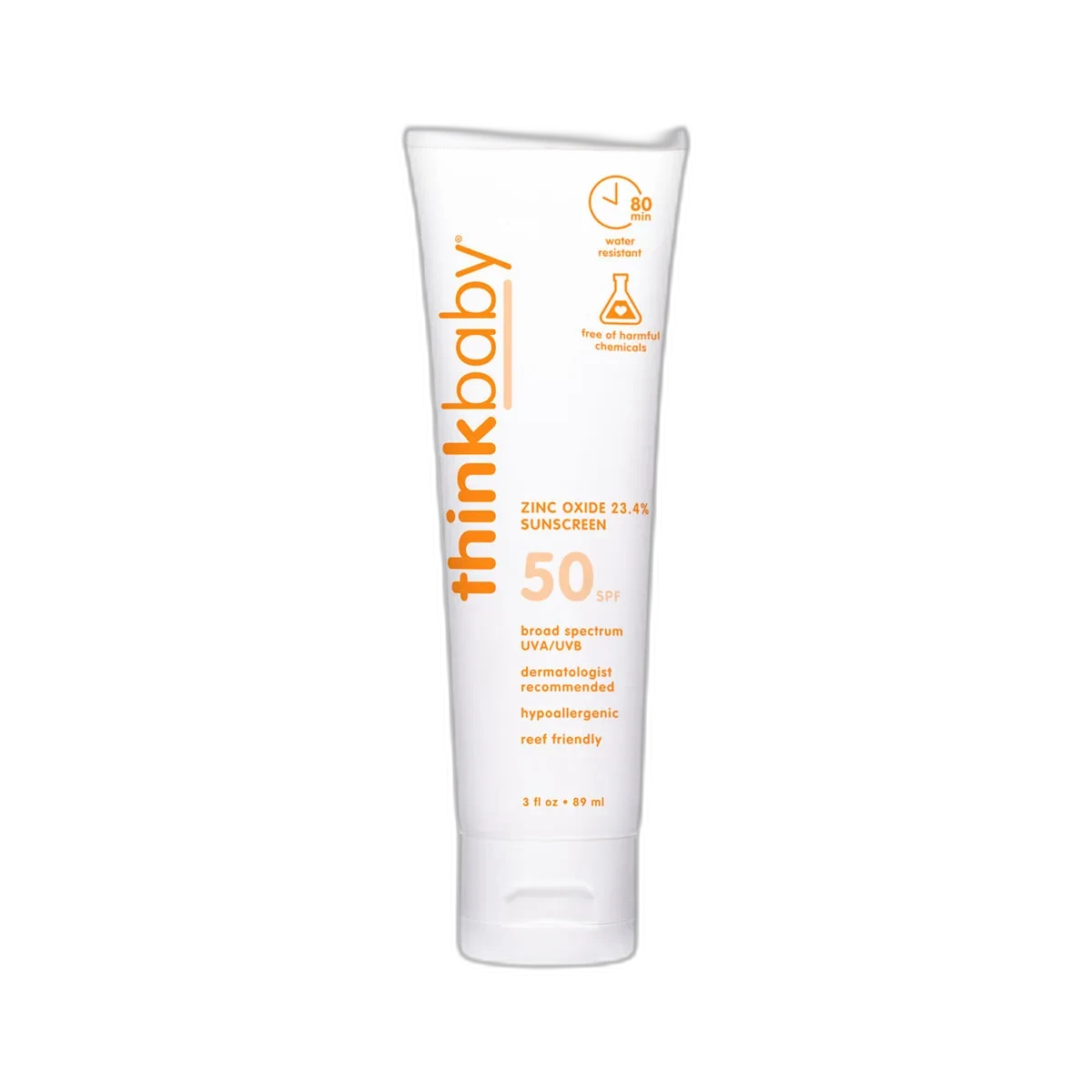
Safe Sunscreen SPF 50+
Parent-Trusted Body SPF
 Verified reviewer
Pros & cons.
- +20% zinc oxide delivers strong broad-spectrum SPF 50+ protection
- +80-minute water resistance holds up in real swimming and sweating
- +Completely fragrance-free with a clean, sensitive-skin-friendly inactive list
- +Reef-safe — no oxybenzone or octinoxate
- +Pediatrician and dermatologist trusted for over a decade
- +Pregnancy and breastfeeding safe
- +Excellent value at $12 for 3oz
- +Repeatedly independently tested by Consumer Reports and EWG
- −Visible white cast on medium and deep skin tones
- −Thick texture requires deliberate massage to apply
- −Olive oil content may not suit acne-prone face users
- −Better suited to body than face — use the Everyday Face version for daily facial wear
- −Tube format isn't the most convenient for travel
The full review.
When Kevin Brodwick started Thinkbaby in 2008, the American sunscreen market was bifurcated in a way that frustrated him. On one side were the chemical sunscreens — cosmetically elegant, lightweight, easy to apply, but full of UV filters whose long-term safety profiles were the subject of ongoing debate and increasingly contentious environmental concerns about coral reef damage. On the other side were the mineral sunscreens — clinically appealing on paper, with zinc oxide and titanium dioxide as the active ingredients, but in practice almost universally formulated with fragrance, parabens, or other inactive ingredients that defeated the whole point for parents trying to put something genuinely clean on their children’s skin. There wasn’t a third option. So Brodwick made one. The Safe Sunscreen SPF 50+ launched as Thinkbaby’s flagship product and immediately became something the existing market hadn’t really seen: a high-SPF, water-resistant, fragrance-free, mineral-only sunscreen that didn’t ask you to compromise on either protection or ingredient quality. The fact that it became the first sunscreen ever to pass Whole Foods Premium Body Care criteria wasn’t a marketing achievement — it was a signal that the standard had been raised.
A decade and a half later, the formula is essentially unchanged, which tells you something. In a market that churns through sunscreen launches every season, the Thinkbaby Safe Sunscreen has held its position not through clever rebrands or texture upgrades but through the simple persistence of a formulation that does what it claims. The active ingredient is twenty percent zinc oxide, the high end of what’s commonly used in mineral sunscreens, and the inactive list is built around aloe vera, sunflower and olive oils, methylpropanediol, glycerin, vitamin E, and vitamin C. There’s no fragrance. There are no chemical UV filters. The water resistance carries the maximum eighty-minute label permitted by the FDA, which holds up in real swimming and sweating conditions. For body use during outdoor activities, vacations, and the daily summer life of children and adults with sensitive skin, this is one of the most defensible sunscreens you can put on.
Application is the part that requires patience. The lotion comes out of the tube thick and white, and it takes deliberate massage to spread it evenly across body skin. Most users learn to apply it in sections — one arm, one leg, the chest, the back — rather than trying to cover everything at once. The white cast is honest and visible, especially on medium and deep skin tones, and the brand has never pretended otherwise. For body use on a beach day or at the pool, this typically isn’t a meaningful problem. For face use, it’s why Thinkbaby eventually launched a separate Everyday Face version with a slightly refined texture. The water resistance, once the formula has set on the skin for the recommended fifteen minutes before sun exposure, holds up in actual water — not just FDA-test water but real ocean swims and sweaty hikes. Reapplication every eighty minutes during water exposure is non-negotiable, and reapplication after toweling off is necessary regardless of what the label says about water resistance.
The sensitive-skin credentials are the other thing that has kept this product on shelves for so long. The fragrance-free formulation, the absence of chemical UV filters, and the soothing aloe and vitamin E content make it one of the few sunscreens that pediatricians and dermatologists routinely recommend for infants over six months, eczema-prone children, post-procedure adult skin, and pregnancy use. The brand has been independently tested repeatedly by Consumer Reports and EWG, and while the test results have varied across years and methodologies, the product has consistently held up as one of the better mineral options on standardized testing. The community trust around this brand is real and earned, and it accounts for much of the loyalty the product enjoys despite its cosmetic limitations.
The value is excellent. Twelve dollars for three ounces is genuinely cheap for the quality of formulation here, especially considering the fragrance-free, water-resistant, high-zinc profile. There are larger sizes available for families that go through sunscreen quickly during summer. The brand also offers spray and stick formats of essentially the same formulation for users who prefer alternative application methods, though the spray version has slightly different inactive ingredients and the stick is best suited to focused application on the face and ears. The lotion remains the original and the most universally recommended format.
This sunscreen belongs in the bag of any family with young children, anyone with sensitive or reactive body skin, anyone who prioritizes mineral-only and fragrance-free formulations, anyone planning extended outdoor activity who needs reliable water resistance, and anyone who has tried other mineral sunscreens and reacted to one ingredient or another. It does not belong in the routine of someone who needs an invisible finish on medium or deep skin tones, or someone who needs a sunscreen that wears smoothly under daily makeup. For its intended audience, it remains one of the most justifiable picks in the entire sunscreen category. Fifteen years of consistent quality is a hard track record to argue with.
Ingredient analysis.
Full INCI list
Active: Zinc Oxide 20%. Inactive: Water, Aloe Barbadensis Leaf Juice, Methylpropanediol, Glycerin, Caprylic/Capric Triglyceride, Cetyl Dimethicone, Helianthus Annuus (Sunflower) Seed Oil, Olea Europaea (Olive) Fruit Oil, Cetearyl Olivate, Sorbitan Olivate, Magnesium Sulfate, Glyceryl Stearate, Tocopherol (Vitamin E), Hydrogenated Methyl Abietate, Sodium Chloride, Hydrogenated Castor Oil, Cetyl Alcohol, Lauryl Lysine, Ascorbic Acid (Vitamin C), Raspberry Seed Oil, Cranberry Seed Oil, Sodium Gluconate, Glyceryl Caprylate, Glyceryl Undecylenate, p-Anisic Acid
Skin match.
The science.
The Science
Zinc oxide is the only single-ingredient active ingredient the FDA approves for true broad-spectrum UVA and UVB protection without extra chemical UV filters. This product uses a 20% concentration, which sits at the high end for mineral sunscreens; most over-the-counter mineral SPFs use 10% to 18% zinc oxide. Higher concentrations increase broad-spectrum protection, especially in the long-wave UVA range (UVA1, 340-400nm) where many chemical filters fail. The 80-minute water resistance rating hits the FDA maximum. The inactive base's lipid structure—sunflower and olive oils, cetyl dimethicone, and emulsifying waxes—creates a film that resists water and sweat. The water resistance test measures SPF before and after timed water immersion; an 80-minute label means the product kept its labeled SPF after that immersion time under standardized conditions. The vitamin C and vitamin E in the inactive list act as documented adjuncts in photoprotection. Dermatologic research shows topical antioxidants neutralize free radicals from UV exposure that even physical sunscreens do not fully stop. UV radiation produces reactive oxygen species regardless of whether a filter blocks it, and antioxidants mop up that oxidative damage. Mineral-only formulations also offer reef safety. Environmental research shows oxybenzone and octinoxate, two common chemical UV filters, cause coral bleaching and reproductive damage in marine ecosystems; jurisdictions like Hawaii have banned their sale. Mineral sunscreens with non-nano zinc oxide are the standard alternative.
Dermatologist Perspective
Dermatologists and pediatricians often recommend high-concentration mineral sunscreens like this one for infants over six months of age and patients with eczema, rosacea, sensitive skin, or post-procedure recovery. The fragrance-free, mineral-only formulation is the safest choice during pregnancy and breastfeeding, when chemical UV filter absorption raises theoretical concerns. Board-certified dermatologists also note that the high zinc concentration provides anti-inflammatory benefits alongside UV protection, which helps inflammatory skin conditions. The dermatologic community acknowledges a cosmetic trade-off: patients with deeper skin tones or those wanting invisible wear under makeup typically use tinted mineral options or hybrid sunscreens.
Where it fits in your routine.
Apply liberally to all sun-exposed body skin fifteen minutes before sun exposure. Use a full ounce — about a shot-glass worth — for full-body coverage. Massage thoroughly until the white cast settles into a soft natural finish. Reapply every eighty minutes during swimming or sweating, and every two hours otherwise during active sun exposure. Reapply after toweling off, regardless of how much time has passed.
At $12 for 3oz, this fragrance-free 20% zinc oxide sunscreen offers excellent value. It has 80-minute water resistance, comes from an established brand, and has EWG verification. The brand sells larger family sizes for outdoor-active households and a smaller travel size for first-time buyers. A 3oz tube lasts one to two weeks of daily full-body coverage if applied properly during summer. It lasts longer with face-only or intermittent use. The cost-per-application is lower than almost any prestige mineral sunscreen and competes with most drugstore options.
Families with children over six months of age, people with sensitive or reactive body skin, and those needing high-SPF water-resistant mineral sunscreen for outdoor activities. It suits swimmers concerned about reef safety and pregnant or breastfeeding individuals seeking a fragrance-free, chemical-filter-free option.
People with medium-to-deep skin tones who cannot tolerate visible white cast should use tinted mineral or hybrid alternatives. Those wanting a sunscreen primarily for daily face use should pick the Everyday Face version. People with severe acne or fungal acne should avoid the olive-oil-based formulation.
Product details.
Thick white lotion that needs patient massage to spread evenly across the body.
Essentially fragrance-free with a faint plant-oil natural aroma.
Plastic squeeze tube with flip cap, also available in spray and stick formats.
Application takes effort—the thick texture requires massage to blend into body skin. Once applied, it provides a full day of dependable protection without stinging or fragrance. Reapplication is straightforward.
Use daily on the full body for 1-2 weeks during summer; use longer if applying only to the face or using intermittently.
12 months
All Year
The backstory.
Thinkbaby's founder Kevin Brodwick set out in 2008 to create a sunscreen he could trust on his own children, after finding the existing mineral sunscreen market either ineffective, fragranced, or full of preservatives he didn't want near a baby's skin. The Safe Sunscreen SPF 50+ launched as the brand's flagship and quickly became a reference product in the natural and parent-focused communities, eventually defining what mainstream consumers came to expect from a clean mineral sunscreen.
About Thinkbaby
Established Brand (5–20 years)Thinkbaby launched in 2008. Safe Sunscreen is its flagship product and the first sunscreen to pass Whole Foods Premium Body Care criteria. Consumer Reports and EWG independently tested the product, which has long-term credibility in the mineral sunscreen category.
Common myths.
Mineral sunscreens can't be water resistant.
They can—this product has an 80-minute water resistance rating, the FDA maximum. The formula's lipid structure provides this water resistance, not chemical filters.
SPF 50 is meaningfully better than SPF 30 for daily use.
SPF 50 blocks about 98% of UVB rays compared to SPF 30's 97%. The marginal protection difference matters most during extended outdoor activity, not for incidental daily exposure. Where SPF 50+ does help is in providing a buffer for the under-application that almost everyone is guilty of.
FAQ.
Is the Thinkbaby Safe Sunscreen SPF 50+ safe for babies?
Marketing targets babies six months and older, following American Academy of Pediatrics guidance on infant sunscreen use. Pediatricians and dermatologists often recommend this fragrance-free, 20% zinc oxide formulation for sensitive infant skin.
How is this different from Thinksport SPF 50?
The active ingredient and concentration are nearly the same. Thinksport targets adult athletes and uses inactive ingredients that tolerate sweat. Thinkbaby targets babies, kids, and adults with sensitive skin using a more soothing inactive list. Either works for most users.
Is it really water resistant for 80 minutes?
Yes — the product has the FDA-permitted 80 minutes of water resistance. This works during swimming and sweating, but reapply after toweling off for full protection.
Can I use it on my face?
You can, but the brand makes an Everyday Face version with a refined inactive list for facial skin. Use the SPF 50+ for the body. Use the Everyday Face SPF 30 for daily face use.
Does it leave a white cast?
Yes — the 20% zinc oxide leaves a visible white cast, especially on medium and deep skin tones. This is usually more acceptable for body use than face use, but know this before you buy.
Is it safe for coral reefs?
Yes. The mineral-only active ingredient profile excludes oxybenzone and octinoxate, the two chemical UV filters most linked to coral reef damage. It meets reef-safe sunscreen requirements in Hawaii and other jurisdictions.
Can I use it during pregnancy?
Yes — the mineral-only, fragrance-free formulation makes this one of the more commonly recommended sunscreens for pregnancy and breastfeeding. There are no chemical UV filters or hormonal disruptors of concern.
Community
What the community says.
"truly broad-spectrum protection"
"safe for kids and adults"
"no fragrance"
"water resistant for real activities"
"trusted by parents for over a decade"
"thick and white"
"hard to rub in"
"olive oil may bother some users"
"not great under makeup"
People also looked at.