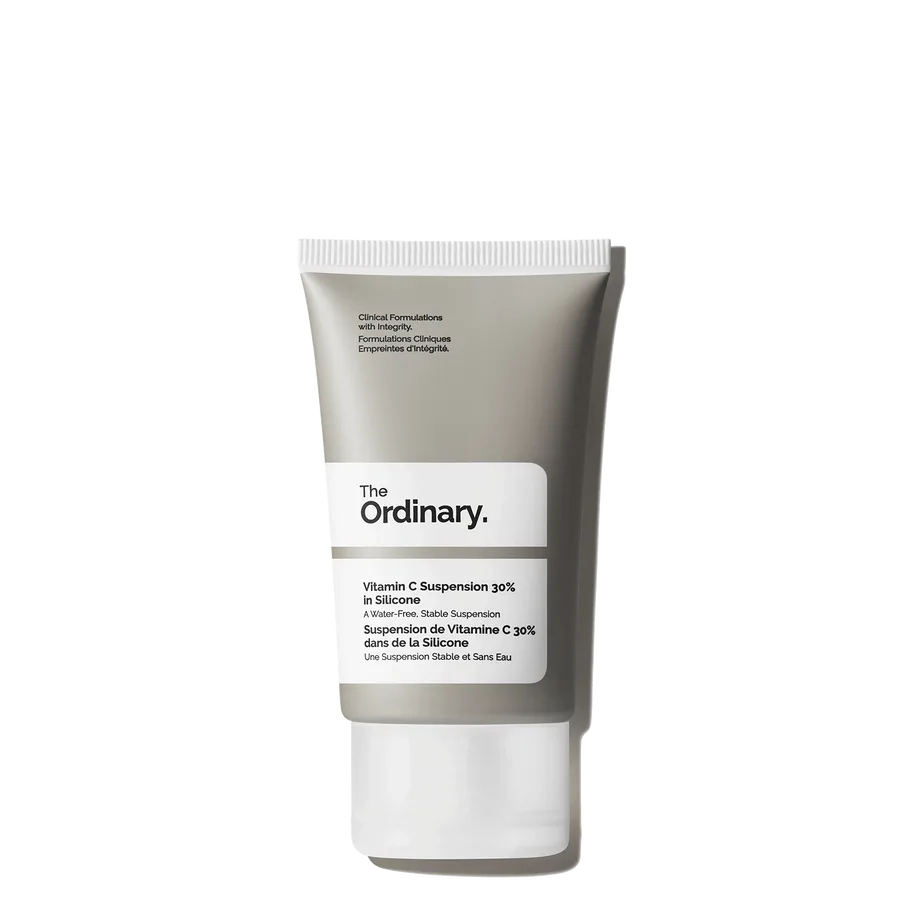
Vitamin C Suspension 30% in Silicone
Maximum Strength Vitamin C
 Verified reviewer
Pros & cons.
- +Completely smooth, non-gritty texture — a major improvement over the 23% version
- +Four-ingredient formula minimizes the risk of reactions to inactive ingredients
- +Water-free silicone base prevents oxidation and extends shelf life indefinitely until opened
- +At $7.50, one of the most affordable high-concentration vitamin C treatments available
- +Matte, primer-like finish works well under makeup for occasional AM use
- +Cruelty-free, vegan, fragrance-free, and oil-free
- −Silicone base reduces L-ascorbic acid bioavailability despite the higher 30% concentration
- −Intense stinging from the extreme acidity — more potent than the 23% version in this regard
- −Silicone film interferes with absorption of products layered on top
- −No moisturizing, hydrating, or synergistic antioxidant ingredients whatsoever
- −Dry skin types may find the formula drying under the silicone barrier
- −Results may appear slower than with better-penetrating vitamin C formulations
The full review.
The Ordinary’s Vitamin C Suspension 23% + HA Spheres 2% has a texture problem. Users often mention the grittiness—the feeling of spreading fine sand across the face while concentrated acid stings underneath. It works, but many customers cannot use it consistently enough to see results. The Vitamin C Suspension 30% in Silicone is The Ordinary’s attempt to solve this, and the solution is both clever and imperfect.
The formulation approach is different. While the 23% version suspends ascorbic acid particles in a squalane-oil base with hyaluronic acid spheres, this product puts the vitamin C into a pure silicone matrix: dimethicone, polysilicone-11, and PEG-10 dimethicone. Four ingredients total. The result is a cream that glides on like a silicone primer, without the sandpaper texture of the 23% version. If texture was your only objection to The Ordinary’s vitamin C lineup, this product removes it.
But silicone has trade-offs, and The Ordinary is transparent about the main one: dimethicone partially entraps the ascorbic acid, slowing and reducing how much vitamin C penetrates the skin. This is why the concentration rose to 30%—it is not a higher dose for higher efficacy, but a higher dose to compensate for lower delivery. The actual amount of L-ascorbic acid reaching the dermis is likely comparable to the 23% version, or even slightly less. You are not getting more vitamin C on your skin. You are getting the same vitamin C in a better format.
This distinction matters because 30% L-ascorbic acid is acidic. The stinging upon application is often more intense than the 23% version despite the silicone buffering. More acid means more acid, regardless of the suspension. The first few seconds after application bring a sharp tingle that can escalate to discomfort on thinner-skinned areas like the eyes or nose. This subsides within minutes, but it requires the same tolerance-building approach as any high-concentration acid product: start two to three times per week and work up.
Texture
The texture is pleasant. The cream has a distinctive silicone slip—smooth and velvety, without the gritty resistance of undissolved vitamin C particles. It dries to a matte, film-like finish that feels like a lightweight primer. For users who struggled with the 23% version, this is a legitimate upgrade during application.
Conflicts With
The trade-off surfaces afterward. The silicone film sits on the skin; while dimethicone is non-comedogenic and allows gas exchange, it creates a barrier that slows the absorption of anything layered on top. Water-based serums applied after this product may not penetrate as effectively. This needs to be the last active step in your routine, followed only by moisturizer. If you have a multi-step evening routine with several serums, the silicone base disrupts the layering order.
Works for
The ingredient list is minimal, with just four components. There are no moisturizing agents, humectants, or antioxidant synergists. Unlike the 23% version, which includes squalane for conditioning and hyaluronic acid spheres for hydration, this formula contains only vitamin C and the silicone needed to deliver it. For dry skin, this means the product provides no moisture—and the acidic L-ascorbic acid can feel drying under the silicone film. A good moisturizer after application is essential.
Not ideal for
The absence of vitamin E and ferulic acid is the same limitation found in the 23% version. Vitamin C research shows enhanced photoprotection when L-ascorbic acid combines with these two antioxidants. Neither of The Ordinary’s vitamin C suspensions includes them, so both products deliver vitamin C in isolation rather than the synergistic combination supported by clinical evidence.
Common Praise
The Ordinary has offered this product since approximately 2017, and reception has been mixed—better texture ratings than the 23% version, but worse efficacy perception. Users switching from the 23% to the 30% often report that results take longer to appear or feel less dramatic, which aligns with the reduced bioavailability hypothesis. The product suits those who prioritize comfort and compliance: a vitamin C you actually use every night delivers more cumulative benefit than a vitamin C you abandon after a week because of the application.
Best for
At $7.50, the value is strong for 30% pure L-ascorbic acid in a stable, water-free base. The formula will not oxidize or degrade like aqueous vitamin C serums. But the real question is about priority. Do you want the vitamin C that feels better going on, or the vitamin C that works more efficiently once it is there? The Ordinary offers both options and lets you decide.
Ingredient analysis.
Full INCI list
Dimethicone, Ascorbic Acid, Polysilicone-11, PEG-10 Dimethicone
Skin match.
The science.
The Science
This product's formulation trades skin delivery for stability. L-ascorbic acid is hydrophilic; it dissolves in and works best through aqueous solutions at low pH. Dimethicone is a hydrophobic silicone polymer that forms a non-polar matrix around the ascorbic acid particles. Published research on silicone-based delivery systems shows that dimethicone provides excellent stability and a smooth feel, but it reduces the rate and extent of active ingredient release compared to oil-in-water or anhydrous non-silicone vehicles.
The 30% concentration uses dose escalation to counter this lower bioavailability. However, Pinnell and colleagues published research in Dermatologic Surgery in 2001 showing that L-ascorbic acid skin saturation reaches approximately 20% in aqueous formulations. Published literature has not specifically studied if the same saturation curve applies to silicone-based delivery vehicles, leaving an evidence gap for this formulation approach.
This formula lacks vitamin E (tocopherol) and ferulic acid. Pinnell's 2005 study in the Journal of Investigative Dermatology showed that adding 1% vitamin E and 0.5% ferulic acid to a 15% L-ascorbic acid solution doubled its photoprotective capacity. Ferulic acid stabilizes and regenerates oxidized vitamin C and E to create a self-reinforcing antioxidant network. Without these, the L-ascorbic acid in this product works as a solo antioxidant; it is still beneficial but lacks the enhanced protection found in C+E+ferulic research.
Dimethicone is a well-studied dermatological vehicle. The FDA classifies it as a skin protectant. It forms a breathable, non-comedogenic film and published research shows it supports barrier function without occluding the skin. The concern is active ingredient delivery, not the safety or dermatological suitability of the silicone base.
References
- Topical Vitamin C and the Skin: Mechanisms of Action and Clinical Applications — Journal of Clinical and Aesthetic Dermatology (2017)
- Ferulic Acid Stabilizes a Solution of Vitamins C and E and Doubles its Photoprotection of Skin — Journal of Investigative Dermatology (2005)
Dermatologist Perspective
Dermatologists see silicone-based vitamin C delivery as a viable option for patients who dislike the texture of traditional suspensions, though they note the bioavailability compromise. Board-certified dermatologists say compliance drives vitamin C efficacy — a product a patient uses nightly delivers more cumulative benefit than a theoretically superior product abandoned after a week. Dermatologists typically recommend this product to patients who struggle with consistency using grittier formulations, while noting that 15-20% aqueous vitamin C serums with vitamin E and ferulic acid remain the clinical gold standard.
Where it fits in your routine.
Apply a small amount to clean, dry skin at night. Use The cream as your last active step. Apply all water-based serums first; the silicone film slows their absorption if applied later. Wait 3-5 minutes for the tingling to stop, then apply moisturizer. Use 2-3 times per week initially and increase frequency as tolerance builds. Use SPF 30+ sunscreen the next morning. Do not combine with niacinamide, AHA/BHA, or retinoids in the same routine step.
At $7.50 for 30ml, this product provides high value for a 30% L-ascorbic acid treatment — prestige vitamin C serums with lower concentrations usually cost $50-165. However, the silicone barrier effect means effective vitamin C delivery is likely comparable to or slightly less than the $5.80 version (23% + HA Spheres). The $1.70 premium over the 23% version buys a smoother texture and a matte finish. Deciding if that texture justifies the lower bioavailability depends on whether you use the grittier version consistently.
Users want high-concentration vitamin C without the gritty texture of traditional suspensions. This works best for normal, combination, or oily skin types seeking a matte, primer-like finish and existing tolerance to acidic skincare products.
Avoid this product if you have sensitive, dry, or barrier-compromised skin — 30% L-ascorbic acid is too intense for any delivery vehicle. Layering multiple serums in a PM routine may be disrupted by the silicone base. For maximum clinically supported vitamin C efficacy, use formulations that include vitamin E and ferulic acid.
Product details.
Fragrance-free. The L-ascorbic acid has a faint acidic scent, but the encapsulating silicone base makes it much less intense than the 23% version.
Opaque squeeze tube that protects the vitamin C from light degradation. Standard The Ordinary tube design with screw cap. ***
The first application shows the main difference from the 23% version — no grittiness. The cream glides on with a silicone-smooth feel. However, the higher concentration causes tingling within seconds that feels more intense than the 23% version. Expect 3-5 minutes of stinging that subsides as the product settles. Use 2-3 times per week to start. ***
3-4 months with nightly use ***
12 months ***
All Year ***
The backstory.
Created as a direct response to the texture complaints that plagued The Ordinary's original 23% Vitamin C Suspension. Rather than simply smoothing out the original formula, DECIEM took a fundamentally different approach — suspending the vitamin C in silicone rather than squalane-based oils. The 30% concentration is not an attempt to outdo the 23% but rather to compensate for the silicone's barrier effect on absorption.
About The Ordinary
Established Brand (5–20 years)The Ordinary launched in 2016 under DECIEM. It became an influential skincare brand by offering clinical-grade ingredients at transparent, accessible prices. This product is a smoother-textured alternative to the brand's original gritty 23% Vitamin C Suspension.
Common myths.
30% vitamin C is more effective than 23% vitamin C
The higher concentration offsets the silicone base's reduced penetration. The amount of L-ascorbic acid that reaches the skin is similar to the 23% version. Clinical research shows skin saturation of L-ascorbic acid occurs at 20%, where higher concentrations offer diminishing returns.
Silicone-based products clog pores and stop skin from breathing
Dimethicone forms a breathable film for gas and moisture exchange. It is non-comedogenic and dermatological products use it because it protects without occluding. The concern is not clogging, but that the silicone layer slows absorption of subsequent products.
FAQ.
What's the difference between The Ordinary Vitamin C 30% and 23%?
The 30% version uses a pure silicone (dimethicone) base, giving it a smooth, non-gritty texture but reducing how much vitamin C actually penetrates the skin. The 23% version uses a squalane-oil base with hyaluronic acid spheres — grittier texture but better penetration and added hydration. The 30% compensates for reduced absorption with a higher concentration. Choose the 30% for texture comfort, the 23% for maximum delivery.
Does The Ordinary Vitamin C 30% in Silicone actually work?
Yes, but the silicone base slows the delivery speed and amount of L-ascorbic acid reaching the skin. Regular use over 4-8 weeks consistently shows brightening and dark spot improvement. The smoother texture means less potency than formulations with better skin penetration.
Why does The Ordinary Vitamin C 30% sting so much?
Pure L-ascorbic acid is acidic at a 30% concentration. It drops surface pH below 3.5 on the skin, which triggers nerve endings and causes stinging. This is a pH reaction, not an allergic response. Build tolerance by starting 2-3 times per week and increasing frequency gradually.
Can I use other serums over The Ordinary Vitamin C 30% in Silicone?
The silicone base forms a film on the skin. This film slows or partially blocks absorption of water-based products applied afterward. Apply water-based serums (hyaluronic acid, niacinamide) before this product. Follow only with a moisturizer and skip additional layering for best results.
Is The Ordinary Vitamin C 30% safe for sensitive skin?
Generally no — The Ordinary's highest concentration is 30% L-ascorbic acid, which stings even resilient skin. Sensitive skin types should use gentler vitamin C derivatives like Ascorbyl Glucoside 12% or Ascorbyl Tetraisopalmitate 20% in Vitamin F. These provide vitamin C benefits without high acidity.
Community
What the community says.
"Smooth, non-gritty texture is a major improvement over the 23% version"
"Exceptional value for a 30% L-ascorbic acid product at $7.50"
"Four-ingredient formula minimizes risk of reactions to inactive ingredients"
"Noticeable brightening and improved skin tone with consistent use"
"Stable water-free formula that doesn't oxidize"
"Significant tingling and stinging from the extreme 30% acid concentration"
"Silicone base feels occlusive and can interfere with other product absorption"
"Reduced vitamin C penetration compared to aqueous formulations at lower concentrations"
"No moisturizing or hydrating ingredients — skin can feel dry underneath the silicone film"
"Still has a noticeable acidic odor despite the silicone base"
Featured in.
People also looked at.