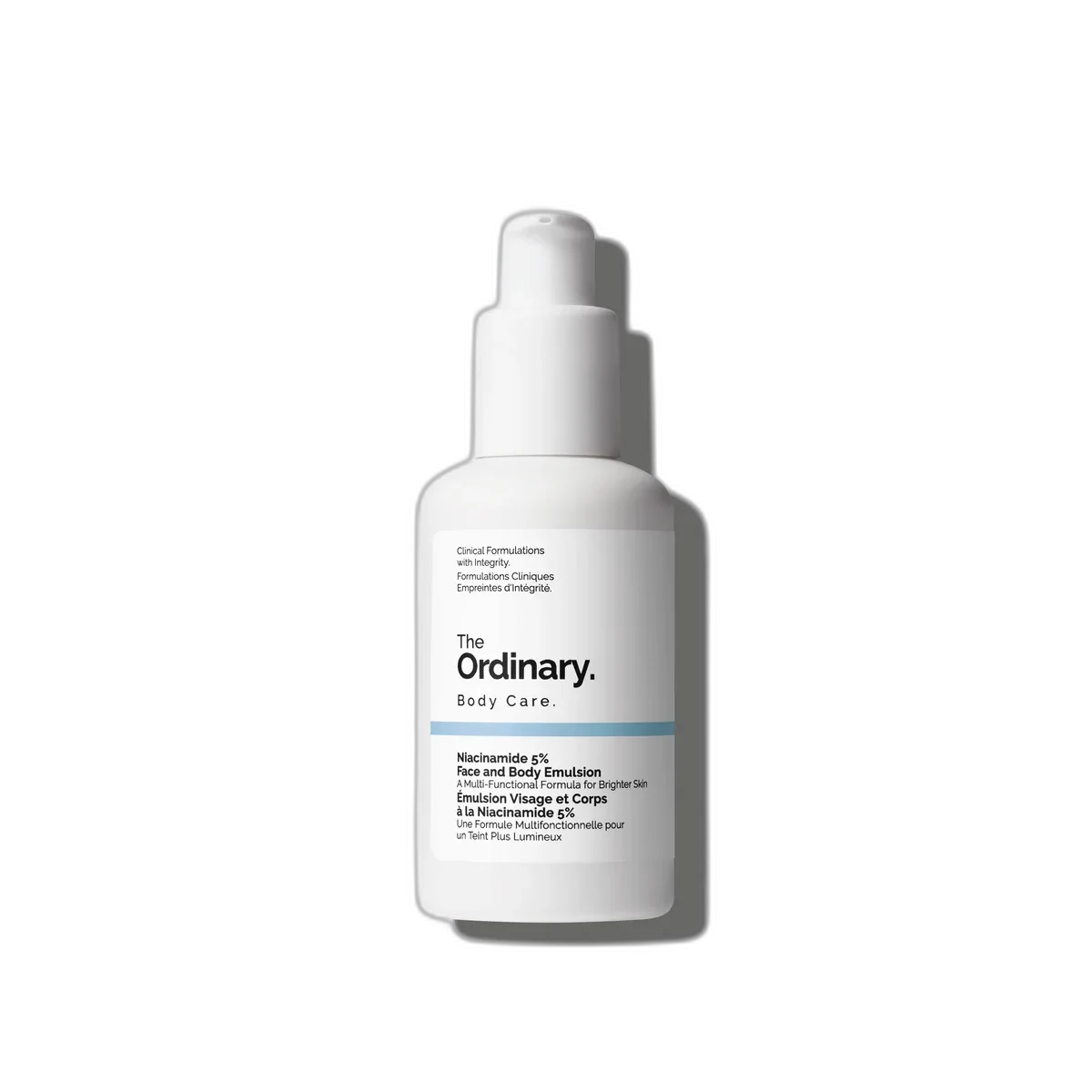
Niacinamide 5% Face and Body Emulsion
Body-Tone Workhorse
 Verified reviewer
Pros & cons.
- +5% niacinamide is clinically supported for tone correction
- +100 mL size makes body-scale use realistic and affordable
- +Lightweight emulsion spreads and absorbs without greasiness
- +Fragrance-free and sensitive-skin compatible
- +Works as a dual-purpose face and body product
- +Addresses a genuinely underserved problem (body hyperpigmentation)
- +Layers cleanly with sunscreen and other actives
- +Pregnancy-compatible
- −Not rich enough as a standalone winter face moisturizer
- −Slow results — requires 8–12 weeks for visible change
- −Not a treatment for melasma or deep dermal pigmentation
- −Clinical sensory profile — no scent or ritual appeal
- −Pump can struggle near the bottom of the bottle
The full review.
Skincare often ignores body hyperpigmentation. People spend time and money fading facial dark spots, but post-inflammatory pigmentation on the chest, back, shoulders, bikini line, and inner arms gets overlooked. This isn’t because the problem is small, but because the right products don’t exist. The face category has used 10% niacinamide serums in 30 mL bottles for years; these work on the face but make no economic sense for a full chest or back. Meanwhile, body lotions are usually fragranced aesthetic products or simple moisturizers with actives no stronger than shea butter. This emulsion is Deciem’s attempt to fill that gap, and it is one of the most useful recent launches from The Ordinary.
The formulation makes niacinamide practical for the body. The active concentration drops from 10% to 5%. This isn’t a reduction in efficacy; 5% is the concentration most clinical niacinamide research for pigmentation uses. The original 10% face serum sits at the upper end of the useful range rather than the minimum effective dose. A 5% load provides the same clinical results with better tolerance and more room for other ingredients. The bottle size increases from 30 mL to 100 mL, allowing realistic twice-daily use on the chest and shoulders without running out in a week. The vehicle is a lightweight milky emulsion instead of the tacky water serum used in the original. Products for large surface areas must spread cleanly and absorb fast rather than sitting on the skin like a face serum.
The rest of the ingredient deck supports this practicality. Ethyl macadamiate gives the emulsion a soft, milky slip without a greasy film, making it work on both the face and body. Glycerin and propanediol provide humectants at levels appropriate for a diluted body lotion. Sphingomonas ferment extract adds a small conditioning component, following Deciem’s pattern of including supporting skin-food ingredients. A small amount of citric and malic acid sits near the bottom of the INCI list to act as a pH adjuster, not an exfoliant; at these levels, the emulsion is not meaningfully keratolytic. The preservative system and standard Deciem ingredients complete the formula. It has no fragrance, no dye, and no unnecessary botanicals. It is a short, clean deck designed for daily use on large areas without triggering reactivity.
The product works on actual body concerns. Post-inflammatory hyperpigmentation from bikini line ingrown hairs, old acne scars on the back and shoulders, darkened knees and elbows, or friction-driven tone issues in the underarms and inner thighs all respond to sustained topical niacinamide over an 8–12 week window. The effect is slow—not overnight or dramatic week-to-week—but it accumulates. After twelve weeks of daily use, most of these patterns look visibly more even. The emulsion does not bleach pigment, does not exfoliate aggressively, and does not replace sunscreen. It is a tyrosinase-modulating tone corrector that works with normal cell turnover.
There are honest limits. This will not fade melasma or deep dermal pigmentation that requires prescription topicals or laser treatment. It will not treat keratosis pilaris as a primary ingredient; KP responds to urea, lactic acid, or salicylic acid, while niacinamide only acts as a supporting calmer for redness. It is not a rich moisturizer, so you will need a heavier layer on very dry skin or in deep winter. The fragrance-free, unscented formula is good for sensitive skin, but it lacks the sensory experience some people want from body care. If you prefer scented body products, this will feel clinical.
On the face, it is a useful dual-purpose product for oily or combination skin, or for anyone in warm climates wanting a lightweight morning moisturizer with tone correction. It is not rich enough for dry skin in winter, but it layers well under cream. The fragrance-free formulation also works well with other actives like vitamin C in the morning or acids and retinoids at night without increasing irritation.
At fourteen dollars for a hundred milliliters, the value is strong. Comparable body products with niacinamide at similar strengths usually cost twenty-five to forty dollars for smaller or equal sizes. Most of those are face serums marketed as body products rather than formulations built for large surface areas. The Ordinary’s version is cheaper, better sized, and formulated for this specific use case. Twice-daily full-body application lasts about six to eight weeks, which matches the pace needed for tone correction. For anyone frustrated by body hyperpigmentation, this emulsion is the obvious first step, and the price makes it an easy experiment.
Formula
Ingredient analysis.
Full INCI list
Aqua/Water/Eau, Ethyl Macadamiate, Niacinamide, Propanediol, Glycerin, Sphingomonas Ferment Extract, Pentylene Glycol, Ethylhexyl Olivate, Polyglyceryl-4 Oleate, Sodium Acrylates Copolymer, Isoceteth-20, Sodium Citrate, Citric Acid, Malic Acid, Trisodium Ethylenediamine Disuccinate, Tocopherol, Ethylhexylglycerin, Phenoxyethanol, Chlorphenesin
Skin match.
The science.
The Science
Topical niacinamide is a top-studied active for hyperpigmentation and tone correction. Clinical trials from the early 2000s — specifically work by Procter & Gamble researchers — show that niacinamide at 2% to 5% concentrations reduces hyperpigmented lesions in Asian women with melasma and age spots after 4–8 weeks of twice-daily use. It works by inhibiting melanosome transfer from melanocytes to keratinocytes. This pathway differs from tyrosinase inhibition, so niacinamide works well with upstream tone correctors. The 5% concentration in this emulsion sits at the top of that clinically supported range and matches the concentration in several seminal studies. Niacinamide has strong evidence for post-inflammatory hyperpigmentation — the main pigmentation type on body skin from ingrown hairs, friction, and healed acne. Peer-reviewed work also shows niacinamide has modest anti-inflammatory activity by reducing pro-inflammatory cytokines, improves barrier function by upregulating ceramide and other lipid synthesis, and has a mild sebum-modulating effect. The supporting cast in this formulation — ethyl macadamiate, glycerin, Sphingomonas ferment — provides structure and conditioning rather than active therapy. The science of this product is niacinamide science, which is as well-established as any active in consumer skincare.
Dermatologist Perspective
Dermatologists view niacinamide as one of the most useful, lowest-risk actives available and frequently recommend it for patients with post-inflammatory hyperpigmentation across many skin tones. Board-certified dermatologists note that clinical conversations often underaddress body hyperpigmentation because patients assume it is untreatable — and a well-dosed topical niacinamide product is often the right starting point before using more aggressive options. The 5% strength here is clinically appropriate and well-tolerated across skin types, including darker skin tones where other tone correctors carry rebound risk. The main clinical caveat is that sustained use matters — niacinamide does not provide rapid results, and patients who stop at 3–4 weeks miss the window when tone changes become visible. Dermatologists also emphasize pairing with daily sunscreen on sun-exposed areas, as UV exposure drives pigmentation faster than any topical can fade it. For pregnant patients, niacinamide is a go-to recommendation because it fits the pregnancy-avoidance list most OB-GYNs use.
Where it fits in your routine.
Apply after cleansing (face) or showering (body), ideally to damp skin to improve absorption. On the body, target areas with tone issues — chest, back, shoulders, bikini line, inner arms, underarms — using enough to cover skin without pooling. On the face, use as a lightweight moisturizer or layer under a thicker cream. Apply daily in the morning, at night, or both, and use daily broad-spectrum sunscreen on exposed areas. Use the product consistently for 8–12 weeks to see effects on pigmentation — results are slow and cumulative, not overnight. You can safely combine it with AHA or BHA body products, vitamin C, and retinoids.
At $14 for 100 mL, this product offers high value with a real active. Specialist and luxury niacinamide body products often cost $25–$45 for 100–150 mL, and many are just face serums in larger bottles instead of formulations built for body use. Applying it twice daily to the full body uses the bottle in six to eight weeks. This makes the monthly cost about nine dollars — a small amount for serious body care. The bottle lasts longer if you use it on specific body areas only. The emulsion also works as a lightweight face moisturizer, which increases the per-ounce value. This pricing makes the product easy to recommend without hedging.
Use this for post-inflammatory hyperpigmentation on the body caused by ingrown hairs, old acne, friction, or shaving — especially on the chest, back, shoulders, or bikini line. It also works as a dual-purpose option for oily or combination facial skin needing a lightweight niacinamide moisturizer for both face and body. The formula is pregnancy-safe and fits most skin types.
Skip this if you have very dry skin and need a thick, occlusive body butter — this emulsion is too lightweight to be your only winter moisturizer. Skip this if your pigmentation is melasma or deep dermal in origin, because niacinamide alone does not reach those issues. Also skip this if you want fragranced body care; this product is clinical and unscented by design.
Product details.
This thin, milky lotion spreads easily and absorbs within a minute, leaving a soft, satin finish.
Fragrance-free, with a faint neutral note from the macadamiate ester.
100 mL plastic pump bottle — standard Deciem white-and-grey labeling.
The first few uses feel like a light body lotion with a slightly slick finish that absorbs fast. It has no tingle, no scent, and no visible residue. Some people use it as a standalone moisturizer on the face in warm weather; others layer it under a thicker cream in winter. Body pigmentation shows visible results after 8–12 weeks of consistent daily use.
Apply daily to the full body for 6–8 weeks; use on the face or targeted body areas for longer.
12 months
All Year
The backstory.
The Ordinary spent years selling 10% niacinamide as a face serum before noticing that a significant share of their customers were using it on body areas — chest, back, inner arms, bikini line — where small 30 mL bottles made that use pattern impractical. The face-and-body emulsion is Deciem's answer to that use case: the same well-understood active, at a slightly lower and more body-appropriate concentration, in a format designed for larger surface areas.
About The Ordinary
Established Brand (5–20 years)The Ordinary launched in 2016. Its niacinamide formulations are some of the most widely sold and dermatologist-recommended actives in the brand portfolio. The body emulsion is a newer format in the lineup, but it uses a formulation area where Deciem has deep experience.
Common myths.
5% niacinamide is weaker than 10% and works less effectively.
Most clinical studies show niacinamide works for hyperpigmentation at 2% to 5%. The 10% load in the original face serum sits at the upper end of the useful range, not the minimum effective dose. 5% is an evidence-backed strength for tone correction.
Lasers or prescriptions are required to fade body hyperpigmentation.
Topical tyrosinase modulators like niacinamide treat body hyperpigmentation from post-inflammatory causes, especially when used with consistent sunscreen on exposed areas and gentle exfoliation. Results are slow but real; this emulsion targets this specific problem.
FAQ.
Why 5% niacinamide for the body instead of 10%?
5% falls within the effective range shown in clinical studies for hyperpigmentation and tone correction. The 10% in The Ordinary's face serum is at the upper end of the useful range, not a minimum. For body use, 5% balances efficacy, cost per milliliter, and broad tolerance.
Can I use it on my face instead of a moisturizer?
Yes — in warm weather or for oily and combination skin, it works well as a standalone lightweight moisturizer for the face. In winter or for dry skin, use it as a lightweight serum step or pair it with a thicker cream on top.
Does it really fade dark spots on the body?
Niacinamide at this concentration improves post-inflammatory hyperpigmentation from ingrown hairs, friction, old acne, or bikini-line irritation after 8–12 weeks of consistent daily use. It does not fade melasma or deep dermal pigmentation; those need different actives or prescription options.
Can I use it on keratosis pilaris?
It helps secondary redness and rough texture, but KP is a follicular keratinization issue. KP responds best to urea, lactic acid, or salicylic acid body products. Niacinamide is complementary—pair it with a KP-specific treatment for best results instead of using it alone.
Is it pregnancy safe?
Niacinamide is a top skincare active recommendation during pregnancy and breastfeeding. The supporting ingredients in this emulsion are not known to be problematic. Pregnant patients often use it as a safe choice for tone and pigmentation concerns.
Does it work for bikini-line and underarm hyperpigmentation?
Yes — those areas are typical use cases for body niacinamide. Pigmentation in those zones usually comes from post-inflammatory friction, waxing, or shaving, and responds to topical tyrosinase modulation. Apply daily after showering and use gentle exfoliation once or twice a week.
Can I use it under sunscreen?
Yes — niacinamide layers cleanly under any sunscreen. Sunscreen is essential for results; if you treat pigmentation on exposed skin without sun protection, UV re-triggers pigmentation faster than niacinamide fades it.
What the community says.
"Actually works on body hyperpigmentation from ingrowns and old acne"
"Lightweight, non-greasy finish"
"100 mL for $14 is strong body-care value"
"Fragrance-free and sensitive-skin friendly"
"Not rich enough as a sole face moisturizer in winter"
"Bottle can be hard to dispense near the end"
"Needs consistent weeks of use before visible change"