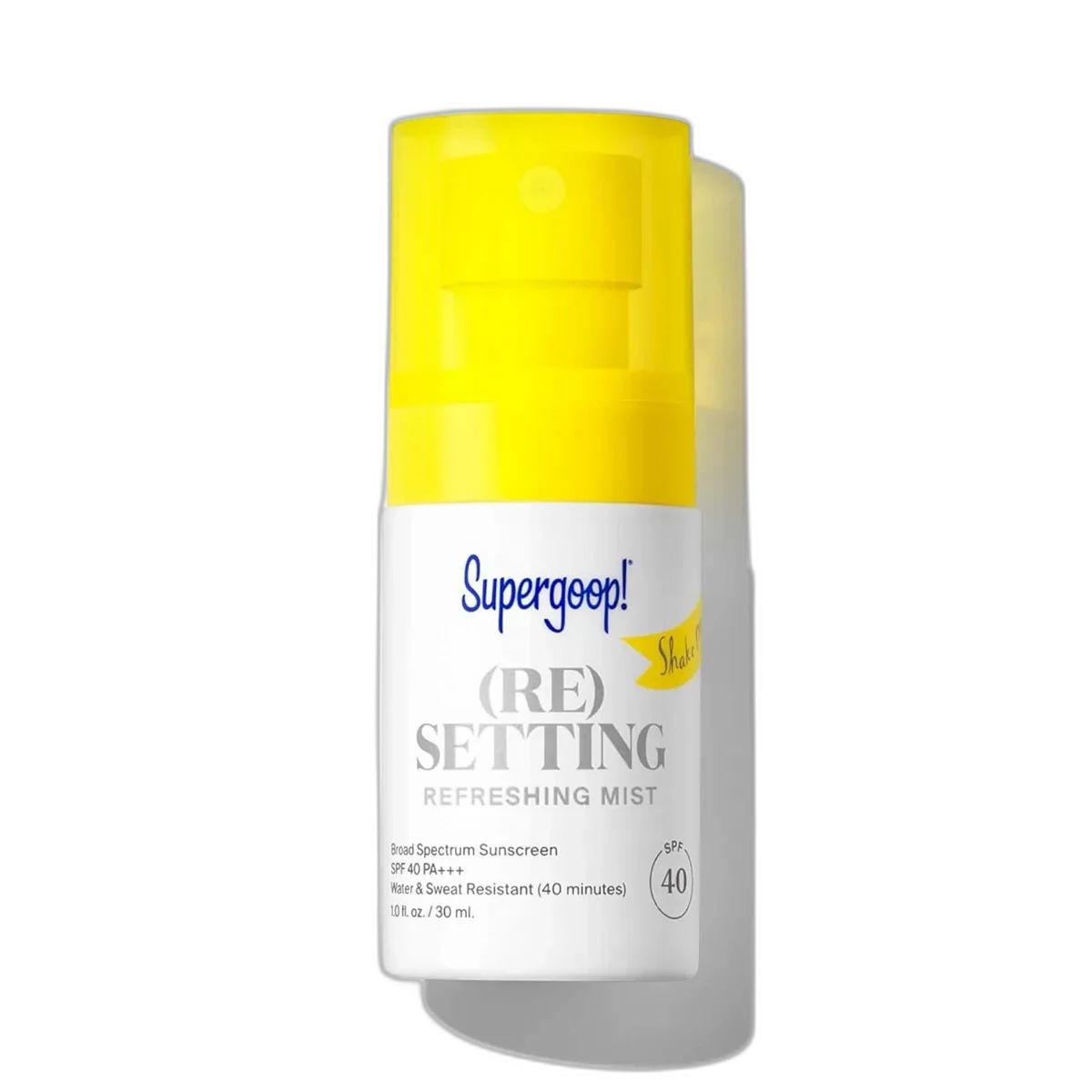
RE:SETTING Refreshing Mist SPF 40
The Over-Makeup SPF Solution
 Verified reviewer
Pros & cons.
- +Solves the over-makeup SPF reapplication problem with an ultrafine mist that doesn't disturb foundation
- +Triple avobenzone stabilization system (octocrylene + DESM + ethyl ferulate) is unusually sophisticated
- +Oil-absorbing nylon-12 and silica microspheres provide genuine mattifying and makeup-setting function
- +Reformulated nozzle delivers significantly finer, more even mist than the original version
- +Refreshing peppermint-spearmint-rosemary scent provides a cooling midday sensation
- +Fungal acne safe and non-comedogenic formula
- −High denatured alcohol content (estimated 24-35%) is drying and unsuitable for sensitive skin
- −Essential oils (peppermint, spearmint, rosemary) are documented sensitizers for fragrance-reactive individuals
- −Chemical UV filters sting eyes significantly if mist drifts during application
- −Must shake vigorously before each use or UV filter distribution may be uneven
- −Not a substitute for a proper first application of sunscreen in the morning
- −Can feel slightly tacky during the setting phase before fully drying
The full review.
Dermatology’s most acknowledged unresolved issue is the reapplication problem. Every sunscreen label requires reapplication every two hours. Dermatologists emphasize that a single morning application provides diminishing protection by midday. People wearing makeup know that reapplying a cream sunscreen at lunch destroys foundation, concealer, powder, and patience. Consequently, most sunscreen-wearing adults go unprotected during afternoon UV exposure.
Supergoop! RE:SETTING Refreshing Mist SPF 40 has addressed this gap since approximately 2015, when it launched as Defense Refresh (Re)Setting Mist. The current version, reformulated around 2022 with a finer nozzle, lighter texture, and adjusted scent, shows over a decade of iteration on one idea: putting real UV filters in a setting spray fine enough to land on makeup without ruining it.
The UV filter system puts this product above the typical setting spray weight class. Four chemical filters — avobenzone, homosalate, octisalate, and octocrylene — deliver SPF 40 broad-spectrum protection. The formulation sophistication goes deeper. Avobenzone is photounstable, losing approximately half its UVA-protective capacity within an hour of sun exposure through molecular degradation. Most sunscreens address this with octocrylene alone. This formula triple-stabilizes the avobenzone: octocrylene as a triplet-state quencher, diethylhexyl syringylidenemalonate (DESM) — which research in Photochemistry and Photobiology (2006) showed provides a sevenfold increase in avobenzone photostability — and ethyl ferulate, which adds antioxidant stabilization and UV-absorbing contribution. This level of UV filter engineering is unusual for a setting spray.
The bi-phase formula is the mechanical innovation that makes the product work. UV filters and oil-absorbing powders naturally separate, so the bottle contains internal shaker balls to recombine the formula when you shake before each use. This is not decorative — skipping the shake means spraying unevenly distributed UV filters, which defeats the purpose. Shaking is required.
Once shaken and sprayed, the mist is fine. The reformulated nozzle responded to complaints about the original version’s coarser spray, and the improvement is substantial. From eight to ten inches away, the mist settles over foundation, concealer, and powder like a light fog without displacing or streaking the makeup underneath. The nylon-12 and silica microspheres in the formula absorb excess sebum on contact, providing the mattifying and setting effect that justifies the product’s role in a makeup routine beyond UV protection.
Peppermint and spearmint essential oils provide an immediate, refreshing cooling sensation — particularly during midday reapplication in warm weather. Rosemary oil adds a clean, natural herbal note rather than a medicinal one. The scent fades within a few minutes and does not compete with other fragrances.
Alcohol content is the formula’s most polarizing element. Alcohol Denat. is the first inactive ingredient, estimated at 24-35% of the formula. This high concentration allows the mist to evaporate rapidly on skin without leaving a wet, makeup-disrupting residue. Without alcohol, the product would be too wet to use over makeup. However, high alcohol means potential drying, stinging on irritated skin, and incompatibility with sensitive, rosacea-prone, or barrier-compromised skin types. The bisabolol (chamomile derivative) at an estimated 5-7.5% helps offset some irritation, but it cannot fully counteract the alcohol.
Essential oils are a secondary irritation concern. Peppermint, spearmint, and rosemary oils are documented skin sensitizers that some individuals react to over time. This product is a non-starter for fragrance-free purists. For others, the natural mint-rosemary scent is a frequently praised feature — it makes reapplication feel like a midday refresh rather than a medical obligation.
This is a reapplication product, not a primary sunscreen. No mist guarantees the thick, even coverage a properly applied cream or lotion delivers. The two-dimensional spray pattern of any mist cannot replicate the three-dimensional rubbing that distributes a cream evenly across facial contours. Dermatologists recommend applying a standard sunscreen as a morning base and using products like this for midday top-ups.
Eye stinging is the most consistent practical complaint. Chemical UV filters — particularly avobenzone — are eye irritants, and a facial mist sends droplets toward the eye area. Closing eyes tightly during spraying is mandatory. Some users hold a hand across their brow line as an additional shield.
At $34 for 3.4 fl oz, the pricing is reasonable for the category. A 1 fl oz travel size costs around $20, which is useful for a purse or desk. For a product used once or twice between morning sunscreen and evening cleanse, a bottle lasts six to eight weeks of daily use.
The product that started as an idea — SPF in a setting spray — has matured into a carefully formulated product. The triple avobenzone stabilization puts it in a different class than most facial mists claiming SPF benefits. It won’t replace your morning sunscreen, but it will make your two o’clock reapplication happen, and that practical compliance may do more for long-term UV protection than any SPF number on a bottle you only apply once.
Formula
PM routine
Ingredient analysis.
Full INCI list
Active Ingredients: Avobenzone 2.9%, Homosalate 9.8%, Octisalate 4.9%, Octocrylene 9.5%. Inactive Ingredients: Alcohol Denat., Bisabolol, Brassica Campestris/Aleurites Fordi Oil Copolymer, Butyloctyl Salicylate, Caprylic/Capric Triglyceride, Capryloyl Glycerin/Sebacic Acid Copolymer, Dicaprylyl Carbonate, Diethylhexyl Syringylidenemalonate, Diheptyl Succinate, Diisooctyl Succinate, Ethyl Ferulate, Isododecane, Lauroyl Lysine, Mentha Piperita (Peppermint) Oil, Mentha Viridis (Spearmint) Leaf Oil, Nylon-12, PVP, Rosmarinus Officinalis (Rosemary) Leaf Oil, Silica Caprylyl Silylate
Skin match.
The science.
The Science
RE:SETTING Mist uses a triple-stabilization approach for avobenzone. Avobenzone (butyl methoxydibenzoylmethane) at 2.9% provides UVA protection in the 310-400nm range, but Norrish type I cleavage causes rapid photodegradation, losing about 50% efficacy within one hour of UV exposure. This formula uses three stabilization mechanisms:
First, octocrylene at 9.5% acts as a triplet-state quencher, absorbing excited-state energy from UV-irradiated avobenzone to prevent molecular breakdown. Second, diethylhexyl syringylidenemalonate (DESM) is a photostabilizer with antioxidant functionality. Chaudhuri and colleagues published research in Photochemistry and Photobiology (2006) showing DESM increases avobenzone photostability sevenfold, making it one of the most effective single-ingredient stabilizers. Third, ethyl ferulate adds antioxidant UV absorption to reduce oxidative stress on the avobenzone molecule.
Molecules (2018) studied ethyl ferulate independently. The research documented its UV-absorbing capacity and anti-inflammatory properties, making it a dual-function ingredient that protects and soothes. This combination of UV filtering and anti-inflammatory activity matters for a product sprayed onto skin after several hours of UV exposure.
The oil-absorbing powder system uses nylon-12 microspheres and silica caprylyl silylate to absorb sebum physically rather than through chemical astringency. This mechanism sets the skin without the stripping action of alcohol-based toners, while the microspheres create a soft-focus optical blurring that improves the appearance of makeup underneath.
References
- Design of a photostabilizer having built-in antioxidant functionality and its utility in obtaining broad-spectrum sunscreen formulations — Photochemistry and Photobiology (2006)
- Ethyl Ferulate, a Component with Anti-Inflammatory Properties for Emulsion-Based Creams — Molecules (2018)
Dermatologist Perspective
Board-certified dermatologists often note that sunscreen reapplication compliance is a major gap in real-world photoprotection. RE:SETTING Mist makes midday reapplication practical for makeup wearers who would otherwise skip it. Dermatologists say this product should supplement — not replace — a proper morning sunscreen application. The SPF 40 broad-spectrum rating meets dermatological recommendations, and the photostabilization system prevents the protection from degrading rapidly on skin. Dermatologists would flag the high alcohol content and essential oils as concerns for patients with rosacea, eczema, or contact dermatitis, recommending fragrance-free, alcohol-free alternatives for those populations.
Where it fits in your routine.
Shake well before every use; the bi-phase formula needs mixing. Close eyes and hold the bottle 8-10 inches from your face. Spray in a sweeping X-pattern for even coverage. Do not rub; let the mist settle and dry naturally. Use over finished makeup for midday SPF reapplication. Reapply every two hours during sun exposure. Use this as a supplement to your morning sunscreen, not a replacement. Use a cream, lotion, or gel formula for your initial morning sunscreen application.
At $34 for 3.4 fl oz, the price is reasonable for a specialty SPF product with this formulation sophistication. A 1 fl oz travel size at $20 works well for a desk or purse. The value depends on context: if this product causes you to reapply sunscreen at midday when you otherwise wouldn't, the extra UV protection provides more impact than an expensive morning sunscreen applied once. Supergoop!'s expertise in SPF formulation and the triple avobenzone stabilization system show R&D investment that justifies the premium over generic setting sprays without UV protection.
Makeup wearers who want to reapply SPF without ruining their foundation. Oily and combination skin types benefit from the oil-absorbing powder complex. Anyone who skips midday sunscreen reapplication to save their makeup. It works for office workers near windows or anyone going outside for lunch.
High alcohol and essential oil content makes this unsuitable for sensitive, rosacea-prone, or barrier-compromised skin. This product works for reapplication, not as a primary morning sunscreen. The essential oil fragrance smells minty or herbal. Contact lens wearers must apply carefully to avoid eye irritation.
Product details.
Natural essential oils provide an aromatic rosemary and mint blend. It feels refreshing and cooling on application, then fades within a few minutes. It does not smell synthetic.
The reformulated version uses a spray bottle with an improved nozzle and internal shaker balls to mix the bi-phase formula. It comes in 3.4 fl oz (full) and 1 fl oz (travel) sizes. The packaging features Supergoop!'s branding.
The first shake-and-spray produces a fine mist that cools skin immediately via peppermint and spearmint oils. The alcohol evaporates in seconds, and the powder complex leaves a soft-focus finish over makeup. Spraying from the recommended 8-10 inch distance does not disrupt foundation or concealer. Keep eyes closed — the chemical UV filters sting on contact.
6-8 weeks with daily use as a midday reapplication product
12 months
All Year
The backstory.
Originally launched around 2015 as Defense Refresh (Re)Setting Mist, this product addressed one of the most practical problems in daily sunscreen use: how to reapply SPF at lunch without ruining your makeup. After celebrating its five-year anniversary with a limited-edition artist collaboration in 2020, Supergoop! reformulated the product circa 2022 with a finer mist nozzle, lighter texture, and gentler scent in response to user feedback about the original version's spray quality.
About Supergoop!
Established Brand (5–20 years)Supergoop! launched in 2007 as the first lifestyle brand focused only on sun protection. Defense Refresh (Re)Setting Mist debuted around 2015, then underwent reformulation circa 2022 with a lighter texture and improved nozzle. It won a SHAPE Sun Award for Best Over Make-Up SPF.
Common myths.
SPF setting sprays offer the same protection as regular sunscreen application
No mist or spray provides the same even, thick coverage as a properly applied cream or lotion sunscreen. This product works for reapplication and topping up protection during the day, not as a replacement for your morning sunscreen application. Dermatologists recommend using a standard sunscreen as your base and this type of product for convenient reapplication.
Don't shake bi-phase sunscreen products before use
The UV filters and oil-absorbing powders in this formula separate when the bottle sits idle. If you do not shake before spraying, the UV filter distribution is uneven, which reduces the actual protection. The shaker balls inside exist for a reason — use them.
FAQ.
Why do I need to shake Supergoop RE:SETTING Mist?
This is a bi-phase formula; UV filters and oil-absorbing powders separate when the bottle sits idle. Internal shaker balls recombine the formula when you shake before each use. Skipping this step causes uneven UV filter distribution and reduces protection quality.
Does Supergoop RE:SETTING Mist sting your eyes?
Yes — this happens often. The chemical UV filters (avobenzone, homosalate, octisalate, octocrylene) and denatured alcohol sting if the mist hits your eyes. Always close your eyes tightly and spray in a sweeping pattern instead of directly at the face.
Is Supergoop RE:SETTING Mist good for oily skin?
Yes. The nylon-12 and silica microspheres absorb excess sebum and control midday shine. This works well for oily and combination skin types. It acts as a setting spray and an oil-controlling mist with SPF benefits.
What the community says.
"Solves the midday SPF reapplication problem without disturbing makeup"
"Ultrafine mist delivers even coverage without disrupting foundation"
"Refreshing rosemary-mint scent provides a cooling sensation"
"Oil-absorbing powders help control midday shine and set makeup"
"Improved nozzle in reformulated version delivers a much finer mist"
"Bi-phase formula with shaker balls ensures consistent UV filter distribution"
"Can sting eyes if mist drifts during application — must close eyes tightly"
"High alcohol content may feel drying on already-dry skin"
"Essential oil scent is too strong for some fragrance-sensitive users"
"Must shake vigorously before each use or UV filters may not distribute evenly"
"Not a substitute for a proper first application of sunscreen in the morning"
"Some users feel the mist can be slightly tacky as it sets"
Featured in.
People also looked at.