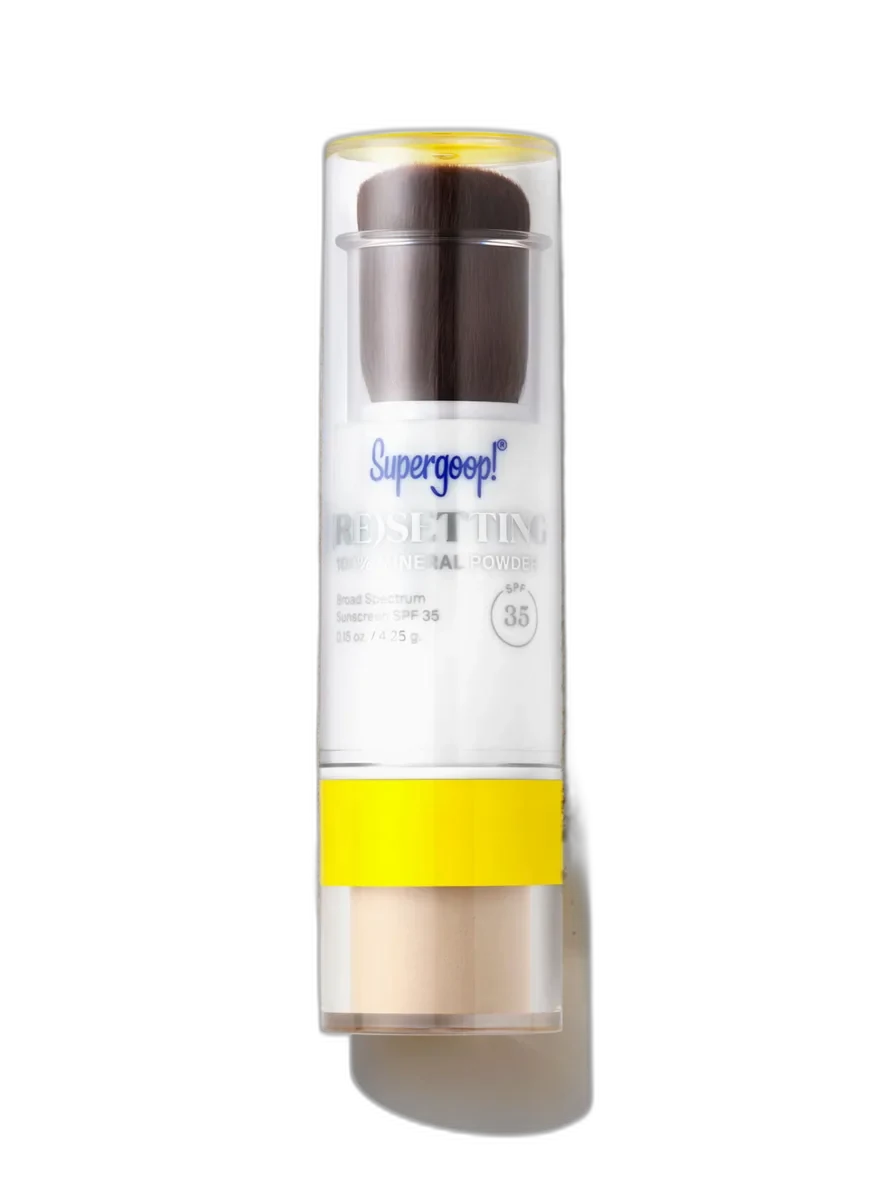
(Re)setting 100% Mineral Powder SPF 35
On-the-Go SPF MVP
 Verified reviewer
Pros & cons.
- +Makes SPF reapplication over makeup effortless with a 10-second brush application
- +Near-maximum 24.7% zinc oxide as the sole UV filter provides broad-spectrum protection
- +Ceramide NP and ascorbyl palmitate add barrier support and antioxidant defense beyond basic UV blocking
- +Fragrance-free, mineral-only formula is exceptionally gentle for sensitive and reactive skin
- +Light-diffusing microspheres create a genuine soft-focus, pore-smoothing effect
- +Portable twist-brush design fits in any bag for on-the-go use
- +Non-nano zinc oxide addresses both reef-safety and absorption concerns
- −At $35 for 0.15 oz, the cost per gram is significantly higher than liquid mineral sunscreens
- −Powder application cannot realistically achieve the application density required for labeled SPF protection
- −Dispensing mechanism has a learning curve — first-time users frequently spill powder
- −Only four shades, which may not adequately match all skin tones
- −Brush is difficult to clean without introducing moisture into the powder chamber
- −Should not be relied upon as standalone primary sun protection
The full review.
Every dermatologist gives the same advice about sunscreen reapplication: every two hours of sun exposure, reapply. And almost nobody does it. The morning application is manageable — it’s part of the routine, it goes on bare skin or under makeup, and it takes thirty seconds. But the midday reapplication? That requires carrying a bottle, finding a mirror, smearing cream over a face of carefully applied makeup, and walking back into a meeting looking like you just applied a face mask in the bathroom. The compliance rate for sunscreen reapplication is, to put it charitably, abysmal.
Supergoop’s (Re)setting 100% Mineral Powder SPF 35 exists because of this compliance gap. It is a finely milled mineral powder with 24.7% zinc oxide — just barely below the FDA-allowed maximum — dispensed through a built-in soft-bristled brush. You twist the base, tap, and buff it onto your face like setting powder. It takes ten seconds, it does not disturb makeup, and it deposits a layer of UV protection that functions as both a sun shield and an oil-absorbing touch-up. It transforms sunscreen reapplication from a disruption into a quick cosmetic refresh.
The formulation deserves credit for being more than just zinc oxide in a tube. Ceramide NP supports the skin barrier — a thoughtful addition given that mineral powders can be drying over the course of a day. Ascorbyl palmitate provides lipid-soluble antioxidant backup, catching free radicals that any UV light sneaking past the zinc oxide might generate. Olive glycerides add a touch of emolliency. The light-diffusing silica and polymethyl methacrylate spheres create a genuine soft-focus effect that smooths the appearance of pores and imperfections. This is a sunscreen that was engineered to make you look better, not just more protected.
The finish is genuinely impressive for a powder product. It mattifies without looking flat or chalky, controls shine for three to five hours on combination skin, and creates a natural, lit-from-within look rather than the matte-as-drywall effect that some setting powders inflict. It is available in four shades — Translucent, Light, Medium, Deep — which provides basic coverage across skin tones, though the shade range could reasonably be expanded.
The built-in brush is both the product’s greatest convenience and its greatest frustration. In practice, the twist-and-buff application is intuitive once you figure it out. But the learning curve on first use is real. The dispensing mechanism requires twisting the base to push powder up through the bristles, and if you twist too aggressively or hold the tube at the wrong angle, powder cascades everywhere. Multiple reviewers describe their first encounter with this product as a small mineral avalanche over their bathroom counter. The instructions could be clearer. Once mastered, though, the portability is unmatched — the slim tube fits in a pocket, a clutch, or a desk drawer, ready for a ten-second SPF refresh.
Now for the question that hovers over every powder sunscreen: does it actually protect? The answer requires honesty. SPF values are tested at an application density of 2 mg/cm², and achieving that density with a powder applied via brush is extraordinarily difficult. Research consistently shows that most people apply far less powder than would be needed to achieve the labeled SPF. This does not mean the product is useless — any zinc oxide on the skin provides some UV absorption, and the 24.7% concentration means even a thin layer delivers meaningful protection. But it means the (Re)setting Powder is best understood as a supplemental SPF boost, not a standalone sun defense. Apply your liquid or cream SPF 30+ in the morning, and use this powder to maintain and refresh that protection throughout the day. That is the honest use case, and it is still tremendously valuable.
The ingredient list is remarkably clean. No fragrance, no essential oils, no chemical UV filters, no common irritants. The zinc oxide is non-nano, addressing concerns about nanoparticle absorption and reef impact. This is one of the safest, most broadly tolerable SPF products on the market, suitable for sensitive, reactive, and even post-procedure skin. Pregnant users will appreciate the mineral-only formula.
Value is where the product gets squeezed. At $35 for 0.15 ounces — four and a quarter grams — you are paying a premium for the delivery system and the formulation quality. If you use this daily for midday touch-ups, a tube lasts roughly four to six weeks. That is approximately $8-9 per month just for supplemental SPF, on top of whatever your primary sunscreen costs. For a brand that has built its identity on making sunscreen accessible and non-negotiable, the price creates a tension between the mission and the math.
The Allure Best of Beauty award in 2022 reflects the industry’s recognition that this product solves a real problem elegantly. Supergoop has been refining this concept since the original Invincible Setting Powder SPF 45 around 2018, and the (Re)setting reformulation shows the learning. The current version has better texture, better skin-supporting ingredients, and a more refined dispensing mechanism than its predecessor.
Ultimately, the (Re)setting Powder earns its place in a skincare routine not by being the strongest sunscreen, but by being the sunscreen you will actually use at two in the afternoon. That compliance factor — the bridge between knowing you should reapply and actually doing it — is worth more than any SPF number. Just pair it with a proper liquid or cream sunscreen in the morning and let the powder handle the rest of the day.
Formula
Ingredient analysis.
Full INCI list
Active Ingredient: Zinc Oxide 24.7%. Inactive Ingredients: Calcium Aluminum Borosilicate, Silica, Trimethylsiloxysilicate, Calcium Sodium Borosilicate, Polymethyl Methacrylate, Lauroyl Lysine, Polyglyceryl-10 Pentaisostearate, Boron Nitride, Triethoxycaprylylsilane, Ethylhexylglycerin, Nylon-6/12, Sodium Dehydroacetate, Olive Glycerides, Ascorbyl Palmitate, Ceramide NP. May Contain: Iron Oxides (CI 77492, CI 77491, CI 77499)
Skin match.
The science.
The Science
Zinc oxide is one of two FDA-approved inorganic (mineral) UV filters and remains the gold standard for single-ingredient broad-spectrum protection. This formula uses 24.7% zinc oxide—just under the 25% regulatory maximum—to cover both UVA and UVB wavelengths. People often wrongly assume zinc oxide works by reflecting UV rays like a mirror. A 2016 study shows metal oxide sunscreens protect skin mainly through semiconductor band-gap absorption; reflection or scattering accounts for less than 5% of UV protection (Cole et al., 2016).
A 2017 risk assessment of zinc oxide in sunscreens found a margin of safety of 448.2, which is well above the threshold of concern. This confirms zinc oxide is safe for topical use at concentrations up to 25%. The study also found minimal systemic absorption even with repeated application (2017).
Application density is the critical question for powder sunscreens. SPF testing uses 2 mg/cm², but studies show users typically apply only 0.5-1.5 mg/cm² for liquid formulations. Applying 1 mg/cm² via brush is difficult. Consequently, the real-world SPF of a powder is likely much lower than the labeled value. A 2020 review noted that powder sunscreens provide meaningful supplemental UV protection but are not equivalent to properly applied liquid or cream sunscreens.
The non-nano zinc oxide formulation addresses two issues: nanoparticle skin penetration (non-nano particles are too large to penetrate intact stratum corneum) and environmental impact (non-nano particles are less bioavailable in marine environments). A 2013 review in Nanotechnology, Science and Applications confirmed non-nano metal oxide particles show low irritation potential and minimal skin penetration.
References
- Metal oxide sunscreens protect skin by absorption, not by reflection or scattering — Photodermatology, Photoimmunology & Photomedicine (2016)
- Risk assessment of zinc oxide, a cosmetic ingredient used as a UV filter of sunscreens — Journal of Toxicological Sciences (2017)
- Titanium dioxide and zinc oxide nanoparticles in sunscreens: focus on their safety and effectiveness — Nanotechnology, Science and Applications (2013)
Dermatologist Perspective
Dermatologists emphasize that the best sunscreen is the one used and reapplied. Board-certified dermatologists see powder mineral sunscreens as a tool to improve reapplication compliance, especially for patients wearing makeup who resist cream-based reapplication. Dermatologists typically recommend this powder SPF as a supplement to, not a replacement for, a properly applied liquid or cream sunscreen in the morning. The zinc oxide-only formula at near-maximum concentration works for patients with rosacea, post-procedure sensitivity, or reactions to chemical UV filters. Dermatologists note that any zinc oxide on the skin provides UV protection, and the compliance benefit of an easy-to-use powder may outweigh the theoretical shortfall in application density.
Where it fits in your routine.
Twist the brush base one to two turns to dispense powder through the bristles. Tap the brush against the back of your hand to distribute powder evenly. Buff onto the face in circular motions, focusing on the T-zone, nose bridge, cheeks, and forehead — areas of highest sun exposure. Apply over your morning liquid or cream SPF to set and boost coverage. Reapply every 2 hours during direct sun exposure. Store upright so powder does not clog the brush.
At $35 for 0.15 oz, the (Re)setting Powder costs more per gram than liquid mineral sunscreens. The value is not the zinc oxide; it is the delivery system and the compliance it enables. The (Re)setting Powder has no refill option (unlike the Glow-setting version), increasing long-term costs. One tube lasts about 4-6 weeks with daily touch-ups. For a brand founded in 2007 with a history of sun protection innovation, the price reflects formulation and packaging engineering, though budget-conscious consumers can find cheaper powder SPF alternatives.
The (Re)setting Powder works for makeup wearers reapplying sunscreen without ruining their look, oily-skinned people wanting a mattifying SPF touch-up, and anyone needing a gentle mineral-only formula for sensitive or post-procedure skin.
Skip this if you need standalone primary sun protection — use a liquid or cream SPF as your foundation. Users with very dry skin may find the mattifying effect too drying for midday use. Budget-conscious consumers may find the $35 price for 0.15 oz of setting%20100%25%20Mineral%20Powder%20SPF%2035) expensive.
Product details.
A built-in soft-bristled kabuki-style brush dispenses finely milled loose mineral powder. The powder feels lightweight and silky, blending without visible particles or chalkiness. Applying it feels more like using a finishing powder than a sunscreen.
Fragrance-free and has no detectable scent. It is one of the cleanest sensory experiences in the SPF category.
A cylindrical twist-up tube has a built-in retractable brush. Twisting the base dispenses powder through the bristles. The design is portable and fits in a bag or pocket. The dispensing mechanism has a learning curve; first-time users often spill powder while learning the twist mechanism, and some find the brush does not consistently deliver enough product.
The first use requires trial and error with the twist mechanism. Once mastered, application is intuitive: twist, tap, buff. It immediately reduces shine and provides a soft-focus smoothing of pores. The powder feels light, not heavy or chalky, and does not disturb existing makeup. No shade leaves a white cast.
4-6 weeks with daily touch-up use (reapplying once or twice during the day)
12 months
spring summer
The backstory.
Supergoop! recognized that the biggest barrier to consistent sunscreen use isn't the morning application — it's the reapplication. Nobody wants to smear a cream over their makeup at lunch. The (Re)setting Powder evolved from the brand's earlier Invincible Setting Powder SPF 45 (launched around 2018), reformulated with a higher zinc oxide concentration and added skincare ingredients. The name change to '(Re)setting' reflects the product's dual purpose: re-setting makeup and resetting your SPF protection.
About Supergoop!
Established Brand (5–20 years)Holly Thaggard founded Supergoop! in 2007 to change how the world views sunscreen. The brand is Leaping Bunny and PETA certified cruelty-free. Supergoop! specializes in sun protection with formulas designed for daily wear. The (Re)setting powder evolved from the Invincible Setting Powder SPF 45, which first launched around 2018.
Common myths.
Mineral powder sunscreens offer the same SPF protection as liquid sunscreens.
SPF testing requires applying 2 mg/cm² of product to achieve the labeled protection factor. It is extremely difficult to achieve this application density with a powder — studies suggest most users apply far less. Powder SPFs are best used as a supplemental SPF boost on top of a liquid or cream sunscreen, not as standalone primary sun protection.
Zinc oxide reflects UV rays like a mirror.
Modern research shows zinc oxide protects primarily by absorbing UV radiation through semiconductor band-gap energy transitions, not by reflecting or scattering light. A 2016 study confirmed that reflection provides less than 5% of UV protection from metal oxide sunscreens — absorption accounts for the vast majority.
FAQ.
How often should I reapply Supergoop (Re)setting Powder?
Reapply every 2 hours during direct sun exposure, like any sunscreen. The twist-brush format allows easy midday reapplication without disturbing makeup. For indoor days with minimal sun exposure, one morning application over your liquid SPF is sufficient.
Does Supergoop (Re)setting Powder leave a white cast?
No — the powder has four shades (Translucent, Light, Medium, Deep) that blend into various skin tones without a white cast. The Translucent shade works for most light to medium skin tones. Medium or Deep shades prevent chalkiness on deeper skin tones.
How do I dispense the powder without spilling it?
Twist the tube base slowly; a few turns dispense powder through the brush. Tap the brush against your hand to spread powder through the bristles before buffing it onto your face. For first use, twist slowly and hold the brush upright so powder does not fall out.
Is Supergoop (Re)setting Powder reef-safe?
This powder excludes oxybenzone and octinoxate (the UV filters most linked to coral reef damage) and uses non-nano zinc oxide as the only UV filter. No universal 'reef-safe' certification standard exists, but this formulation meets Hawaii's reef-protection legislation criteria.
Can I use Supergoop (Re)setting Powder on sensitive skin?
Yes — this is one of the gentlest SPF products available. The zinc oxide-only formula has no chemical UV filters, no fragrance, no essential oils, and no common irritants. Ceramide NP supports barrier function. It works for sensitive, reactive, and post-procedure skin.
What the community says.
"Effortless SPF reapplication over makeup throughout the day"
"Effective mattifying and shine control with a natural-looking finish"
"Built-in brush is portable and travel-friendly for on-the-go use"
"Mineral-only formula is gentle enough for sensitive and reactive skin"
"Sets makeup without looking cakey or adding visible product buildup"
"Soft-focus effect visually minimizes pores and smooths skin texture"
"Packaging is confusing to operate — difficult to figure out dispensing mechanism initially"
"Brush may not dispense enough powder for consistent, meaningful UV protection"
"Very small amount of product (0.15 oz) for $35 — poor value per gram"
"Only four shades available, which may not match all skin tones accurately"
"Questions remain about whether powder application delivers the labeled SPF level"
"Brush is difficult to clean without getting water into the powder chamber"
Featured in.
People also looked at.