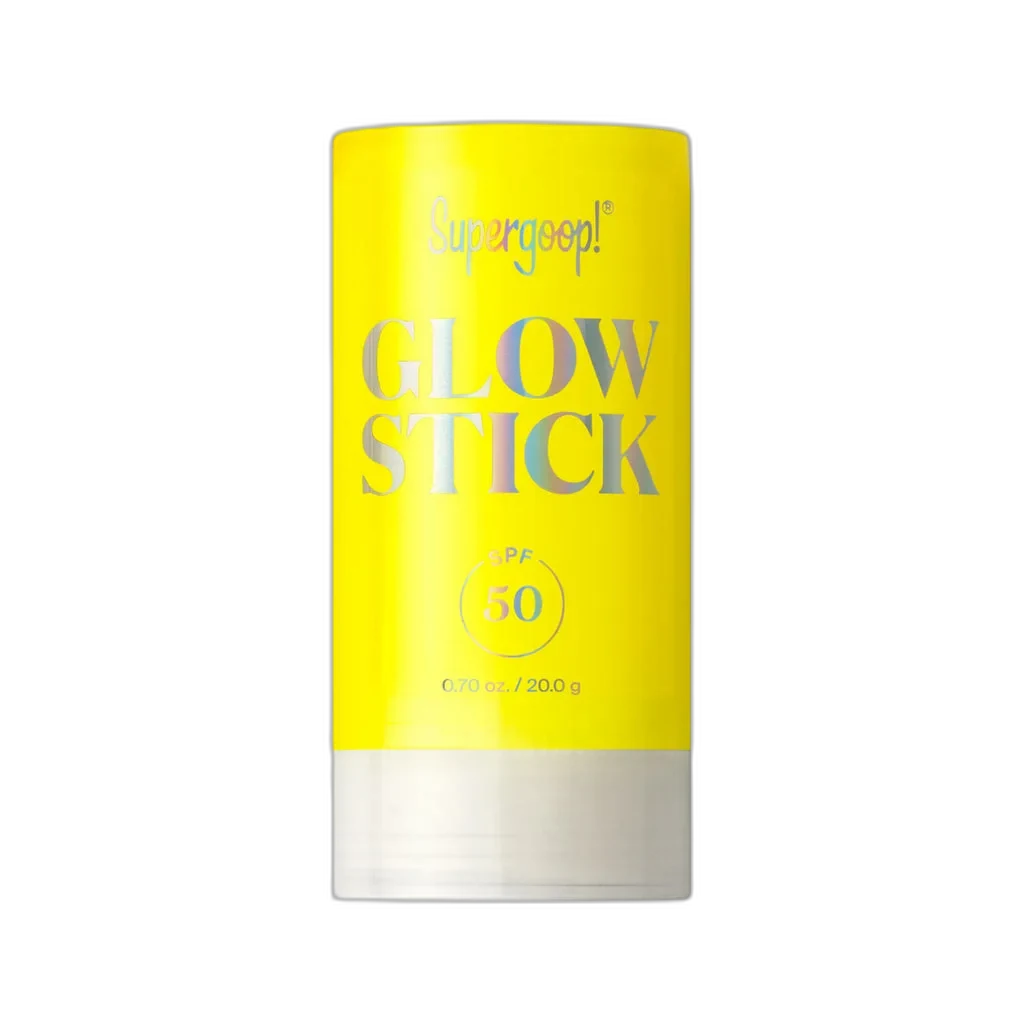
Glow Stick SPF 50
Glow-Boosting SPF
 Verified reviewer
Pros & cons.
- +Buriti oil delivers a genuinely beautiful golden-hour glow that doubles as a natural highlighter
- +Double-stabilized avobenzone ensures reliable UVA protection that doesn't degrade throughout the day
- +Mess-free stick format is ideal for on-the-go SPF reapplication without touching the face
- +Botanical oil blend (tamanu, meadowfoam, sunflower) provides real skin nourishment beyond basic SPF
- +Fragrance-free with no common irritants — well-tolerated by most skin types
- +Travel-friendly solid format with zero leaking risk in bags or luggage
- +Zero white cast — the sheer golden tint enhances all skin tones
- −Dewy, oil-rich finish is too shiny for oily and combination skin types
- −At $32 for 0.70 oz, the cost per application is significantly higher than liquid SPF alternatives
- −Stick format makes it difficult to achieve the application density required for the labeled SPF 50
- −Product softens and can melt in temperatures above approximately 90°F
- −Oil-based formula may contribute to clogged pores in acne-prone skin
- −Limited to glow-seeking users — those wanting a matte or natural finish should look elsewhere
The full review.
There is a reason highlighters sell better than sunscreens. One makes you look immediately, visibly better. The other asks you to trust that invisible damage is being prevented by an invisible product that you can’t see, feel, or appreciate in the mirror. Supergoop understood this asymmetry when they created the Glow Stick — a sunscreen that borrows the reward loop of cosmetics. You apply it, you look in the mirror, you look better, you want to apply it again later. Suddenly, reapplication isn’t a chore driven by guilt. It’s a beauty step driven by vanity. And vanity, it turns out, is a far more reliable motivator than sun safety statistics.
The Glow Stick launched in 2018 and immediately demonstrated this thesis by selling out at Sephora multiple times. The product is a twist-up stick with a golden, semi-translucent formula that catches light the way expensive highlighters do. The luminous effect comes primarily from buriti oil — an Amazonian fruit oil so rich in beta-carotene that it is naturally orange-gold. When you swipe the stick across your cheekbones, the bridge of your nose, your collarbones, or your shoulders, the carotenoid pigments create a warm, lit-from-within glow that is sheer enough to work on any skin tone but visible enough to register as genuinely flattering.
Beneath the glow, the UV protection is serious. Three chemical filters — avobenzone at 3%, octisalate at 5%, and octocrylene at the FDA-maximum 10% — provide broad-spectrum SPF 50 with PA++++ UVA coverage. What makes this formula particularly robust is the double-stabilization system for avobenzone. Octocrylene absorbs the excited triplet-state energy that would normally degrade avobenzone under UV exposure, and diethylhexyl syringylidenemalonate (listed among the inactive ingredients) provides an additional photostabilization mechanism. This belt-and-suspenders approach means the UVA protection holds up over the course of a day, even during extended outdoor time.
The oil base is where the Glow Stick diverges from typical sunscreen sticks. Most stick sunscreens use wax-heavy formulas that deposit a matte, slightly chalky film — functional but unappealing. The Glow Stick replaces that approach with a collection of botanical oils: buriti for carotenoid antioxidants, tamanu for anti-inflammatory and healing support, meadowfoam for oxidation-resistant moisture, and sunflower seed oil for linoleic acid and barrier support. The result is a product that feels more like a hydrating balm than a sunscreen — smooth, emollient, and genuinely nourishing for dry or dehydrated skin.
The texture on application is satisfying. The stick glides without dragging, melting slightly on contact with warm skin and spreading into a thin, even film. There is no tugging, no white cast, and no detectable sunscreen smell — just a faint, naturally tropical aroma from the botanical oils. The entire experience is calibrated to feel luxurious rather than practical.
This luxury, however, comes with a clear audience limitation. The dewy, oil-rich finish that dry skin types adore is the same finish that oily skin types find intolerable. On combination or oily skin, the Glow Stick reads less as ‘golden hour glow’ and more as ‘I forgot to blot.’ If your T-zone produces significant oil, this product will amplify that rather than control it. There is no version of this formula that works as a mattifying sunscreen — the entire concept is built around luminosity, and that cuts both ways.
The practical concerns with stick sunscreens apply here as well. Achieving the 2 mg/cm² application density that SPF testing requires is difficult with a stick — you need to swipe back and forth over each area multiple times, which most users don’t do. The Glow Stick absolutely provides meaningful UV protection with typical application, but calling it SPF 50 is aspirational unless you are very deliberate about coverage. The most honest use case is as a touch-up and glow-boost over a liquid or cream sunscreen applied in the morning.
The product is also temperature-sensitive. The oil-rich formula softens in heat, and leaving it in a hot car or a beach bag in direct sun will turn your stick into an expensive mess. It resolidifies when cooled, but the texture may not return to its original smooth consistency. Store it in a cool place, and don’t test its heat tolerance on the hottest day of summer.
Value is the Glow Stick’s most significant weakness. At $32 for 0.70 ounces, the cost per gram is steep even by prestige sunscreen standards. The larger 1.23-ounce size improves the math somewhat. If you use it daily on face, chest, and shoulders, a stick lasts roughly six to eight weeks for face-only use, less if you are generous with body application. For a product positioned as something you should reapply throughout the day, the economics of finishing a $32 tube in six weeks add up.
But here is what the math misses: this is one of the only sunscreens that people actively look forward to applying. It sits on a vanity next to makeup, not in a medicine cabinet next to the first aid kit. It goes in a clutch for a night out, not just in a beach bag. The Glow Stick does something that almost no sunscreen manages — it makes sun protection feel like self-care rather than self-discipline. For dry-skinned people who want their SPF to make them look radiant, who travel frequently and need a leak-proof format, or who simply refuse to reapply something that makes them look worse, the Glow Stick is worth every penny. For everyone else, there are less expensive ways to achieve SPF 50.
Ingredient analysis.
Full INCI list
Active Ingredients: Avobenzone 3.0%, Octisalate 5.0%, Octocrylene 10.0%. Inactive Ingredients: C12-15 Alkyl Benzoate, Calendula Officinalis Extract, Calophyllum Inophyllum Seed Oil, Caprylic/Capric Triglyceride, Dibutyl Ethylhexanoyl Glutamide, Dibutyl Lauroyl Glutamide, Dicaprylyl Carbonate, Diethylhexyl Syringylidenemalonate, Helianthus Annuus (Sunflower) Seed Oil, Isododecane, Isohexadecane, Limnanthes Alba (Meadowfoam) Seed Oil, Mauritia Flexuosa Fruit Oil, Octyldodecanol, Pentaclethra Macroloba Oil, Polyester-8, Tocopherol
Skin match.
The science.
The Science
The Glow Stick's UV filter system uses the avobenzone-octocrylene synergy, a highly studied combination in sunscreen chemistry. Avobenzone (butyl methoxydibenzoylmethane) is the only FDA-approved organic filter that absorbs effectively across the critical UVA1 range (340-400nm), but it is photolabile — UV exposure triggers a photodegradation pathway that destroys the molecule within hours. A 2006 study by Gaspar and Maia Campos in the International Journal of Pharmaceutics shows that octocrylene significantly enhances avobenzone photostability in combination, quenching the triplet-state energy that drives degradation (Gaspar & Campos, Int J Pharm, 2006).
This formula adds a second stabilization layer with diethylhexyl syringylidenemalonate. This ingredient stabilizes avobenzone through a different mechanism, providing redundant protection against photodegradation. This dual approach is more robust than using octocrylene alone.
A 2019 review by Berardesca et al. in JEADV evaluated octocrylene's safety profile and confirmed it is safe at concentrations up to 10% (the exact concentration used in this product), with rare contact allergy reports and effective avobenzone stabilization (Berardesca et al., JEADV, 2019).
The botanical oil base adds photoprotection beyond the UV filters. Buriti oil's high carotenoid content — particularly beta-carotene — provides antioxidant quenching of singlet oxygen and free radicals generated by UV exposure. While carotenoids are not UV filters in the regulatory sense, their ability to neutralize reactive oxygen species adds cellular protection that complements the chemical UV absorption.
References
- Evaluation of the photostability of different UV filter combinations in a sunscreen — International Journal of Pharmaceutics (2006)
- Review of the safety of octocrylene used as an ultraviolet filter in cosmetics — Journal of the European Academy of Dermatology and Venereology (2019)
Dermatologist Perspective
Dermatologists value sunscreen formats that improve patient compliance; the Glow Stick's cosmetic appeal addresses a common barrier to consistent sun protection. Board-certified dermatologists note that while stick sunscreens require more deliberate application to achieve labeled SPF, any zinc-free chemical sunscreen a patient actually reapplies is better than a higher-SPF product that stays in the medicine cabinet. Dermatologists typically recommend the Glow Stick as a complement to a properly applied liquid sunscreen in the morning, noting the stick format works well for touch-ups on exposed areas like cheekbones, nose bridge, and shoulders. Most patients tolerate the fragrance-free, oil-based formula well, though dermatologists may steer acne-prone patients toward non-comedogenic alternatives.
Where it fits in your routine.
Twist up a small amount. Swipe back and forth 3-4 times over each area for coverage. Apply to the face, ears, neck, chest, and shoulders—any sun-exposed area. Use it over or under makeup. Apply to the high points of the face for a subtle glow-and-protect effect. Reapply every 2 hours in direct sun or after 40 minutes of water or sweat. Store in a cool place away from direct heat.
At $32 for 0.70 oz, the Glow Stick is one of the most expensive sunscreens per ounce in the prestige market. The 1.23 oz size offers better value per unit. For a brand with nearly two decades of sun-protection innovation, the price reflects a unique formulation — no direct equivalent combines this UV protection with this luminous finish. Value depends on whether you value the cosmetic glow as much as the sun protection. The price is hard to justify as a pure SPF product. As a hybrid sunscreen-highlighter, it occupies a category of one.
The Glow Stick works for dry and normal skin types wanting a sunscreen that acts as a luminous highlighter. It suits frequent travelers needing a leak-proof SPF format and anyone who avoids sunscreen reapplication because they dislike the process.
Skip the Glow Stick if you have oily or acne-prone skin that doesn't tolerate oil-rich products, if you prefer a matte or invisible finish from your sunscreen, or if you need the most cost-effective SPF per ounce. Those requiring the full labeled SPF 50 from a single product should use a liquid or cream sunscreen instead.
Product details.
This solid, twist-up stick has a dry-oil feel and glides smoothly across skin. The formula is thick and emollient but not waxy. It melts slightly and spreads easily on warm skin. The botanical oil base feels softer than typical sunscreen sticks, but the stick can soften in hot environments.
Fragrance-free with no added perfume, but natural botanical oils (buriti, tamanu, meadowfoam) give it a faint, pleasant, slightly tropical aroma. Most users call it mild and inoffensive.
A clear twist-up tube shows the golden-hued product inside. The retractable stick format keeps hands clean. It fits in a pocket or small bag. The clear casing shows how much product remains. The cap clicks securely to prevent accidental deployment.
The first swipe shows an immediate, visible glow — the buriti oil's natural carotenoid tint catches light on cheekbones and shoulders. The application feels smooth and hydrating, like a balm rather than a sunscreen. It has no adjustment period, no stinging, and no white cast. The luminous effect shows from the first use.
6-8 weeks with daily use on face only; shorter if used on body areas
12 months
spring summer
The backstory.
The Glow Stick launched in 2018 as Supergoop's entry into the sunscreen-as-cosmetic conversation. Holly Thaggard's insight was that people would be more likely to reapply sunscreen if the act of reapplication made them look better rather than just more responsible. By combining SPF 50 protection with the luminous, golden finish of a highlighter stick, the Glow Stick turned sun protection into a beauty step — and promptly sold out at Sephora multiple times, proving that vanity could be a powerful motivator for healthy behavior.
About Supergoop!
Established Brand (5–20 years)Holly Thaggard founded Supergoop! in 2007 to change how people view sunscreen. The brand is Leaping Bunny and PETA certified cruelty-free and leads the US prestige sun-protection market. The Glow Stick sold out at Sephora repeatedly after its 2018 launch.
Common myths.
Sunscreen sticks offer the same SPF protection as lotions and creams.
SPF tests use a 2 mg/cm² application density. Stick sunscreens need multiple passes to reach this density; most users apply less than the tested amount. The Glow Stick provides UV protection, but reaching the full SPF 50 requires thorough application. Dermatologists recommend swiping back and forth over each area at least 3-4 times.
The golden glow from this stick leaves a visible color on dark skin.
The buriti oil's warm, golden tint is sheer and translucent. It enhances skin tones instead of depositing opaque color. The Glow Stick blends invisibly across all skin tones, showing subtle luminosity rather than a visible shade.
FAQ.
Is Supergoop Glow Stick good for oily skin?
The Glow Stick works best for dry to normal skin. The thick formula and dewy finish look too shiny on oily or combination skin. If you have oily skin but like the concept, use it only on high points (cheekbones, bridge of nose) as a targeted highlighter instead of all-over sunscreen.
Can I use Supergoop Glow Stick as my only sunscreen?
You can, but SPF 50 protection requires thorough application—swipe each area 3-4 times. Most people apply less than the tested amount using a stick format. For maximum protection, use a liquid or cream SPF as your base and the Glow Stick for touch-ups and glow throughout the day.
Does Supergoop Glow Stick melt in hot weather?
The oil-rich formula softens in high heat or direct sunlight. Store it away from heat; do not leave it in a hot car or in direct sun at the beach. The product works best below about 90°F. If it softens, it re-solidifies when cooled, though the texture may change slightly.
Can I wear Supergoop Glow Stick under makeup?
Yes — the Glow Stick works well under or over makeup. Use it under foundation for a luminous base. Use it over makeup as a highlighter and for SPF touch-ups. The dewy finish works best with natural or satin-finish foundations, not full-matte looks.
What gives Supergoop Glow Stick its golden color?
Buriti oil (Mauritia Flexuosa), an Amazonian fruit oil high in beta-carotene, provides the warm golden hue. This is a natural carotenoid pigment, not a synthetic colorant. The sheer, translucent tint blends into all skin tones as warm luminosity instead of a visible color.
What the community says.
"Convenient stick format makes hands-free SPF application and reapplication effortless"
"Beautiful luminous glow that doubles as a natural-looking highlighter"
"No white cast — works beautifully across all skin tones"
"Travel-friendly solid format with zero risk of leaking in bags"
"Hydrating and nourishing for dry skin types thanks to botanical oils"
"Pleasant, subtle scent that doesn't smell like typical sunscreen"
"Too oily and shiny for combination or oily skin types"
"Expensive at $32 for only 0.70 oz of product"
"Stick can become soft or melt in hot temperatures during summer"
"Takes time to fully absorb — can feel heavy on bare skin initially"
"Difficult to achieve even, adequate SPF coverage with a stick applicator"
"Dewy finish may be too intense for those preferring a matte or natural look"
People also looked at.