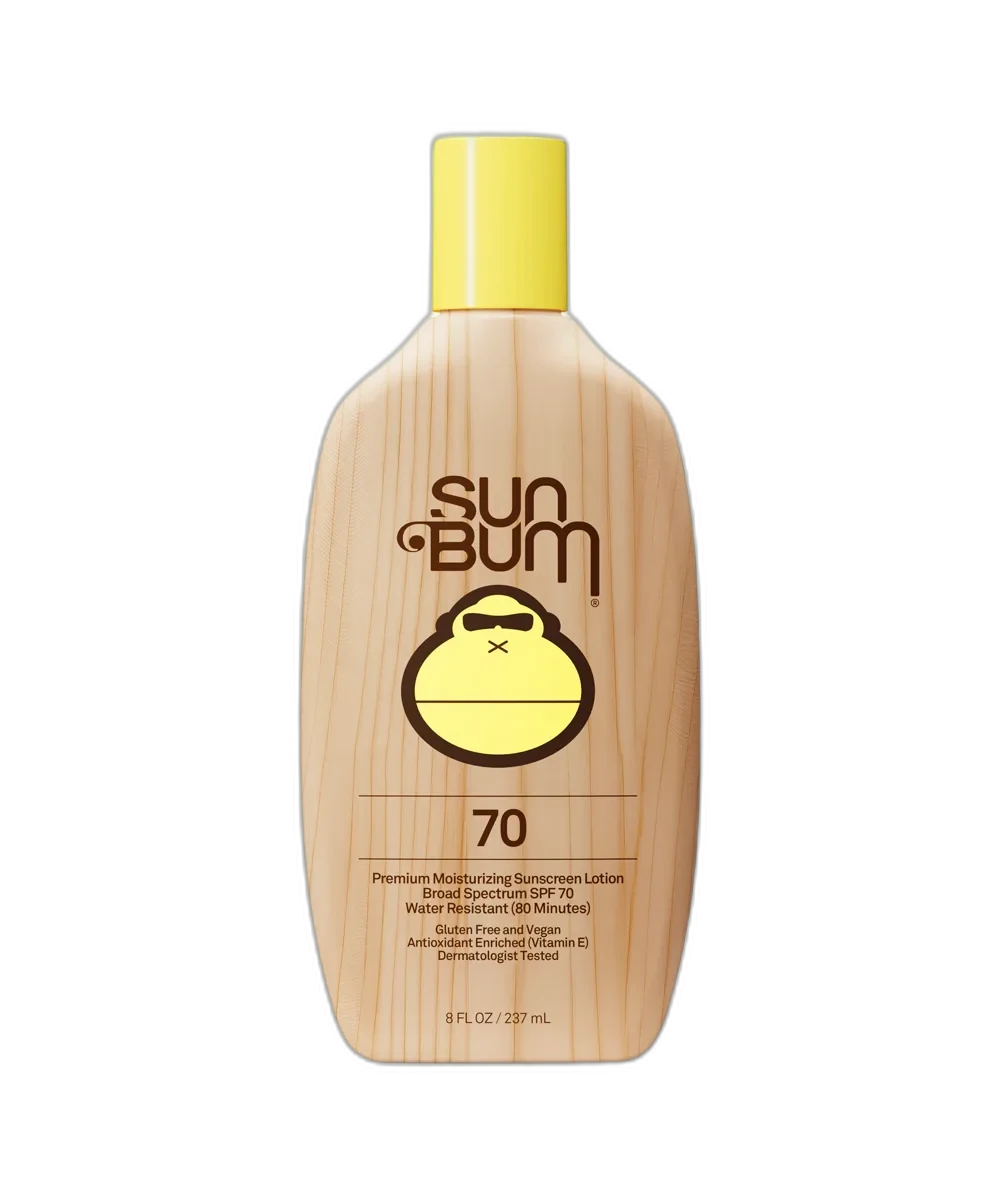
Original SPF 70 Sunscreen Lotion
Maximum Chemical SPF
 Verified reviewer
Pros & cons.
- +Higher SPF provides a real-world buffer for the majority of people who under-apply sunscreen
- +Only about $1 more than the SPF 50 for meaningful additional protection margin
- +Contains Dipotassium Glycyrrhizate to help soothe skin under the higher UV filter load
- +Pleasant tropical coconut-banana scent consistent with the Sun Bum brand identity
- +80-minute water resistance for swimming and active outdoor use
- +Multiple size options including a TSA-friendly 3 oz travel size
- +Vegan and cruelty-free certified by both PETA and Leaping Bunny
- −Homosalate at 15% exceeds the EU SCCS recommended maximum of 7.34% by more than double
- −Slightly thicker texture than the SPF 50 version takes longer to absorb
- −Contains fragrance that limits suitability for sensitive and reactive skin
- −Cetyl Palmitate in the base is potentially comedogenic for acne-prone users
- −Real-world SPF difference over SPF 50 is marginal for proper appliers
The full review.
Some sunscreen shoppers always choose the highest SPF on the shelf. There is a rational argument for this, but they must understand what they are buying. Sun Bum’s Original SPF 70 Lotion targets these shoppers, and its formulation shows the trade-offs inherent in high-SPF chemical sunscreens.
The main difference between this and Sun Bum’s SPF 50 body lotion is Homosalate. The SPF 50 uses 10% Homosalate. This formula uses 15%—the FDA maximum. This 50% increase in one UV filter raises the SPF from 50 to 70, but it carries trade-offs. The European Commission’s Scientific Committee on Consumer Safety recommends limiting Homosalate to 7.34% due to endocrine disruption concerns at higher levels. This product contains more than double that limit. The FDA has not adopted the European restriction; Homosalate remains Category III (insufficient safety data, not proven unsafe), but the regulatory disagreement matters.
The rest of the UV filter system is standard Sun Bum: Avobenzone at 3% for UVA protection, Octocrylene at 10% as a UV absorber and Avobenzone photostabilizer, and Octisalate at 5% for UVB coverage. This four-filter combination appears across the Sun Bum Original line.
One notable detail: the SPF 70 includes Dipotassium Glycyrrhizate, a licorice root derivative with anti-inflammatory properties, which the SPF 50 formula lacks. This is intentional. Higher chemical UV filter concentrations increase the risk of skin irritation and sensitization. Adding a soothing agent acts as a hedge against the higher filter load. It is a small detail regarding the practical results of chasing higher SPF numbers.
Texture
The texture is slightly thicker than Sun Bum’s SPF 50 body lotion. It is not a paste, but it has more substance and takes longer to rub in. Cetyl Palmitate in the base creates a more emollient feel; some users will like this on dry skin, while others may find it too heavy in humidity. Once absorbed, it leaves a satin finish without the sticky residue found in many high-SPF lotions.
Scent
The scent is classic Sun Bum—a tropical coconut-banana blend. It uses the same fragrance profile as the SPF 50 body lotion. It remains polarizing: users either enjoy the scent or dislike it. For a body sunscreen used at the beach, the scent is part of the product’s identity and appeal.
Reality
Here is the reality of SPF 70 versus SPF 50. In lab conditions using standard testing protocols, SPF 50 blocks about 98% of UVB radiation and SPF 70 blocks about 98.6%. This 0.6 percentage point difference is clinically negligible. The real-world value of higher SPF depends on human behavior. Studies show people often apply only 25-50% of the recommended sunscreen amount. If you under-apply by half, the effective SPF drops significantly—SPF 50 becomes roughly SPF 25, and SPF 70 becomes roughly SPF 35. That real-world buffer is the actual value of higher-SPF products.
Water Resistance
The water resistance is the same 80-minute maximum as the SPF 50, the FDA limit for such claims. Film-forming polymers and silicones help the UV filters stay on during swimming and sweating. You must still reapply after 80 minutes of water exposure or two hours of continuous sun.
Packaging
At $17.49 for 6 ounces—one dollar more than the SPF 50 in the same size—the price barely penalizes the higher SPF. The 8 oz bottle at $18.99 and the 3 oz travel size at $11.49 are also available. This is competitive pricing for a branded body sunscreen, and the per-ounce cost stays in drugstore territory.
Certifications
The certifications match the Sun Bum Original line: PETA and Leaping Bunny cruelty-free, vegan, and Hawaii Act 104 compliant. The same reef-safety caveat applies—compliance with Hawaii’s law means no Oxybenzone or Octinoxate, but Octocrylene is still present and appears on some environmental concern lists.
Best for
This product suits high-exposure scenarios: tropical vacations, all-day outdoor events, water sports, and inconsistent reapplication. The extra SPF buffer compensates for poor application habits, and the scent and texture encourage use. It is less suitable for those cautious about chemical UV filter exposure—the 15% Homosalate is a concern if following European regulatory trends—or for sensitive skin types needing gentler formulas.
Sun Bum’s SPF 70 is an honest product for a specific use case. It is not dramatically superior to SPF 50, and the price reflects that. It is an insurance policy: the extra coverage is unnecessary if you apply correctly, but it provides protection if you do not.
Ingredient analysis.
Full INCI list
Active Ingredients: Avobenzone 3%, Homosalate 15%, Octisalate 5%, Octocrylene 10%. Inactive Ingredients: Water, Cetyl Palmitate, Hydrated Silica, Acrylates/C12-22 Alkyl Methacrylate Copolymer, Caprylyl Methicone, Styrene/Acrylates Copolymer, Cetyl Dimethicone, Glyceryl Stearate, PEG-100 Stearate, Polyester-8, Trideceth-6, Dimethicone, Ethylhexyl Stearate, Fragrance, Phenoxyethanol, Dimethyl Capramide, Sodium Polyacrylate, Trimethylsiloxysilicate, Xanthan Gum, BHT, Dipotassium Glycyrrhizate, Tocopheryl Acetate, Ethylhexylglycerin, Tetrasodium Glutamate Diacetate
Skin match.
The science.
The Science
This SPF 70 differs from Sun Bum's SPF 50 body lotion primarily in Homosalate concentration: 15% versus 10%. Homosalate absorbs UVB and has appeared in sunscreens since the 1970s, though its safety profile faces scrutiny. In 2020, the European Commission's SCCS issued an opinion stating Homosalate is not safe at the EU's permitted 10% concentration and recommended a 7.34% maximum due to endocrine-disrupting concerns. This product contains over twice that recommended limit.
The 2020 JAMA study by Matta et al. on systemic absorption of sunscreen actives applies here. Under maximal use, Homosalate showed the most persistent absorption of all tested filters, staying above the FDA's 0.5 ng/mL safety threshold through day 21 after stopping application. At 15% concentration on large body surface areas, systemic exposure is proportionally higher than in lower-concentration formulations.
The Avobenzone-Octocrylene photostabilization system works the same way as in the SPF 50: Octocrylene quenches Avobenzone's excited triplet state via energy transfer to prevent irreversible photodegradation. A 2023 review in Pharmaceutics (Garavadde & Pires) showed Octocrylene improves Avobenzone's photostability from about 23% to 90% after UV irradiation — a finding that explains why this pairing is essential for UVA protection.
The SPF difference between 50 and 70 follows the SPF-to-protection relationship: SPF measures UVB radiation reaching the skin. SPF 50 allows 1/50th (2%) through; SPF 70 allows 1/70th (1.4%) through. SPF 70 reduces UVB penetration by an extra 0.6 percentage points. However, this relationship changes non-linearly during real-world use. Because SPF drops exponentially when under-applied, the buffer from higher SPF matters more when you apply less product.
References
- Effect of Sunscreen Application on Plasma Concentration of Sunscreen Active Ingredients: A Randomized Clinical Trial — JAMA (2020)
- Drug Delivery Strategies for Avobenzone: A Case Study of Photostabilization — Pharmaceutics (2023)
Dermatologist Perspective
Dermatologists usually recommend SPF 30-50 as sufficient for most people if applied correctly, noting the incremental protection from SPF 50 to 70 is clinically minimal. However, many board-certified dermatologists see practical value in higher SPF as a buffer for under-application — a near-universal patient behavior. The American Academy of Dermatology recommends SPF 30 or higher without an upper limit. For this specific product, dermatologists would note the Homosalate concentration exceeds European safety recommendations, and the fragrance and chemical UV filter system makes it unsuitable for patients with sensitive skin conditions. For patients facing intense sun exposure who will use a chemical sunscreen anyway, the marginal protection advantage and comfortable formulation support compliance.
Where it fits in your routine.
Apply about one ounce (a shot glass full) to all exposed body areas 15 minutes before sun exposure. Squeeze a line of product along each limb and the torso, then rub it in. Cover the back of the neck, tops of ears, backs of hands, and tops of feet. Reapply every 2 hours during continuous sun exposure, or every 80 minutes after swimming or heavy sweating. Higher SPF does not change reapplication frequency — UV filter degradation occurs regardless of the initial SPF rating.
At $17.49 for 6 ounces ($2.92/oz) — just over a dollar more than the SPF 50 in the same size — the price adds little for the higher SPF rating. The 8 oz bottle at $18.99 ($2.37/oz) has the best per-unit value. This price competes with drugstore body sunscreens at this SPF level and costs much less than prestige brands. Choosing SPF 70 over SPF 50 depends on how you apply it: consistent, generous appliers see little benefit. Under-appliers — most people — get a real-world protection buffer for almost no extra cost.
Outdoor enthusiasts facing intense or long sun exposure — tropical vacations, beach days, hiking, water sports — who want the widest margin of error for UV protection. This works well for people who under-apply sunscreen or cannot reapply as often as recommended.
This works for anyone with sensitive skin, fragrance sensitivities, or concerns about high-concentration chemical UV filter exposure. The SPF 50 version offers nearly identical protection with less Homosalate if you apply sunscreen generously and reapply consistently. Acne-prone users should note the Cetyl Palmitate in the formula.
Product details.
Sun Bum's signature tropical banana-coconut fragrance is warm and noticeable. It evokes beach culture and lasts longer than some lighter sunscreen formulations.
Bright yellow squeeze tube (6 oz) or bottle (8 oz) features Sun Bum's Sonny mascot. A 3 oz travel-friendly size also exists. All packaging uses the brand's yellow-and-brown beach aesthetic.
It squeezes out as a white lotion that rubs in invisibly within minutes. The tropical scent is immediate. It spreads with slightly more resistance than the SPF 50 version, but remains manageable for full-body application. Most users feel no stinging or tingling upon application.
1-2 months with regular full-body application for beach or outdoor days
12 months
spring summer
The backstory.
Sun Bum's SPF 70 Lotion exists for the consumers who want the highest number on the label — the people heading to tropical vacations, all-day outdoor festivals, or extended water sports where psychological comfort in maximum rated protection matters. While dermatologists generally consider SPF 50 sufficient, the SPF 70 provides a small additional buffer for under-appliers and addresses the anxiety of intense sun exposure scenarios.
About Sun Bum
Established Brand (5–20 years)Sun Bum started in 2010 in Cocoa Beach, Florida, and is now a top US sun care brand. SC Johnson acquired the brand in 2019. Sun Bum has PETA and Leaping Bunny cruelty-free certifications and is the official sunscreen of USA Surfing. Its formulations use standard chemical UV filter technology without clinical dermatology development.
Common myths.
SPF 70 is significantly more protective than SPF 50.
SPF 50 blocks about 98% of UVB rays, and SPF 70 blocks about 98.6%. The real-world difference is under 1 percentage point. Higher SPF matters because it provides a larger margin of error for people who under-apply — which is most people. Applying half the recommended amount of SPF 70 gives roughly SPF 35 protection, compared to SPF 25 with the SPF 50.
Higher SPF sunscreens are always thicker and feel more uncomfortable.
This SPF 70 has a thicker texture than Sun Bum's SPF 50 because it uses more Homosalate, not because of the high SPF. Other brands use different UV filter combinations to reach SPF 50-70 with lightweight, elegant textures.
FAQ.
Is SPF 70 really better than SPF 50?
Laboratory conditions show minimal difference: SPF 50 blocks about 98% of UVB and SPF 70 blocks about 98.6%. But SPF 70 offers a larger margin of error for under-application. Most people apply only 25-50% of the recommended amount, so SPF 70 gives SPF 35-50 in real-world use compared to SPF 25-35 with an SPF 50 product.
What's different between the Sun Bum SPF 70 and SPF 50 formulas?
The main difference is Homosalate concentration: 15% in the SPF 70 and 10% in the SPF 50. The SPF 70 also has Dipotassium Glycyrrhizate (a licorice root soothing agent) but the SPF 50 does not, likely to offset irritation from the higher UV filter load. The SPF 70 feels slightly thicker when applied.
Is the Sun Bum SPF 70 safe for sensitive skin?
Use caution. The 15% Homosalate concentration is higher than the European SCCS maximum of 7.34%, and the formula contains fragrance. Dipotassium Glycyrrhizate provides soothing benefits, but people with sensitive, reactive, or eczema-prone skin should use a mineral sunscreen with gentler ingredients.
Does this sunscreen work for the face?
You can use this on your face, but it is formulated as a body sunscreen. It has fragrance, Cetyl Palmitate (potentially comedogenic), and a thicker texture than face-specific formulas. Sun Bum makes a separate fragrance-free Face Lotion with a matte finish that works better for the face.
Is the Sun Bum SPF 70 reef-safe?
It complies with Hawaii Act 104 and excludes Oxybenzone and Octinoxate. It does contain Octocrylene, which some environmental groups list as reef-harmful. For the strictest reef safety, mineral-only sunscreens with zinc oxide or titanium dioxide are the conservative choice.
Community
What the community says.
"Effective high-SPF protection that prevents sunburn during intense outdoor activities"
"Pleasant tropical banana-coconut scent associated with the Sun Bum brand"
"Absorbs to a non-greasy finish without a white cast"
"Water-resistant for 80 minutes during swimming and surfing"
"Moisturizing formula that leaves skin feeling soft"
"Slightly thicker texture than lower-SPF Sun Bum variants"
"Tropical scent too strong for some users"
"Occasional reports of allergic reactions including hives in sensitive individuals"
"Some users find it doesn't absorb as cleanly as the SPF 50 formula"
"SPF 70 vs SPF 50 offers minimal additional real-world protection"
People also looked at.