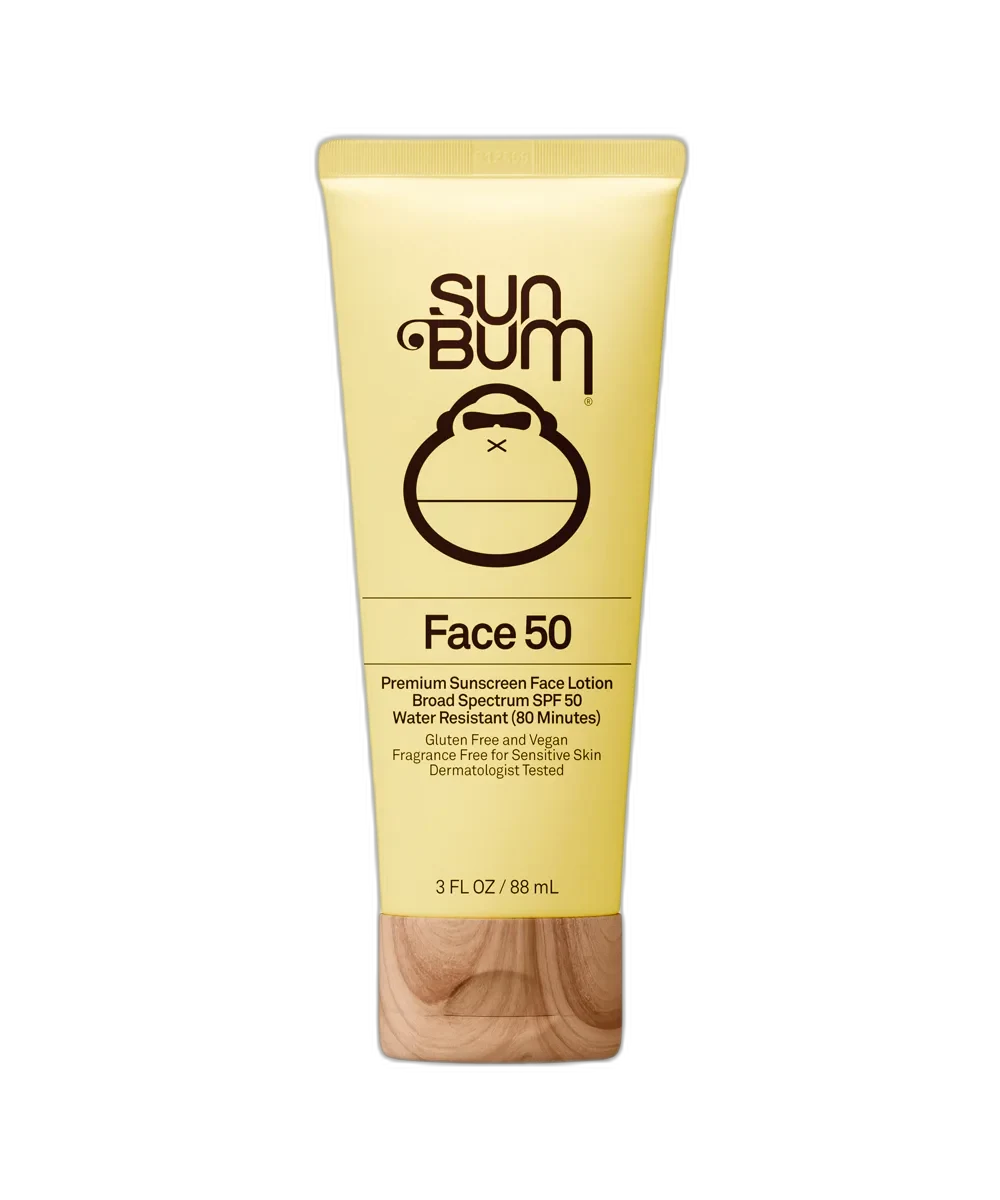
Original SPF 50 Sunscreen Face Lotion
Matte Finish Daily SPF
 Verified reviewer
Pros & cons.
- +Fragrance-free formula unlike the rest of Sun Bum's scented line
- +Matte finish sets quickly and works well under makeup
- +Lightweight texture absorbs without a white cast on any skin tone
- +Reasonable price at about $5 per ounce for a face-specific sunscreen
- +80-minute water resistance for active outdoor use
- +Oil-free formula suitable for oily and combination skin types
- +Vegan and Leaping Bunny cruelty-free certified
- −Contains Methylisothiazolinone — a documented contact allergen banned from EU leave-on products
- −Frequently reported eye stinging when the formula migrates during sweating
- −No meaningful skincare actives beyond basic UV protection
- −Contains BHT, which some consumers prefer to avoid
- −Not fully reef-safe despite Hawaii Act 104 compliance
The full review.
Sun Bum has an identity split. The brand built its personality on tropical-scented, beach-ready sun protection. Then they released the Face Lotion, which has no scent and sets to a matte finish designed to disappear under makeup. It is the serious sibling in a family of beach party extroverts.
This formula uses the same four-filter chemical UV system found across much of Sun Bum’s range: Avobenzone at 3% for UVA protection, Homosalate and Octisalate for UVB coverage, and Octocrylene as both a UV absorber and an Avobenzone photostabilizer. These use the same concentrations as the SPF 30 stick. The SPF 50 claim comes from the lotion vehicle—a water-based emulsion with silicones—rather than different filters. This allows the UV filters to form a more uniform, complete film on the skin than a wax-based stick.
The application is pleasant for a chemical sunscreen in this price range. It goes on as a light, milky white lotion that emulsifies quickly and disappears. The dimethicone and caprylyl methicone create a smooth, primer-like layer that sets to a matte finish within two to three minutes. For oily and combination skin, this works well—it adds no shine and does not compete with moisturizer for pore space. It layers under makeup without pilling and lacks the slippery, unabsorbed feeling of many chemical sunscreens.
However, eye stinging is a major problem and a frequent complaint in reviews. Avobenzone is a documented ocular irritant, and in a liquid lotion, it migrates more than a wax stick. During sweating, exercise, or humid conditions, this sunscreen moves into the eye area and burns. Many users report no issues, but it is the most common complaint across retailers. If you sweat heavily or live in a humid climate, consider this.
The second issue is technical: this formula contains Methylisothiazolinone (MI) as a preservative. MI is a well-documented contact allergen. The European Commission’s Scientific Committee on Consumer Safety has flagged it, and the EU has banned it from leave-on cosmetic products since 2016. Using it in a face lotion for daily use is a formulation choice worth questioning. MI will not cause problems for most people. But for those with MI sensitivity, this sunscreen causes contact dermatitis that may look like a reaction to UV filters or other ingredients.
The ingredient list is utilitarian. It has Tocopherol Acetate (vitamin E) as an antioxidant, but no other skincare actives. There is no hyaluronic acid, no niacinamide, and no peptides. You get sun protection and a matte finish. For the price, this is reasonable, but your morning routine must handle hydration, antioxidant protection, and active treatments before this goes on.
The fragrance-free formulation distinguishes the Face Lotion from the rest of Sun Bum’s range. For a brand built on scent, removing fragrance for a face product shows they know beach scents do not belong on the face at the office. A faint chemical sunscreen smell may exist on application from the UV filters, but it dissipates within minutes.
Water resistance is rated at 80 minutes, the maximum FDA claim. It holds up well for swimming and moderate sweating, though eye migration shows the sunscreen moves on the skin surface during perspiration even if UV protection remains intact.
At $15.49 for three ounces, the per-ounce price is reasonable for a face sunscreen. The tube lasts two to three months with daily use, making the monthly cost roughly five to eight dollars. This is an easy expense for a category where daily compliance matters most.
Sun Bum’s Face Lotion occupies an awkward middle ground. It is too utilitarian for users wanting sunscreen that also hydrates, brightens, or protects against blue light. It contains a preservative the EU bans in this category and migrates into eyes during sweating. But for someone with normal, resilient skin who wants a fragrance-free, matte, affordable daily sunscreen and does not overthink ingredients, it does its job. The question is if “competent with caveats” is enough when the market offers alternatives without these caveats.
Formula
Ingredient analysis.
Full INCI list
Active Ingredients: Avobenzone 3%, Homosalate 10%, Octisalate 5%, Octocrylene 10%. Inactive Ingredients: Water, Butyloctyl Salicylate, Hydrated Silica, VP/Hexadecene Copolymer, Styrene/Acrylates Copolymer, Dimethicone, Polyester-8, Tocopherol Acetate, BHT, Glyceryl Stearate, PEG-100 Stearate, Ethylhexyl Stearate, Behenyl Alcohol, Caprylyl Methicone, Trimethylsiloxysilicate, Dimethyl Capramide, Sodium Polyacrylate, Xanthan Gum, Trideceth-6, Disodium EDTA, Ethylhexylglycerin, Polyaminopropyl Biguanide, Methylisothiazolinone
Skin match.
The science.
The Science
This face lotion uses the same four-filter chemical UV protection system found in Sun Bum's range, but the lotion vehicle changes how those filters work compared to a wax-based stick. An emulsion system with dimethicone and film-forming polymers (Styrene/Acrylates Copolymer, VP/Hexadecene Copolymer) distributes UV filters more uniformly across the skin, creating a more consistent protective film. This uniform distribution allows the same four filters at the same concentrations to reach SPF 50 here instead of SPF 30 in the stick format — the wax matrix of a stick creates a less homogeneous film with potential coverage gaps.
The Avobenzone-Octocrylene photostabilization system drives the broad-spectrum claim. Avobenzone at 3% absorbs UVA1 radiation (310-400nm), while Octocrylene at 10% absorbs UVB/short UVA2 and stabilizes Avobenzone via triplet-state energy quenching. Homosalate (10%) and Octisalate (5%) add UVB absorption.
The 2020 JAMA randomized clinical trial by Matta et al. is the most relevant study for this formula. The study tested systemic absorption of chemical sunscreen actives under maximal use conditions and found all four ingredients in this product exceeded the FDA's 0.5 ng/mL threshold for further safety investigation. Homosalate showed the most persistent absorption, staying above the threshold through day 21 after cessation of application. The European Commission's SCCS later concluded that Homosalate is not safe at 10% concentration (the exact level in this product) and recommended reducing the maximum to 7.34%.
Separately, studies show the preservative Methylisothiazolinone (MI) is a contact allergen. A 2013 multicenter European study in the British Journal of Dermatology documented rising MI sensitization rates across Europe, which led to the EU's 2016 ban on MI in leave-on cosmetic products. While the US FDA has not restricted MI in cosmetics, dermatological literature identifies it as a common cause of cosmetic contact dermatitis.
References
- Effect of Sunscreen Application on Plasma Concentration of Sunscreen Active Ingredients: A Randomized Clinical Trial — JAMA (2020)
- Effect of Sunscreen Application Under Maximal Use Conditions on Plasma Concentration of Sunscreen Active Ingredients: A Randomized Clinical Trial — JAMA (2019)
Dermatologist Perspective
Dermatologists know cosmetic elegance affects sunscreen compliance — patients use sunscreen daily more often if it feels pleasant and works under makeup. This face lotion's matte, fragrance-free formulation addresses these compliance barriers. However, board-certified dermatologists would flag Methylisothiazolinone as a concern for patients with known contact sensitivities, and eye-stinging may limit use for patients who exercise outdoors. For patients with resilient skin seeking an affordable daily SPF 50, it provides adequate UV protection. Dermatologists managing patients with sensitive or reactive skin typically recommend MI-free alternatives.
Where it fits in your routine.
Apply a nickel-sized amount (approximately 1/4 teaspoon) to the face 15 minutes before sun exposure. Spread it evenly over the forehead, cheeks, nose, chin, ears, and neck. Let the formula set to its matte finish for 2-3 minutes before applying makeup. Reapply every 2 hours during continuous sun exposure, or every 80 minutes if swimming or sweating. To reapply over makeup at midday, blot excess oil first, then pat a fresh layer on top.
At $15.49 for 3 fluid ounces, this face lotion costs a mid-range price for dedicated face sunscreens. The $5.16 per-ounce cost is fair; it costs much less than prestige sunscreens but uses the same core UV protection technology. One tube lasts 2-3 months with daily facial application, so monthly sun protection costs around $5-8. The formula is purely functional and has no added skincare benefits to offset the price. You pay for competent SPF 50 protection in a cosmetically elegant vehicle, which offers reasonable value at this price point.
People with normal, combination, or oily skin want an affordable, fragrance-free, matte daily sunscreen that works under makeup. It suits resilient skin types that prioritize broad-spectrum protection and cosmetic elegance without extra skincare ingredients.
People with sensitive skin, eczema, or known contact allergies should avoid this formula because it contains Methylisothiazolinone. Heavy sweaters and outdoor exercisers should be cautious; the reported eye stinging during perspiration limits active use.
Product details.
Fragrance-free. Some users notice a faint chemical sunscreen smell that fades minutes after application.
White squeeze tube with flip-top cap, 3 fl oz. Features Sun Bum's yellow branding and Sonny mascot. Designed for easy one-handed dispensing.
The formula applies smoothly with a milky white appearance that turns invisible as you blend. It sets to a matte finish within a couple of minutes. Most users feel no stinging or tingling on application, though heavy sweating may cause eye irritation as the formula migrates throughout the day.
2-3 months with once-daily facial application
12 months
All Year
The backstory.
Sun Bum built its reputation on coconut-scented body sunscreens for the beach crowd, but recognized that face-specific formulations needed different priorities — no fragrance, matte finish, makeup compatibility. The Face Lotion was developed to extend the brand beyond seasonal beach use into a year-round daily sunscreen for people who already trusted Sun Bum but needed something more refined for their face.
About Sun Bum
Established Brand (5–20 years)Sun Bum started in 2010 in Cocoa Beach, Florida, and is now one of the most widely distributed sun care brands in the US. SC Johnson acquired the brand in 2019. Sun Bum has strong retail presence and consumer trust, but its formulations use standard chemical UV filter systems instead of the clinical dermatology backing found in pharmacy-heritage brands.
Common myths.
SPF 50 provides dramatically better protection than SPF 30.
SPF 30 blocks about 97% of UVB rays, and SPF 50 blocks about 98%. The real-world difference is small. Application amount and reapplication frequency matter more. SPF 50 gives a small extra buffer for people who under-apply.
Chemical sunscreens are unsafe because they enter the bloodstream.
The 2020 JAMA study shows systemic absorption of chemical UV filters (including all four actives in this product), which highlights the need for more safety data—not that these ingredients are harmful. The FDA explicitly stated these findings don't mean sunscreens are unsafe. Dermatologists agree that sun damage from unprotected exposure is a far greater established risk.
What the community says.
"Lightweight, non-greasy formula absorbs quickly into skin"
"No white cast — blends completely invisible on all skin tones"
"Matte finish works well as a makeup base"
"Fragrance-free unlike Sun Bum's signature scented body line"
"Water-resistant for 80 minutes during swimming and sweating"
"Migrates into eyes during sweating and causes significant stinging"
"Contains Methylisothiazolinone, a documented contact allergen"
"Some users report an oily feel that persists for hours"
"Minimal skincare ingredients — purely a sunscreen with no added benefits"
"Not fully reef-safe by stricter environmental standards"
Featured in.
People also looked at.