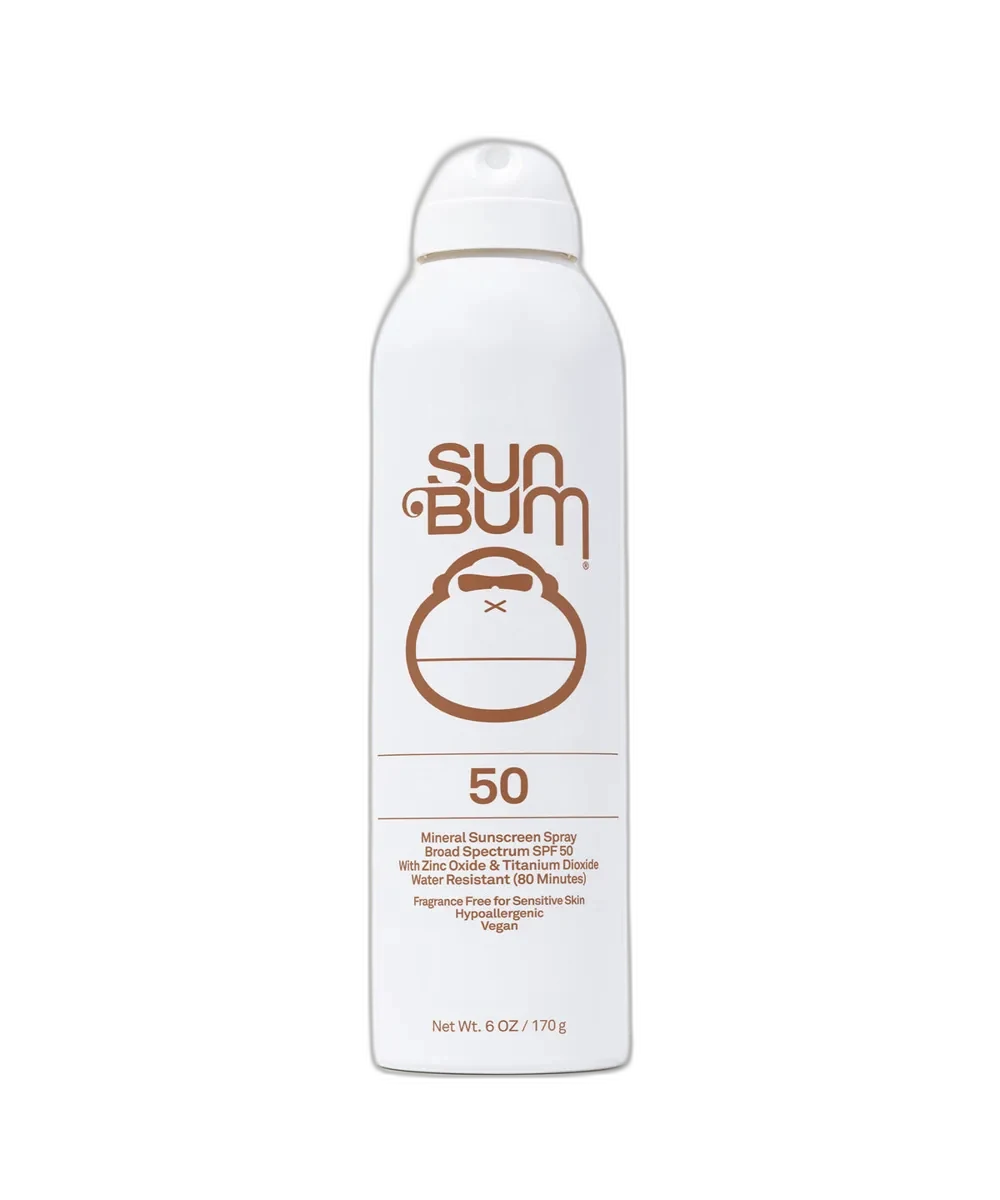
Mineral SPF 50 Sunscreen Spray
Mineral Spray Pioneer
 Verified reviewer
Pros & cons.
- +One of the few mineral sunscreens achieving SPF 50 in a spray format
- +Fragrance-free, silicone-free, and paraben-free with a gentle preservative system
- +Best per-ounce value in Sun Bum's mineral lineup at $3.42/oz
- +Bag-on-Valve technology provides even output without chemical propellants
- +Aloe vera, bisabolol, and vitamin E provide soothing and antioxidant support
- +80-minute water resistance and Hawaii Act 104 compliant
- −Sprays out as thick white cream requiring thorough rubbing — not a true spray experience
- −Significant white cast that intensifies in sweat and skin creases
- −White streaks transfer to dark clothing and fabrics
- −Spray nozzle prone to clogging from the thick mineral formula
- −Defeats the hands-free convenience that spray format promises
- −Pregnancy safety uncertain due to butyloctyl salicylate content
The full review.
The premise is elegant: take the broad-spectrum mineral protection that dermatologists love and put it in the spray format that consumers prefer for body application. The reality, as anyone who has used a mineral spray sunscreen knows, is more complicated. Zinc oxide and titanium dioxide are dense, opaque particles that do not play nicely with spray mechanisms designed for liquid chemical formulas. Sun Bum’s engineering solution is real — they use Bag-on-Valve technology, bentonite clay, microcrystalline cellulose, and silica to keep those particles suspended and dispensable — but the output tells you that nature has not been fully tamed.
What comes out of this can is a thick, white cream. Not a mist. Not a spray in any sense that matches consumer expectations built by decades of chemical spray sunscreens. It deposits a visible white layer on your skin that requires immediate and thorough rubbing to distribute. If you spray and walk away, you will look like you applied spackle to your arms.
This is not a failure of this specific product — it is a category-wide reality. Every mineral spray sunscreen on the market shares this fundamental constraint. The mineral particles are simply too large and too dense to atomize into a translucent mist. What Sun Bum has done is make the best version of this imperfect concept: the B.O.V. system provides even, controlled output; the cream blends more willingly than some competitors; and the formula stays put once rubbed in.
The dual mineral system — 16% zinc oxide and 3.4% titanium dioxide — provides robust broad-spectrum coverage at SPF 50. The zinc oxide handles the critical UVA protection across the full 320-400 nm range, while titanium dioxide boosts UVB defense. At 19.4% total mineral content, this is serious protection. The 80-minute water resistance rating holds up in practice, which matters for the beach and pool audience this product targets.
The white cast, predictably, is the dominant complaint. Even after diligent rubbing, a chalky or ashy appearance persists — particularly visible on medium to dark skin tones, and particularly visible when sweat causes the blended minerals to re-concentrate in skin creases. This is the inescapable trade-off of high-concentration mineral filters. For lighter-skinned users, the cast fades to a faint matte sheen. For everyone else, it remains a cosmetic compromise.
Credit where it is due on the supporting formula: fragrance-free, silicone-free, and paraben-free with a gentle caprylyl glycol and caprylhydroxamic acid preservative system. Aloe vera, bisabolol, and vitamin E provide soothing, anti-inflammatory, and antioxidant support respectively. Sunflower seed oil and glycerin add hydration. This is a formula that was designed with sensitive skin in mind — the kind of thoughtfulness you want in a mineral sunscreen.
Banana fruit extract is an unusual inclusion that adds mild skin-conditioning benefits while contributing to the tropical identity the brand cultivates. It is present in small enough amounts that it is a minor textural contributor rather than a significant active.
The spray format provides genuine practical advantages despite the rubbing requirement. The can is easier to carry than a tube, holds more product (6 oz versus the lotion’s 3 oz), and allows you to deposit product on hard-to-reach areas like the back and shoulders before rubbing it in. For families at the beach, the ability to spray a child’s back and then spread it is faster than trying to apply lotion to a squirming target.
At $20.49 for 6 ounces, the per-ounce cost ($3.42) is actually the best value in Sun Bum’s mineral lineup — better than the face lotion ($12.35/oz), face stick ($32/oz), and body lotion ($5.83/oz). The spray can also produces less waste since you can empty it more completely than a squeeze tube. For the price-conscious mineral sunscreen buyer, this is the most economical entry point in the Sun Bum mineral range.
The nozzle clogging is a real-world annoyance worth mentioning. The thick mineral formula can dry around the spray opening, requiring occasional clearing. Wiping the nozzle after each use and storing the can upright helps prevent this.
Sun Bum’s Mineral SPF 50 Spray represents the best current answer to an imperfect question: can mineral sunscreen be convenient? The answer is sort of. You still have to rub it in. You still get a white cast. But you get fragrance-free, silicone-free, dual-mineral SPF 50 protection in the format that holds the most product at the lowest per-ounce cost in the lineup. For families, beach-goers, and outdoor enthusiasts who have committed to mineral-only protection, the convenience gains — however imperfect — are real.
Formula
Ingredient analysis.
Full INCI list
Active Ingredients: Titanium Dioxide 3.4%, Zinc Oxide 16%. Inactive Ingredients: Water, Butyloctyl Salicylate, Helianthus Annuus (Sunflower) Seed Oil, Dicaprylyl Carbonate, Propanediol, Isocetyl Stearoyl Stearate, Methyl Dihydroabietate, Cetearyl Alcohol, Polyester-8, Sodium Stearoyl Glutamate, Coco-Glucoside, Aloe Barbadensis Leaf Juice, Musa Sapientum (Banana) Fruit Extract, Tocopherol, Glycerin, Cellulose Gum, Bentonite, Microcrystalline Cellulose, Caprylyl Glycol, Silica, Polyhydroxystearic Acid, Citric Acid, Alumina, Bisabolol, Sodium Gluconate, Caprylhydroxamic Acid
Skin match.
The science.
The Science
This spray uses 16% zinc oxide and 3.4% titanium dioxide for a 19.4% total mineral content, providing SPF 50 broad-spectrum protection. The dual-mineral system covers the UV spectrum: zinc oxide absorbs across the full UVA and UVB spectrum (290-400 nm), especially in UVA-I (340-400 nm), while titanium dioxide peaks in the UVB range (290-320 nm) with moderate UVA-II coverage.
To suspend dense mineral particles in a spray, the formula uses rheology modifiers: bentonite clay (a natural thixotropic agent that keeps particles suspended), microcrystalline cellulose (a structural scaffolding material), and silica (a thickening and anti-settling agent). Research in the International Journal of Pharmaceutics shows these suspension systems keep mineral particles distributed for long periods, but you must shake before use to ensure homogeneity.
The Bag-on-Valve (B.O.V.) dispensing system uses compressed nitrogen or air to push product from a sealed bag, so it uses no chemical propellants. Research shows B.O.V. systems maintain product sterility better than traditional pump dispensers, which matters for a preservative-light formula.
Bisabolol and aloe vera juice provide anti-inflammatory support via different mechanisms. Bisabolol inhibits cyclooxygenase activity and reduces pro-inflammatory cytokine production, while aloe polysaccharides modulate inflammatory signaling pathways. In a sunscreen used during sun exposure, this dual anti-inflammatory approach manages the sub-clinical inflammation UV radiation causes even through SPF protection.
Dermatologist Perspective
Dermatologists see mineral spray sunscreens as a convenient compromise for patients who want mineral-only protection in a spray format. Board-certified dermatologists say the critical factor for any spray sunscreen — mineral or chemical — is adequate application: the FDA recommends holding the can 4-6 inches from the skin, spraying until the skin glistens, and rubbing in thoroughly. For mineral sprays, the rubbing step is non-negotiable because mineral particles cannot self-distribute. Dermatologists note the 16% zinc oxide provides robust UVA protection for patients with melasma, hyperpigmentation, or photoaging concerns. The fragrance-free formulation works well for patients with sensitive or reactive skin. For face application, dermatologists recommend spraying onto hands first and then applying manually to avoid inhalation risk.
Where it fits in your routine.
Shake can vigorously for 5-10 seconds before each use. Hold 4-6 inches from skin and spray liberally onto each body section. Immediately rub in thoroughly with hands to ensure even distribution and minimize white cast. For face application, spray onto palms first and then apply manually — never spray directly at the face due to inhalation risk. Reapply every 2 hours during sun exposure, or immediately after swimming, sweating, or toweling off. Wipe the nozzle after each use to prevent clogging. Store upright.
At $20.49 for 6 ounces ($3.42/oz), this is the best value in Sun Bum's mineral lineup — significantly cheaper per ounce than the face lotion ($12.35/oz), face stick ($32/oz), and body lotion ($5.83/oz). The 6 oz can provides approximately 3-4 full-body applications, comparable to two tubes of the 3 oz body lotion at $34.98 combined versus $20.49 for the spray. For budget-conscious mineral sunscreen users, this is the most practical option for body coverage. The B.O.V. system also allows more complete emptying than squeeze tubes, reducing waste.
Families and beach-goers get the most product per dollar with this affordable entry into Sun Bum's mineral lineup. It works well for covering large body areas quickly if you rub it in. This is a good choice for sensitive skin, eczema, and rosacea sufferers who need fragrance-free mineral protection in a portable format.
This is not a spray-and-go product; you must rub it in like a lotion. It is not for people who cannot tolerate a visible white cast. It works for those needing a lightweight, invisible sunscreen for daily cosmetic wear. Pregnant women should consult their physician about the butyloctyl salicylate content.
Product details.
Sprays as a thick, lotion-like cream instead of a fine mist. This is a standard trait of mineral spray sunscreens because dense mineral particles do not atomize like chemical formulas. You must rub it in thoroughly after spraying to spread it evenly. It sets to a matte finish once blended.
Fragrance-free with a slight mineral/zinc scent that fades fast after application.
6 oz aluminum Bag-on-Valve (B.O.V.) spray can uses Sun Bum's signature yellow and teal mineral line branding and Sonny ape mascot. Compressed air powers the continuous spray mechanism (non-aerosol). The B.O.V. technology enables a preservative-light formula.
The first spray deposits a visible white cream that looks alarming before rubbing. The cream is thicker than expected for a spray and needs 30-60 seconds of rubbing per body section to blend. Once rubbed in, the white cast reduces but stays visible. The formula feels matte and non-greasy once dry.
3-4 full-body applications per can; lasts about 1-2 weeks of regular beach or outdoor use
24 months
spring summer
The backstory.
Sun Bum developed the mineral spray around 2020 to address a genuine gap: consumers who preferred mineral-only protection but wanted the application convenience of a spray format. Achieving SPF 50 with mineral filters in a spray can required formulation engineering with suspension agents (bentonite, cellulose, silica) to keep the dense mineral particles evenly distributed in the canister, plus Bag-on-Valve technology that dispenses product via compressed air rather than chemical propellants.
About Sun Bum
Established Brand (5–20 years)Sun Bum launched in 2010 in Cocoa Beach, Florida and SC Johnson acquired it in 2019. Products are manufactured in the USA and are PETA certified cruelty-free. The brand's mineral line responds to reef-safe legislation and rising consumer demand for mineral-only sun protection.
Common myths.
Mineral spray sunscreens work like regular spray sunscreens — spray and go.
Chemical spray sunscreens partially self-distribute, but mineral sprays deposit a thick cream that requires manual rubbing. Mineral particles (zinc oxide, titanium dioxide) cannot form a uniform protective film without manual spreading. Spraying alone leaves patchy, inadequate protection.
Spray sunscreens are less effective than lotions.
When applied properly (sprayed generously and rubbed in), spray sunscreens provide the same SPF protection as lotions. User behavior is the problem—many people spray too quickly, too far away, and skip rubbing, which leaves inadequate coverage. Mineral sprays use a thick cream output that encourages better rubbing habits.
FAQ.
Does the Sun Bum Mineral SPF 50 Spray leave a white cast?
Yes — users complain about this most. The 16% zinc oxide and 3.4% titanium dioxide mix leaves a visible white layer that needs thorough rubbing to minimize. White streaks reappear when you sweat. The cast is particularly noticeable and hard to remove on medium to dark skin tones.
Does the Sun Bum Mineral Spray actually spray like a regular spray sunscreen?
No — it sprays as a thick, lotion-like cream instead of a fine mist. All mineral spray sunscreens work this way because dense mineral particles do not atomize like chemical filters. You must spray the product onto skin and rub it in by hand, like a lotion. The spray format offers portability, not no-touch application.
Is the Sun Bum Mineral SPF 50 Spray safe during pregnancy?
Zinc oxide and titanium dioxide are widely considered pregnancy-safe mineral UV filters. However, this formula contains butyloctyl salicylate, a salicylate ester that some pregnancy-cautious sources flag for potential absorption. Consult your healthcare provider before using this during pregnancy.
Can I spray the Sun Bum Mineral Spray directly on my face?
The FDA advises against spraying any sunscreen directly onto the face to avoid inhalation. Spray the product onto your hands, then apply to your face and rub in. This method provides more even facial coverage than a direct spray.
How is the Bag-on-Valve spray different from aerosol?
Bag-on-Valve (B.O.V.) technology uses compressed air to push product from a sealed bag inside the can. It avoids chemical propellants (like butane or propane) found in aerosol sunscreens. This method uses fewer preservatives and produces zero aerosol emissions. The spray output is thicker and more controlled than aerosol.
What the community says.
"Effective broad-spectrum mineral protection without chemical UV filters"
"Fragrance-free formula appreciated by sensitive skin users"
"Hawaii reef-compliant and environmentally conscious"
"Convenient spray can format for a mineral sunscreen"
"80-minute water resistance holds up during water activities"
"Non-greasy once rubbed in and fully dried down"
"Significant white cast requiring extensive rubbing to minimize"
"Sprays out as thick cream rather than fine mist — essentially a lotion in a spray can"
"White streaks appear when sweating during outdoor activity"
"Can transfer to clothing and dark fabrics"
"Spray nozzle can clog with the thick mineral formula"
"Defeats the convenience purpose of a spray by requiring thorough rubbing"
Featured in.
People also looked at.