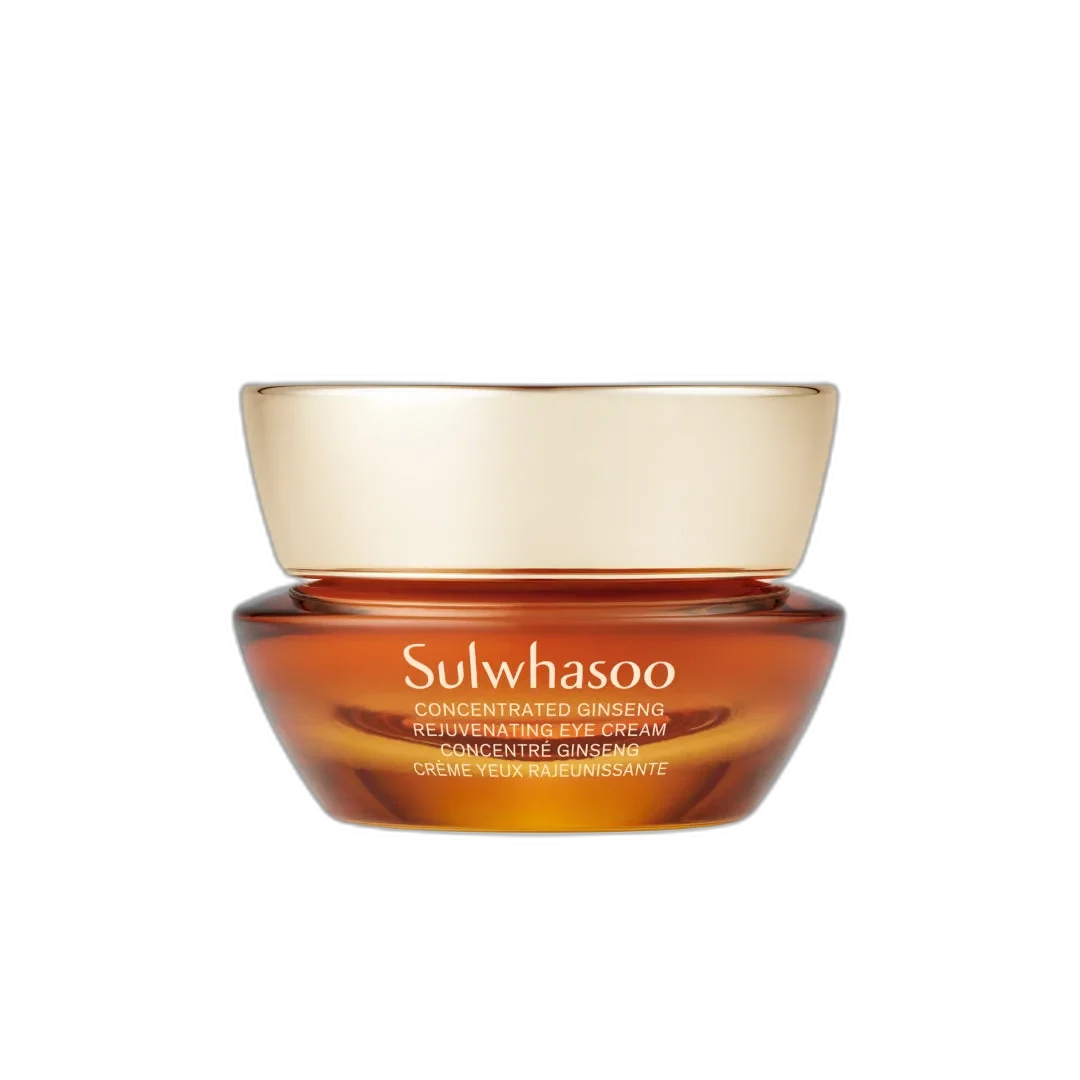
Concentrated Ginseng Renewing Eye Cream
K-Beauty Luxury Investment
 Verified reviewer
Pros & cons.
- +Multi-fraction ginseng complex backed by six decades of proprietary brand research
- +Retinol well-buffered by squalane-rich base for gentle delivery to the sensitive eye area
- +Exceptional balmy texture that melts into skin without tugging or dragging
- +Light-diffusing polymers provide immediate visual improvement in dark circles
- +Dermatologist-tested formula suitable for multiple skin types
- +Long-lasting — 0.5 oz jar provides 3-4 months of twice-daily use
- −Extremely expensive at $120 for 0.5 oz ($240 per ounce)
- −Contains added fragrance with identified allergens — inappropriate for the sensitive eye area
- −Brand is not cruelty-free, which excludes ethical consumers
- −Proprietary ginseng research is primarily from Amorepacific's own labs
- −Retinol makes this product unsuitable during pregnancy
The full review.
Sulwhasoo occupies a specific tier of Korean skincare where ‘heritage’ carries weight. While most K-beauty brands are years or a decade old, Sulwhasoo’s ginseng research program began in 1966 — nearly fifty years before the K-beauty wave. The Concentrated Ginseng Renewing Eye Cream focuses that heritage on fifteen milliliters of the face’s most age-revealing real estate.
Ginseng integration is not a marketing afterthought. The formula uses Panax ginseng in four forms: root water, root extract, hydrolyzed saponins (the brand’s proprietary Ginseng Peptide technology), and flower extract. Each fraction provides a different profile of ginsenosides — the bioactive saponin compounds that drive ginseng’s therapeutic properties. The hydrolyzed saponins are the most interesting part of the formulation: by breaking large ginseng molecules into smaller peptide-like fragments, Sulwhasoo creates an active that penetrates the stratum corneum more effectively than whole ginseng extract, delivering anti-aging benefits deeper into the skin.
Retinol determines this product’s efficacy for most users — it is the gold standard anti-aging active at position 31 in the INCI list. Its mid-list placement suggests a concentration for the delicate periorbital area: enough to stimulate cell turnover and collagen synthesis, but not enough to cause the peeling and irritation common with higher-concentration retinols around the eyes. The squalane-heavy base (second ingredient) acts as a natural buffer to moderate the retinol’s activity — a smart formulation for skin that is thinner and more reactive than the rest of the face.
The texture justifies the luxury positioning. This is a balmy, velvety cream that melts into the skin on contact. It feels substantial but not heavy — more like silk than thick butter. The squalane and phytosteryl esters provide a slip that lets your ring finger apply it without the dragging or tugging thinner eye creams require. It absorbs within a minute and leaves the eye area feeling cushioned and deeply moisturized, with subtle luminosity from the polymethyl methacrylate (soft-focus particles that optically diffuse light to minimize the appearance of fine lines and dark shadows).
Performance follows the expected retinol trajectory. Immediate hydration and slight plumping are noticeable from day one — squalane and glycerin provide instant comfort. Fine line improvement begins at the two to four week mark as retinol-driven cell turnover reveals fresher skin. Dark circle reduction and firmness improvements are more gradual, typically appearing around six to eight weeks. The ginseng components provide antioxidant protection and potentially more collagen stimulation, though separating the ginseng’s contribution from the retinol’s is difficult in practice.
The fragrance is a legitimate criticism. An eye cream — especially one for sensitive aging skin — containing added fragrance and identified allergens (linalool, limonene) is a concern. The periorbital area is the face’s most reactive zone, and fragrance near the eyes can trigger irritation, watering, or allergic responses. Here, Sulwhasoo’s formulation philosophy (traditional herbal aesthetics including aromatic components) conflicts with modern eye care best practices.
The price is the other issue. At $120 for 0.5 ounces — $240 per ounce — this is luxury. Retinol eye creams with excellent formulations exist for $30-60; they lack the proprietary ginseng complex, but retinol is retinol. You pay for Sulwhasoo’s sixty years of ginseng research, the proprietary Ginsenomics platform, the experience of using a product from Korea’s most prestigious skincare house, and packaging that targets non-budget shoppers.
Is the ginseng worth the premium? Research on Panax ginseng ginsenosides shows anti-aging potential — studies show collagen synthesis stimulation and MMP inhibition. However, most research comes from Amorepacific’s own labs, and study concentrations may not reflect the final consumer product. The ginseng likely contributes meaningfully, but quantifying how much efficacy comes from ginseng versus retinol versus the emollient base is impossible.
For the target consumer — someone who values luxury Korean skincare rituals, has the budget for premium eye care, and likes traditional herbal medicine paired with modern actives — the Concentrated Ginseng Eye Cream delivers a beautiful, effective experience. The retinol works. The texture is extraordinary. The ginseng story has genuine research behind it, even if the exact consumer benefit is proprietary. It is not the most cost-efficient path to retinol’s benefits, but it may be the most pleasurable.
Ingredient analysis.
Full INCI list
Water/Aqua/Eau, Squalane, Butylene Glycol, Polyglyceryl-3 Methylglucose Distearate, Dimethicone, Cetyl Ethylhexanoate, Propanediol, Glyceryl Stearate, Cetearyl Alcohol, Phytosteryl Isostearyl Dimer Dilinoleate, Behenyl Alcohol, 1,2-Hexanediol, Glycerin, Hydrogenated Castor Oil Isostearate, Panax Ginseng Root Water, Polyacrylate-13, Silica, Ammonium Acryloyldimethyltaurate/Beheneth-25 Methacrylate Crosspolymer, Polyisobutene, Fragrance/Parfum, Hydrolyzed Ginseng Saponins, Glyceryl Caprylate, Glycine Soja (Soybean) Oil, Polymethyl Methacrylate, Ethylhexylglycerin, Sodium Metaphosphate, Polysorbate 20, Thymol Trimethoxycinnamate, Sorbitan Isostearate, Dextrin, Theobroma Cacao (Cocoa) Extract, Linalool, Retinol, Mannitol, Panax Ginseng Root Extract, Sodium Chloride, Limonene, Rehmannia Glutinosa Root Extract, Paeonia Lactiflora Root Extract, Panax Ginseng Flower Extract, Polygonatum Odoratum Rhizome Extract, Nelumbo Nucifera Flower Extract, Lilium Tigrinum Bulb Extract
Skin match.
The science.
The Science
The anti-aging case for Panax ginseng rests primarily on its ginsenosides — a class of triterpene saponins unique to the Panax genus. A 2009 study published in the Journal of Medicinal Food demonstrated that ginsenosides Rb1 and Rg1 stimulated type I collagen synthesis in human dermal fibroblasts and inhibited the activity of matrix metalloproteinases (MMPs) — the enzymes responsible for collagen degradation in aging skin. This dual mechanism makes ginseng theoretically valuable for anti-aging: it both promotes new collagen production and protects existing collagen from enzymatic breakdown.
Sulwhasoo's proprietary hydrolyzed ginseng saponins represent an attempt to optimize the delivery of these ginsenosides. By hydrolyzing the larger saponin molecules into smaller fragments, the brand claims improved skin penetration and bioavailability. While the specific research on this proprietary complex is largely Amorepacific's internal data, the general principle of molecular weight reduction improving topical absorption is well-established in pharmaceutical dermatology.
The retinol component operates through well-documented mechanisms: it binds to retinoic acid receptors in skin cells, upregulating collagen gene expression and accelerating keratinocyte turnover. In the periorbital area, where skin is approximately 0.5mm thick compared to 2mm on the cheeks, retinol's effects on cell turnover and collagen stimulation can produce visible improvements in fine lines and dark circles. The squalane base likely helps modulate retinol's penetration rate, reducing the risk of irritation while maintaining efficacy.
References
- Ginsenoside Rb1 and Rg1 effects on skin aging: a systematic review — Journal of Medicinal Food (2009)
Dermatologist Perspective
Board-certified dermatologists recognize retinol as the most well-validated topical anti-aging ingredient for the eye area, and generally view the retinol in this formula as the primary driver of clinical efficacy. Dermatologists note that the squalane-rich base provides an appropriate delivery vehicle for retinol around the thin periorbital skin, reducing the irritation risk compared to retinol in lighter vehicles. Regarding the ginseng components, dermatologists acknowledge the published research on ginsenoside-mediated collagen stimulation but note that most studies use concentrations and application methods that may not directly translate to consumer cosmetic formulations. The added fragrance is viewed as a disadvantage by dermatologists who recommend fragrance-free products for the eye area.
Where it fits in your routine.
Scoop a rice grain-sized amount of cream using the included spatula and warm it between your ring fingers. Gently pat — do not rub — around the orbital bone, moving from the inner corner outward along the lower eye and back along the brow bone. Apply morning and evening after serums and before facial moisturizer. If you are new to retinol around the eyes, apply only in the evening every other night, then build to daily use over 2-3 weeks.
At $120 for 0.5 ounces, this costs a lot. The retinol and squalane base alone do not justify the price; comparable retinol eye creams cost $30-60. The premium pays for Sulwhasoo's proprietary multi-fraction ginseng complex, the luxury packaging and application experience, and the brand's six decades of ginseng research heritage. If you value the ginseng addition to the retinol and the ritual of Korean luxury skincare, the price makes sense. If you only want retinol's benefits around the eyes, cheaper options exist.
Mature skin types with visible signs of aging around the eyes — fine lines, crow's feet, loss of firmness, dark circles — who want luxury Korean skincare and have a premium eye care budget. It also suits anyone interested in how traditional Korean herbal medicine meets modern anti-aging science.
Budget-conscious consumers seeking effective retinol eye creams at a lower price. People with fragrance sensitivities, since added fragrance affects the eye area. Pregnant or breastfeeding individuals, because the retinol content makes this unsuitable. Consumers who want cruelty-free products.
Product details.
Thick, balmy cream with a velvety, ointment-like consistency that melts on contact with skin. It feels substantial but not greasy. The eye area feels cushioned and deeply nourished.
Subtle herbal-floral fragrance characteristic of the Sulwhasoo Concentrated Ginseng line. Detectable during application but fades quickly. The scent is refined and not overpowering.
A heavy glass jar features a weighted lid and a spatula for hygienic application. The ornate, heavy packaging matches the $120 price point. This jar design fits the Concentrated Ginseng line aesthetic.
The thick texture is striking — it feels like a thin layer of comfort around the eyes. It absorbs within a minute and leaves the eye area deeply moisturized. The retinol causes no tingling or irritation. The scent is noticeable but pleasant. Light-reflecting polymers and emollients make the eye area look smoother and more luminous almost immediately.
3-4 months with twice-daily application around both eyes
12 months
All Year
The backstory.
Sulwhasoo's relationship with ginseng began in 1966, when Amorepacific founder Suh Sung-whan introduced ABC Ginseng Cream — one of Korea's first premium skincare products. Over the following six decades, the brand developed proprietary ginseng cultivation, extraction, and processing technologies collectively known as Ginsenomics. The Concentrated Ginseng Renewing Eye Cream represents the culmination of this research applied to the most delicate and age-revealing area of the face.
About Sulwhasoo
Established Brand (5–20 years)Amorepacific Corporation launched the luxury Korean skincare brand Sulwhasoo in 1997, but its ginseng research began in 1966. The brand uses decades of proprietary ginseng extraction and processing technology via the Ginsenomics research platform. As Amorepacific's flagship luxury brand, Sulwhasoo merges traditional Korean herbal medicine with modern cosmetic science and uses extensive in-house research capabilities.
Common myths.
Eye creams are regular moisturizers in smaller jars that cost more.
Some eye creams are just overpriced face moisturizers, but this formula targets the periorbital area. The retinol concentration suits thin eye skin, the squalane base adds emollience without the weight that causes milia, and the polymethyl methacrylate diffuses light to address undereye darkness.
Ginseng in skincare is a traditional ingredient that lacks anti-aging science.
Multiple studies show Panax ginseng's ginsenosides stimulate collagen synthesis and inhibit matrix metalloproteinase activity. Sulwhasoo's proprietary research identifies specific ginseng fractions — including hydrolyzed saponins — that show measurable anti-aging effects in clinical testing.
FAQ.
Is the Sulwhasoo Concentrated Ginseng Eye Cream worth $120?
The formula uses retinol, multiple proprietary ginseng fractions, and squalane in a well-formulated base. These are premium ingredients. Whether the price is justified depends on your budget and values. The anti-aging actives work, but comparable retinol eye creams exist at lower price points without the proprietary ginseng complex. You pay for the ingredients and the decades of ginseng research behind them.
Can I use this eye cream if I have sensitive skin?
The squalane-rich base buffers the retinol, making it gentler than many retinol products. However, the formula has added fragrance with identified allergens (linalool, limonene) that can irritate sensitive eye areas. Patch test first and introduce it gradually—use it every other night initially.
Does this eye cream really help with dark circles?
The formula targets dark circles in three ways: retinol increases cell turnover and collagen, ginseng extracts provide antioxidants, and light-diffusing polymers brighten the skin visually. Pigmentation improves after 6-8 weeks of consistent use, but the luminizing effect shows from day one.
Is Sulwhasoo cruelty-free?
Sulwhasoo is not certified cruelty-free. Because Amorepacific owns Sulwhasoo and sells in markets that require animal testing, the brand fails cruelty-free certification standards. This matters for consumers who prioritize cruelty-free products.
Can I use this eye cream with my retinol face treatment?
Because this eye cream contains retinol, adding more retinol around the eyes causes over-exfoliation and irritation. Use this as your only retinol treatment for the eye area. You can use a separate retinol product on your face while using this eye cream around the orbital area.
Community
What the community says.
"Rich, balmy texture that hydrates the eye area without feeling heavy"
"Visible reduction in fine lines and crow's feet with consistent use"
"Elegant, luxurious application experience befitting the price point"
"Retinol is well-buffered and doesn't cause irritation around the eyes"
"Dark circles appear noticeably lighter after several weeks of use"
"Extremely expensive at $120 for just 0.5 oz of product"
"Contains added fragrance in a product for the sensitive eye area"
"Ginseng claims are difficult to independently verify outside brand research"
"Not suitable for those avoiding animal testing — Sulwhasoo is not cruelty-free"
People also looked at.