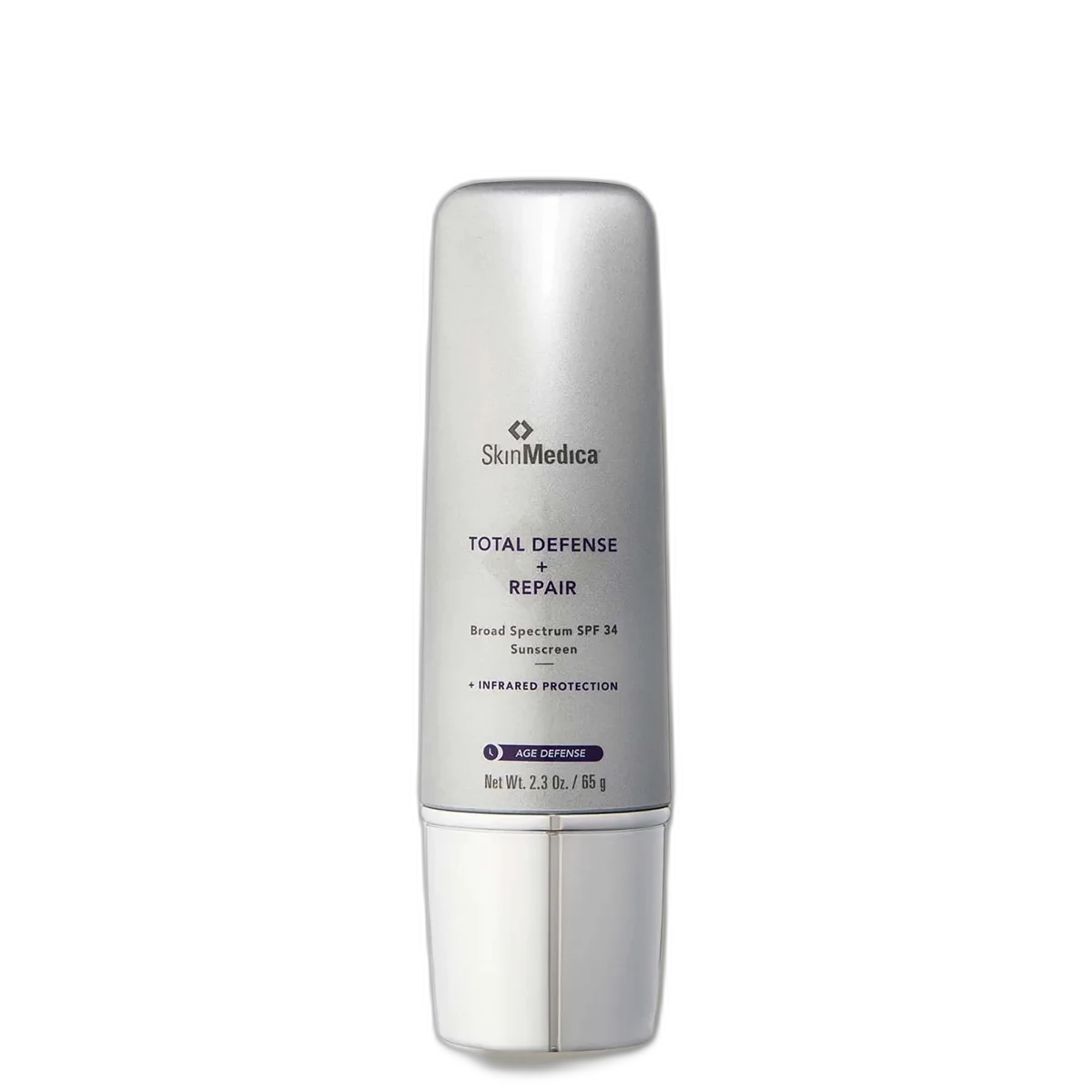
Total Defense + Repair SPF 34
Derm Office Hybrid SPF Staple
 Verified reviewer
Pros & cons.
- +Hybrid filter system delivers elegant finish with real UVA coverage from 8% zinc oxide
- +SOL-IR antioxidant complex is a substantive addition, not token vitamin E
- +Niacinamide included at meaningful levels for post-UV barrier support
- +Topical melanin is a rare visible-light consideration in an untinted sunscreen
- +No white cast on most skin tones, layers well under makeup
- +Fragrance-free, alcohol-free, and comfortable for dry and sensitive skin
- −Contains octinoxate, which is banned in Hawaii and several other reef-protection jurisdictions
- −SPF 34 is below the current SPF 50 norm for daily anti-aging sunscreens
- −$70 for 2.3 oz is significantly more than drugstore hybrid options
- −Not the best choice during pregnancy due to octinoxate
- −Has not been reformulated with newer, safer chemical filters available internationally
The full review.
Total Defense + Repair launched in 2013. At that time, most dermatology-channel sunscreens functioned as utilitarian final steps rather than anti-aging products. SkinMedica used a simple, forward-looking strategy: build a broad-spectrum filter system, layer a serious antioxidant complex on top, add niacinamide and a topical melanin fraction for visible-light defense, and sell it as a single-bottle photoaging treatment. That thesis is now standard—every dermatology sunscreen brand discusses infrared and visible light—but this product helped define the language. The filter chemistry has not changed as gracefully. The 2013 version used 7.5 percent octinoxate (for UVB), 3 percent octisalate (for UVB and stability), and 8 percent zinc oxide (for broad UVA). That combination worked well for its era: it avoided the white cast of a pure mineral sunscreen, delivered UVA coverage from the zinc, and left a cosmetically usable finish. It still does these things. But in 2026, octinoxate is harder to recommend. It is banned in Hawaii, the US Virgin Islands, and several other jurisdictions due to coral reef concerns, and many readers—especially swimmers—avoid it. Reformulating to avobenzone, bemotrizinol, or pure zinc-plus-titanium would improve this product’s market position. The rest of the formula has aged better. The SOL-IR Advanced Antioxidant Complex uses ubiquinone, tocopherol, Dunaliella salina carotenoids, Physalis angulata, green tea, and silver ear mushroom to go beyond the token vitamin E found in most sunscreens. Niacinamide appears high on the INCI list to provide barrier-support and post-UV-repair benefits. Squalane and shea butter provide cushion, keeping the formula comfortable on dry skin without grease. The topical melanin inclusion—still unusual in 2026—addresses the visible-light portion of photoprotection that mineral filters handle via tint and chemical filters mostly ignore. It does not replace a tinted iron oxide sunscreen for managing melasma, but it offers more than most untinted options. Cosmetically, it is pleasant. The cream-lotion spreads smoothly, absorbs in about a minute, and sets to a light satin finish that layers under most makeup. It leaves no white cast on medium to deeper skin tones, which is rare for a sunscreen with 8 percent zinc. The scent is a faint, neutral cosmetic note—essentially fragrance-free—and the texture does not pill when you apply moisturizer or foundation over it. For readers who dislike the finish of pure mineral sunscreens, this has been a go-to hybrid option for over a decade. SPF 34 is also notable. SPF 34 blocks about 97 percent of UVB compared to SPF 50’s 98 percent—a small difference used to defend lower SPF ratings. However, people often under-apply sunscreen, and a higher SPF provides a margin of error when applying only half the tested amount. For daily facial use with generous application and appropriate reapplication, SPF 34 is adequate. For beach use, extended outdoor time, or readers with heavy sun damage history, an SPF 50 option is better. The price is $70 for 2.3 ounces, or about $30 per ounce, placing it in the professional-channel premium tier. Drugstore hybrid sunscreens with similar filter systems cost a third to a half as much, though they usually lack the SOL-IR complex or meaningful levels of niacinamide. The best reason to pay this price is if you already use other SkinMedica actives and want a sunscreen engineered to pair with them, or if you value the finish and antioxidant profile. The weaker reason is using it as a default daily sunscreen—reef-friendlier, higher-SPF alternatives exist at every price point. One more consideration: pregnancy. Octinoxate has a long safety record on human skin, but some dermatologists flag it as a theoretical hormone-disruption concern during pregnancy, despite limited human data. Mineral-only sunscreens are the more cautious choice if you are pregnant or breastfeeding. In this case, SkinMedica’s own Essential Defense mineral line is the better choice within the brand.
Ingredient analysis.
Full INCI list
Active: Octinoxate 7.5%, Octisalate 3.0%, Zinc Oxide 8.0%. Inactive: Water, Caprylic/Capric Triglyceride, Silica, Squalane, Glycerin, Niacinamide, Dimethicone, Glyceryl Stearate, PEG-100 Stearate, Cetearyl Alcohol, Butyrospermum Parkii (Shea) Butter, Polygonum Aviculare Extract, Physalis Angulata Extract, Dunaliella Salina Extract, Ubiquinone, Camellia Sinensis Leaf Extract, Tremella Fuciformis Sporocarp Extract, Betaine, Melanin, Tocopheryl Acetate, Tocopherol, Hydroxyacetophenone, Batyl Alcohol, C12-15 Alkyl Benzoate, Panthenol, Butylene Glycol, Ceteareth-20, Polyhydroxystearic Acid, Isostearic Acid, Xanthan Gum, Ethylhexylglycerin, Disodium EDTA, Aminomethyl Propanol, Caprylyl Glycol, Potassium Sorbate, Sorbic Acid, Phenoxyethanol
Skin match.
The science.
The Science
Broad-spectrum sunscreen must cover UVB and UVA wavelengths. Modern photoaging research also identifies visible light and infrared-A as drivers of oxidative skin damage. Octinoxate is a well-studied UVB filter used globally for decades; it has a strong human safety record, but environmental research flags it for contributing to coral bleaching, leading jurisdictions like Hawaii to restrict it. Octisalate adds UVB coverage and stabilizes other filters. Zinc oxide is the broadest-spectrum UV filter available and provides the UVA protection this formula needs. Niacinamide has substantial published evidence for reducing UV-induced DNA damage, supporting barrier function, and improving photoaging markers over time; its inclusion in a sunscreen makes mechanistic sense. Coenzyme Q10 (ubiquinone) has antioxidant data showing it mitigates oxidative stress, and the carotenoid content of Dunaliella salina adds antioxidant activity. Topical melanin absorbs blue-range visible light and serves as a potential adjunct to sunscreen for patients with melasma and post-inflammatory hyperpigmentation, though clinical evidence for topical melanin is smaller than for iron oxide pigments. The SOL-IR complex relies on company research regarding visible and infrared light protection; independent clinical data on this specific blend is limited.
Dermatologist Perspective
Dermatologists often recommend daily broad-spectrum sunscreen as the most impactful anti-aging product available. SkinMedica's Total Defense + Repair is a hybrid option frequently stocked in dermatology offices for patients wanting an elegant finish with antioxidant support. Board-certified dermatologists note that octinoxate is safe for topical use despite environmental concerns, but they recommend mineral-only alternatives for patients who swim in marine environments, are pregnant or breastfeeding, or want to avoid chemical filters. This product is typically recommended as a daytime finisher over SkinMedica's TNS Advanced+ or other brand serums.
Where it fits in your routine.
Apply this as the final step of your morning routine, over serums and moisturizer. Use about one-quarter to one-third teaspoon for the face — more than most people use — and cover the neck and chest. Wait 60 seconds to absorb before applying makeup. Reapply every two hours if you have continuous sun exposure. The formula is not water-resistant; reapply after swimming or heavy sweating.
At $70 for 2.3 ounces, this costs more than most daily sunscreens. The value depends on your comparison. The premium is defensible if you want cosmetic elegance, the antioxidant complex, and integration with other SkinMedica products. If you want the best reef-friendly, high-SPF, broad-spectrum protection per dollar, better options exist at every price tier because the market has moved past octinoxate-based formulas. The per-ounce value is fixed because there is no larger size.
Readers want an elegant hybrid sunscreen with anti-aging ingredient support, especially if they use other SkinMedica products. It works for normal to dry skin that dislikes pure mineral sunscreen finishes.
Marine swimmers, reef-safety advocates, pregnant or breastfeeding readers seeking mineral-only sunscreens, and those wanting maximum SPF 50 protection can find better value. High-SPF, reef-friendly options exist at lower prices per ounce.
Product details.
Lightweight cream-lotion spreads smoothly and absorbs to a soft, slightly satin finish.
Silicones and emulsifiers create a faint neutral cosmetic note; there is no added fragrance.
2. 3 oz squeeze tube in a clinical SkinMedica carton.
Blends out without white cast and sets to a comfortable, non-tacky finish within a minute. No stinging or reactivity issues for most users. The octinoxate content may cause mild warmth or tingling in very reactive skin.
About 2-3 months if you apply the correct amount to face and neck daily.
12 months
All Year
The backstory.
SkinMedica launched Total Defense + Repair around 2013 as part of the brand's push to position sunscreen as an anti-aging treatment rather than a separate product category. The SOL-IR Advanced Antioxidant Complex was the brand's formal answer to emerging research on infrared-A and visible-light contributions to photoaging — at the time a newer conversation in dermatology that most other sunscreens were not addressing.
About SkinMedica
Established Brand (5–20 years)SkinMedica launched in 1999 and belongs to Allergan Aesthetics (AbbVie). It sells through US dermatology and medspa channels. Its sunscreens often follow procedures and feature the SOL-IR Advanced Antioxidant Complex, which company-sponsored research shows provides broader spectrum photoprotection.
Common myths.
SPF 34 is almost the same as SPF 50.
SPF 34 blocks about 97 percent of UVB, while SPF 50 blocks about 98 percent. This numerical difference is small on paper but matters when people under-apply sunscreen. Higher SPF provides a larger margin of error for daily wear.
Octinoxate is safe because it has been used for decades.
Octinoxate has a long safety record on human skin. However, Hawaii and several other jurisdictions banned it due to environmental concerns about coral reef impact. Readers who prioritize reef safety or swim in marine environments may prefer a mineral-only alternative.
FAQ.
Is SkinMedica Total Defense + Repair reef-safe?
No. The formula has 7.5 percent octinoxate. Hawaii and several other jurisdictions ban this ingredient because it impacts coral reefs. If reef safety matters or you swim in marine environments, use a mineral-only alternative instead.
What is the SOL-IR Advanced Antioxidant Complex?
This is SkinMedica's proprietary blend of ubiquinone (CoQ10), vitamin E, Dunaliella salina algae, Physalis angulata, green tea, and silver ear mushroom extract. The blend provides supplemental protection against visible and infrared light. These light sources cause photoaging that UV filters do not address alone.
Is this sunscreen safe during pregnancy?
The formula contains octinoxate. Some dermatologists suggest pregnant patients avoid octinoxate due to theoretical hormone-disruption concerns, though human data is limited. Mineral-only sunscreens are the general preference during pregnancy. Ask your OB before using this product.
Will it leave a white cast?
No. Even with 8 percent zinc oxide, the formula blends to a near-invisible finish on most skin tones. Very deep skin tones may still show a faint cast at full application amounts.
How does this compare to SkinMedica's Essential Defense mineral sunscreens?
Total Defense + Repair uses a hybrid formula of chemical and mineral filters with a large antioxidant complex for anti-aging. The Essential Defense line uses only mineral filters, has fewer added actives, and suits readers who avoid chemical UV filters.
Can I wear makeup over it?
Yes. The finish sets to a light satin. It layers well under tinted moisturizer, BB cream, and most liquid foundations without pilling if you let it absorb for about 60 seconds.
What the community says.
"Elegant, non-greasy finish that works under makeup"
"No white cast despite the 8% zinc"
"Feels hydrating on dry skin"
"Niacinamide and antioxidant complex feel like real additions"
"Contains octinoxate, which is banned in Hawaii and some other jurisdictions"
"SPF 34 feels low compared to current SPF 50 options"
"Expensive for a 2.3 oz sunscreen"
"Only one size available"
Featured in.
People also looked at.