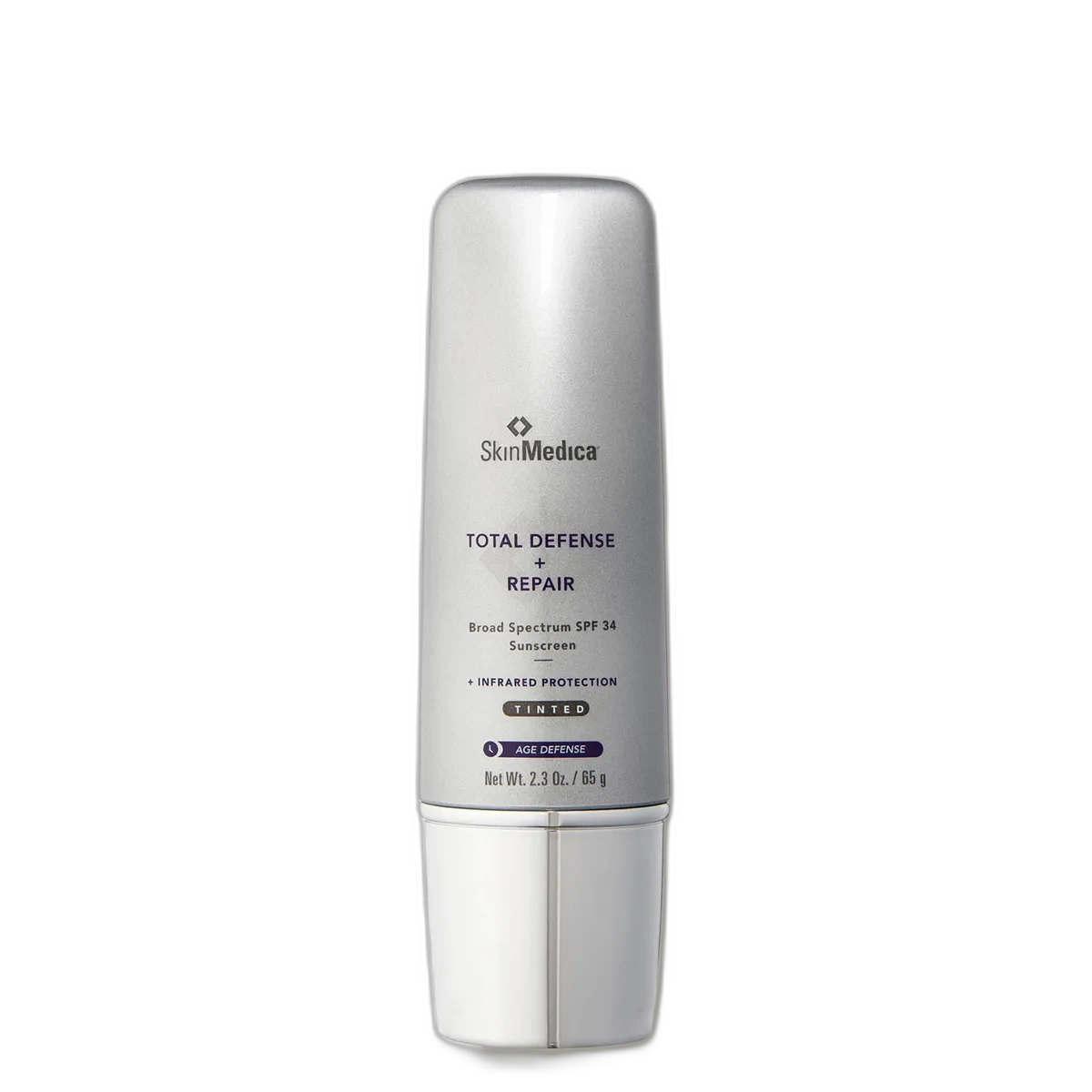
Total Defense + Repair SPF 34 Tinted
Melasma-Smart Tinted SPF
 Verified reviewer
Pros & cons.
- +Iron oxide pigments provide real visible light protection, the gold standard for melasma defense
- +Four-filter hybrid system with 8% zinc and 3.5% titanium for broad UVA and UVB coverage
- +Topical melanin and niacinamide reinforce the pigment-defense story from multiple angles
- +SOL-IR antioxidant complex addresses oxidative damage from infrared and visible light
- +Cosmetically elegant — sheer tint that blurs tone without looking like foundation
- +Works as a standalone daytime complexion product or under makeup
- −Tint only suits light to medium skin tones — no expanded shade range
- −Contains octinoxate, not reef-friendly and restricted in Hawaii
- −SPF 34 is below the current SPF 50 baseline
- −$70 for 2.3 oz is expensive compared to newer tinted mineral options
- −Not ideal during pregnancy due to octinoxate
The full review.
For years, dermatologists recommending sunscreen to melasma patients faced a frustration: the best UV filters cannot fully stop pigmentation from worsening in summer because melasma is not driven by UV alone. High-energy visible light — the blue-ish wavelengths from sunlight and screens — drives melasma, yet most sunscreens do nothing about it. Chemical filters work on UV. Mineral filters work on UV. Antioxidant complexes help with downstream oxidative stress, but they are a secondary defense. Only iron oxides have published evidence for blocking visible light topically. The tinted version of SkinMedica’s Total Defense + Repair, launched after the untinted formula, uses this insight. It uses the same four-filter hybrid sunscreen base as the untinted version — zinc oxide, titanium dioxide, octinoxate, octisalate — and adds iron oxides (red, yellow, and black), topical melanin, and niacinamide to target pathways for melasma and post-inflammatory hyperpigmentation. This is not a cosmetic tint with incidental color. It is a pigment-protection system that also looks good on the skin. The tint is sheer and mostly neutral, acting as a universal light-to-medium shade. On fair skin, it looks like a subtle warm glow; on medium skin, it blurs minor redness and uneven tone without looking like foundation. The product reaches its limit on deeper skin tones — the tint can look slightly ashy or grey. Readers with deeper complexions are better served by brands like Supergoop, Paula’s Choice, or EltaMD Elements with expanded shade ranges, or dedicated tinted mineral sunscreens in darker tones. SkinMedica has not meaningfully updated the shade range since launch, which is the product’s most significant aging issue. Texturally, the formula is close to the untinted version: a lightweight cream-lotion that spreads smoothly, absorbs in about a minute, and leaves a natural soft-satin finish. It works well under makeup — better than many heavier tinted mineral options — and the iron oxides blur skin texture like a skin-finishing primer. On its own, it replaces light coverage foundation for most users wanting an even, low-maintenance daytime look. Under foundation, it acts as a subtle color-correcting base that softens redness and evens tone. The active ingredients justify this version. Niacinamide has strong evidence for reducing melanosome transfer, a mechanism for visible hyperpigmentation. Iron oxides block visible light. Topical melanin adds a second layer of visible light defense. The SOL-IR Advanced Antioxidant Complex — ubiquinone, tocopherol, Dunaliella salina, Physalis, green tea, silver ear mushroom — addresses oxidative damage from light that reaches the skin. Stacking these mechanisms gives the tinted version a case the untinted lacks: if your goal is pigment control, use this SKU. Now the caveats, as the base formula remains the same. It still contains octinoxate, which is banned in Hawaii and restricted elsewhere due to coral reef concerns. It is still SPF 34, which works for controlled daily use but sits below the SPF 50 norm for aggressive photoprotection. It is still $70 for 2.3 ounces, which is steep. It is still not the best choice during pregnancy or for readers who strictly prefer mineral-only sunscreens. However, the value math improves versus the untinted version because iron oxides add real functionality — this version is a more protective product for pigment-prone skin, not just the untinted formula with color. One more note: if you have melasma, use this as part of a broader regimen, not a standalone fix. A dedicated melasma protocol typically includes a daily tinted mineral or hybrid sunscreen, an evening tyrosinase inhibitor (hydroquinone, tranexamic acid, azelaic acid, or cysteamine), and strict sun avoidance during peak hours. This sunscreen handles one piece of that puzzle, but it will not erase existing pigmentation alone — leave-on actives layered underneath do that work.
Ingredient analysis.
Full INCI list
Active: Zinc Oxide 8.0%, Octinoxate 7.5%, Titanium Dioxide 3.5%, Octisalate 3.0%. Inactive: Aqua, Caprylic/Capric Triglyceride, Squalane, Silica, Glycerin, Niacinamide, Dimethicone, Glyceryl Stearate, PEG-100 Stearate, Cetostearyl Alcohol, Butyrospermum Parkii (Shea) Butter, Phenoxyethanol, Ceteareth-20, Batyl Alcohol, Iron Oxides (CI 77492), Hydroxyacetophenone, Polyhydroxystearic Acid, DL-Alpha-Tocopheryl Acetate, Physalis Angulata Extract, Butylene Glycol, Xanthan Gum, DL-Panthenol, C12-15 Alkyl Benzoate, Iron Oxides (CI 77491), Betaine, Ethylhexylglycerin, Disodium EDTA, Aminomethyl Propanol, Isostearic Acid, Camellia Sinensis Leaf Extract, Iron Oxides (CI 77499), Potassium Sorbate, Polygonum Aviculare Extract, PEG-12 Dimethicone, Ubiquinone Q10, Hydrolyzed Tremella Fuciformis Sporocarp Extract, Melanin, Dunaliella Salina Extract, Caprylyl Glycol, Tocopherols, Sorbic Acid
Skin match.
The science.
The Science
High-energy visible light research is a central topic in photoprotection for melasma and post-inflammatory hyperpigmentation. Published studies show visible light—especially blue wavelengths near 415 nanometers—induces persistent pigmentation in melanocompetent skin. Standard UV filters provide little to no protection against these wavelengths. Iron oxide pigments, used as cosmetics colorants for decades, block visible light effectively and offer the most practical topical defense against HEV-induced pigmentation. A 2014 study in Photodermatology, Photoimmunology & Photomedicine compared sunscreens with and without iron oxide pigments in melasma patients; the iron oxide arm showed significantly better pigment control. Niacinamide reduces melanosome transfer from melanocytes to keratinocytes, which results in less visible surface pigmentation over time. Topical melanin is a newer adjunct with less published evidence that acts as a supplementary visible light absorber. Combining physical light blocking via iron oxides, melanosome transfer reduction via niacinamide, and visible light absorption via topical melanin gives this tinted formula a different protection profile than its untinted counterpart for pigment-prone patients.
Dermatologist Perspective
Dermatologists recommend tinted sunscreens with iron oxides for patients with melasma, post-inflammatory hyperpigmentation, and visible light sensitivity. SkinMedica's tinted version is a frequent option in US dermatology practices serving those patients. Board-certified dermatologists often call iron-oxide-containing sunscreens a non-negotiable part of melasma treatment plans. Sunscreen choice is often the biggest variable in whether a patient's pigmentation improves or worsens during months of treatment. This product typically pairs with evening pigment-correcting actives like hydroquinone, tranexamic acid, or azelaic acid for a full melasma protocol.
Where it fits in your routine.
Apply this as your final morning step over serums and moisturizer. Use 0.25 to 0.33 teaspoon for the face — more than most people use — to ensure adequate SPF coverage and even tint distribution. Blend from the center of the face outward. Wait 60 seconds before applying makeup, or wear it alone for a natural finish. Reapply every two hours during outdoor sun exposure; powder sunscreens work well over makeup.
At $70 for 2.3 ounces, the tinted version of Total Defense + Repair costs the same as the untinted version and offers better protection for pigment concerns. The per-ounce price is high—comparable tinted mineral sunscreens cost half as much, but often lack the SOL-IR antioxidant complex or the topical melanin inclusion. Paying full price makes sense for readers with moderate-to-severe melasma who want the full SkinMedica platform or follow a dermatologist's recommendation for the brand. Budget-conscious readers can get most iron oxide benefits from cheaper tinted mineral sunscreens and use the savings on a separate pigment-correcting serum.
This product suits readers with melasma, post-inflammatory hyperpigmentation, dark spots, or visible light sensitivity seeking professional-channel tinted sunscreen with real HEV protection. It fits readers with light to medium skin tones wanting one product for both sunscreen and daytime complexion evening, and those already using the SkinMedica ecosystem.
Deeper skin tones that mismatch the sheer universal tint, pregnant or breastfeeding readers wanting mineral-only formulas, anyone prioritizing reef safety, and budget-conscious readers who find comparable iron oxide protection in cheaper tinted mineral sunscreens.
Product details.
All Year
The backstory.
SkinMedica added the tinted version to its Total Defense + Repair lineup shortly after the original, as emerging dermatology research on visible light contributions to melasma drove demand for iron-oxide-containing sunscreens. The inclusion of iron oxides, topical melanin, and niacinamide made it one of the first professional-channel sunscreens specifically positioned as a pigment-defense product rather than simply a UV-protection product.
About SkinMedica
Established Brand (5–20 years)Dermatologist Dr. Richard Fitzpatrick founded SkinMedica in 1999, now part of Allergan Aesthetics. US dermatology offices widely stock its sunscreen line, which uses the SOL-IR Advanced Antioxidant Complex and company-sponsored research on broader spectrum photoprotection.
Common myths.
A tinted sunscreen is a sunscreen with added color for cosmetic reasons.
Iron oxide tints are among the few topical ingredients that protect against high-energy visible light, which worsens melasma. A tinted sunscreen with iron oxides works differently than an untinted version — the tint is part of the protection.
This tint matches all skin tones.
The sheer universal tint works best on light to medium skin tones. Deeper skin tones may show a slight ashy or grey cast and need alternatives with darker iron oxide shade ranges or more extensive matching.
FAQ.
What skin tones does the tint match?
The sheer universal tint works on light to medium skin tones. The tint adds subtle warmth to fair skin and gives medium skin a natural blur effect. Deeper skin tones may see a slight grey or ashy cast and should choose brands with expanded tint ranges.
Does iron oxide really protect against visible light?
Yes. Published dermatology research shows iron oxide pigments protect against visible light, specifically the blue high-energy visible wavelengths linked to melasma. This is one of the few topical, evidence-backed ways to address visible light's contribution to hyperpigmentation.
Can I wear it alone or do I need foundation over it?
Wear it alone or under makeup. The sheer tint provides enough coverage for an even, natural finish on its own. Layered under makeup, it works as a sunscreen primer with subtle color correction.
Is it safe during pregnancy?
The formula contains octinoxate. Some dermatologists recommend pregnant patients avoid octinoxate because human data is limited. Mineral-only alternatives are generally preferred during pregnancy. Check with your OB before use.
Can I use this instead of foundation?
Yes, many users do. The sheer tint lacks the opacity to cover significant blemishes or dark spots, but it even out the overall complexion and reduces mild redness on its own.
What the community says.
"Evens skin tone immediately with a sheer, natural tint"
"Feels lightweight and non-greasy"
"Great base under makeup or worn alone"
"Iron oxide tint helps control melasma flares"
"Tint only works for light to medium skin tones"
"Contains octinoxate"
"Only SPF 34"
"Expensive for the size"
Featured in.
People also looked at.