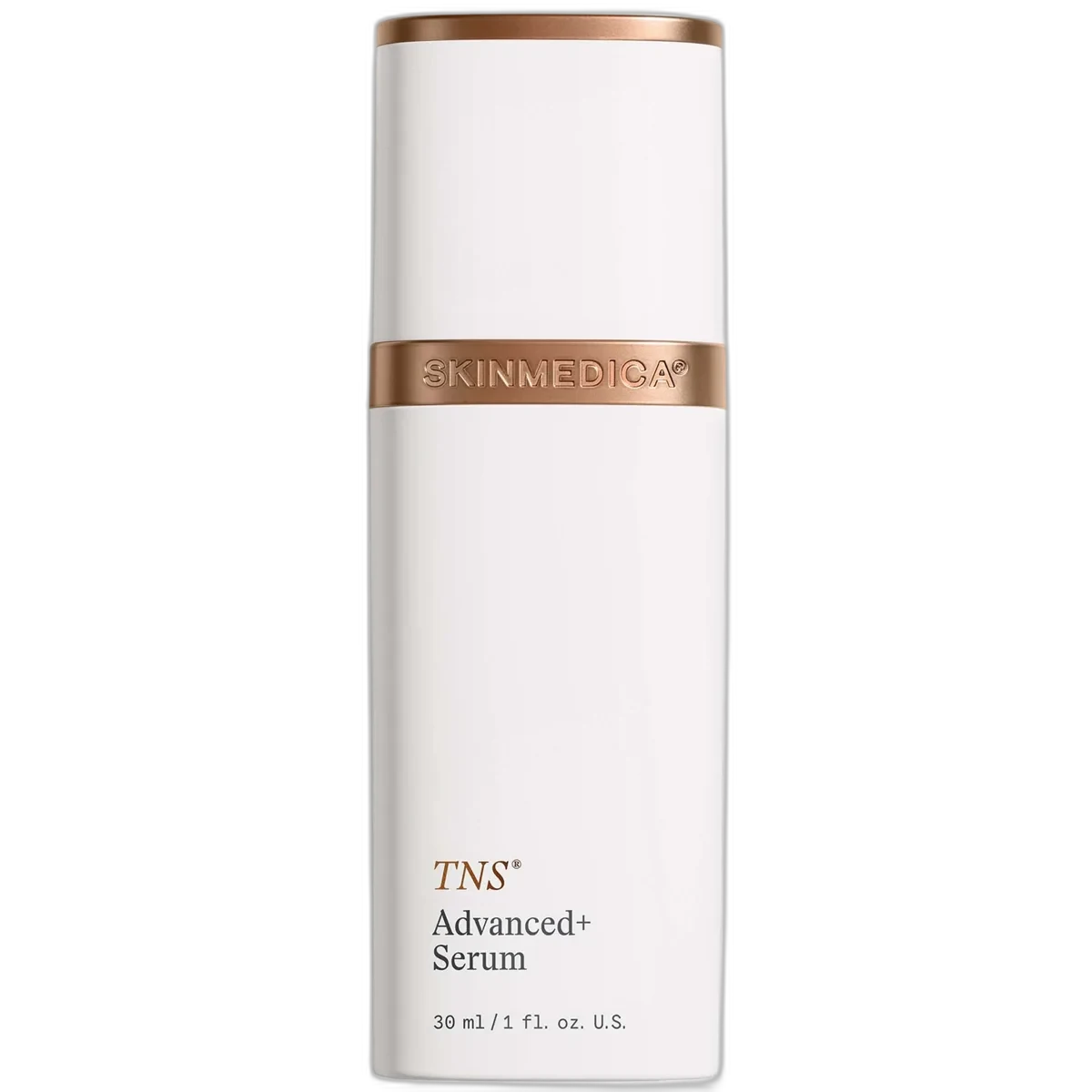
TNS Advanced+ Serum
Derm Office Hall-of-Fame Serum
 Verified reviewer
Pros & cons.
- +Backed by the longest track record in topical growth factor skincare
- +Dense formulation combines TNS growth factors with credible peptides and botanical actives
- +Cosmetically elegant — light cream-gel texture, fragrance-free, sits well under any layer
- +Tolerated by sensitive skin and compatible with retinoids
- +Measurable improvements in fine lines and texture in company clinical studies at 12-24 weeks
- +Airless pump packaging protects the delicate protein actives
- −$295 for 1 ounce is one of the highest prices in the serum category
- −Results build slowly — not a fast-acting product for impatient users
- −Formal clinical evidence is largely from company-sponsored studies, not independent trials
- −Some dermatologists prefer to avoid growth factor serums for cancer patients out of theoretical caution
- −Contains whey protein, which is a consideration for readers with dairy allergies
The full review.
Before TNS, topical growth factor skincare was not a category. The original TNS Recovery Complex, launched by SkinMedica in 1999 under the direction of dermatologist Dr. Richard Fitzpatrick, was the first widely distributed topical growth factor product and the starting point for an entire corner of professional skincare. Twenty-plus years later, TNS Advanced+ is what that original idea has become: the TNS-MR platform — an updated human fibroblast conditioned media fraction — paired with Renessensce Advanced, a supporting cast of signal peptides, postbiotics, marine algae extract, and botanical stem cell extracts designed to push the same wrinkle, texture, and firmness endpoints from multiple angles at once. This is the serum the rest of the growth factor category is still, in some sense, reacting to. The formulation reads unlike most luxury serums. After water and pentylene glycol, the third ingredient is Human Fibroblast Conditioned Media — the signature TNS fraction. Shea butter ethyl esters provide a silky cushion without an oily finish. Then the serum stacks into Lactococcus ferment lysate, whey protein, chlorella extract, saccharide isomerate (a humectant), and two peptides that are doing real work — trifluoroacetyl tripeptide-2, marketed as Uplevity for its elastin effects, and dimer tripeptide-43, a Nrf2 pathway peptide that supports cellular antioxidant defense. Underneath that sit hydrolyzed linseed extract, grape flower cell extract, and apple fruit extract, all of which contribute supporting antioxidant and signaling activity. It is a remarkably dense formula, and it is structured the way SkinMedica has always built flagships: a primary active backed by several supporting actives aimed at overlapping pathways, with the formulation vehicle chosen to protect and deliver the delicate protein components.
Texture
Texture-wise, it delivers immediately. The serum dispenses from the airless pump as a light cream-gel that spreads like a thin lotion and absorbs within about thirty seconds, leaving a slightly cushioned, velvety finish that sits well under any moisturizer or sunscreen.
Scent
It is genuinely fragrance-free — there is a very faint neutral note that comes from the protein actives themselves, not from added scent — and tolerant of almost every skin type, including sensitive and post-procedure skin.
How to Use
This is one of the rare luxury serums that actually feels worth applying twice a day, which matters because compliance drives outcomes in this category more than ingredient lists do.
Best for
Performance is the hard conversation. TNS is a slow builder. The first couple of weeks give you softness and plumping that is mostly hydration, and new users sometimes feel impatient waiting for the more impressive changes. Those show up further out, usually between weeks 8 and 16, as fine lines begin to soften, crepey texture smooths, and overall skin quality improves in a way that is easier to see in photos than in the mirror.
Common Praise
SkinMedica has run several company-sponsored clinical studies on the TNS platform measuring wrinkle, texture, and tone improvements at the 12 to 24 week mark; the data is promising and consistent with what longtime users report, though it is not independent academic research and the effect sizes are modest rather than dramatic.
Pairs Well With
What TNS is not is a retinol replacement. It signals from a different pathway, and users who want maximum anti-aging performance layer both — TNS in the morning, retinol at night, or TNS under retinol in the same evening routine. The two are complementary, and the combination is one of the more common derm-office recommendations for mature skin.
Price
Now the price. Two hundred and ninety-five dollars for one ounce is, on any reasonable accounting, a luxury purchase. That price is defensible in the specific context of a reader who is already investing in aesthetic procedures, who has mature skin with real anti-aging goals, and who wants a cosmetically elegant daily serum with a long and credible brand pedigree to back it up. It is not defensible as a default starter anti-aging serum for someone building their first routine. Well-formulated peptide serums and stable retinol products exist in the $30 to $80 range and will give most readers a stronger per-dollar outcome. The best case for TNS Advanced+ is as the centerpiece of an already-expensive regimen, not as the sole anti-aging product trying to justify its own sticker price.
Other Considerations
One more thing worth naming: the growth factor sourcing discussion. The TNS fraction is human fibroblast conditioned media — the molecules cultured cells secrete, not the cells themselves — and for some readers the origin story is a consideration. There is no clinical evidence linking topical growth factor serums to any increased cancer risk in cosmetic use, and the molecules are large and absorb poorly, but some dermatologists avoid recommending them to active cancer patients out of theoretical caution. If that is relevant to your situation, talk to your doctor.
Ingredient analysis.
Full INCI list
Water/Aqua/Eau, Pentylene Glycol, Human Fibroblast Conditioned Media, Glycereth-7 Triacetate, Shea Butter Ethyl Esters, Glycerin, Ethoxydiglycol, Lactococcus Ferment Lysate, Whey Protein, Chlorella Vulgaris Extract, Saccharide Isomerate, Trifluoroacetyl Tripeptide-2, Dimer Tripeptide-43, Hydrolyzed Linseed Extract, Vitis Vinifera (Grape) Flower Cell Extract, Pyrus Malus (Apple) Fruit Extract, Hydroxyacetophenone, Tocopheryl Acetate, Propanediol, Xanthan Gum, Polyacrylate Crosspolymer-6, Polyacrylate-13, Polyisobutene, Sclerotium Gum, PEG-12 Dimethicone, Lecithin, Pullulan, Butylene Glycol, Sodium Citrate, Polysorbate 20, Aminomethyl Propanol, Dextran, Disodium EDTA, Phenoxyethanol, Ethylhexylglycerin
Skin match.
The science.
The Science
Growth factors are signaling proteins that regulate cellular processes like proliferation, migration, and extracellular matrix production. In skin, fibroblast-derived growth factors drive collagen and elastin synthesis during wound healing and normal turnover. Researchers have studied topical growth factor mixtures for cosmetic anti-aging for over two decades; SkinMedica's TNS platform is among the earliest and most researched. Company-sponsored clinical trials of TNS Recovery Complex and TNS Advanced+ show statistically significant improvements in fine lines, wrinkles, skin texture, and tone after 12 to 24 weeks of twice-daily use. These effect sizes are moderate rather than transformative. The formula's peptides — trifluoroacetyl tripeptide-2 (Uplevity) and dimer tripeptide-43 — have small evidence bases for Nrf2 pathway activation and elastin synthesis respectively, though most data comes from company or supplier research. Critics often question if large protein molecules penetrate the stratum corneum in meaningful amounts; penetration is limited but not zero, and the mechanism of action may involve signaling at the skin surface instead of deep delivery. Independent peer-reviewed research on topical growth factor serums is limited compared to retinoids and vitamin C, so readers should weigh that gap when interpreting claims.
Dermatologist Perspective
Dermatologists often recommend TNS Advanced+ as a daily anti-aging serum for mature or photoaged skin, especially for patients undergoing in-office procedures like microneedling, fractional laser, or energy-based skin tightening. Board-certified dermatologists note that growth factor serums like TNS work alongside retinoids rather than replacing them, and adherence determines the outcome. This product is a cornerstone of the SkinMedica ecosystem, typically paired with a vitamin C serum in the morning and a retinol complex at night. Some dermatologists express theoretical caution about growth factor serums for patients with a history of active cancer, though no clinical evidence shows topical risk.
Where it fits in your routine.
Apply one to two pumps to clean, dry skin every morning and evening. Smooth it over the face, neck, and décolletage. Use moisturizer next and broad-spectrum sunscreen in the morning. TNS Advanced+ layers well over a morning vitamin C serum and under an evening retinol complex. Do not apply TNS Advanced+ directly over strong acids, as they denature protein actives; wait a few minutes after using an acid toner. Close the airless pump cap to protect the growth factor fraction from oxidation.
At $295 for one ounce, this is an investment serum. Using it twice daily on the full face for two to three months costs roughly $3-4 per use. This price exceeds any drugstore or mid-tier luxury serum. The cost reflects SkinMedica's leadership in growth factor skincare, the thick and elegant Advanced+ formulation, and company-sponsored clinical data for the TNS platform. For those paying for aesthetic procedures, the marginal cost is small compared to procedure budgets, and the cosmetic payoff is real. For others, a well-formulated retinol, a peptide serum, and consistent sunscreen offer more value per dollar.
Readers with mature or photoaged skin want a flagship anti-aging serum with a credible brand pedigree and clinical data. This fits those using aesthetic procedures or seeking a cornerstone product for a comprehensive anti-aging regimen. It also works for sensitive skin types that struggle with higher-irritation actives.
Choose this if you want a budget-friendly first anti-aging routine where a well-formulated retinol and peptide serum offers more value per dollar. Skip this if you are pregnant or breastfeeding without consulting your OB, have a dairy allergy, or want fast-acting results instead of cumulative anti-aging results.
Product details.
This light cream-gel spreads like a thin lotion and absorbs fast, leaving a slightly cushioned finish.
It is essentially odorless, with a faint neutral note typical of protein-based serums.
A 1 oz airless pump bottle comes in a branded clinical carton. This design protects the growth factor fraction from light and oxygen.
The first few applications feel plumping and hydrating, but the anti-aging effects build over months. Do not judge the serum by week two — TNS is a slow, cumulative treatment, and results show up later.
Roughly 2-3 months with twice-daily full-face application.
6 months
All Year
The backstory.
SkinMedica was founded in 1999 by dermatologist Dr. Richard Fitzpatrick, and the first TNS Recovery Complex launched shortly after as one of the earliest topical growth factor serums. TNS Advanced+ arrived in 2020 as a next-generation reformulation, combining the updated TNS-MR growth factor platform with the Renessensce Advanced complex. It is the brand's flagship product and the one that dermatology offices tend to stock first.
About SkinMedica
Established Brand (5–20 years)Dermatologist Dr. Richard Fitzpatrick founded SkinMedica in 1999 using the original TNS growth factor platform, now owned by Allergan Aesthetics. Multiple company-sponsored clinical trials show TNS technology improves wrinkle and skin texture scores. US dermatology practices distribute the serum line extensively.
Common myths.
Growth factors in skincare can cause cancer.
Topical serums use growth factor fractions that differ from systemic growth factor therapy. These large molecules absorb poorly. Cosmetic use of topical growth factor serums shows no clinical evidence of increased cancer risk. Some dermatologists avoid recommending them to patients with active cancer due to theoretical caution.
TNS is a stem cell product.
TNS is a conditioned media product. It contains proteins, growth factors, and signaling molecules secreted by cultured human fibroblasts, but not the cells. The serum has no live stem cells.
FAQ.
How long does it take to see results from TNS Advanced+ Serum?
Most users see softer skin and better texture within 6-8 weeks of twice-daily use. Changes in fine lines, firmness, and crepey skin show up between 12 and 24 weeks, the period covered by SkinMedica's company-sponsored clinical studies.
Is TNS Advanced+ safe during pregnancy and breastfeeding?
SkinMedica has not tested this product for pregnancy safety. Some dermatologists avoid growth factor serums during pregnancy due to theoretical caution. Ask your OB before adding it to your routine.
Can I use TNS Advanced+ with retinol or tretinoin?
Yes. Many users layer TNS Advanced+ under a retinoid at night, or use TNS in the morning and retinol at night. The peptide and growth factor actives in TNS stay stable with typical retinoid use. Dermatologists often recommend combining them.
Where do the growth factors in TNS come from?
The TNS fraction is human fibroblast conditioned media. This liquid media contains the proteins and growth factors cultured human fibroblast cells naturally secrete. The cells are not in the final product.
How does TNS Advanced+ compare to the older TNS Recovery Complex?
TNS Advanced+ uses an updated TNS-MR growth factor platform and adds the Renessensce Advanced complex of peptides, postbiotics, and botanical extracts. This formula is more comprehensive than the original TNS Recovery Complex, but some longtime users prefer the lighter texture of the older version.
Is the $295 price actually worth it?
Comparison depends on your baseline. If you use in-office aesthetic procedures and want a strong daily companion, the math works. If you are building a routine from scratch on a modest budget, well-formulated retinol and peptide serums offer more value per dollar.
What the community says.
"Visible improvement in fine lines and crepey texture over months of use"
"Dramatically plumper, smoother skin appearance"
"Elegant, non-greasy texture"
"Tolerated by sensitive skin"
"Pairs well with retinol without added irritation"
"One of the most expensive serums on the market"
"Results are slow — not a fast fix"
"Growth factor sourcing raises questions for some users"
"Pump can be temperamental near the end of the bottle"
Featured in.
People also looked at.