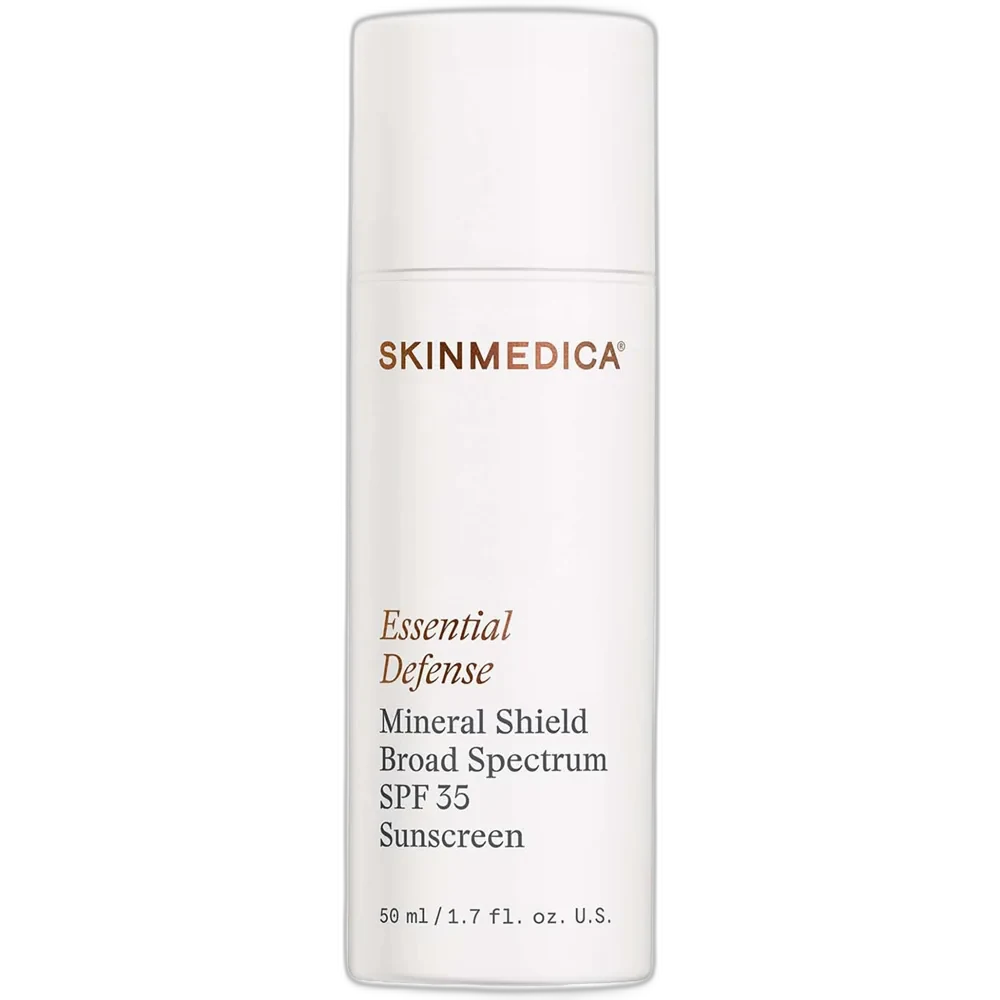
Essential Defense Mineral Shield SPF 35
Derm Office Staple
 Verified reviewer
Pros & cons.
- +100% mineral filters with 16% total active concentration
- +Iron oxides provide meaningful visible light protection
- +Silicone-forward base layers cleanly under makeup
- +Minimal white cast on lighter and medium skin tones
- +Fragrance-free and gentle on post-procedure skin
- +Semi-matte primer-like finish loved by combination skin
- +Fits seamlessly into professional skincare routines
- −Expensive at $40 for 75 grams
- −Visible cast on deeper skin tones
- −Silicone finish not universally preferred
- −Small tube size for daily full-face application
The full review.
Mineral sunscreen used to require compromise. Reliable broad-spectrum protection from zinc oxide meant accepting a white cast, greasy finish, and pilling under makeup. Cosmetic-like textures required low mineral concentrations that relied on silicone bases for performance. For twenty years, these two needs rarely met in one tube. Dermatology-office shelves filled with mineral sunscreens that patients bought once and never repurchased due to poor wear. Formulations have since improved. SkinMedica’s Essential Defense Mineral Shield benefits from this progress. The active filter system is well-loaded with 9% zinc oxide and 7% titanium dioxide. This 16% total mineral filter load delivers the SPF 35 rating with real broad-spectrum performance, unlike the marginal protection found in lower-concentration mineral products. The inactive base shows the formulation work. Cyclopentasiloxane, isododecane, dimethicone, and C12-15 alkyl benzoate are high in the ingredient list. This gives the lotion a silicone-forward character that spreads easily, sets quickly, and does not pool in fine lines or around the nose like older mineral sunscreens. The semi-matte, primer-like silicone finish makes this a favorite for most users wearing makeup. The iron oxide inclusion is a more interesting formulation choice. Labels often list iron oxides as mere colorants, but clinical research from the last decade shows high-energy visible light—the blue end of the spectrum—worsens melasma and post-inflammatory hyperpigmentation. Iron oxides in sunscreen provide measurable protection against these wavelengths where zinc and titanium alone fail. Including iron oxides here is a functional photoprotection choice, not just a way to add a neutral tint; it makes the sunscreen more useful for pigment concerns. This matters because patients visiting dermatology offices for TNS Advanced+ or Lytera often need visible light coverage. SkinMedica choosing this sunscreen to accompany those treatments is intentional. On skin, the sunscreen acts like a modern cosmetic mineral sunscreen. It glides on sheer, sets within one or two minutes, and leaves a finish most users call matte-but-not-dry. Lighter skin tones see minimal white cast. Medium tones see a modest cast that blends with rubbing. Deep skin tones see visible residue—an honest limitation of any 16% mineral formulation, not a brand failure. Users with deeper skin tones are better served by the tinted SkinMedica offering or mineral sunscreens designed for darker skin. Some love the silicone finish; others dislike it. If you like Korean BB cream textures and silicone primers, you will like this. If you prefer the watery, dewy feel of hybrid chemical-mineral sunscreens, this will feel more like a primer. Durability is good. The sunscreen resists pilling under foundation better than most mineral options, and you can reapply throughout the day by pressing and patting over makeup. The frustrations are mostly commercial. At forty dollars for 75 grams, you pay dermatology-office pricing for a mineral sunscreen that offers no more absolute protection than thirty-dollar alternatives. The value lies in the wearability and iron oxide inclusion, though this may not justify forty dollars for budget-conscious buyers. Also, 75 grams is a small amount; applying the full recommended daily amount will empty the tube in two to three months. For professional skincare users already using the SkinMedica ecosystem, the price is easy to justify because the wearability under makeup is a win. For shoppers comparing cost-per-gram, cheaper options do the basic job adequately. Within its lane, this is a well-engineered mineral sunscreen with a meaningful visible light feature and is a reliable pick in the dermatology-office photoprotection category.
Formula
Ingredient analysis.
Full INCI list
Active: Zinc Oxide 9%, Titanium Dioxide 7%. Inactive: Water, Cyclopentasiloxane, Isododecane, C12-15 Alkyl Benzoate, Dimethicone, Butyloctyl Salicylate, Cetyl PEG/PPG-10/1 Dimethicone, Polyhydroxystearic Acid, Isohexadecane, Sorbitan Sesquioleate, Glycerin, Silica, Phenoxyethanol, Disteardimonium Hectorite, Tocopheryl Acetate, Disodium EDTA, Triethoxycaprylylsilane, Propylene Carbonate, Iron Oxides
Skin match.
The science.
The Science
The active filter system in this sunscreen uses a standard modern mineral approach: 9% zinc oxide and 7% titanium dioxide, totaling 16% mineral filters. Zinc oxide provides broad-spectrum UVA and UVB protection, with strong UVA1 coverage that chemical filters often lack. Titanium dioxide adds UVB protection and boosts the SPF value efficiently. Decades of photoprotection research support these two filters, making them one of the most reliable mineral UV defense combinations. Recent formulation trends focus on iron oxides. Research from the last decade shows that high-energy visible light — mainly in the 400-450 nm blue range — drives hyperpigmentation and worsens melasma, especially in darker skin types. Iron oxides, used at cosmetic-tinting concentrations, absorb these wavelengths. Clinical studies show they reduce melasma recurrence when used with conventional UV filters. Their inclusion in this formula is functional photoprotection, not ornamental. The silicone-heavy base is also scientifically relevant: studies show dimethicone and cyclopentasiloxane-based vehicles create the uniform film formation required to reach labeled SPF values. A mineral sunscreen depends on the film it forms, and a silicone base helps maintain that film integrity during wear.
Dermatologist Perspective
Dermatologists often recommend this sunscreen for patients recovering from chemical peels, lasers, microneedling, and other in-office procedures, as mineral-only filters avoid stinging or irritating compromised skin. Board-certified dermatologists note that the iron oxide inclusion makes this sunscreen a meaningful choice for patients with melasma, post-inflammatory hyperpigmentation, and Fitzpatrick skin types III-V who face higher visible light pigmentation risks. Dermatology and plastic surgery offices commonly stock it as the photoprotection companion to growth factor serums and pigmentation treatments. Dermatology advice stresses that generous application and proper reapplication are essential to achieve the labeled SPF value.
Where it fits in your routine.
Apply this as the last step of a morning routine, after moisturizer. Use about a quarter teaspoon — roughly two finger-lengths — for the face, and more for the neck and chest. Spread it evenly and pat it into the skin. Let the silicone base set for 1-2 minutes before applying makeup. Reapply every 2 hours during direct sun exposure, and after swimming or heavy sweating. Apply gently to post-procedure skin without rubbing. It is safe for daily year-round use.
At $40 for 75 grams, this sunscreen costs as much as dermatology-office SPF options and roughly twice the price of comparable drugstore mineral sunscreens. The price covers the silicone-forward wearability, the iron oxide visible light feature, and its place in the SkinMedica ecosystem. The price fits naturally into a routine for users already buying other SkinMedica products. For shoppers prioritizing cost-per-gram, cheaper mineral sunscreens from brands like EltaMD, La Roche-Posay, or Blue Lizard offer comparable basic photoprotection at lower prices, but lack the specific iron oxide advantage.
Sensitive and post-procedure skin types needing mineral-only protection, people with melasma or pigmentation concerns who benefit from iron oxide visible light defense, makeup wearers who want a sunscreen that doubles as a primer base, and existing SkinMedica users looking for an ecosystem-matched SPF.
Users with deep skin tones who want zero white cast, budget-conscious shoppers seeking basic mineral protection at lower price points, and anyone who dislikes silicone-forward textures in skincare.
Product details.
Completely fragrance-free
White plastic tube with flip cap
The first application feels like a sheer silicone primer rather than a sunscreen. It glides on easily, sets fast, and leaves a smooth semi-matte finish that works like a primer under makeup. Lighter skin tones see minimal white cast; medium-to-deep tones see visible mineral residue. It causes no stinging or adjustment period.
2-3 months with twice-daily face application and appropriate reapplication
12 months
All Year
The backstory.
Developed to fit into SkinMedica's professional-office protocol lineup as the mineral daytime protection step that sits after their growth factor and retinoid treatments. Dermatology and plastic surgery offices that stock TNS Advanced+ typically also stock this as the photoprotection companion.
About SkinMedica
Legacy Brand (20+ years)SkinMedica was founded in 1999 and is part of Allergan Aesthetics, with deep distribution through dermatology and plastic surgery offices. The brand's TNS Advanced+ Serum is one of the most clinically referenced growth factor products in professional skincare.
Common myths.
Mineral sunscreens always leave a white cast
Modern mineral formulations like this one use non-nano particles in a silicone base. This reduces visible white cast on light and medium skin tones. Deep skin tones still show some residue—a real limitation—but the cast is less dramatic than older mineral sunscreens.
Iron oxides in sunscreen are just for tinting
Iron oxides protect against high-energy visible light, which worsens melasma and post-inflammatory hyperpigmentation. Their inclusion here provides functional photoprotection, not just a cosmetic tint.
FAQ.
Is this a 100% mineral sunscreen?
Yes — zinc oxide at 9% and titanium dioxide at 7% are the only UV filters. It has no chemical filters, so it works for reactive skin, post-procedure use, and anyone who prefers mineral-only protection.
Does it leave a white cast?
The silicone-forward base and non-nano mineral particles keep the white cast minimal on lighter and medium skin tones. Deep skin tones show visible residue — 16% combined mineral filters have this limitation, regardless of brand.
Can I use it after a chemical peel or laser?
Yes — this fits its intended use case. Mineral sunscreens work better than chemical filters right after procedures because they don't sting compromised skin. The fragrance-free silicone base is well-tolerated on freshly treated faces.
Does the iron oxide content protect against melasma?
The iron oxide inclusion protects against high-energy visible light. Clinical research shows this light worsens melasma and post-inflammatory hyperpigmentation. This formulation choice works for pigment-prone users.
Is it good for acne-prone skin?
Yes — it is oil-free, fragrance-free, and non-comedogenic. The silicone base sits on skin without clogging pores, and the mineral-only filter system avoids the stinging some chemical sunscreens cause on breakout skin.
Can I wear makeup over it?
Yes — it sets to a smooth, semi-matte finish that works like a makeup primer. Wait 1-2 minutes after application before layering foundation. Most users report excellent makeup wear over this sunscreen.
How much should I apply?
Use about a quarter teaspoon for the face, or two finger-lengths of product. Under-application causes the most SPF protection to fall below the label, so use enough.
What the community says.
"No white cast on lighter skin tones"
"Doesn't sting reactive skin"
"Layers well under makeup"
"Fragrance-free and non-irritating"
"Expensive for a mineral sunscreen"
"Small 75g tube"
"Visible cast on deeper skin tones"
"Silicone finish not universally loved"
Featured in.
People also looked at.