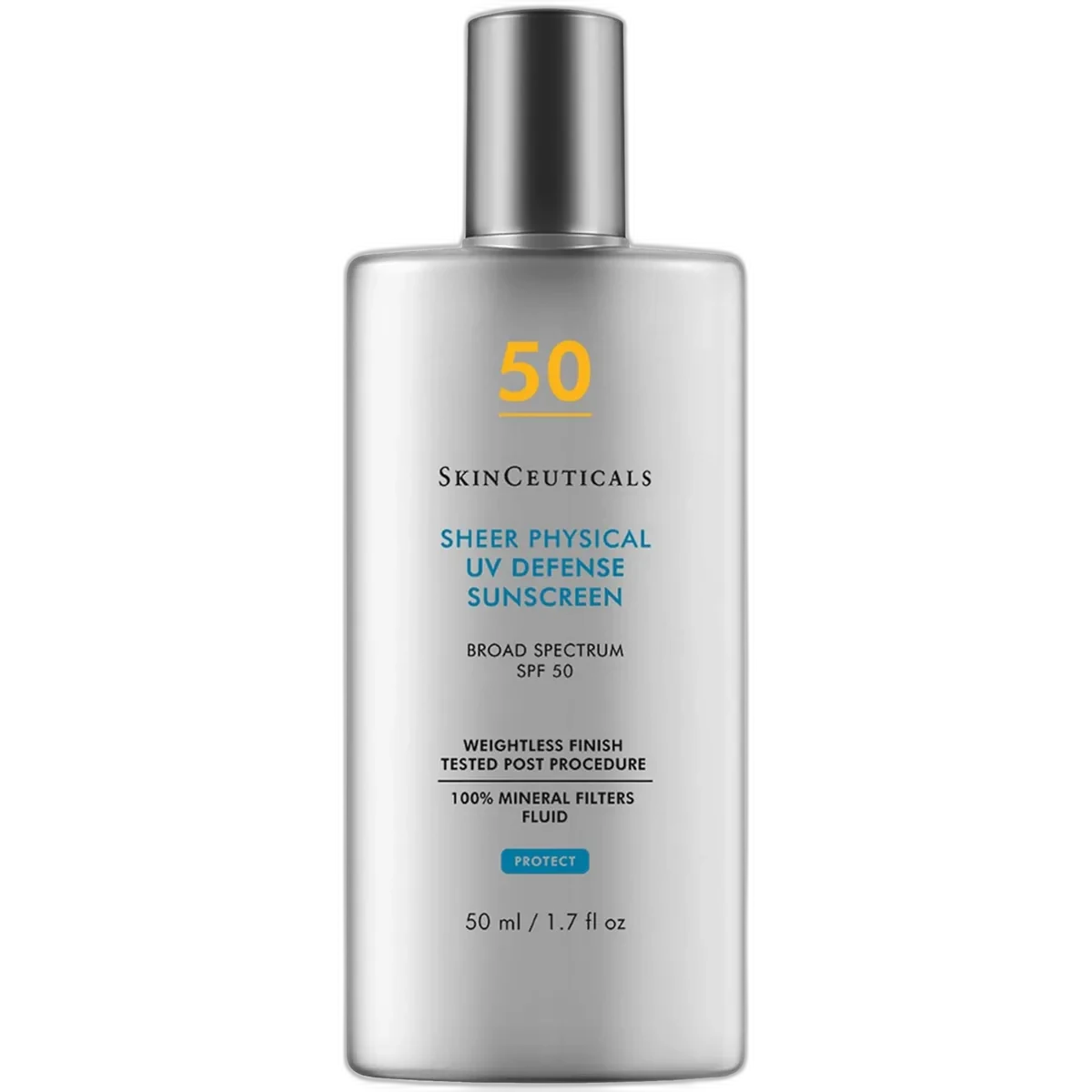
Sheer Physical UV Defense SPF 50
Sensitive-Skin Mineral Daily
 Verified reviewer
Pros & cons.
- +Genuinely lighter finish than most mineral sunscreens
- +Same protective active load as Physical Matte in a normal-skin-friendly base
- +Fragrance-free and well-tolerated by rosacea and post-procedure skin
- +Appropriate for pregnancy, nursing, and age-appropriate pediatric use
- +Frequently recommended for melasma patients who need mineral-only filters
- +Layers well under makeup with minimal pilling
- −$40 for 1.7 oz is premium pricing vs drugstore mineral alternatives
- −Still leaves a visible cast on medium-deep and deep skin tones
- −Not matte enough for very oily skin — the Physical Matte variant fits better
- −Silicone feel isn't for everyone
- −Single-size only — no travel or bulk options
The full review.
The history of mineral sunscreen is basically a long story of cosmetic chemists trying to make zinc oxide and titanium dioxide feel like something other than zinc oxide and titanium dioxide. For most of the last thirty years, the answer has been: not quite. Mineral sunscreens were pasty, heavy, chalky, and reserved for people who genuinely couldn’t use chemical filters — infants, rosacea patients, post-laser recovery, pregnancy — rather than chosen on the merits. Sheer Physical UV Defense is one of the first mineral sunscreens to cross the line from ‘tolerable out of necessity’ to ‘genuinely wearable by choice.’ It’s not the absolute lightest mineral option on the market today, but for its time it set a new bar for what a physical SPF 50 could feel like on normal and sensitive skin.
The formula takes the same 6% coated titanium dioxide and 5% zinc oxide load that SkinCeuticals uses in their Physical Matte variant and redeploys it in a meaningfully different carrier. Instead of a silica-heavy mattifying base, Sheer Physical uses a lighter silicone emulsion that spreads easily, absorbs partially, and sets to a natural satin finish. The silicone dispersion is critical — it’s what allows the coated mineral particles to lay down evenly without creating the patchy, streaky look that older mineral sunscreens produced. A small amount of iron oxides contributes gentle warmth to the finish, and artemia extract and tocopherol provide modest antioxidant support consistent with the SkinCeuticals house style.
How to Use
Application is forgiving. Squeeze out approximately two finger-lengths for the face and neck — less than that and you’re undercutting the SPF — and work it across the skin in a single pass. There’s a brief period where the product looks slightly white on the face, but pressing it in rather than rubbing distributes the minerals evenly and reduces the visible cast within 30-60 seconds. The final finish is satin — not dewy, not matte, just a natural skin-like effect that layers well under most makeup and doesn’t require touching up throughout the day if you haven’t been sweating. No tingling, no warmth, no characteristic ‘sunscreen feel’ that signals something’s sitting on your face.
Works for
Where this sunscreen delivers is in the breadth of who can wear it well. Rosacea patients report that daily use doesn’t provoke flushing the way some chemical sunscreens do. Post-procedure patients use it immediately after the acute recovery window to protect freshly-treated skin. Melasma patients — who are strongly advised to use mineral filters because some chemical filters may contribute to melasma flare — have a sunscreen they can wear daily without compromising efficacy. Combination and normal skin users simply get a mineral option that feels lighter than they expect from the category. It’s not a perfect match for every skin type — very oily skin will prefer the Physical Matte version, and deeper skin tones will still see some residual cast — but the suitability breadth is notably wide for a mineral-only formula.
Common Complaints
The honest limitations are mostly about pricing context. Forty dollars for 1.7 ounces is fair for this tier of sunscreen, and the larger tube means the per-ounce cost is meaningfully better than the Physical Matte version. Still, drugstore mineral sunscreens exist at a fraction of the price, and some deliver comparable finishes — brands like La Roche-Posay and Eucerin have narrowed the gap significantly over the last several years. What SkinCeuticals offers is the specific formulation consistency, the dermatology-office pedigree, and the reliability of knowing exactly what you’re getting. For patients already in the brand ecosystem, it’s a natural pairing with C E Ferulic or Serum 10 for the morning routine. For price-sensitive users, the value question is more open.
Who Should Buy
Board-certified dermatologists tend to recommend Sheer Physical for sensitive, rosacea-prone, and post-procedure patients who need a mineral sunscreen they can actually wear daily without feeling like they’re applying a heavy mask. It’s also frequently suggested for melasma patients, pregnant and nursing patients, and pediatric use where age-appropriate. If any of those descriptions fit, this is a reliably good option that earns its place in a daily routine. For oily skin the Physical Matte variant is probably a better match, and for deeper skin tones the tinted Physical Fusion version from the same brand is often the more wearable choice.
Ingredient analysis.
Full INCI list
Active Ingredients: Titanium Dioxide 6.0%, Zinc Oxide 5.0%. Inactive Ingredients: Water, Cyclopentasiloxane, Dimethicone, Butyloctyl Salicylate, Silica, Isododecane, Polyglyceryl-4 Isostearate, Cetyl PEG/PPG-10/1 Dimethicone, Hexyl Laurate, Nylon-12, Aluminum Hydroxide, Magnesium Sulfate, Phenoxyethanol, PEG-9 Polydimethylsiloxyethyl Dimethicone, Stearic Acid, Dimethicone/Vinyl Dimethicone Crosspolymer, Chlorphenesin, Trimethylsiloxysilicate, Alumina, Triethoxycaprylylsilane, Disodium EDTA, Iron Oxides, Tocopherol, Artemia Extract
Skin match.
The science.
The Science
The UV protection uses the same mineral filter principles as the Physical Matte variant and the broader category. Titanium dioxide covers UVB and short UVA (290-350nm) by scattering and absorbing radiation; zinc oxide extends coverage across UVA II and UVA I (up to 400nm), where most deep photoaging damage occurs. Combining coated titanium and zinc is the most reliable mineral-only method for broad-spectrum protection. Coating mineral particles with triethoxycaprylylsilane — a strategy in cosmetic chemistry literature since the mid-2000s — improves dispersion in emulsion bases and reduces the visible whiteness of uncoated physical filters. The sheer finish comes from this coating technology and the silicone carrier system, which lets coated particles form a thinner, more even film. Mineral sunscreens are the first-line recommendation for melasma because some studies suggest certain chemical UV filters may drive melasma progression, making physical filter-only formulas the safer choice for patients managing the condition. They are also the preferred choice for pregnancy, nursing, pediatric use, and post-procedure recovery, where chemical filter absorption is a greater concern. The artemia extract and tocopherol provide a modest antioxidant layer, matching the SkinCeuticals approach of pairing UV protection with antioxidant defense.
Dermatologist Perspective
Dermatologists often recommend Sheer Physical UV Defense for patients who need a mineral sunscreen for daily wear without cosmetic compromise. Board-certified dermatologists frequently suggest it for patients with rosacea, melasma, sensitive skin, and post-procedure skin, and for pregnant and nursing patients who prefer mineral filters over chemical ones. It is a cosmetically-elegant mineral sunscreen in the dermatology-office price tier and works well for first-time mineral sunscreen users who avoided the category due to heaviness or cast. Dermatologists suggest other options when oil control is the priority (the Physical Matte variant fits better), when a deeper skin tone needs a tinted option, or when budget constraints make a drugstore mineral sunscreen more practical.
Where it fits in your routine.
Apply this as your final morning step once serums and moisturizer absorb. Use two finger-lengths for face and neck, or a quarter-teaspoon for face alone. Spread in one pass, then press visible residue into the skin instead of rubbing. Let it set for one minute before applying makeup. Reapply every two hours of direct sun exposure, and every 40 minutes when swimming or sweating heavily. For post-procedure skin, wait until the acute healing window passes before applying — follow your provider's specific aftercare instructions.
Forty dollars for 1.7 fluid ounces is fair for this tier and actually offers a meaningfully better per-ounce rate than the 1 oz Physical Matte version at the same brand. A daily full-face user will consume a tube in about six to ten weeks, putting the annual cost between two hundred and three hundred dollars — reasonable for a dermatology-tier daily sunscreen. Lower-priced alternatives exist: La Roche-Posay Anthelios Mineral, Eucerin mineral options, and several others deliver comparable mineral protection at a lower price point. What SkinCeuticals offers is the specific formulation consistency and the pairing with the brand's antioxidant serums for users already in the ecosystem. The tube is not offered in multiple sizes, so there's no bulk or travel option to soften the cost.
Normal, combination, sensitive, or dry skin types wanting a mineral sunscreen that feels lighter than the category average. It works well for rosacea, melasma, pregnancy, post-procedure, and pediatric use — anyone needing a physical filter for daily wear.
Users with very oily skin should use the Physical Matte variant from the same brand. Medium-deep and deep skin tones should check for residual cast and may prefer a tinted mineral option like the SkinCeuticals Physical Fusion. Budget-conscious users can find comparable protection at lower price points from La Roche-Posay, Eucerin, and other dermatologically-aligned brands.
Product details.
Lightweight, slightly fluid cream that spreads easily
Essentially unscented — faint mineral note
White squeeze tube with flip cap
The texture is thicker than chemical sunscreens but lighter than the Physical Matte version. It spreads in one pass and absorbs into a natural satin finish within a minute. Sensitive skin feels nothing on application—no tingling or warming. A very slight tint shows on medium-deep skin; pressing instead of rubbing reduces this.
About 6-10 weeks with daily face and neck application
12 months
All Year
The backstory.
SkinCeuticals launched Sheer Physical UV Defense in 2011 as a more wearable mineral alternative to their earlier physical sunscreens, responding to dermatology-office feedback that patients were skipping mineral sunscreens because the existing options felt too heavy. The formulation was engineered specifically for daily facial wear on sensitive and post-procedure skin that needed a physical filter but couldn't tolerate the cosmetic drawbacks of older formulas.
About SkinCeuticals
Dr. Sheldon Pinnell's antioxidant research at Duke University founded SkinCeuticals in 1997. Dermatologists widely use the brand's sunscreens, which include the brand's signature antioxidant heritage in their formulations. *Established Brand (5–20 years)*
Common myths.
Sheer mineral sunscreens provide less protection than chemical ones.
Protection depends on filter concentration, coverage, and application amount, not chemical vs mineral. This formula uses 6% titanium and 5% zinc to deliver broad-spectrum SPF 50 protection comparable to chemical equivalents at the recommended amount.
Sheer sunscreens don't require the 'two fingers' recommendation.
Application amount determines your actual SPF. Using half the recommended amount cuts effective protection by roughly half, even if the finish is sheer. Sheerness is a cosmetic property, not a protection property.
FAQ.
Is this sunscreen tinted?
No, this version is untinted. SkinCeuticals offers a tinted Physical Fusion version for color correction. Sheer Physical has a slight whitening effect on deeper skin tones from the physical filters, but lacks added pigments.
How is this different from Physical Matte UV Defense?
The active filter load is the same, but the carrier bases differ. Sheer Physical uses a light, hydrating emulsion for normal-to-combination skin. Physical Matte uses a silica-rich base for oily skin needing sebum control. Pick based on your skin type and finish preference.
Can I wear it under makeup?
Yes — the satin finish helps most foundations grip, and the silicone-based formula works well under powder and liquid makeup. Wait one full minute for absorption before applying makeup to prevent pilling.
Is it safe for pregnancy and children?
Mineral sunscreens are the preferred choice for pregnancy, nursing, and pediatric use because the filters stay on the skin surface. This formula is fragrance-free, so it works for sensitive and pediatric skin. Always confirm pediatric age-appropriateness with your provider.
Will it pill or flake?
It pills if you layer it over tacky products or serums that haven't absorbed. Wait 60-90 seconds for each layer to absorb. Press subsequent layers instead of rubbing. Oil-based products under this sunscreen often cause pilling.
How much should I apply?
The standard recommendation is approximately two finger-lengths of product for face and neck, or about a quarter-teaspoon for face alone. Underapplying significantly reduces the SPF you actually get. Don't forget ears, hairline, and back of neck.
Does it work on dark skin tones?
The titanium and zinc filters leave a visible white cast on medium-deep and deep skin tones. Press the product in instead of rubbing to reduce this. Users with deeper complexions may prefer a chemical or tinted mineral sunscreen, like the SkinCeuticals Physical Fusion UV Defense.
What the community says.
"Lighter feel than most mineral sunscreens"
"Minimal white cast on light-to-medium skin"
"Well-tolerated by rosacea and post-procedure skin"
"Layers well under makeup"
"Still leaves a visible cast on medium-deep skin tones"
"Not matte enough for very oily skin"
"Expensive per ounce compared to drugstore mineral options"
Featured in.
People also looked at.