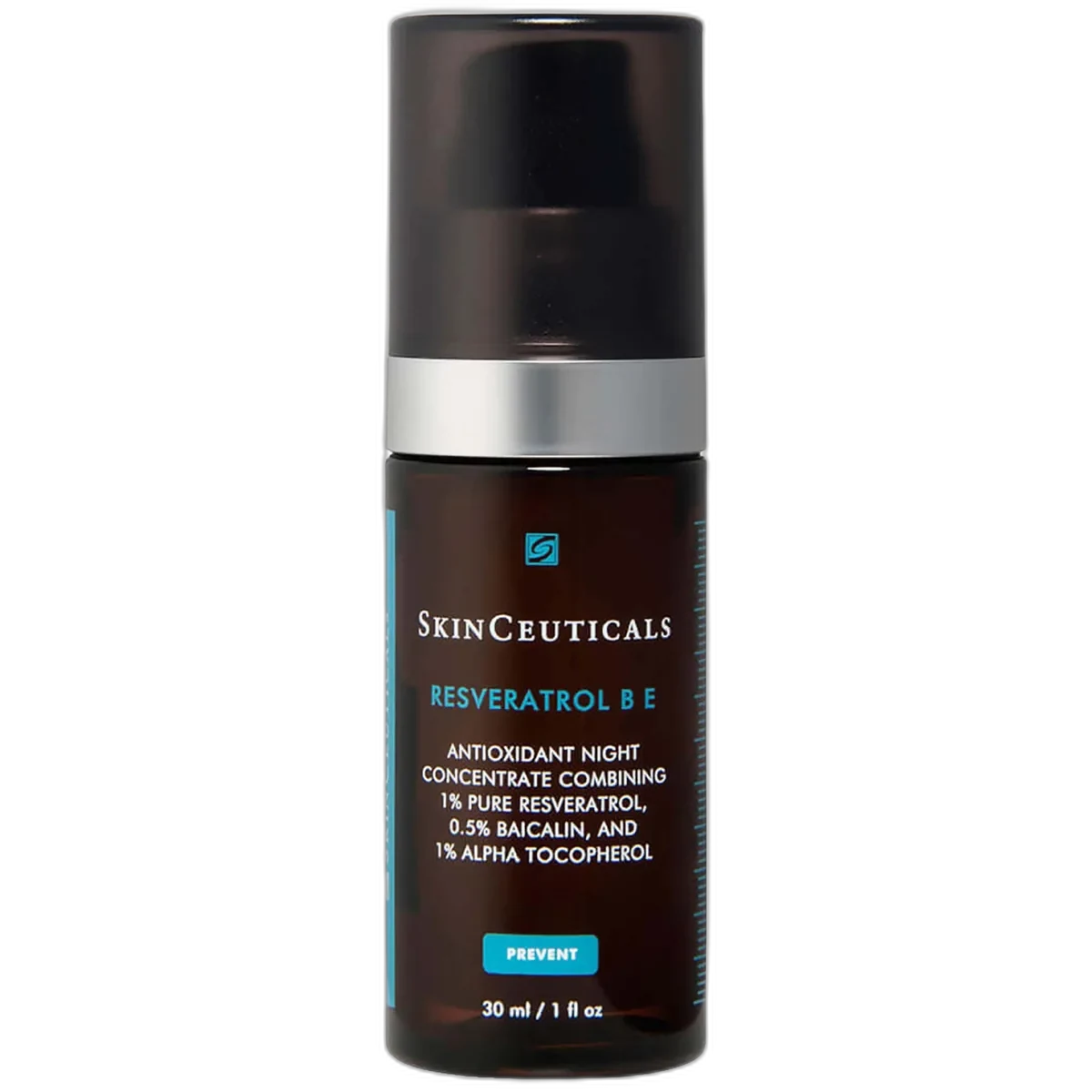
Resveratrol B E
Nighttime Antioxidant Specialist
 Verified reviewer
Pros & cons.
- +1% resveratrol is one of the highest stabilized topical concentrations available
- +Backed by brand-sponsored clinical research on topical resveratrol stability
- +Pairs with C E Ferulic for genuinely complementary 24-hour antioxidant coverage
- +Fragrance-free and tolerable on nearly all skin types
- +Light milky texture layers easily with retinoids and moisturizers
- +Preventative mechanism different from vitamin C — adds genuine variety
- −$182 for 1 oz is a serious financial commitment for a subtle product
- −Results are slow, cumulative, and hard to visibly attribute
- −Not a priority first purchase over retinoids, vitamin C, or sunscreen
- −Dropper packaging allows some air exposure that can degrade actives over time
- −Much cheaper resveratrol alternatives exist for budget-conscious users
The full review.
Resveratrol has had an awkward run in skincare. For years it was the ingredient your aunt mentioned as a reason to drink more red wine, wrapped in wellness-industry enthusiasm and headline studies about polyphenols and longevity. Actual clinical evidence for oral resveratrol has been underwhelming — bioavailability is poor, dosing is unclear, and most supplement trials have come up short. What almost nobody talks about is that topical resveratrol, delivered in a stabilized leave-on formula, operates on completely different principles and has a much more plausible case for doing something useful. SkinCeuticals Resveratrol B E is one of the few products built to actually test that case.
The formula centers on 1% resveratrol paired with 1% alpha-tocopherol (vitamin E) and 0.5% baicalin, the flavonoid extracted from Chinese skullcap. The combination isn’t random — SkinCeuticals has published research demonstrating that this specific trio improves the stability of resveratrol in a cosmetic base, addresses the compound’s photosensitivity, and produces measurable effects on the skin’s endogenous antioxidant defenses. The mechanism matters here, because it’s fundamentally different from how vitamin C works. Vitamin C directly neutralizes free radicals as they form — it’s reactive, scavenging damage in real time. Resveratrol operates upstream, activating the Nrf2 pathway that upregulates the skin’s own antioxidant enzyme production. In theory, this makes the two serums genuinely complementary: C E Ferulic in the morning for direct defense, Resveratrol B E at night to restore the skin’s internal antioxidant machinery for the next day’s exposure.
Texture
The texture is almost anticlimactic. It’s a thin milky-white serum that dispenses from a standard dropper, spreads effortlessly, and absorbs in under a minute. There’s no tingling, no cooling, no sense that anything dramatic is happening on the skin. First-time users often wonder if they’re using it correctly — this is normal. Antioxidant serums of this type are cumulative, preventative, and almost entirely invisible in their active mechanism. You’re not supposed to feel it working; you’re supposed to notice, over weeks and months, that your skin looks marginally better than it otherwise would.
Common Praise
And there’s the first honest limitation. Resveratrol B E doesn’t produce the kind of immediate visible results that a glycolic acid, a retinoid, or even a well-formulated vitamin C serum can deliver. Users who stick with it for six months or longer typically report a subtle improvement in overall radiance, tone, and the general “healthier-looking” quality that preventative skincare tends to produce over time. Users who try it for a few weeks and don’t see obvious change often conclude it isn’t doing anything — which is almost impossible to prove or disprove for this category of product.
Common Complaints
The second honest limitation is the price. One hundred and eighty-two dollars for a one-ounce bottle is firmly in the luxury skincare tier, and for a product whose effects are this subtle, the value math demands specific commitment. A nightly user will go through a bottle in about two to three months, which puts the annual cost above eight hundred dollars for this single serum. There are far cheaper resveratrol products on the market — The Ordinary’s Resveratrol 3% + Ferulic Acid 3% serum is under ten dollars — though they lack the SkinCeuticals formulation research, stability data, and clinical provenance. For users who specifically want the dermatology-office-validated version, this is essentially the only option at this concentration and formulation.
Who Should Buy
Board-certified dermatologists tend to recommend Resveratrol B E for a specific kind of patient: someone already using C E Ferulic who wants to complete the 24-hour antioxidant coverage, someone focused on long-term preventative anti-aging rather than addressing active concerns, and someone whose budget can absorb a premium nighttime serum without forcing tradeoffs elsewhere in the routine. For casual users building a first serious skincare routine, this is not where the money should go first — a retinoid, a good vitamin C, and a solid sunscreen deliver more visible results per dollar spent. But for the right patient, this is a thoughtfully formulated and uniquely positioned product that earns its place in a mature, well-researched routine.
Ingredient analysis.
Full INCI list · pH 6.5
Water/Aqua, Butylene Glycol, Glycerin, Tocopherol, Dimethicone, Caprylic/Capric Triglyceride, Sodium Hydroxide, Pentylene Glycol, Resveratrol, Baicalin, Phenoxyethanol, Carbomer, Ammonium Acryloyldimethyltaurate/VP Copolymer, Sodium Hyaluronate, Caprylyl Glycol, Ethylhexylglycerin, Dimethiconol, Disodium EDTA, Xanthan Gum, Citric Acid, BHT
Skin match.
The science.
The Science
Topical resveratrol works differently than the common vitamin C and vitamin E antioxidant mechanism. Instead of directly donating electrons to neutralize free radicals like vitamin C, resveratrol activates the Nrf2 (nuclear factor erythroid 2-related factor 2) transcription factor. This upregulates the skin's own antioxidant enzymes, including glutathione peroxidase, superoxide dismutase, and heme oxygenase-1. It boosts the skin's endogenous antioxidant capacity instead of just adding exogenous antioxidants; this is why researchers call it a 'defense system activator' rather than a direct antioxidant. SkinCeuticals published in-house research in the Journal of Drugs in Dermatology and other peer-reviewed venues showing that this 1% resveratrol / 1% vitamin E / 0.5% baicalin combination is more stable than resveratrol alone and shows measurable antioxidant effects in ex vivo skin models. The baicalin stabilizes resveratrol (which is photosensitive and prone to oxidation in solution) and has its own documented anti-inflammatory activity by inhibiting the NF-kB pathway. Independent clinical evidence for topical resveratrol is thinner than for vitamin C or retinoids, so the evidence level is 'promising' rather than 'well-established.' The compound has solid laboratory support, growing clinical support, and a reasonable biological case, but it lacks the evidence tier of the best-studied actives in dermatology.
Dermatologist Perspective
Dermatologists often recommend Resveratrol B E to complement SkinCeuticals' C E Ferulic for patients seeking a 24-hour antioxidant strategy. Board-certified dermatologists value the stabilized formulation and SkinCeuticals' research into topical resveratrol delivery — few products at this concentration have published stability data. They frequently suggest it to patients focused on preventative anti-aging, patients with accumulated environmental damage, and patients wanting a nighttime serum that pairs with retinoids without adding irritation. Dermatologists steer patients elsewhere if budget is a constraint, if stronger evidence actives like retinoids or vitamin C better address primary concerns, or if a patient building a first routine needs to prioritize foundational products.
Where it fits in your routine.
Apply 4-5 drops to clean, dry skin as your first PM step. You can use it in the morning, but the formula targets PM use. Pat it into your face, neck, and décolletage. Wait about 60 seconds for full absorption before applying other products. It layers well under retinoids, moisturizers, and occlusives. Avoid the immediate eye area. Using this with C E Ferulic during the day creates the intended 24-hour antioxidant routine. Store away from direct sunlight and heat to maintain stability. Resveratrol is photosensitive, so nighttime use helps preserve active integrity.
Resveratrol B E costs one hundred and eighty-two dollars for one fluid ounce. This luxury serum's value depends on how much antioxidant coverage a buyer wants. A nightly user finishes a bottle in two to three months, making the annual cost about eight hundred dollars—a high price even for premium skincare users. Lower-priced alternatives exist: The Ordinary has a resveratrol-based serum for under ten dollars, and K-beauty brands offer resveratrol products between $30-60. These lack the same formulation research or stability data, but they may deliver comparable benefits for users focused on the active ingredient rather than brand provenance. For patients using the SkinCeuticals antioxidant system and C E Ferulic in the morning, this is a logical nighttime addition. For everyone else, the value is harder to justify.
Users already using C E Ferulic or another vitamin C serum in the morning can use this for a complementary nighttime antioxidant strategy. It suits patients focused on long-term preventative anti-aging, those concerned about cumulative environmental damage, and anyone building a comprehensive dermatology-office-grade routine with the budget to support it.
Prioritize retinoids, vitamin C, and sunscreen before adding this to a first serious skincare routine. Budget-conscious users can find comparable resveratrol benefits in The Ordinary and other affordable alternatives. Users wanting dramatic visible results in weeks rather than months should spend on actives with faster, more obvious effects.
Product details.
Lightweight milky-white serum that absorbs quickly
Fragrance-free — faint botanical note
Opaque frosted glass bottle with dropper
This thin milky lotion has a slight botanical note. It absorbs within 60 seconds and leaves no residue. It causes no tingling, stinging, or active sensation. This serum works subtly and cumulatively by design; you do not feel it working.
2-3 months with nightly use
12 months
All Year
The backstory.
SkinCeuticals developed Resveratrol B E in 2014 specifically as the nighttime complement to their flagship C E Ferulic serum — the idea being that vitamin C handles antioxidant defense during the day when UV and environmental damage occurs, and resveratrol supports the skin's own antioxidant restoration overnight. The formulation grew out of the brand's ongoing research into stabilized topical resveratrol delivery, an area where most cosmetic companies had struggled because pure resveratrol is notoriously unstable in leave-on products.
About SkinCeuticals
Established Brand (5–20 years)SkinCeuticals launched in 1997, based on Dr. Sheldon Pinnell's antioxidant research at Duke University. The brand publishes clinical work on topical resveratrol as an endogenous antioxidant booster in peer-reviewed dermatology journals.
Common myths.
Resveratrol is just another version of vitamin C.
They work through different mechanisms. Vitamin C neutralizes free radicals directly; resveratrol activates the Nrf2 pathway to upregulate the skin's endogenous antioxidant enzymes. Using both is complementary, not redundant.
You need to drink red wine to get resveratrol benefits.
Wine contains too little resveratrol to benefit skin, and oral resveratrol has poor bioavailability. Topical delivery of a stabilized 1% concentration works better; this is how the ingredient performs best.
FAQ.
How is this different from C E Ferulic?
C E Ferulic is a daytime vitamin C serum that neutralizes free radicals from UV and pollution. Resveratrol B E is a nighttime serum that supports the skin's own antioxidant restoration. These products complement rather than replace each other — many dermatologists recommend using both for 24-hour antioxidant coverage.
When will I see results?
This serum works through cumulative prevention rather than delivering dramatic results. Subtle radiance and brightness improvements show after 4-8 weeks, while more meaningful benefits appear after 3-6 months of nightly use. It does not provide the immediate visual change seen with an AHA or retinoid.
Can I use this with retinol or tretinoin?
Yes. Apply Resveratrol B E to clean dry skin first. Wait for it to absorb, then apply your retinoid on top. This antioxidant support buffers oxidative stress that retinoids generate during the adjustment period.
Is resveratrol scientifically proven for skin?
Topical resveratrol shows growing evidence for antioxidant and anti-aging effects. Clinical studies, including some SkinCeuticals-sponsored research, show measurable improvements. The evidence base is smaller than for vitamin C or retinoids, so it sits in the 'promising' category rather than 'definitively proven' for all claimed benefits.
Is this safe during pregnancy?
Resveratrol B E ingredients are not on standard pregnancy-avoidance lists. Many dermatologists call it a reasonable option for pregnant patients who want to keep a serum routine. Always confirm with your OB if you have concerns.
Do I need this if I already use vitamin C?
Vitamin C alone works as a strong antioxidant strategy. Resveratrol B E adds to a comprehensive antioxidant routine or targets cumulative environmental damage and oxidative aging. Vitamin C alone is sufficient for casual users.
Can I use it in the morning?
This formula works best at night, though morning application is not harmful. Using it then misses the logic of pairing daytime vitamin C with nighttime resveratrol for 24-hour coverage.
What the community says.
"Light, comfortable texture that layers well at night"
"Pairs seamlessly with C E Ferulic for 24-hour antioxidant coverage"
"Noticeable brightness and radiance over several months"
"Tolerable on nearly all skin types"
"Very expensive for a subtle preventative serum"
"Slow, cumulative results that require patience"
"Effects are hard to attribute to this product alone"
Featured in.
People also looked at.