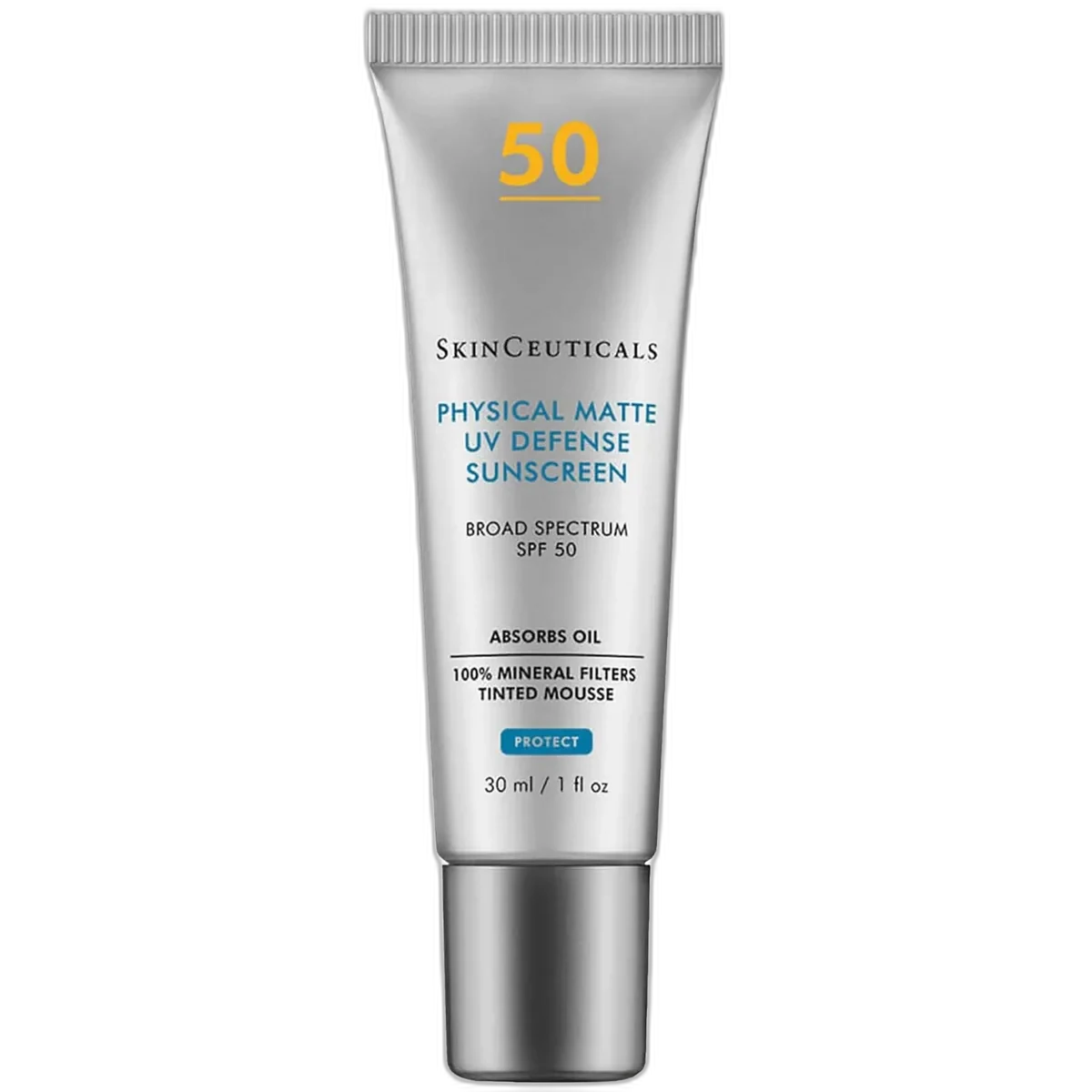
Physical Matte UV Defense SPF 50
Oily-Skin Mineral MVP
 Verified reviewer
Pros & cons.
- +Genuinely matte finish that holds for 6-8 hours on oily skin
- +Fragrance-free and well-tolerated by rosacea and sensitive skin
- +Coated mineral filters minimize cast on light-to-medium tones
- +Non-comedogenic and safe for acne-prone skin
- +Commonly used as post-procedure aftercare in dermatology offices
- +Silica-based mattifying doesn't rely on drying alcohols
- +Reef-safe with only titanium dioxide and zinc oxide
- −$38 for 1 oz makes it one of the more expensive mineral sunscreens per ounce
- −Visible residual cast on medium-deep and deep skin tones
- −Matte finish can accentuate dry patches on dehydrated skin
- −Thick texture requires patient application technique
- −Only comes in one size, so buying in bulk isn't an option
The full review.
Observe a busy dermatology practice on a Friday afternoon after laser, peel, or microneedling sessions. Staff give patients a small white tube and tell them to use only this sunscreen for two weeks. Nine times out of ten, that tube is this one. Physical Matte UV Defense is a staple on dermatology office aftercare shelves. It solves a common mineral sunscreen problem: it avoids the chalk, heaviness, or tacky finish that migrates when patients sweat, which usually punishes oily, reactive, or freshly-treated skin.
The formula is straightforward. Six percent coated titanium dioxide handles UVB and short UVA loads, while five percent zinc oxide extends coverage deeper into the UVA spectrum where most photoaging damage occurs. A silicone-and-silica base differentiates this from typical mineral SPF; it disperses mineral filters evenly while silica soaks up sebum throughout the day. The formula lacks drying alcohol, fragrance, or starch powder that creates a dusty, old-school mineral sunscreen feel.
Application requires patience. The lotion is thicker than chemical sunscreens and works best when pressed in rather than swiped. Once worked in, the finish is matte. It is not a “slightly less shiny than dewy” hybrid finish, but a proper shine-free surface that holds makeup and lasts eight hours for most oily-to-combination skin types. Artemia extract and tocopherol provide antioxidant support, a touch consistent with SkinCeuticals’ antioxidant heritage.
Physical Matte UV Defense works best for sensitive skin and post-procedure needs. The fragrance-free base, non-chemical filters, and restrained ingredient list mean rosacea skin doesn’t flush, eczema-prone skin doesn’t itch, and a freshly-peeled face doesn’t sting. Acne-prone users report the oil-absorbing finish doesn’t clog. The formula is non-comedogenic by testing and skips the heavy occlusives that cause mineral sunscreens to trigger breakouts on reactive skin.
The limitations are clear. At $38 for a one-ounce tube, the cost per ounce is steep even for luxury sunscreens, and users consume one tube faster than expected when applying enough for proper protection. A visible residual cast remains on medium-deep and deep skin tones that pressing in only partially fixes; readers with richer complexions may prefer a chemical or tinted SPF. While the matte finish suits oily skin, it can emphasize dry patches on dehydrated or mature skin that needs more cushioning. This is not a universal sunscreen; it targets a specific user.
Its popularity in dermatology offices is intentional. Board-certified dermatologists use this because it meets a standard most mineral sunscreens miss: cosmetic wearability for oily skin without sacrificing the tolerability sensitive and post-procedure patients need. If you have combination or oily skin, flush easily, manage rosacea, recover from an in-office treatment, or want a fragrance-free mineral option that won’t slide off at hour four, this formula is a safe bet for your routine. If you have dry skin, deep skin tone, or a budget that cannot absorb a $38 one-ounce sunscreen, the answer is different. That is a legitimate gap, not a flaw in the product.
Ingredient analysis.
Full INCI list
Active Ingredients: Titanium Dioxide 6.0%, Zinc Oxide 5.0%. Inactive Ingredients: Water, Cyclopentasiloxane, Silica, Butyloctyl Salicylate, Butylene Glycol, Isododecane, Polyglyceryl-4 Isostearate, Cetyl PEG/PPG-10/1 Dimethicone, Hexyl Laurate, Nylon-12, Aluminum Hydroxide, Magnesium Sulfate, Phenoxyethanol, PEG-9 Polydimethylsiloxyethyl Dimethicone, Stearic Acid, Dimethicone/Vinyl Dimethicone Crosspolymer, Chlorphenesin, Trimethylsiloxysilicate, Alumina, Triethoxycaprylylsilane, Dimethicone, Disodium EDTA, Iron Oxides, Tocopherol, Artemia Extract
Skin match.
The science.
The Science
Two physical filters with decades of clinical and regulatory backing provide the UV protection. Titanium dioxide scatters and absorbs UVB and short UVA, mostly in the 290-350nm range. Zinc oxide extends absorption across UVA II and UVA I, covering roughly 290-400nm. The AAD and multiple consensus guidelines call the combination of coated titanium and zinc the most reliable mineral-only approach to broad-spectrum coverage, as neither filter alone covers the full UVA I range that drives deep photoaging. SkinCeuticals coats the mineral particles with triethoxycaprylylsilane to improve dispersion into emulsion bases and reduce the visible whiteness of uncoated mineral filters, a strategy documented in cosmetic chemistry literature since the mid-2000s. Studies show the artemia (plankton) extract supports heat shock protein 70 expression, which helps skin cells manage UV-induced oxidative stress; early studies suggest a modest antioxidant role, though the evidence base is thinner than for vitamin C or vitamin E. The tocopherol stabilizes both the formula and the skin's lipid layer during UV exposure. Per recommendations from the American Academy of Dermatology, broad-spectrum mineral SPF is the first-line photoprotection for rosacea, post-procedure recovery, melasma management, and pediatric use.
Dermatologist Perspective
Dermatologists often recommend this sunscreen for patients with oily, acne-prone, or rosacea-affected skin who struggle to wear a mineral sunscreen daily. Board-certified dermatologists note that the combination of coated physical filters, a fragrance-free base, and mattifying silica makes it one of the few mineral options post-procedure patients tolerate well after lasers, peels, and microneedling. Doctors also suggest it for patients who cannot or prefer not to use chemical UV filters, such as pregnant and nursing patients who often prefer a chemical-free approach. Dermatologists steer patients elsewhere if the patient has dry or mature skin, or if budget is a concern—in those cases, a different mineral or hybrid SPF usually makes more clinical sense.
Where it fits in your routine.
Apply this as your final morning step, once serums and moisturizer absorb. Use about two finger-lengths for your face and neck. Mineral sunscreens require specific amounts to reach their SPF rating; underapplying reduces protection. Press and pat the product into your skin instead of rubbing to help filters set evenly and prevent streaking. Let it set for one minute before applying makeup. Reapply every two hours of direct sun exposure, or every 40 minutes when swimming or sweating heavily. For post-procedure skin, wait until raw or weeping areas close before applying.
At $38 for one fluid ounce, the price is high. A full-face daily user finishes a tube in six to eight weeks, making the annual cost over two hundred dollars for one product. The formulation justifies this for oily, sensitive, rosacea-prone, or post-procedure skin. Few matte fragrance-free mineral sunscreens last through a workday, and the dermatologist-office track record is real. For other skin types, the value is lower. EltaMD UV Clear and similar options offer overlapping benefits for less, but lack this matte finish. This product only comes in one size, so no larger-tube discount lowers the per-ounce cost.
Oily, combination, rosacea-prone, or post-procedure skin needs a fragrance-free mineral sunscreen with a matte finish. It works well for patients recovering from in-office treatments, those managing flushing or redness, and makeup wearers needing a mattifying base for foundation grip.
Dry, dehydrated, or mature skin seeking a dewy or cushioning finish will find this formula too stripping. Medium-deep and deep skin tones should test for cast before committing. If a $38 one-ounce tube exceeds your budget, look at comparable mineral options in a lower price tier.
Product details.
Thick, slightly tinted cream that blends into a soft-focus matte film
Essentially unscented — faint mineral note
Opaque white squeeze tube with flip cap
The texture is thicker than chemical sunscreens and needs dotting and blending. It sets quickly to a shine-free finish. A very slight tint can look like a white cast on medium-deep skin; press it in instead of rubbing. It causes no stinging or tingling.
About 6-8 weeks with daily full-face application
12 months
All Year
The backstory.
SkinCeuticals developed this as the mineral counterpart to their popular chemical Ultra Facial Defense, specifically targeting the derm office request for a non-chemical SPF that wouldn't slide off acne-prone or sebum-heavy skin during summer months or after in-office procedures like lasers and peels.
About SkinCeuticals
Established Brand (5–20 years)SkinCeuticals launched in 1997, built on Dr. Sheldon Pinnell's antioxidant research at Duke University. Dermatologists and med-spas use these formulations, which appear in peer-reviewed literature on topical antioxidant photoprotection.
Common myths.
Mineral sunscreens always leave a white cast.
They did. This coated titanium dioxide and silicone carrier system produces a minimal cast on light-to-medium tones, but deeper skin may still show some residual lightening.
Matte sunscreens are drying.
This formula uses silica absorption for its mattifying effect instead of alcohol or astringents, so it controls shine without dehydrating the skin.
FAQ.
Will this sunscreen cause a white cast?
On light-to-medium skin, the cast is minimal because coated titanium and zinc disperse better. Medium-deep and deep skin tones show visible residual lightening — SkinCeuticals offers tinted and chemical options that may suit deeper complexions better.
Can I use this after a laser or chemical peel?
Yes. Mineral filters stay on the skin surface instead of absorbing. Dermatologists often recommend this fragrance-free formula for post-procedure use. Apply only after all open areas have closed.
Does it work under makeup?
The silica-based matte finish helps most powder and liquid foundations grip the skin. Heavy silicone primers sometimes pill when layered on top; press them in instead of rubbing.
Is it waterproof or sweatproof?
The label says it is water-resistant for 40 minutes. Reapply every 40-60 minutes of water exposure during beach trips or heavy sweating.
How is this different from SkinCeuticals Sheer Physical UV Defense?
Sheer Physical has a thinner, more hydrating finish for normal and dry skin. Physical Matte uses more titanium and added silica to absorb oil and mattify. Physical Matte works better for combination, oily, and acne-prone skin.
Does it contain fragrance or essential oils?
No — the formula is fragrance-free and essential-oil-free. This is why dermatologists recommend it for rosacea, sensitive skin, and compromised barriers.
Community
What the community says.
"Truly matte finish that controls shine all day"
"No white cast on light-to-medium skin"
"Gentle enough for rosacea and post-laser skin"
"Layers well under makeup"
"Expensive for a 1 oz tube"
"Visible white cast on deeper skin tones"
"Can feel drying on already-dry skin"
"Silicone feel isn't for everyone"
People also looked at.