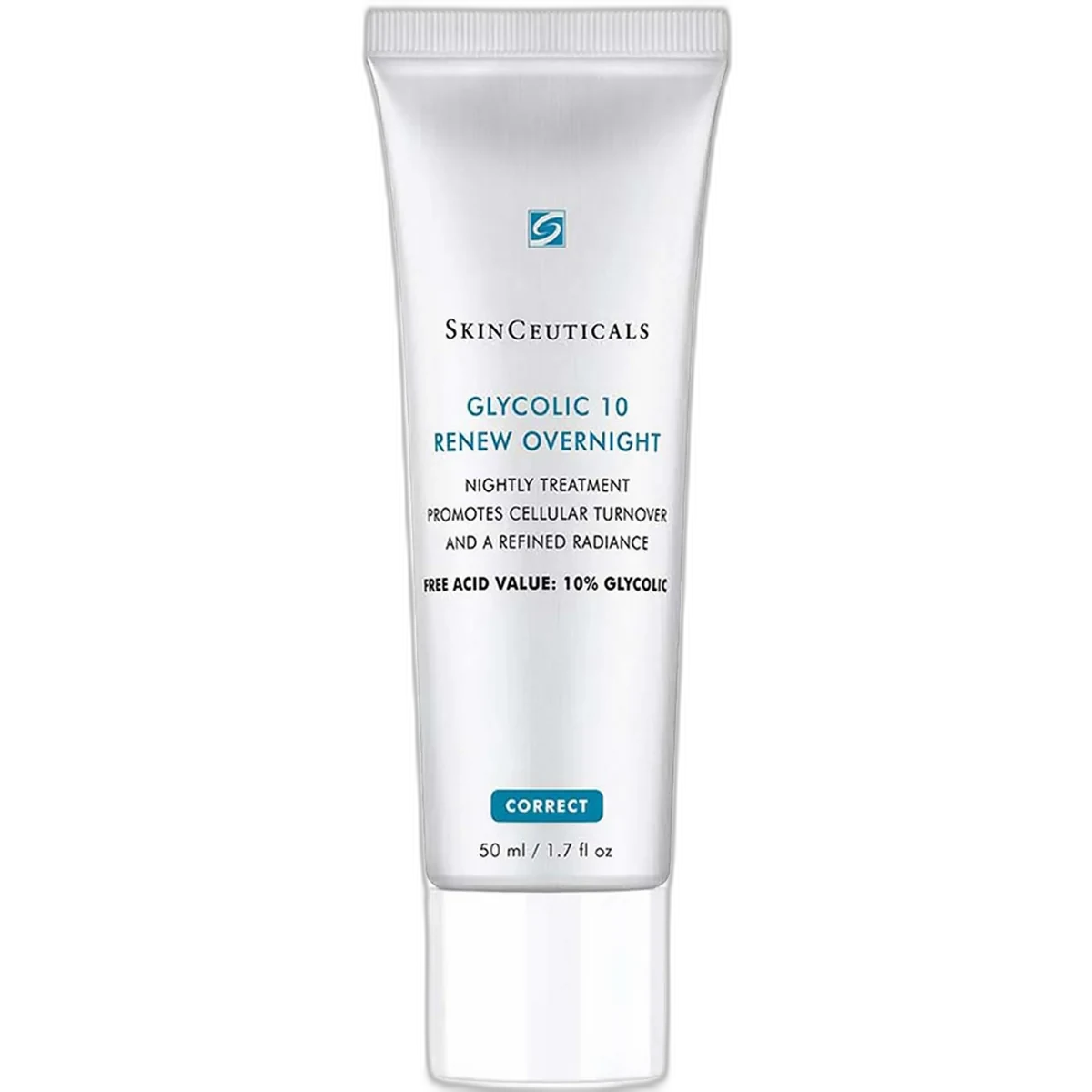
Glycolic 10 Renew Overnight
Clinical-Grade Glycolic Resurfacer
 Verified reviewer
Pros & cons.
- +10% glycolic acid at free acid value provides clinically proven overnight exfoliation and cell turnover
- +2% phytic acid adds chelation-enhanced brightening beyond what exfoliation alone achieves
- +Cream vehicle with jojoba esters and sunflower wax makes high-concentration glycolic wearable overnight
- +Clinical study data demonstrates 36% improvement in radiance and 37% in texture at 8 weeks
- +Fragrance-free formula from a brand with genuine dermatological research credentials
- +Acts as both treatment and light moisturizer, simplifying the PM routine
- −$96 for a glycolic acid cream is difficult to justify when comparable formulations cost $25-40
- −Thick, dense texture is difficult to spread and may reduce user compliance
- −10% glycolic acid causes significant irritation in sensitive or unprepared skin
- −Jar packaging exposes product to air and contamination — inferior to tubes or airless pumps
- −Not cruelty-free, which will concern ethically-minded consumers
- −Contains dimethicone and nylon-12 which some clean beauty adherents prefer to avoid
The full review.
About SkinCeuticals
SkinCeuticals has earned an almost unassailable reputation in clinical skincare through Dr. Sheldon Pinnell’s groundbreaking vitamin C research and the iconic C E Ferulic serum that emerged from it. That pedigree provides a halo effect that extends across the entire product line — including this glycolic acid overnight cream, where the question isn’t whether it works (it does) but whether the SkinCeuticals name on the label earns its premium over formulations that work equally well.
Reality
Glycolic acid at 10% free acid value is the formula’s single defining ingredient. As the smallest alpha-hydroxy acid molecule, glycolic acid penetrates the stratum corneum more deeply than lactic or mandelic acid, dissolving the intercellular bonds that hold dead corneocytes together. In an overnight leave-on format, that means approximately eight hours of continuous, steady exfoliation — a significant cumulative effect that’s why dermatologists often prefer leave-on treatments over wash-off products for meaningful results.
The addition of 2% phytic acid is the formula’s most interesting supporting move. Phytic acid (inositol hexaphosphate) is both a mild exfoliant and a potent metal chelator — it binds iron and copper ions that catalyze Fenton reactions, which generate the reactive oxygen species that drive melanin overproduction and collagen degradation. In practical terms, this means the phytic acid attacks discoloration from two angles: removing pigmented dead cells through exfoliation while reducing the oxidative processes that create new pigmentation. It’s a smarter approach than glycolic acid alone.
A trace amount of salicylic acid appears near the end of the INCI list — likely present at a concentration below active exfoliating levels but potentially contributing mild pore-clearing support. The combination of a surface AHA (glycolic) with a lipophilic BHA (salicylic), even at low concentration, provides broader coverage of the exfoliation spectrum than glycolic alone.
The cream vehicle is where SkinCeuticals’ formulation expertise shows most clearly. High-concentration glycolic acid in a thin serum or toner can be punishing — it penetrates rapidly, causes immediate stinging, and often leads to excessive dryness and peeling. By embedding the acid in a cream base with dimethicone, jojoba esters, sunflower seed wax, and dicaprylyl carbonate, SkinCeuticals controls the delivery rate and provides a protective emollient layer that moderates the acid’s impact on the barrier. The result is a treatment that’s wearable as a nightly cream rather than something you watch the clock with.
Texture
That said, the texture is this product’s Achilles heel. It’s thick. Dense. Sometimes reluctant to spread. Multiple reviewers describe having to warm it between their fingers before application, and some find the consistency unpleasant enough to affect compliance. The aluminum starch and nylon-12 in the formula contribute to this heaviness — they’re included for mattifying and texture purposes but make the cream feel more substantial than many users expect from a night treatment.
Works for
In clinical testing with 52 subjects over 8 weeks, the product demonstrated a 36% average improvement in radiance, 37% in texture, and 19% in skin tone. These are solid, clinically significant numbers that align with what the dermatological literature shows for 10% glycolic acid applied consistently over similar timeframes. The radiance improvement, in particular, is where most users first notice the difference — within the first week, skin looks more luminous, less dull, and catches light differently.
The anti-aging effects build more slowly. Glycolic acid’s ability to stimulate collagen and glycosaminoglycan synthesis in the dermis requires months of consistent use, and fine line reduction is typically visible around the 8-12 week mark. The overnight format maximizes contact time, which is directly correlated with dermal remodeling effects — it’s one of the genuine advantages of a leave-on cream over a wash-off peel.
Common Complaints
Irritation is real and expected. The first few applications will produce tingling — sometimes significant — and mild redness. This is the nature of 10% glycolic acid and not a sign that the product is wrong for you, unless the reaction persists beyond a few minutes or is accompanied by burning, swelling, or broken skin. Some peeling and dryness during the first two weeks is normal. Building up gradually — starting with two to three nights per week — is essential.
Packaging
The jar packaging is a misstep. Active ingredients, even relatively stable ones like glycolic acid, benefit from airless, opaque packaging that prevents oxidation and contamination. Every time you dip fingers into a jar, you introduce bacteria and expose the contents to air. SkinCeuticals’ own C E Ferulic comes in a dropper bottle for this reason — the choice to package this treatment in a jar feels like a formulation team that wasn’t consulted on packaging, or a design team that prioritized aesthetics.
Price
Now, the price. At $96 for 50ml, this is expensive by any standard, but it’s extraordinary for a glycolic acid product. Glycolic acid is one of the most affordable active ingredients in skincare — the raw material costs are minimal. The supporting formula is competent but not complex: emollients, silicones, waxes, and a standard preservative system. Well-formulated 10% glycolic acid treatments from brands with legitimate dermatological credentials exist at $25-40. The SkinCeuticals premium reflects the brand name, the clinical testing, and the physician-dispensed distribution model — but it does not reflect dramatically different ingredient quality.
Best for
The product works. That’s not in question. The glycolic acid concentration is clinically relevant, the phytic acid addition is thoughtful, and the cream vehicle makes nightly use feasible for most non-sensitive skin types. But the honest question is whether working well at $96 is meaningfully different from working well at $30, and for glycolic acid — one of the most studied, most predictable, least patent-protectable ingredients in skincare — the answer leans uncomfortably toward no.
Ingredient analysis.
Full INCI list
Aqua/Water, Glycolic Acid, Dicaprylyl Carbonate, Dimethicone, Sodium Hydroxide, Butylene Glycol, Propanediol, Glycerin, Phytic Acid, Cetyl PEG/PPG-10/1 Dimethicone, Aluminum Starch Octenylsuccinate, Nylon-12, Polyglyceryl-4 Isostearate, Magnesium Sulfate, Jojoba Esters, Phenoxyethanol, Helianthus Annuus Seed Cera/Sunflower Seed Wax, Caprylyl Glycol, Disodium EDTA, Salicylic Acid, Acacia Decurrens Flower Cera/Acacia Decurrens Flower Wax, Polyglycerin-3, Tocopherol, Pentaerythrityl Tetra-di-t-butyl Hydroxyhydrocinnamate
Skin match.
The science.
The Science
Glycolic acid is the most studied alpha-hydroxy acid in dermatology. Decades of research support its use for exfoliation, anti-aging, and hyperpigmentation treatment. A landmark review in the Journal of the American Academy of Dermatology shows that 5-15% glycolic acid promotes desquamation, stimulates epidermal renewal, and increases dermal collagen and glycosaminoglycan synthesis at sustained concentrations. The mechanism is clear: glycolic acid reduces calcium ion-dependent cell adhesion at the stratum corneum level to shed dead corneocytes.
The 10% free acid value in this formula matters. Free acid value is the amount of glycolic acid available to penetrate the skin after the formula's pH buffers neutralize any excess. Research shows glycolic acid efficacy depends on three factors: concentration, pH, and free acid value. Free acid value is the most reliable predictor of clinical outcomes.
Phytic acid (inositol hexaphosphate) at 2% uses a dual mechanism to complement glycolic acid's exfoliation. Research in the International Journal of Cosmetic Science shows phytic acid's iron-chelating properties reduce the Fenton reaction. This iron-catalyzed oxidative process generates hydroxyl radicals that stimulate melanogenesis. By chelating the iron driving this reaction, phytic acid targets a root cause of hyperpigmentation that exfoliation alone misses.
The overnight leave-on format maximizes the treatment window for glycolic acid. Research comparing leave-on versus wash-off glycolic acid formulations shows that longer contact time correlates with deeper exfoliation and more dermal collagen stimulation. An 8-hour overnight application provides sustained acid activity that short-contact peels cannot match at comparable concentrations.
Dermatologist Perspective
Board-certified dermatologists often recommend SkinCeuticals Glycolic 10 Renew Overnight for patients maintaining skin between professional chemical peels. Dermatologists note the 10% free acid value provides professional-level exfoliation in a consumer-safe format. The cream vehicle moderates delivery to reduce the irritation spikes liquid glycolic acid treatments cause. The phytic acid addition enhances brightening beyond standard glycolic acid products. However, dermatologists emphasize gradual introduction, daily sunscreen use, and avoiding retinoids in the same routine. This product is typically for patients with established acid tolerance rather than exfoliation beginners.
Where it fits in your routine.
Apply a thin, even layer to clean, dry skin as your final evening step. Use it 2-3 nights per week for the first 2 weeks, then increase to nightly use as tolerated. Avoid the eye area and lips. Do not layer retinol, other AHAs/BHAs, or benzoyl peroxide in the same routine. If tingling lasts more than 5-10 minutes, or if you feel burning or significant redness, rinse with water and use less often. Use SPF 50 sunscreen every morning — glycolic acid increases photosensitivity.
At $96 for 50ml, this is one of the market's most expensive glycolic acid treatments. The price is hard to justify by ingredients alone. Glycolic acid is an affordable raw material. While the phytic acid addition and cream vehicle show formulation expertise, other brands sell 10% glycolic acid treatments for $25-40. The price reflects SkinCeuticals' brand premium, clinical testing investment, and physician-dispensed distribution model. It fits well for patients already using the SkinCeuticals ecosystem. Value-conscious consumers can find the same glycolic acid concentration and comparable formulation quality for much less.
Experienced skincare users with normal to oily skin want clinical-grade overnight glycolic acid exfoliation for texture, radiance, and anti-aging. Dermatologist patients use it to maintain results between professional peels. SkinCeuticals ecosystem users can use it for routine consistency.
Avoid this product if you have sensitive, rosacea-prone, or eczema-affected skin. Budget-conscious consumers can find 10% glycolic acid formulations for less. Retinol users who dislike alternating-night schedules may find this inconvenient. Beginners to chemical exfoliation should use lower concentrations before 10% glycolic acid.
Product details.
Fragrance-free. The glycolic acid may cause a faint clinical or acidic scent.
White jar with SkinCeuticals clinical branding. Jar packaging preserves active ingredients less effectively than a tube or pump because each use exposes the product to air and bacteria.
Warm the thick cream between your fingertips before the first application to help it spread. The 10% glycolic acid causes a normal tingling sensation on the skin. This tingling usually stops within 5-10 minutes. Some users see mild flushing. The cream feels substantial but not greasy. Skin feels smoother by morning. Peeling or dryness may occur during the first 1-2 weeks as skin adjusts. ***
2-3 months with nightly use ***
12 months ***
fall winter ***
The backstory.
SkinCeuticals developed this product as a professional-grade at-home exfoliant for patients who want to maintain results between in-office chemical peels. The 10% glycolic acid concentration was chosen as the highest level that most non-sensitive skin types can tolerate as a nightly leave-on treatment without prescription oversight, while the phytic acid was included based on research into chelation-enhanced brightening that goes beyond what exfoliation alone can achieve.
About SkinCeuticals
Legacy Brand (20+ years)SkinCeuticals was founded in 1997 by Dr. Sheldon Pinnell, a Duke University dermatology researcher whose pioneering work on topical vitamin C antioxidants became the foundation of the brand. Now owned by L'Oréal, SkinCeuticals maintains its clinical positioning with products sold primarily through dermatology offices and medical spas, backed by over 25 years of published research.
Common myths.
Higher glycolic acid percentages always yield better results.
The effectiveness of glycolic acid depends not just on concentration but on pH, free acid value, formulation vehicle, and contact time. A well-formulated 10% leave-on overnight treatment can deliver results comparable to a higher-percentage wash-off peel because of the extended contact time — 8 hours of continuous exfoliation at 10% adds up to significant cumulative cell turnover.
Glycolic acid thins the skin over time.
Glycolic acid thins the stratum corneum (the dead cell layer) via exfoliation, but research shows it thickens the living epidermis and increases dermal collagen density. The skin becomes structurally stronger and healthier despite a thinner surface layer of dead cells. The thickening of the epidermis and dermis more than compensates.
FAQ.
How often should I use SkinCeuticals Glycolic 10 Renew Overnight?
Most users apply this nightly after skin adjustment. If you are new to glycolic acid, use it every other night or 2-3 times per week for the first 2 weeks, then increase to nightly use. Reduce frequency if you have persistent redness, peeling, or irritation. Always use SPF 50 sunscreen the next morning.
Conflicts With
Can I use SkinCeuticals Glycolic 10 with retinol?
Avoid using glycolic acid and retinol in the same evening routine. This combination causes excessive irritation and barrier damage. Instead, alternate nights: use glycolic acid one evening and retinol the next. Or use retinol on weeknights and glycolic acid on weekends. Let your skin fully adjust to one active before you introduce the other.
Not ideal for
Is SkinCeuticals Glycolic 10 safe for sensitive skin?
No — 10% glycolic acid is a high concentration. It is not for sensitive, rosacea-prone, or eczema-affected skin. Normal skin users may see tingling, redness, and mild peeling during the first 1-2 weeks. If you have sensitive skin but want glycolic acid benefits, use a lower concentration (5%) or a wash-off glycolic cleanser to reduce contact time.
Why is SkinCeuticals Glycolic 10 so expensive?
The $96 price reflects SkinCeuticals' clinical brand positioning and physician-dispensed distribution model, not exotic ingredient costs. Glycolic acid is an affordable ingredient, and the supporting formula is simple. You pay for clinical testing, the brand's research heritage, and the dermatologist recommendation channel. Other brands offer comparable 10% glycolic acid formulations at significantly lower price points.
Do I need a separate moisturizer after SkinCeuticals Glycolic 10?
The cream vehicle works as a treatment and light moisturizer. jojoba esters and sunflower seed wax provide emollient protection. Most users with normal to oily skin do not need more moisturizer. Those with drier skin or during winter months can apply a hydrating serum underneath or a light moisturizer on top after the glycolic cream has absorbed.
What the community says.
"Noticeable improvement in skin radiance within a week"
"Effectively smooths rough texture and uneven tone"
"Good for maintaining results between professional peels"
"Fragrance-free formula"
"Cream format feels more moisturizing than typical glycolic treatments"
"Very expensive for a glycolic acid product"
"Thick texture can feel heavy and difficult to spread"
"Causes irritation and peeling in sensitive skin types"
"Salicylic acid addition may be too much for some users"
"Some users report pilling when layered with other products"
People also looked at.