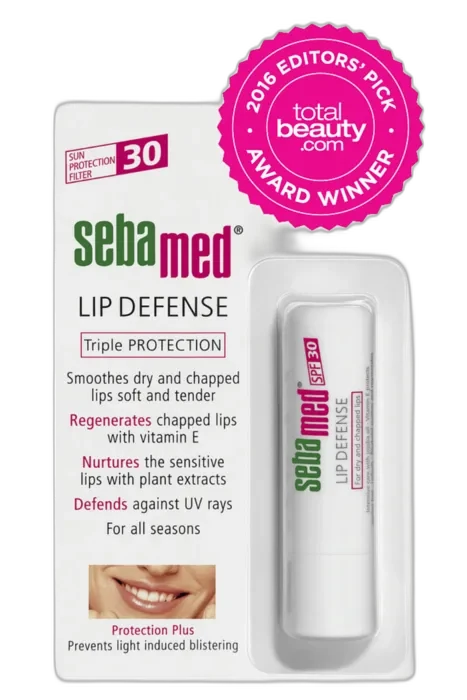
Lip Defense SPF 30
Derm Office Staple
 Verified reviewer
Pros & cons.
- +Proper SPF 30 broad-spectrum coverage instead of the usual SPF 15 tokenism
- +Four-filter system including photo-stable avobenzone combination
- +Long-wearing wax-and-oil base that holds up during daily wear
- +Shea butter and panthenol condition while protecting
- +Under $10 at a pharmacy-friendly price point
- +Dermatologist-developed by a legacy brand
- −Contains aroma/flavor, which can bother flavor-sensitive users
- −Slightly waxy compared to glossy lip balm formats
- −Visible white tint on application before the TiO2 blends in
- −Castor oil and beeswax may migrate slightly onto surrounding skin
The full review.
About Sebamed
The honest limitations: beeswax provides structural work, making it slightly waxier than the glossiest market options. Users preferring a slick, gloss-like texture will find this firmer than usual. The 4.8g stick is a standard lip balm size and lasts most users three to four months with daily application and occasional reapplication; at under $10, this is fair value but not a dramatic bargain. Castor oil and beeswax are mildly comedogenic. This matters if the balm migrates onto surrounding skin and triggers small bumps, though it does not matter for lips.
Myth
Lip sunscreen is the most neglected part of sun protection. Your lips have almost no melanin, the vermillion border is one of the thinnest-skin areas on your body, and chronic UV exposure can cause actinic cheilitis or lip cancers. Despite this, the average drugstore lip balm tops out at SPF 15 with little UVA coverage. Dermatologists recommend lip SPF, yet most people skip it or quit because products feel waxy or offer too little protection.
Reality
Sebamed’s Lip Defense SPF 30 solves this problem. It provides serious SPF without sacrificing a pleasant feel.
How to Use
Application leaves a visible white tint momentarily before it warms and blends into the lips. This is the titanium dioxide working, not a flaw; a truly invisible mineral-containing lip product usually lacks meaningful TiO2. The beeswax structure helps the balm stay on longer than a typical emollient lip product, but you should still reapply every two hours during active sun exposure and after eating or drinking.
Who Should Buy
It is a genuine buy for anyone spending time outdoors or those with lip discoloration and texture changes from chronic sun exposure. It shows that Sebamed, the unfussy German pharmacy brand, produces the quiet, competent products a routine needs.
Texture
The base—castor oil, caprylic/capric triglyceride, beeswax, and shea butter—uses classic lip balm pharmacology. Castor oil provides glossy slip and clings to the lip surface; beeswax gives the balm structure and a water-resistant seal to keep the filter layer in place during eating and drinking; shea butter adds conditioning fatty acids. Together, they feel firmer than a glossy Burt’s Bees but softer than a heavy drugstore wax stick.
Scent
The light flavor note (listed as ‘aroma’ on the INCI) is mild. If you are strictly flavor-averse, look elsewhere, as Sebamed does not offer an unflavored version.
Packaging
The 4.8g stick is a standard lip balm size and lasts most users three to four months with daily application and occasional reapplication. At under $10, this is fair value but not a dramatic bargain.
Best for
At under $10, this is a low-friction skincare routine upgrade. The gap between ‘no lip SPF’ and ‘occasional SPF 15 lip balm’ is small. The gap between ‘occasional SPF 15’ and ‘consistent daily SPF 30 with proper broad-spectrum coverage’ is much larger, and this product fills that territory.
Works for
Panthenol and bisabolol handle conditioning and soothing, which helps people with chapped lips needing healing and protection. Vitamin E provides antioxidant support that pairs with the UV filter system to catch free radicals that slip past the sunscreen.
Not ideal for
People who prefer a very slick, gloss-like texture will find this firmer than they’re used to.
AM routine
The filter system defines this product. Most SPF lip balms use a single organic filter, usually octinoxate, at a low concentration that reaches SPF 15 on paper but likely less in practice. This one uses a four-filter stack: octocrylene, butyl methoxydibenzoylmethane (avobenzone), ethylhexyl salicylate, and titanium dioxide. This combination provides proper broad-spectrum UVB and UVA coverage at SPF 30. The octocrylene is important because it photo-stabilizes the avobenzone, which otherwise degrades under UV and loses UVA activity within hours. In a lip product where reapplication frequency is low, this photostabilization is a meaningful formulation choice.
Ingredient analysis.
Full INCI list
Ricinus Communis (Castor) Seed Oil, Caprylic/Capric Triglyceride, Octocrylene, Cera Alba (Beeswax), Butyl Methoxydibenzoylmethane, Ethylhexyl Salicylate, Butyrospermum Parkii (Shea) Butter, Tocopheryl Acetate, Panthenol, Bisabolol, Titanium Dioxide, Aroma, BHT
Skin match.
The science.
The Science
People often dismiss lip sunscreen, but epidemiology shows otherwise. The vermillion border of the lip is highly UV-vulnerable: it has almost no melanin, the stratum corneum is much thinner than facial skin, and its anatomical position leads to high cumulative UV exposure. Actinic cheilitis — a precancerous condition with scaling, atrophy, and chronic roughness of the lower lip — links directly to cumulative sun exposure. Many untreated actinic cheilitis cases progress to squamous cell carcinoma. Lip cancers make up a small but significant portion of non-melanoma skin cancer in sun-exposed populations.
Dermatological research, including studies in the Journal of the American Academy of Dermatology, shows regular lip SPF use reduces clinical markers of chronic sun damage and lowers actinic cheilitis progression rates. Recommended protection levels have risen over the last two decades; current guidance favors SPF 30 or higher for the lips, well above the SPF 15 that dominated the category for years.
The four-filter system in this balm follows current best practices for lip photoprotection. Octocrylene (a UVB filter that photostabilizes avobenzone), butyl methoxydibenzoylmethane (avobenzone, a broad UVA filter), ethylhexyl salicylate (a UVB and mild UVA filter), and titanium dioxide (a mineral UVB and short-wavelength UVA filter) provide the broad-spectrum coverage a single-filter formulation lacks. Octocrylene's photostability is vital in a lip product, as the formulation sits exposed on a high-UV area for long periods.
The emollient base — castor oil, caprylic/capric triglyceride, beeswax, and shea butter — is also structurally important. An unstable base lets UV filters migrate or wear off too fast, ruining the high SPF rating. The beeswax component specifically improves the water resistance and wear time lip SPF needs to work in real-world conditions.
Dermatologist Perspective
Dermatologists see lip sunscreen as a frequently under-addressed part of daily sun protection. They routinely recommend a SPF 30 lip balm with broad-spectrum coverage for patients with chronic sun exposure, actinic cheilitis history, or a desire to minimize cumulative UV damage. This Sebamed product is viewed favorably in European clinical practice because it provides genuine SPF 30 protection instead of the SPF 15 most drugstore products use, and because the formulation lasts in real-world wear conditions. Board-certified dermatologists note that patient compliance is the bottleneck for lip SPF — a product must feel pleasant to use — and this balm's wax-and-oil base balances this well. The fragrance/flavor component is a minor caveat for reactive users but is unlikely to affect most patients.
Where it fits in your routine.
Apply to clean, dry lips after your morning routine or before going outdoors. Reapply every two hours during sun exposure and after eating, drinking, or wiping your lips. Do not lick your lips during the day, as this removes the SPF layer. You can wear it under lipstick, but reapplication is harder if you wear color.
At under $10, this dermatologist-developed SPF 30 lip balm uses a four-filter broad-spectrum system and offers real value. Drugstore SPF 15 lip balms cost $4-6, while prestige lip SPFs from brands like Supergoop or Shiseido cost $20-30. Sebamed has a middle price but formulation quality closer to prestige options, making this one of the best value lip SPF options. Daily use of the 4.8g stick lasts three to four months, so the monthly cost is negligible. The single-size offering is the only value drawback.
Most people do not wear lip sunscreen. This is a low-friction routine upgrade. It works well for outdoor enthusiasts, people in sunny climates, and those with chronic lip dryness or chapping. It also suits anyone whose dermatologist flagged actinic damage on the lower lip.
People who avoid flavored or fragranced lip products. Users preferring a glossy, balm-style texture may find this slightly too waxy. Anyone with a beeswax allergy should use a vegan alternative.
Product details.
Firm stick with creamy glide on warm application
Light flavored note (undisclosed aroma)
Standard twist-up lip balm stick
Lips soften immediately. A faint white tint appears on application but blends in within seconds. Intact lips feel no stinging or tingling. Mildly chapped lips may feel slight transient tingling from the filter system.
Approximately 3-4 months with daily application and occasional reapplication
12 months
All Year
The backstory.
Lip sunscreen has historically been a neglected category — most drugstore SPF lip balms top out at SPF 15 with minimal UVA coverage, and consumers generally assume that's enough. The Sebamed Lip Defense SPF 30 was developed as a corrective: a lip balm that provides the kind of UV protection dermatologists actually recommend for chronic sun exposure, in a pharmacy-accessible format.
About Sebamed
Legacy Brand (20+ years)German dermatologist Heinz Maurer developed Sebamed in 1967. The brand has decades of experience with pH 5.5-focused skincare. Its lip care products apply this philosophy to one of the face's most neglected UV-exposure areas.
Common myths.
Lips don't really need sunscreen.
Lips have little melanin and a thin stratum corneum, so they are among the face's most UV-vulnerable areas. Chronic UV exposure links to Actinic cheilitis and lip cancers; using an SPF 30 lip balm reduces this risk.
FAQ.
Why is SPF 30 on a lip balm meaningful?
Most drugstore lip balms only offer SPF 15 and limited UVA coverage. Lips lack melanin and are highly UV-vulnerable. Moving from SPF 15 to SPF 30 reduces cumulative UV damage and the risk of actinic cheilitis.
How often should I reapply?
Reapply every 2 hours during active sun exposure, and immediately after eating, drinking, or wiping your lips. Lip products wear off faster than face SPF products.
Can I wear lipstick over it?
Yes — apply this balm first, wait one minute to settle, then apply lipstick over it. Pigment dilution reduces UV protection, but meaningful coverage remains.
Is it waterproof?
It's water-resistant due to the beeswax base, but not waterproof. Reapply after swimming or sweating.
Does it contain fragrance or flavor?
It has a light aroma (flavoring), which is common in lip balms. Flavor-free alternatives exist for those sensitive to lip balm flavorings.
What the community says.
"Actually provides meaningful SPF 30 on lips, not a token SPF 15"
"Long-wearing without the waxy drag of cheaper lip balms"
"Leaves lips feeling soft rather than waxy"
"Contains aroma/flavor"
"Slight white cast immediately after application"
"A bit waxy for people who prefer glossy lip balms"