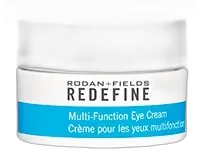
Redefine Multi-Function Eye Cream
Peptide-Stacked MLM Staple
 Verified reviewer
Pros & cons.
- +Four-peptide stack targets collagen support with well-chosen molecules
- +Caffeine delivers immediate visible depuffing effect
- +Tranexamic acid addresses pigmentary component of dark circles
- +Chrysin included specifically for bilirubin-related shadow
- +Silky silicone base with light-reflecting optical finish
- +Hygienic precision nozzle tube packaging
- +Fragrance-free and layers well with retinoids
- −Premium price reflects MLM distribution, not formula cost
- −Small 15ml size accelerates cost-per-use
- −Can pill under some mineral sunscreens
- −Contains honey — not vegan-friendly
- −Silicone-heavy base may not suit minimalist formula preferences
The full review.
Reading the Rodan + Fields ingredient list reveals a surprise. Most multi-level brands rely on one hero peptide, some caffeine, and marketing claims about radiance. This eye cream works harder than most retail competitors. It contains four different peptides, tranexamic acid for pigmentation, chrysin for bilirubin clearance, caffeine for puffiness, and macadamia oil for emolliency. This lineup would earn praise on skincare Reddit if it weren’t attached to a distributor’s Instagram story. It is a paradox: the formulation deserves credit, but the distribution model causes people to discount it. Both are true.
The INCI list tells the story. The peptide blend is the main feature: tetrapeptide-21, tetrapeptide-16, palmitoyl tripeptide-1, and palmitoyl tetrapeptide-7. These four peptides target different collagen-signaling and matrix-support mechanisms. The two palmitoylated versions penetrate the skin better due to their lipophilic tails. Stacking peptides is common in professional lines, and four is more than most. Caffeine provides immediate visible depuffing. Tranexamic acid is a more interesting addition; it is a plasmin inhibitor used for pigmentation in oral and topical forms, making it useful for pigment-driven dark circles. Combined with chrysin—a passionflower flavonoid that clears bilirubin deposits from the periorbital area—the formula targets vascular and pigmentary dark circle profiles rather than just generic firming.
The texture provides an immediate win. It is silicone-heavy; dimethicone and polysilicone-11 create a silky, fast-absorbing slip that settles into fine lines. It uses a subtle mica-and-titanium-dioxide light-reflecting effect to brighten the undereye area on day one. You see the optical effect in the mirror before the peptides work. This formula avoids looking glittery or settling into creases. After consistent twice-daily use for a few weeks, most users report measurable softening of fine lines and reduced shadows, specifically vascular and pigmentary types. Eye creams cannot fix hollowing or structural volume loss; anyone claiming otherwise is lying.
The price-to-formula ratio is complicated. Sixty-seven dollars for 15 milliliters is a premium price. Much of this cost comes from the Rodan + Fields multi-level distribution model and its commission structure. You pay for infrastructure that does not affect the formulation. A comparable peptide-plus-caffeine eye cream from a retail brand costs between twenty and forty dollars, and some are nearly as good on paper. This product offers tranexamic acid and chrysin, which most cheaper versions lack. These are thoughtful choices for dark-circle-focused users. You are paying for both the specific ingredients and the distribution model.
Practically, this cream layers well with most routines. It works with vitamin C serums in the morning and retinoids at night (apply the retinoid first, let it absorb, then buffer with this). The silicone base can pill under heavy mineral sunscreens, so wait 60 seconds between layers. The packaging is a strength: a squeeze tube with a precision nozzle is hygienic, easy to dose, and preserves peptide stability better than a jar.
Ignoring brand politics, this is a well-constructed eye cream. It does what eye creams realistically do: smooth fine lines, reduce puffiness, and address vascular and pigmentary dark circles using a thoughtful periocular formulation. The main complaint is cost efficiency, not quality. If you use a Rodan + Fields consultant and already use the brand, the formulation is worth the cost. If you prioritize value, cheaper peptide-and-caffeine options exist, though the tranexamic acid and chrysin make this one difficult to replace.
Formula
Texture
The texture provides an immediate win. It is silicone-heavy; dimethicone and polysilicone-11 create a silky, fast-absorbing slip that settles into fine lines. It uses a subtle mica-and-titanium-dioxide light-reflecting effect to brighten the undereye area on day one. You see the optical effect in the mirror before the peptides work. This formula avoids looking glittery or settling into creases. After consistent twice-daily use for a few weeks, most users report measurable softening of fine lines and reduced shadows, specifically vascular and pigmentary types. Eye creams cannot fix hollowing or structural volume loss; anyone claiming otherwise is lying.
Packaging
The packaging is a strength: a squeeze tube with a precision nozzle is hygienic, easy to dose, and preserves peptide stability better than a jar.
Pairs Well With
It works with vitamin C serums in the morning and with retinoids at night (apply the retinoid first, let it absorb, then buffer with this).
Conflicts With
The silicone base can pill under heavy mineral sunscreens, so wait 60 seconds between layers.
Best for
Practically, this cream layers well with most routines.
Works for
It does what eye creams realistically do: smooth fine lines, reduce puffiness, and address vascular and pigmentary dark circles using a thoughtful periocular formulation.
Common Complaints
The main complaint is cost efficiency, not quality.
Ingredient analysis.
Full INCI list
Water, Dimethicone, Ethylhexyl Palmitate, Caprylic/Capric/Myristic/Stearic Triglyceride, Glyceryl Stearate, PEG-100 Stearate, Polysilicone-11, Butylene Glycol, Steareth-2, Glycerin, Macadamia Integrifolia Seed Oil, Cetyl Alcohol, Caffeine, Hydrogenated Polyisobutene, Silica, Phenoxyethanol, Saccharomyces Lysate Extract, Caprylyl Glycol, Chlorphenesin, Acrylates/C10-30 Alkyl Acrylate Crosspolymer, Aminomethyl Propanol, Steareth-20, Polyurethane-40, Lecithin, Ginkgo Biloba Leaf Extract, Honey Extract, N-Hydroxysuccinimide, Tetrapeptide-21, Tetrapeptide-16, Tranexamic Acid, Chrysin, Palmitoyl Tripeptide-1, Palmitoyl Tetrapeptide-7, Mica, Titanium Dioxide (CI 77891)
Skin match.
The science.
The Science
The formulation's main claim relies on combining peptides, caffeine, and tranexamic acid. Research shows topical palmitoylated tripeptides and tetrapeptides modestly improve wrinkle appearance over 8-12 weeks of consistent use; the palmitoyl chain improves lipid-layer penetration over unmodified peptides. Caffeine's vasoconstrictive effect on periorbital skin is well-established and provides the immediate depuffing users notice on day one. Tranexamic acid is the most interesting inclusion. Originally used systemically to control bleeding, it now works in dermatology as a topical depigmenting agent with documented efficacy in melasma and post-inflammatory hyperpigmentation. It works by inhibiting plasmin to disrupt the UV-induced pigmentation cascade. This is mechanistically coherent for periorbital dark circles with a pigmentary component. Chrysin, a flavonoid from Passiflora species, has preliminary evidence for supporting bilirubin clearance, which relates to the bluish shadow from vascular stasis in the undereye area. The silicone-rich base provides optical smoothing and delivers the active molecules.
Dermatologist Perspective
Dermatologists note that eye creams with multi-mechanism formulations — combining peptides, caffeine, and pigment-targeting actives — often outperform single-ingredient options for patients with complex periocular concerns. Including tranexamic acid and chrysin targets the specific vascular and pigmentary drivers of dark circles instead of relying only on optical smoothing. However, dermatologists caution that even well-formulated eye creams cannot address structural concerns like undereye hollowing or true volume loss; in-office treatments manage those better. Board-certified dermatologists commonly recommend consistent twice-daily use for 8-12 weeks to see results on fine lines and pigmentation, and often suggest pairing eye creams with daily broad-spectrum sunscreen to protect periorbital skin from photoaging.
Where it fits in your routine.
Apply a pea-sized amount twice daily—morning and evening—after cleansing, toning, and treatment serums. Dot the cream along the orbital bone beneath the eye and at the outer corners. Pat gently with your ring finger until absorbed. Avoid the inner eye area. Follow with moisturizer and, in the morning, sunscreen. If sunscreen causes pilling, wait 60 seconds between layers. You can layer this on top of a retinoid applied to the eye area first.
At $67 for 15ml, this cream is a premium product. Much of the price covers the brand's multi-level distribution model instead of ingredient costs. The formulation—a four-peptide stack with tranexamic acid, chrysin, and caffeine—is well-constructed and worth a $35-45 retail price. At its current price, value depends on whether you want this specific combination of actives or better cost-per-milliliter efficiency from drugstore peptide-and-caffeine creams. No larger size exists, so the per-use cost remains high.
Users over 30 targeting fine lines, puffiness, and dark circles caused by vascular or pigmentary issues. People who use the Rodan + Fields regimen and want a well-integrated line. Anyone seeking tranexamic acid in an eye-area formula.
Budget-conscious shoppers get similar benefits from a $20-30 retail peptide-and-caffeine eye cream. It suits those committed to cruelty-free or vegan purchasing, as this contains honey and the brand lacks cruelty-free certification. It works for users seeking only basic hydration without structural ambitions.
Product details.
Lightweight silicone-based cream that applies silky and absorbs within a minute
Fragrance-free
White plastic squeeze tube with precision nozzle — hygienic and controls dosing well
Silicones and mica particles provide an immediate optical smoothing effect, while caffeine gives a subtle cool depuffing sensation. It causes no tingling or irritation during the adjustment period. Optical results show on day one; structural improvements emerge over weeks.
4-5 months with twice-daily application to both eye areas
12 months
All Year
The backstory.
Rodan + Fields was launched in 2002 by Dr. Katie Rodan and Dr. Kathy Fields, the Stanford dermatologists who previously created Proactiv. After a stint at Estée Lauder, the brand was bought back by the founders and converted to a multi-level distribution model. This eye cream debuted as part of the Redefine regimen around 2011, positioned as the brand's structural-repair-focused anti-aging line.
About Rodan + Fields
Dr. Katie Rodan and Dr. Kathy Fields, the Stanford-trained dermatologists who created Proactiv, founded Rodan + Fields in 2002. The brand uses multi-level distribution, which makes independent clinical validation difficult, but the core formulations use the founders' clinical background. *Established Brand (5–20 years)*
Common myths.
Multi-level brands have weaker formulas than retail brands.
Distribution models do not dictate formulation quality. This specific cream is one of the better-constructed peptide eye creams on the market. The issue is price inflation to cover distributor commissions, not the ingredient list.
FAQ.
Is this eye cream worth the price?
The formulation works well, but the price includes a multi-level distribution markup. The cost is reasonable if you want the specific peptide-plus-tranexamic-acid-plus-chrysin combination. If you only want caffeine and peptides, drugstore alternatives offer similar benefits for less.
Can I use this eye cream with retinol?
Yes. Apply your retinoid to the eye area first. Let it absorb, then layer this cream on top. The silicone-heavy base acts as a mild buffer to reduce retinoid irritation around the eyes.
Is this eye cream safe during pregnancy?
This formulation lacks retinoids, salicylic acid, or hydroquinone, making it generally safe during pregnancy. Tranexamic acid and peptides have low topical risk. Always confirm with your OB/GYN before adding any new product during pregnancy.
Does this help with dark circles?
Yes, especially vascular and pigmentary dark circles. Caffeine reduces vascular pooling, while tranexamic acid and chrysin target pigmentation. However, shadows from undereye bags or hollowing are structural and no topical cream fixes them.
Can I use this around the mouth or forehead?
Technically yes, and the peptide stack works anywhere. But at the per-ounce price, using it only on the orbital area as directed is more economical than using it on larger zones with a standard peptide cream.
Is Rodan + Fields cruelty-free?
Rodan + Fields lacks cruelty-free certification because the brand sells in markets that require animal testing. The formula contains honey extract and is not vegan.
What the community says.
"Visible depuffing effect"
"Helps with fine lines around eyes"
"Silky texture absorbs well"
"Light-reflecting finish brightens instantly"
"Expensive for the 15ml size"
"MLM distribution model is polarizing"
"Can pill under sunscreen"
"Contains honey (not vegan-friendly)"
Featured in.
People also looked at.