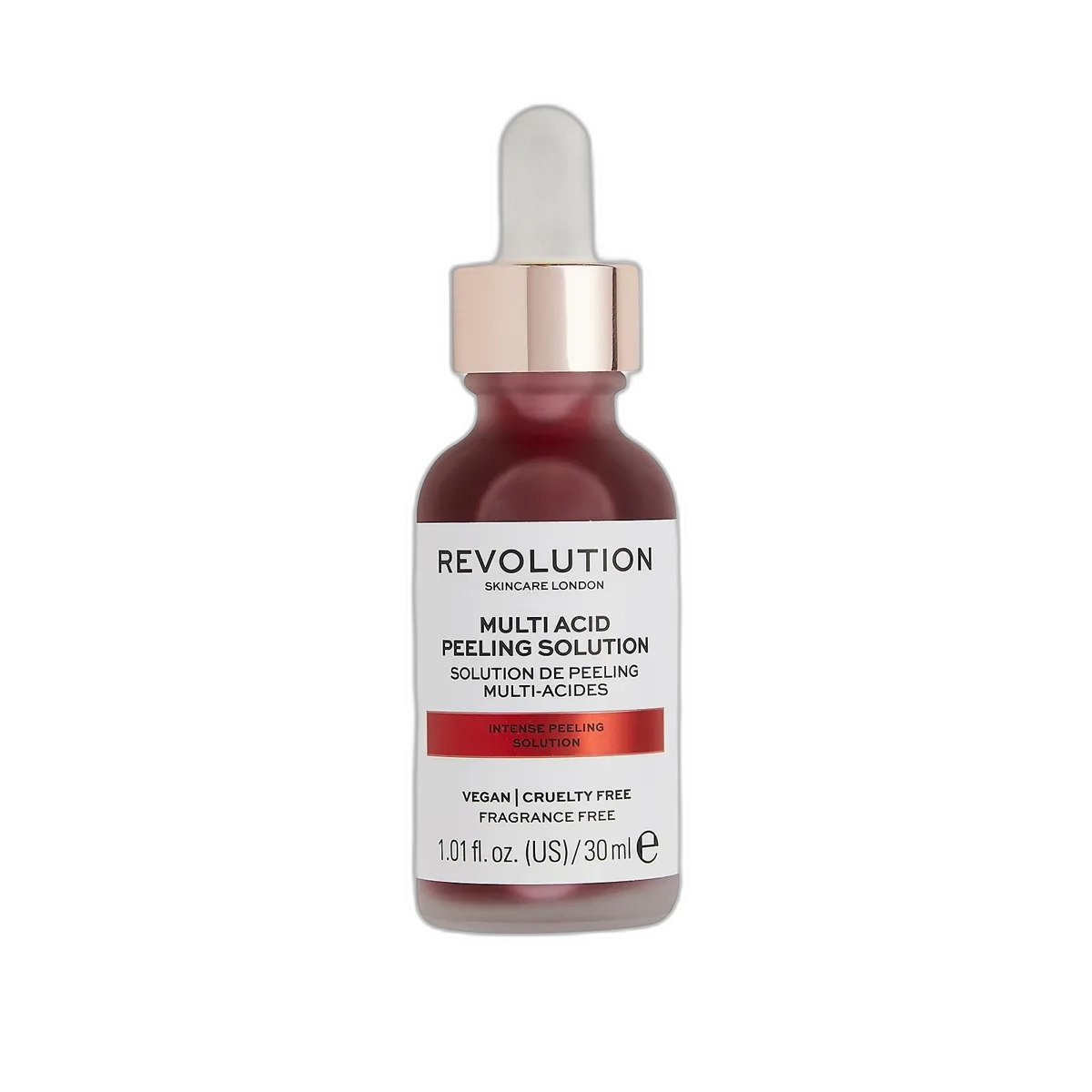
Multi Acid AHA + BHA Peeling Solution
Budget Peel Pick
 Verified reviewer
Pros & cons.
- +Genuine 30% AHA + 1.5% BHA concentration at a budget price
- +Tasmanian pepper anti-irritant reduces stinging without dulling the peel
- +Lactic acid softens the aggression compared to pure glycolic formulations
- +Fragrance-free, vegan, and cruelty-free
- +Effectively mimics The Ordinary's peel at a lower price point
- +Rinse-off format limits cumulative irritation risk
- +Dropper bottle allows precise application control
- −pH not disclosed on the label
- −Contains orange and lemon fruit extracts
- −Not suitable for sensitive, rosacea, or barrier-compromised skin
- −Aggressive for first-time acid users — no beginner-friendly version in one bottle
- −Not pregnancy-safe due to acid concentration
The full review.
About Revolution Skincare
Revolution Skincare launched in 2014 as the skincare branch of Revolution Beauty, a UK indie brand known for affordable color cosmetics.
Who Should Buy
Experienced acid users who have progressed from lower-concentration AHAs and BHAs and want a budget alternative to The Ordinary’s peel or expensive clinical kits. Users with oily, combination, or resilient normal skin dealing with dullness, texture, and congestion who want a weekly reset. Shoppers who value low prices and do not need every routine item to be a branded clinical purchase. For these users, Revolution delivers nearly identical results to The Ordinary at a lower price point, which is useful.
Who should skip
Sensitive skin, rosacea, eczema, compromised barriers, first-time acid users, and anyone unwilling to use daily sunscreen afterward. For these users, gentler options like 5-10% lactic acid serums or enzymatic exfoliants work better and provide smoothing benefits without the barrier risk.
Formula
Ingredient analysis.
Full INCI list
Aqua (Water, Eau), Lactic Acid, Propanediol, Vaccinium Myrtillus Fruit Extract, Glycolic Acid, Glycerin, Saccharum Officinarum (Sugar Cane) Extract, Butylene Glycol, Salicylic Acid, Citrus Aurantium Dulcis (Orange) Fruit Extract, Citrus Limon Fruit Extract, Daucus Carota Sativa (Carrot) Root Extract, Xanthan Gum, Acer Saccharum (Sugar Maple) Extract, Sodium Benzoate, Potassium Sorbate, Disodium EDTA, Tasmannia Lanceolata Fruit/Leaf Extract.
Skin match.
The science.
The Science
This peel uses straightforward, well-studied pharmacology. Extensive research shows alpha hydroxy acids, specifically glycolic and lactic, disrupt corneocyte adhesion and promote desquamation at low pH. AHA activity depends on total concentration and the proportion of free (unbuffered) acid, which pH determines — 30% glycolic at pH 3.0 is much more active than the same concentration at pH 3.8. Most OTC AHA products use partial buffering to improve tolerability while keeping enough free acid. Glycolic acid has a smaller molecular size, penetrates deeper than lactic acid, and has stronger clinical evidence for improving fine lines, photoaging, and hyperpigmentation at controlled concentrations. Lactic acid has a larger molecular footprint and slower penetration, making it better tolerated on sensitive skin and providing humectant benefits — studies in the Journal of Cosmetic Dermatology show higher-concentration lactic acid formulations improve barrier function markers and exfoliate. Salicylic acid, the BHA in this formula, is lipophilic and penetrates sebum-rich follicles to provide comedolytic activity; acne dermatology research shows it works for comedonal acne and blackhead reduction even with short contact times. Tasmannia lanceolata (Tasmanian pepper) extract contains compounds that modulate TRPV1 receptors in sensory nerve endings; this mechanism reduces the stinging sensation users report — published in vitro and preliminary clinical data support this. The main evidence gap for Revolution's specific product is the undisclosed pH, which prevents calculating the exact free acid proportion at the declared concentrations. For comparison, The Ordinary discloses its AHA 30% + BHA 2% peel pH as approximately 3.6, and Revolution's product likely sits in a similar range based on performance.
Dermatologist Perspective
Dermatologists treat at-home peeling solutions at this concentration with caution. They work for experienced acid users with resilient skin seeking a weekly exfoliation reset, but first-time users often misuse them by confusing 30% AHA in a rinse-off format with 5-10% leave-on serums. Board-certified dermatologists steer sensitive skin, rosacea, eczema, and compromised-barrier patients toward gentler alternatives. For patients wanting an at-home chemical peel, clinicians often recommend starting with shorter contact times (5 minutes rather than 10), building to weekly use gradually, and using strict daily SPF 30+ afterward. Most dermatologists treat Revolution and The Ordinary's peels as functionally interchangeable — the pharmacology is similar enough that price and availability drive the recommendation. Pregnant and breastfeeding patients use safer exfoliation options instead.
Where it fits in your routine.
Use once or twice per week, always at night. Start with once per week. Cleanse skin and pat dry; water dilutes the acids and changes their activity. Apply a thin layer evenly across the face using the dropper, avoiding the eye area, lip line, and open breakouts. Leave on for 5 minutes the first time. If you feel only a mild tingle, use for 10 minutes on later applications. Never exceed 10 minutes. Rinse with cool water, then use a hydrating toner, ceramide moisturizer, and optionally a gentle facial oil. Apply broad-spectrum SPF 30 or higher the next morning. Do not use with retinoids, benzoyl peroxide, vitamin C, or other exfoliants on the same night. Patch test behind the ear for 24 hours before facial use. Stop use 7 days before any in-office procedure.
Revolution's Multi Acid Peeling Solution costs roughly $13 for 30 ml in the U.S. (£10 in the UK), placing it among the cheapest at-home chemical peels. The Ordinary's AHA 30% + BHA 2% Peeling Solution at $10-12 is the direct competitor and gives comparable results; the choice depends on availability and preference, not pharmacology. Revolution offers 70-80% of the benefit for 20-30% of the price compared to PCA Skin, Perfect Image, or Image Skincare clinical peel kits in the $30-80 range. One 30 ml bottle lasts 12-15 applications, or 3-4 months, if used once weekly, making the per-use cost around $1. This is a high-value option for budget-conscious acid users seeking a weekly peel.
Experienced acid users with resilient normal, combination, or oily skin can use this as a budget alternative to The Ordinary's AHA 30% + BHA 2% peel. It works best for dullness, texture, blackheads, and mild hyperpigmentation. Use it for aggressive weekly exfoliation if you use daily sunscreen afterward.
First-time acid users, sensitive or rosacea-prone skin, eczema, compromised barriers, and pregnant or breastfeeding users should choose gentler alternatives. If you will not use daily SPF the day after use, do not use this or any other chemical exfoliant.
Product details.
Thin, slightly viscous red liquid that pours from a dropper bottle.
The bilberry and citrus extracts give it a faint, tart scent like diluted fruit juice without added fragrance.
Standard dropper bottle with a pipette — the format The Ordinary pioneered and Revolution uses for its serum line.
Expect 30-60 seconds of tingling, stinging, or mild burning during the first application; this is normal for a peel at this concentration. Rinse immediately if the sensation becomes painful or uncomfortable. New acid users should start with 5-minute contact time and increase to 10 minutes over several sessions.
One 30 ml bottle provides roughly 12-15 uses at one application per week, lasting 3-4 months of weekly use.
12 months
fall winter
The backstory.
Revolution Skincare launched its Multi Acid Peeling Solution in 2019, at the height of the skincare-acid trend that The Ordinary had kicked off two years earlier. The formulation strategy was transparent: take The Ordinary's successful 30% AHA + 2% BHA peel concept, adjust the acid proportions slightly (30% + 1.5% instead of 30% + 2%), add the same Tasmanian pepper anti-irritant, and undercut on price. It's a direct-competitor formulation, and it's one of the better examples of Revolution's value-first category-following approach.
About Revolution Skincare
Established Brand (5–20 years)Revolution Skincare is the skincare branch of Revolution Beauty. This UK-based indie brand started in 2014 and added skincare to its color cosmetics lineup in 2018. The brand offers low prices on actives using a formulation playbook similar to The Ordinary's.
Common myths.
30% AHA at home matches a professional chemical peel.
No. Professional peels use pH-controlled free-acid concentrations, buffered delivery systems, and clinician judgment for duration and neutralization. This OTC peel uses partially buffered acids at an undisclosed pH. The 10-minute rinse-off format stays below the threshold of significant epidermal injury. It works, but it is not equivalent to in-office treatment.
If you don't feel stinging, the peel isn't working.
Stinging shows active acid penetration, but it does not track efficacy. Experienced acid users with built tolerance feel less sting but still get real exfoliation. No sting does not mean the product fails; it means you have adapted.
FAQ.
Is Revolution Multi Acid the same as The Ordinary AHA 30% + BHA 2%?
They are not identical, but very close. Both are 30% AHA rinse-off peels that use the same Tasmanian pepper anti-irritant approach. Revolution uses 1.5% BHA while The Ordinary uses 2%, and the AHA blend differs slightly. Performance is comparable in most real-world comparisons, and Revolution is usually cheaper.
How often should I use this peel?
Beginners use this once per week maximum; experienced acid users use it up to twice weekly. Do not use daily—this high-concentration rinse-off peel is not a leave-on serum. Space peel nights at least 3 days apart. Skip use if your skin shows redness, tightness, or signs of barrier stress.
Do I have to rinse it off?
Yes. This is a rinse-off peel, not a leave-on treatment. Apply to clean dry skin for 10 minutes or less, then rinse thoroughly with water. Leaving this on causes irritation; the product is not formulated for that use.
Is it safe during pregnancy?
No. The 1.5% salicylic acid and 30% AHA total concentration exceed typical pregnancy-safe exfoliation guidelines. Use gentler options like 5-10% lactic acid or enzymatic exfoliation during pregnancy and breastfeeding.
Can I use it with retinol?
Don't use them in the same session. Use your retinol on different nights from the peel, ideally with 2-3 days between. Using retinol and a 30% AHA peel on the same night wrecks your barrier.
Why is pH not listed on the label?
Revolution does not list the pH on the packaging or the product page. This gap matters because pH determines the free acid proportion, which dictates AHA activity. The product works like a functionally active peel, suggesting a pH between 3.0-3.8 similar to The Ordinary's version, but the lack of disclosure is a valid criticism.
Do I really need sunscreen the day after?
All AHA and BHA exfoliants increase UV sensitivity for 24-48 hours after use. You must use a broad-spectrum SPF 30 or higher the day after a peel. Skipping SPF turns an exfoliant into a hyperpigmentation trigger.
What the community says.
"Immediate brightening and smoothing effect"
"Noticeably cheaper than comparable peels"
"Lactic acid softens the bite vs pure glycolic"
"Fragrance-free base"
"Aggressive stinging for first-time acid users"
"Contains citrus extracts"
"pH not disclosed on label"
"Must be rinsed — not a leave-on treatment"
People also looked at.