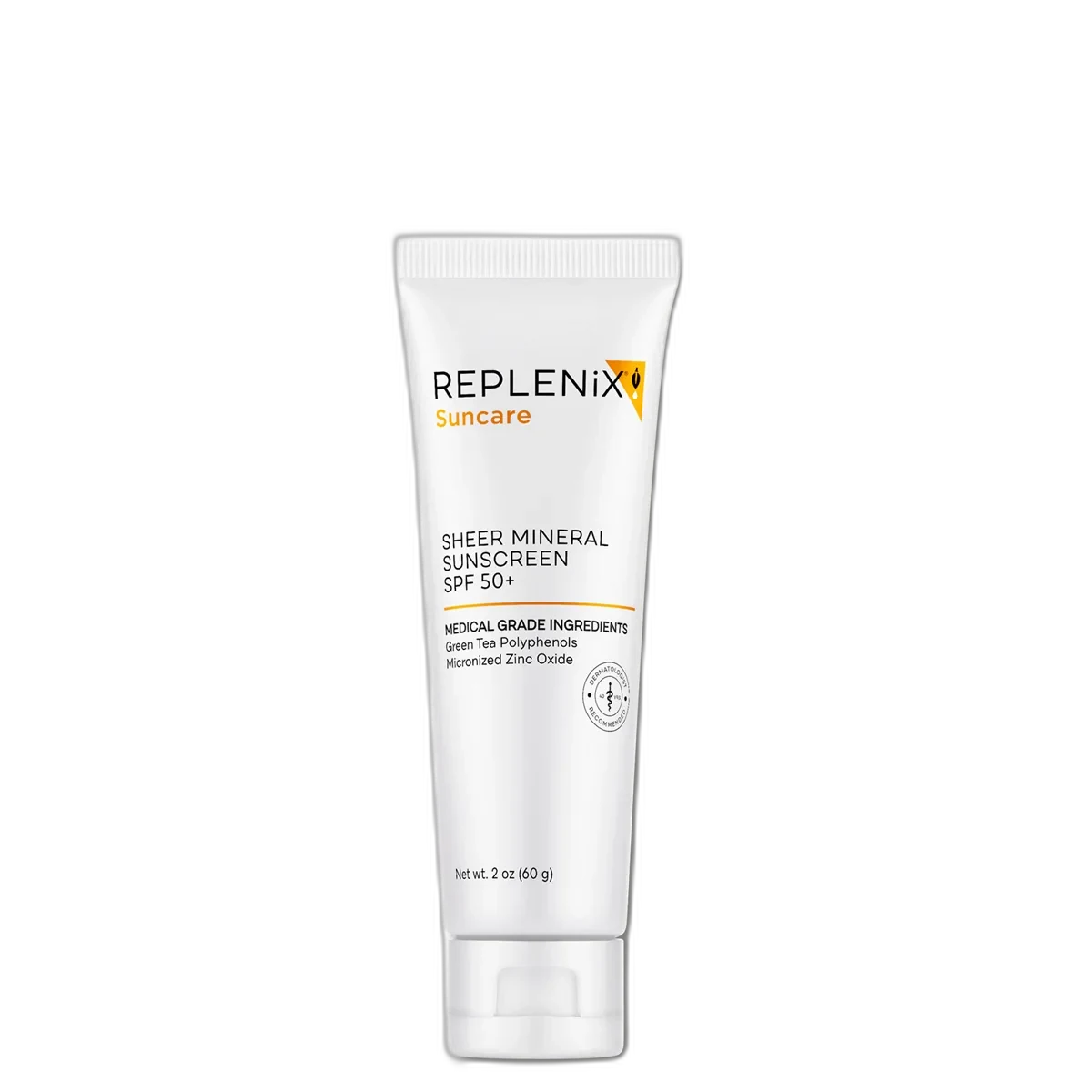
Sheer Physical Sunscreen SPF 50+
Rosacea-Safe Mineral SPF
 Verified reviewer
Pros & cons.
- +High 13.75% zinc oxide delivers true broad-spectrum coverage
- +Surprisingly sheer finish for such a high zinc concentration
- +Antioxidant trio of green tea, vitamin C, and resveratrol
- +Fragrance-free, chemical-filter-free, safe for sensitive skin
- +Long track record of post-procedure and rosacea use
- +Pregnancy and reef-conscious friendly
- +Available in 2 oz and 4 oz sizes
- −White cast on deep skin tones
- −Premium price per ounce vs drugstore mineral options
- −Contains C12-15 alkyl benzoate, mildly comedogenic for some
- −Silicone-heavy base is a dealbreaker for silicone-free routines
- −2 oz tube runs out fast with daily full-face use
The full review.
Mineral sunscreens in the mid-2000s often left a thick, chalky, bluish white cast. They were hard to blend, so most people with sensitive skin used chemical filters instead. Replenix launched this Sheer Physical Sunscreen in the late 2000s. At that time, the professional dermatology channel wanted mineral formulations that balanced protection and wearability. This was an early product to succeed using a high 13.75% zinc oxide concentration. More than 15 years later, the formulation architecture remains the same. Such shelf longevity is rare in sunscreen, as brands reformulate constantly; Replenix got this right the first time.
The formulation is direct. Zinc oxide provides all the UV protection. It uses no titanium dioxide or chemical filter backup, relying only on a high-percentage zinc active for broad-spectrum coverage across UVA1, UVA2, and UVB. At 13.75%, the concentration is in the upper range for cosmetic mineral sunscreens. This allows the SPF 50+ rating to pass FDA testing without other filters. The inactive base uses cyclopentasiloxane, octyldodecyl neopentanoate, and dimethicone to create a sheer, silky application. This choice lets the high zinc percentage spread thin and absorb to a tolerable finish. The antioxidant complex adds more than UV blocking: L-ascorbic acid for water-soluble coverage, green tea polyphenols for lipid-soluble radical scavenging, resveratrol for secondary mitochondrial antioxidant support, and tocopheryl acetate as a stabilizing vitamin E. Each component has evidence for its role in photoprotection support.
The sunscreen is a lightly whitish cream that spreads thin when rubbed. On fair-to-medium skin, a mild initial whitening resolves into a satin finish within 30 seconds, making it wearable under makeup. Deeper skin tones will see more residual cast. This is the reality of a 13.75% zinc sunscreen; no formulation eliminates it entirely. For deep skin, a tinted mineral sunscreen or a chemical filter is more cosmetically elegant. For others, the trade-off is manageable, and the post-application finish is comfortable enough for daily use.
The main benefit shows over time. Dermatologists recommend this when patients need to protect skin recovering from a peel, a microneedling session, or a laser treatment. The combination of high zinc, zero chemical filters, zero fragrance, and gentle antioxidant support fits post-procedure skin needs. Dermatologists also recommend it for rosacea patients whose skin flares from other SPFs. The antioxidant layer helps because UV-induced free radical generation continues even with good SPF coverage. A topical antioxidant at the point of UV contact neutralizes some radicals before they cause oxidative damage.
The downsides are predictable. At $38 for 2 oz, the price is roughly $1 per gram, which is more than drugstore mineral sunscreens. A 2 oz tube lasts six to eight weeks with proper facial application (a quarter-teaspoon per day). This costs about $50 per month if used as your only sunscreen. The 4 oz size has better per-ounce value. The inactive list includes C12-15 alkyl benzoate, which is mildly comedogenic and may affect breakout-prone skin. The formulation also includes silicones, which may not suit silicone-free routines.
This sunscreen earns its professional-channel reputation. It is not the cheapest mineral SPF, the best for deep skin tones, or the lightest daily option. However, for sensitive, rosacea-prone, post-procedure, or reactive skin needing a high-zinc mineral sunscreen with antioxidant support and a long clinical track record, few options are better. You buy it, decide it works, and reorder it for a decade.
Formula
Ingredient analysis.
Full INCI list
Active Ingredient: Zinc Oxide 13.75%. Inactive Ingredients: Purified Water, Cyclopentasiloxane, Octyldodecyl Neopentanoate, Caprylic/Capric Triglyceride, Dimethicone, C12-15 Alkyl Benzoate, Glycerin, Hexyl Laurate, PEG-30 Dipolyhydroxystearate, Ascorbic Acid, Tocopheryl Acetate, Camellia Sinensis (Green Tea) Polyphenols, Resveratrol, Biotin, Ascorbyl Palmitate, Polyhydroxystearic Acid, Acrylates Crosspolymer-4, Cetearyl Alcohol, Phenoxyethanol, Caprylyl Glycol, Disodium EDTA.
Skin match.
The science.
The Science
This formula uses 13.75% zinc oxide, and physics supports its broad-spectrum protection claim. Zinc oxide is unique because one active covers the full UV-A and UV-B spectrum. Particle size distribution determines how well coverage reaches longer UV-A wavelengths (UVA1, 340-400nm). Peer-reviewed photoprotection studies show that well-formulated zinc products at 10-15% concentration deliver UVA1 coverage that many chemical filter combinations struggle to match. The SPF 50+ rating means it passed FDA protocols for at least SPF 50 and extended UVB protection. The antioxidant ingredients are functional, not decorative. UV radiation that penetrates sunscreen generates reactive oxygen species in the dermis and epidermis; these free radicals drive long-term photoaging and photocarcinogenesis. Clinical studies show topical antioxidants applied with sunscreen reduce oxidative damage markers more than SPF alone. L-ascorbic acid is the most clinically validated topical antioxidant and provides water-soluble radical scavenging. Green tea polyphenols (EGCG-rich) provide lipid-soluble antioxidant support and anti-inflammatory effects. Resveratrol adds secondary mitochondrial-level antioxidant activity. Combining these three in a sunscreen base turns this product from a pure UV blocker into a photoprotection plus damage-mitigation formulation. Proving measurable long-term clinical benefit over plain SPF in individuals is difficult, but the mechanistic rationale is solid and the cost of these additions is low.
Dermatologist Perspective
Dermatologists often recommend high-zinc mineral sunscreens like this one for patients with rosacea, eczema, sensitive skin, or chemical filter sensitivities. Board-certified dermatologists favor this formulation for post-procedure care—after chemical peels, microneedling, or laser treatments—because the zero chemical filters, zero fragrance, and gentle antioxidant profile support recovery without risking irritation. Adding topical antioxidants to sunscreen is a standard dermatological photoprotection strategy, and Replenix's history with the green tea polyphenol platform adds clinical credibility. Use this daily with monthly check-ins during high-exposure seasons, and reapply every two hours during direct sun exposure or after swimming.
Where it fits in your routine.
Apply about a quarter-teaspoon to the face and neck. Use it as the final morning step, over moisturizer but before makeup. Rub until the white cast mostly disappears—this takes 30-60 seconds. Reapply every 2 hours of direct sun exposure, or after swimming or sweating. Full-body use requires more product. Use a mineral powder SPF over makeup to replenish coverage during the day if needed.
Replenix Sheer Physical Sunscreen costs $38 for 2 oz, placing it in the premium mineral SPF category. The 4 oz version has better per-ounce value. A 2 oz tube lasts about 6-8 weeks with proper facial application, costing roughly $20-25 per month if used alone. This costs more than drugstore mineral options like CeraVe or La Roche-Posay Anthelios mineral SPF, which cost closer to $15 per bottle. The premium price covers the antioxidant complex, dermatology-office distribution standards, and a long track record. This is worth the cost for post-procedure or sensitive skin coverage, but less essential for casual daily use.
Sensitive, rosacea-prone, or reactive skin needs mineral-only SPF protection with broad-spectrum coverage and antioxidant support. This formula works for patients recovering from in-office procedures and anyone wanting chemical-filter-free sun protection in a daily-use format.
Deep skin tones wanting zero white cast should use tinted mineral options or modern chemical filter sunscreens. Highly breakout-prone users may prefer a fully oil-free formulation, while silicone-free routine followers should look elsewhere. Users on a strict budget can find comparable mineral sunscreens at much lower price points.
Product details.
All Year Certifications Cruelty-FreeFragrance-FreeVeganReef-Conscious
The backstory.
Launched as part of Replenix's expanded sun care line in the late 2000s, when mineral sunscreens were largely thick, chalky, and universally disliked. It was one of the earlier professional-channel formulas to combine a high zinc percentage with a genuinely wearable cosmetic finish, and has stayed in the catalog with minor refinements ever since.
About Replenix
Legacy Brand (20+ years)Replenix has sold dermatology-channel sun care for nearly two decades. This mineral sunscreen has been in the brand's catalog since the late 2000s and dermatologists frequently recommend it for sensitive and post-procedure skin.
Common myths.
Mineral sunscreens don't protect as well as chemical ones.
Zinc oxide at 13.75% provides broad-spectrum coverage across UVA1, UVA2, and UVB. The SPF 50+ rating uses the same FDA protocols as chemical sunscreens. The protection is real; the trade-off is the feel and white cast, not the efficacy.
Adding antioxidants to sunscreen is just marketing.
UV radiation penetrates every sunscreen and generates free radicals in the skin. Sunscreens with topical antioxidants like green tea polyphenols, vitamin C, and resveratrol neutralize some of these free radicals when they form. Clinical studies show this provides a measurable secondary layer of photoprotection.
FAQ.
Does it leave a white cast?
This 13.75% zinc formula is sheerer than most, but still leaves a white cast on deep skin tones. Fair to medium skin tones blend it out fully with rubbing; deeper tones may show a slight grey-white cast that makeup or foundation covers.
Can I use this after a chemical peel or laser treatment?
Yes — dermatologists recommend this sunscreen for post-procedure use. It has no chemical filters or fragrance. A gentle antioxidant complex supports recovery from controlled injury and provides SPF 50+ protection.
Is this sunscreen pregnancy safe?
Yes. Zinc oxide is one of the safest sunscreen filters during pregnancy because it stays on the skin surface instead of absorbing systemically. The antioxidant additions are also safe during pregnancy.
How much should I apply for SPF 50+ protection?
Apply about a quarter-teaspoon (roughly 1.25ml) to cover your full face — the amount used in FDA SPF protocols. Applying less reduces the effective SPF. Reapply every 2 hours in direct sun, or after swimming or sweating.
Will this break me out?
C12-15 alkyl benzoate is in the formula and can be mildly comedogenic for some, but most acne-prone skin tolerates the overall formulation. Users prone to frequent breakouts may prefer a fully oil-free mineral sunscreen. ---
What the community says.
"Minimal white cast for a 13.75% zinc formula"
"Very gentle on sensitive skin"
"Works well under makeup"
"No fragrance or chemical filters"
"Some white cast on deep skin tones"
"Expensive per ounce"
"2 oz size runs out fast with daily full-face use"
Featured in.
People also looked at.