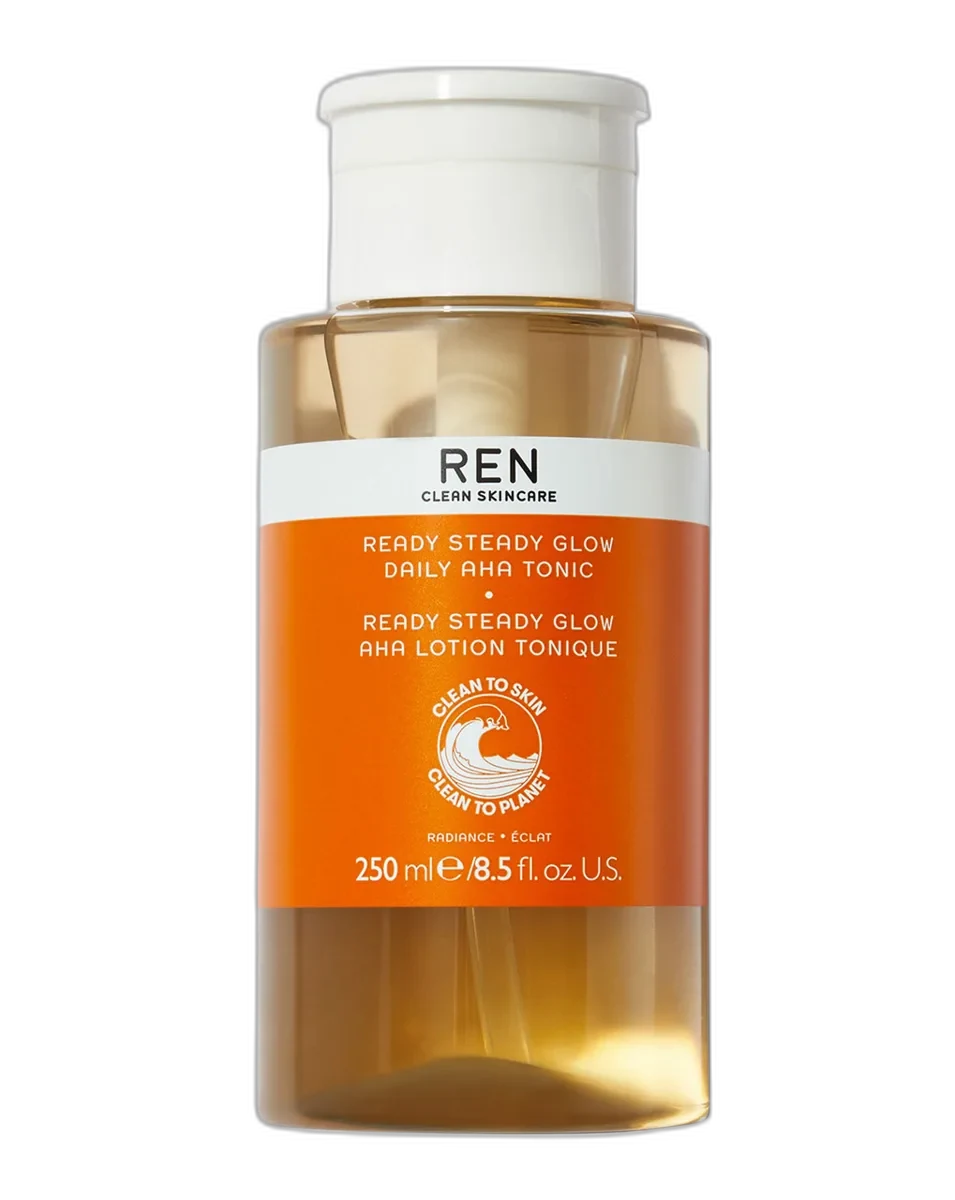
Ready Steady Glow Daily AHA Tonic
Clean Beauty Glow Standard
 Verified reviewer
Pros & cons.
- +Smart lactic, azelaic, and salicin blend that works on multiple fronts
- +Delivers visible glow and smoothing within 1-2 weeks of use
- +Daily-use friendly for most non-sensitive skin types
- +Generous 250ml bottle lasts several months
- +pH formulated correctly for acid bioavailability
- +Layers easily under serums, moisturizers, and makeup
- +Well-established formula with a long track record and reviews
- −Citrus essential oil blend is a problem for sensitive or reactive skin
- −Mild exfoliation only — not strong enough for stubborn hyperpigmentation
- −Price-per-ml higher than comparable drugstore lactic acid toners
- −Single size only, no travel option or smaller trial bottle
- −Not appropriate for eczema or actively compromised barriers
The full review.
Between 2019 and today, a Sephora staffer would likely reach for this frosted 250ml bottle if you asked for a beginner-friendly glow tonic. REN launched Ready Steady Glow in 2018 during a specific shift: The Ordinary proved drugstore-priced acids could sell out, K-beauty essences taught Western shoppers to add steps between cleanser and serum, and clean beauty customers wanted actives without chemistry-set packaging. REN’s solution was this: a watery, citrus-scented daily acid that looks like a botanical toner and fits into a routine with no friction. This cultural context explains why the product remains on shelves seven years later while many contemporaries have been reformulated.
The formula is smarter than its “gentle daily toner” marketing. Lactic acid does the heavy lifting—a humectant AHA that exfoliates slower than glycolic acid but pulls water into the skin. REN adds a small dose of azelaic acid; azelaic acid is hard to formulate in a water-thin base and works well for post-inflammatory marks and redness. Willow bark extract adds a mild salicin effect to lightly unclog pores without the BHA sting. Glycerin is second on the INCI list to prevent a stripping feel. The pH is around 3.8—low enough for acid bioavailability, but high enough for realistic daily use.
The tonic behaves as expected on skin. It pours out watery and absorbs in seconds, leaving a clean, slightly tacky finish that layers under hydrating serums and moisturizers. First-time users usually feel a faint tingle and see softer texture the next morning. After two to three weeks of daily use, pores look neater, tone looks more even, and the skin surface gains the subtle reflectivity often called “glow” on Instagram. It also buffers makeup, giving foundation a smooth base without the polish-stripping feel of stronger acids.
Fragrance is the main limitation. REN’s philosophy uses essential oils, and this tonic includes bergamot, sweet orange, bitter orange flower, grapefruit, mandarin, and litsea cubeba. For some, this herbal-citrus scent is the selling point—it feels spa-like and makes the routine feel indulgent. For reactive skin, rosacea-prone skin, or broken barrier function, these essential oils can sting, flare, or sensitize. This is a formulation tradeoff; know your skin type before buying a $38 bottle. If you react to citrus oils, skip this. If you don’t, you will likely love it.
Value is reasonable. At $38 for 250ml, you pay roughly $0.15 per ml. This is about twice the price-per-ml of The Ordinary’s glycolic toner but much less than luxury resurfacing treatments. The formula is more sophisticated than a single-acid tonic, as the azelaic and salicin inclusions are useful additions rarely found in drugstore equivalents. One daily application with a cotton pad makes the bottle last three to four months; patting it on by hand makes it last longer. For the right skin, the price-to-payoff ratio is fair.
Ready Steady Glow is an easy choice. If you have normal, combination, or oily skin, want a daily glow without intense treatments, and like a strong citrus scent, buy it. The formula has aged well and earns its shelf space. If you have sensitive or rosacea-prone skin, skip it for a fragrance-free lactic acid toner. For acid beginners, this is a gentle entry point if your skin tolerates the essential oil profile.
Ingredient analysis.
Full INCI list · pH 3.8
Aqua/Water/Eau, Glycerin, Lactic Acid, Salix Alba (Willow) Bark Extract, Sodium Hydroxide, Butylene Glycol, Hydroxyacetophenone, Azelaic Acid, Citric Acid, Citrus Aurantium Dulcis (Orange) Peel Oil, Citrus Aurantium Amara (Bitter Orange) Flower Oil, Citrus Aurantium Bergamia (Bergamot) Fruit Oil, Citrus Nobilis (Mandarin Orange) Peel Oil, Citrus Paradisi (Grapefruit) Peel Oil, Litsea Cubeba Fruit Oil, Tasmannia Lanceolata Fruit/Leaf Extract, Pelargonium Graveolens Flower Oil, Citrus Reticulata (Tangerine) Peel Oil, Limonene, Linalool, Citral.
Skin match.
The science.
The Science
Lactic acid is the active backbone and one of the most clinically studied alpha hydroxy acids in dermatology. Peer-reviewed trials show lactic acid increases epidermal thickness, improves stratum corneum hydration, and stimulates ceramide biosynthesis. This differs from glycolic acid because the exfoliation pairs with barrier support instead of working against it. The effect is dose-dependent; at the modest concentrations in daily tonics, consistency drives results rather than intensity, matching the REN usage pattern. Azelaic acid is a second well-validated active. Decades of clinical literature show it benefits inflammatory acne, rosacea, and post-inflammatory hyperpigmentation. Evidence is robust at prescription strengths (15-20%), and lower cosmetic concentrations support tone when used consistently. Willow bark extract has the weakest evidence; it contains salicin, but the concentration of salicylic acid in a finished formula is typically low. Its role is supportive rather than the primary driver of pore effects. This formulation's delivery is interesting: lactic acid loosens the stratum corneum, glycerin pulls water into the newly exfoliated surface, and the azelaic and salicin layer on complementary tone and pore mechanisms. This multi-pathway approach suits real-world use better than a mono-acid tonic of the same intensity, as it addresses dullness, tone, and texture all at once.
Dermatologist Perspective
Dermatologists often recommend daily lactic acid tonics for patients seeking visible tone and texture improvement without the irritation risk of stronger glycolic or retinoid regimens. Clinical guidance describes lactic acid as uniquely suited for daily use because it hydrates while it exfoliates. Board-certified dermatologists note that essential oil content matters—rosacea and eczema patients often avoid citrus oil blends because the fragrance fraction can trigger flares. For the appropriate patient—someone with robust, non-reactive skin addressing dullness or mild unevenness—this tonic is a reasonable over-the-counter option. It is not a typical standalone treatment for active acne or pigmentation disorders, where prescription-strength azelaic acid or a dedicated retinoid is the expected first line.
Where it fits in your routine.
Saturate a cotton pad or clean palms with the tonic after cleansing. Sweep or press it over the face, but avoid the immediate eye area. Wait 30-60 seconds for the acids to work on the skin, then apply your usual serums and moisturizer. Use it morning or night. If using in the morning, always finish with a broad-spectrum SPF 30 or higher because AHAs increase UV sensitivity. Use it every other day for the first week to check tolerance, then move to daily use as comfortable. Skip use on days when you use a retinoid, strong vitamin C, or another chemical exfoliant.
At $38 for 250ml, Ready Steady Glow is an upper-mid range daily exfoliating tonic. The price-to-quality ratio is fair. You pay for a more thoughtful formula than cheap drugstore lactic acid options, plus clean-beauty brand positioning and essential-oil packaging. One 250ml bottle lasts three to four months with daily face use, costing roughly $10-13 per month for a routine step. REN only sells this in the 250ml size; there is no smaller trial bottle or larger better-value option. If you like it, Sephora sale events make the math better.
This works for normal, combination, or oily skin types targeting dullness, uneven tone, or rough texture via a well-formulated daily acid step. It suits clean-beauty shoppers seeking actives that meet their formulation preferences and those moving from occasional weekly exfoliation to a committed routine.
Avoid this if you have rosacea, eczema, sensitized skin, or react to citrus essential oils. Skip this if you use a prescription retinoid or in-office treatments. This is a maintenance and glow tonic, not a solution for active acne or significant hyperpigmentation.
Product details.
Watery, completely liquid — feels like a light essence on the skin.
Bergamot, orange, mandarin, and grapefruit oil blend creates a pronounced citrus-herbal scent.
Frosted recyclable plastic bottle with a flip-top opening — 250ml size.
The first use causes a faint tingle and visibly softens texture. Skin looks slightly brighter by the next morning. Within 1-2 weeks, fine flakiness and rough patches smooth out and pores look tighter. Most users do not experience purging.
Use once daily on the full face with a cotton pad for 3-4 months; hand application takes longer.
12 months
All Year
The backstory.
REN launched this tonic in 2018 at a moment when K-beauty essences and The Ordinary's glycolic toner had primed the market for an acid-based second step. It quickly became the brand's best-seller and played a big role in mainstreaming daily acid toning in clean-beauty circles.
About REN Clean Skincare
Established Brand (5–20 years)REN Clean Skincare launched in London in 2000 as an early prestige clean-beauty brand. Unilever acquired REN Clean Skincare in 2015. Its formulations use plant-derived actives and have a long history in European pharmacies and Sephora.
Common myths.
Daily AHA tonics thin the skin over time.
Chemical exfoliation removes surface corneocytes, not the living layers below. Clinical studies on daily lactic and glycolic acid use at these concentrations show increased dermal thickness after weeks of use.
Its 'clean beauty' label means it does not irritate sensitive skin.
This tonic uses citrus essential oils — bergamot, orange, grapefruit — which often trigger reactive and rosacea-prone skin. 'Clean' here describes formulation philosophy, not low-sensitization.
FAQ.
Is this tonic stronger than The Ordinary Glycolic Acid 7%?
Reality
It is balanced rather than strong. This uses lactic acid, a larger molecule that penetrates more slowly, plus azelaic acid and willow bark for tone and pore support — so the effect is gentler but more multidimensional.
Works for
Does REN Ready Steady Glow help with acne?
Reality
The willow bark content and exfoliating action help with mild breakouts and blackheads, but active inflammatory acne needs a dedicated BHA or benzoyl peroxide treatment. This works better as a texture and tone product.
AM routine
Can I use this in the morning?
Reality
Yes, if you follow with a broad-spectrum SPF 30+ sunscreen. Exfoliating acids increase UV sensitivity temporarily, so you must use daily sunscreen when using this tonic.
Scent
Why does it smell so strongly of citrus?
Reality
The formula uses a blend of bergamot, orange, grapefruit, and mandarin essential oils for fragrance. Some users like this spa-like scent; others with sensitive skin find these essential oils irritating and want a fragrance-free alternative.
Pregnancy safe
Is REN Ready Steady Glow pregnancy safe?
Reality
Lactic acid and azelaic acid are safe during pregnancy at these low concentrations. The citrus essential oils cause more concern — if you have sensitivities or uncertainty, ask your OB or dermatologist before daily use.
Community
What the community says.
"Noticeably smoother skin within a week"
"Doesn't sting like stronger acids"
"Great glow without dryness"
"Bottle lasts a long time"
"Strong citrus scent"
"Essential oils unsuitable for sensitive skin"
"Price creep over the years"
People also looked at.