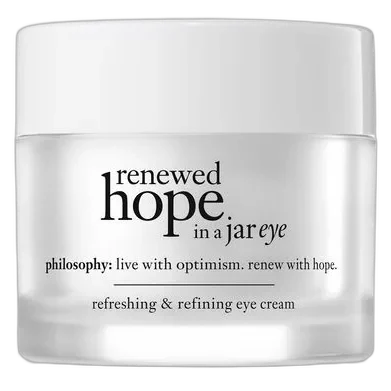
Renewed Hope in a Jar Eye Cream
Optical Brightener Pick
 Verified reviewer
Pros & cons.
- +Immediate optical brightening from mica and titanium dioxide
- +Fragrance-free — appropriate for the sensitive eye area
- +Excellent concealer primer effect
- +Lightweight gel-cream texture absorbs quickly
- +Cruelty-free with established department store availability
- +Safe for sensitive skin and pregnancy
- −Brightening effect is cosmetic and washes off
- −Expensive at $45 for 15ml
- −Underlying anti-aging actives are modest at best
- −Jar packaging is suboptimal for preservation
- −Limited effect on genetic pigmentation
The full review.
Distinguish between anti-aging products that treat biology and those that disguise symptoms. Both work, but knowing which one you buy sets your expectations and determines value. Philosophy’s Renewed Hope in a Jar Eye Cream sits on the ‘disguise’ side of the spectrum. The real active ingredients aren’t anti-aging compounds; they are mica and titanium dioxide.
These light-diffusing mineral particles scatter light to soften shadows, fine lines, and uneven texture. They don’t change skin biology; they optically smooth the surface. The effect is immediate, appearing within seconds. This is why the product is known for ‘instantly brightening’ the under-eye area. Scoop a small amount onto your ring finger and pat it along the orbital bone; your eyes look awake within ten seconds. The mechanism delivers on this core promise.
The rest of the formula supports this optical effect. A lightweight gel-cream base uses glycerin, silicones, and polyacrylate film-formers to create a smooth, satiny finish for use under concealer. The fragrance-free formulation departs from Philosophy’s usual scented products, making it better for the periorbital area and sensitive eyes near the lash line. Active ingredients include adenosine (a regulatory-recognized anti-wrinkle ingredient with clinical data), glucosamine HCl (which supports hyaluronic acid synthesis and shows evidence for pigment modulation), hyaluronic acid and sodium hyaluronate for humectant support, algae and yeast extracts, and evodia rutaecarpa fruit extract for the brand’s proprietary ‘microcirculation’ claim.
Here is how these actives work. Adenosine has modest clinical data for fine line improvement, but its position on the list suggests a supporting role. Glucosamine shows some evidence for mild hydration and pigment support, but the effect is incremental at these concentrations. Algae extracts and yeast ferments have small, inconsistent research bodies. The evodia rutaecarpa ‘microcirculation’ claim has limited evidence; there is not enough independent data to evaluate it. These ingredients provide a reasonable baseline of support, but the dramatic ‘results’ come from the optical mica effect, not the biological actives.
The cream has a light, bouncy texture that absorbs quickly. It leaves a faintly mattifying finish that works under concealer without pilling or creasing. The pink-tinted glass jar looks good on a vanity, though glass isn’t ideal for preserving actives over the two to three months it takes to empty. Morning users get a good sensory and cosmetic experience from the immediate brightening. Night users expecting long-term structural improvement will see much slower, subtle effects.
The product struggles with value. At $45 for 15ml, you pay approximately $3 per milliliter. Any pressed-powder highlighter, tinted moisturizer, or brightening concealer replicates the primary optical brightening effect for much less. This product delivers that effect in a skincare format that sits on bare skin or under makeup without a visible layer. However, based on active ingredient delivery, the formula does not justify prestige pricing. You pay for the Philosophy brand, the glass jar, the Sephora placement, and the department-store skincare experience.
Who should buy it
users who want immediate optical brightening for under-eye concealer application, enjoy the Philosophy sensory experience, prefer fragrance-free eye creams, and have the budget for prestige products.
Who should skip it
anyone expecting dramatic long-term anti-aging effects from the actives, anyone shopping for value, and anyone with deeply pigmented or genetic dark circles that optical effects only partially address. This product works well inside its specific use case but is a poor value outside of it.
Formula
Ingredient analysis.
Full INCI list
Aqua/Water/Eau, Glycerin, Isononyl Isononanoate, Caprylic/Capric Triglyceride, Tribehenin PEG-20 Esters, Polyglyceryl-2 Diisostearate, Cyclopentasiloxane, Propanediol, Cyclohexasiloxane, Phenoxyethanol, Sodium Polyacrylate, Acrylates Crosspolymer, Butylene Glycol, Mica, Acrylates/C10-30 Alkyl Acrylate Crosspolymer, Tocopheryl Acetate, Sorbitol, Titanium Dioxide, Evodia Rutaecarpa Fruit Extract, Ethylhexyl Palmitate, Urea, Glucosamine HCl, Algae Extract, Ascophyllum Nodosum Extract, Asparagopsis Armata Extract, Saccharomyces Cerevisiae Extract, Adenosine, Sodium Hydroxide, Isostearic Acid, Chrysanthellum Indicum Extract, Faex/Yeast Extract, Silica Dimethyl Silylate, Tin Oxide, Potassium Sorbate, Caprylyl Glycol, Hyaluronic Acid, Silanetriol, Citric Acid, Ethylhexylglycerin, Sodium Hyaluronate, Sorbic Acid, Hexylene Glycol
Skin match.
The science.
The Science
Mica and titanium dioxide drive the primary visible effect of this eye cream. These cosmetic-grade mineral particles have well-documented light-diffusing properties. Mica's refractive index and particle morphology scatter visible light to reduce contrast between shadows and surrounding skin. This effect is standard in cosmetic formulation science for primers, complexion products, and 'soft focus' skincare. Titanium dioxide also scatters light and provides mild opacity. These mechanisms are cosmetic, not biological; the product's "immediate results" reputation rests almost entirely on them. The biological actives have smaller but real evidence bases. Multiple Korean and Japanese dermatological studies show adenosine improves facial fine lines at regulated concentrations. Glucosamine HCl has documented effects on hyaluronic acid precursor synthesis and peer-reviewed evidence for modest pigmentation modulation. The algae and yeast extracts have small, inconsistent research bases; they act as formulation flavor rather than proven efficacy drivers. This product is scientifically interesting because of the gap between the striking visible effect and the modest biological mechanisms. The mica-and-TiO2 system does most of the heavy lifting users report.
References
- Adenosine in dermatology and skin aging — Journal of Cosmetic Dermatology (2009)
Dermatologist Perspective
Dermatologists view optical-brightening eye creams as useful cosmetic tools for patients wanting immediate visible improvement around the eye area, especially for makeup and morning routines. Board-certified dermatologists note that light-diffusing mineral particles are a legitimate cosmetic mechanism that adds to any skincare benefits from supporting ingredients. Clinical guidance on periorbital skincare emphasizes fragrance-free formulations — which this product satisfies — and cautions patients against expecting dramatic long-term changes in genetic dark circles or deep volume-loss hollows from any topical product, whether optical or active.
Guidance
Where it fits in your routine.
Use a pea-sized amount for both eyes. Pat it along the orbital bone with your ring finger, starting at the inner corner and moving outward. Wait 30-60 seconds for absorption before you apply concealer or other makeup. Use it in the morning under makeup to show the optical brightening effect, or at night as a hydration layer. It is safe to use with daytime sunscreen.
At $45 for 15ml, the price is $3 per milliliter. Using it twice daily under both eyes lasts three to four months, making the monthly cost $11-15. The value is fair if you want the optical brightening effect for concealer primer use—a benefit most drugstore eye creams lack. The value is poor based on active ingredient density, as the biological actives are modest and similar compositions cost much less. Philosophy has department store credibility, which justifies a premium, but the formulation isn't uniquely advanced. This is a "buy it for the sensory experience and optical effect" product, not a "buy it for maximum active delivery" product.
Users seeking immediate brightening under concealer, fragrance-free eye area formulas, and the Philosophy brand experience at a prestige price will like this. It works well for morning makeup routines where cosmetic optical effects matter most.
Skip this if you want dramatic long-term anti-aging results; the biological actives are modest. Also skip this if you want value, as cheaper eye creams provide similar baseline hydration without the prestige pricing.
Product details.
Light gel-cream that smooths into a soft, mattifying finish
Fragrance-free
Small pink-tinted glass jar with screw lid
The first application shows the product's personality most clearly. Light-diffusing minerals make the under-eye area look brighter and more awake within seconds. The effect works well under concealer. After weeks of use, hydration and mild anti-aging benefits appear subtly, but the dramatic 'results' are mostly optical.
3-4 months with twice-daily use under both eyes
12 months
All Year
The backstory.
Hope in a Jar launched in 1996 as Philosophy's flagship moisturizer and became one of the defining department store skincare products of that decade. The Renewed Hope in a Jar line launched in the 2010s as a modernization of the franchise, with the eye cream added to capture the growing demand for prestige periorbital products. The brand's emphasis on optical smoothing reflects the market trend toward 'instant' effects alongside longer-term ingredient stories.
About Philosophy
Established Brand (5–20 years)Philosophy launched in 1996, centering its identity on the original Hope in a Jar moisturizer, a top department store skincare launch of the 1990s. The Renewed Hope line evolved that franchise in the 2010s; Coty now owns it and distributes it through Sephora and Ulta.
Common myths.
Eye creams with mica hide dark circles with shimmer.
The mica in this cream is a light-diffusing particle, not a shimmer. It scatters light to soften shadows and fine lines without visible glitter. The effect is subtle and cosmetic, not glittery.
If an eye cream shows immediate results, the results are permanent.
Optical blurring ingredients like mica and titanium dioxide work only while the product stays on the skin. They wash off. Long-term changes come from repeated use of the underlying actives — here, adenosine, glucosamine, and hydrating agents provide modest contributions.
FAQ.
Does the brightening effect last all day?
The mica and titanium dioxide provide optical brightening for several hours. This effect survives gentle concealer application but fades as the cream settles into the skin. Reapply at midday for an all-day effect.
Can I use it under concealer?
Yes — this is one of its best uses. Light-diffusing minerals and the smooth silicone-based finish create a subtle primer effect. This helps concealer sit more evenly and look more natural. Wait one minute for absorption before applying concealer.
Does it work on genetic dark circles?
The optical brightening softens shadows to address various dark circles. It does not treat the underlying cause. For deep genetic pigment or volume-loss hollows, the effect is cosmetic and partial, not transformative.
Is it safe for sensitive skin?
Yes. The formula is fragrance-free and lacks essential oils, denatured alcohol, or known strong sensitizers. The ingredient list is moderately long but mostly inert regarding irritation potential.
Can I use it with retinol?
Yes — apply this eye cream first around the orbital bone to buffer. Then apply a retinoid to the rest of the face, avoiding the immediate eye area. The hydration from this eye cream offsets retinoid dryness.
Is it safe during pregnancy?
Yes. The ingredient list lacks retinoids, high-dose salicylic acid, or other pregnancy-restricted actives. It is safe for use during pregnancy and breastfeeding.
How does it compare to the original Hope in a Jar eye cream?
The Renewed Hope version uses a lighter gel-cream texture and adds mica-based optical brightening. The original Hope in a Jar line uses a thicker cream base without that instant cosmetic effect. Renewed Hope works better for immediate brightening; the original formulations remain available if you want a plain moisturizing eye cream.
What the community says.
"Immediate brightening effect"
"Works well as a concealer primer"
"Lightweight texture"
"Fragrance-free"
"Expensive for the actual active content"
"Brightening is cosmetic, not biological"
"Small 15ml jar"
"Limited effect on genetic dark circles"
People also looked at.