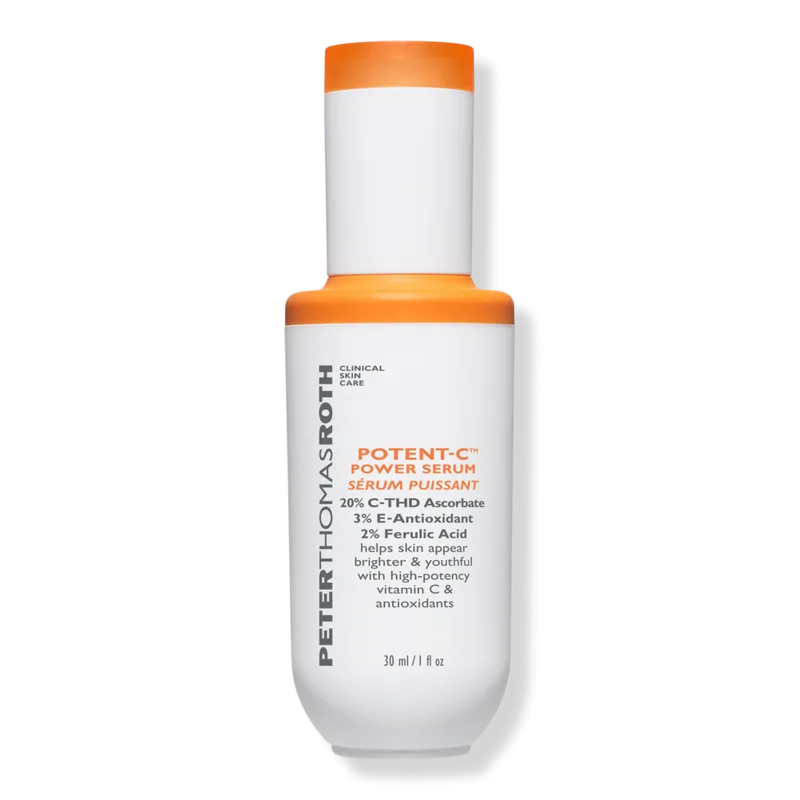
Potent-C Power Serum
Gentle Glow Powerhouse
 Verified reviewer
Pros & cons.
- +20% THD ascorbate provides vitamin C benefits without the stinging and instability of L-ascorbic acid
- +Classic C+E+Ferulic antioxidant trio for synergistic photoprotection and brightening
- +Turmeric extract adds a second pathway for targeting hyperpigmentation and dark spots
- +Silky, fast-absorbing texture with subtle luminosity that works beautifully under makeup and sunscreen
- +Fragrance-free, alcohol-free formula suitable for sensitive and reactive skin types
- +Airless pump packaging protects the vitamin C from light and air degradation
- +Visible brightening and tone-evening results within 1-2 weeks of consistent use
- −At $95 for 1 oz, it is a significant investment for a single product in the routine
- −THD ascorbate has less published clinical evidence than L-ascorbic acid
- −Results develop more gradually than with pure L-ascorbic acid serums
- −Subtle golden tint from turmeric and mica may concern very fair skin tones
- −Contains beeswax derivative (Polyglyceryl-3 Beeswax) — not suitable for strict vegans
The full review.
Peter Thomas Roth’s Potent-C Power Serum is defined by what it excludes. While L-ascorbic acid dominates the vitamin C market—the pure form SkinCeuticals turned into a phenomenon—PTR uses tetrahexyldecyl ascorbate (THD). This was a strategic choice, not a cost-cutting one, and it reveals how vitamin C works on skin.
L-ascorbic acid is the gold standard due to extensive clinical research. However, it is hard to formulate. It oxidizes with light, air, or water. It requires a pH below 3.5 to penetrate skin, which causes stinging and irritation. Because it does not dissolve in oils, it struggles to cross the skin’s lipid barrier. Many people abandon vitamin C serums because L-ascorbic acid burns their skin.
THD ascorbate solves these three issues. It is oil-soluble, so it crosses the skin’s lipid barrier naturally. It works at neutral pH, preventing stinging. It is also more stable than L-ascorbic acid, resisting the oxidation that turns many vitamin C serums orange. The trade-off is that THD ascorbate converts to active ascorbic acid inside the skin. This results in a gentler, more sustained delivery with a slightly slower onset.
The 20% concentration—listed second in the INCI after water—is a meaningful dose. PTR claims it is fifty times more powerful than traditional vitamin C, based on in-vitro potency rather than clinical efficacy. More accurately, the 20% THD ascorbate likely provides brightening and antioxidant protection similar to a lower concentration of L-ascorbic acid, but with better stability and tolerability.
The supporting ingredients elevate this serum. Ferulic acid at 2% and tocopheryl acetate (vitamin E) at 3% complete the C+E+Ferulic trio. Duke University researchers showed this combination doubles photoprotection when used under sunscreen. This uses the same antioxidant architecture as SkinCeuticals, but with a THD ascorbate base.
Turmeric root extract adds curcuminoids that inhibit tyrosinase—the enzyme for melanin production—via a different pathway than vitamin C. This allows the serum to attack hyperpigmentation from two directions. Ginger root extract provides anti-inflammatory support, while ginseng extract adds to the antioxidant and energizing profile. These are functional ingredients, not just botanical additions.
Squalane and sodium hyaluronate handle hydration. The texture is a golden-tinted, silky emulsion that absorbs quickly, leaving skin smooth and subtly luminous. It is not greasy or sticky and leaves no residue. Mica adds a subtle soft-focus glow for immediate healthiness. The airless pump packaging protects the active ingredient from light and air.
The THD ascorbate choice improves the user experience. Applying this serum feels like applying a lightweight moisturizer. There is no stinging, no redness, and no need to wait for burning to subside before layering products. For those who endured L-ascorbic acid serums out of necessity, this is a revelation: vitamin C benefits without the pain.
Results develop more slowly than with L-ascorbic acid. Expect improved luminosity and even tone within one to two weeks, fading of dark spots and hyperpigmentation over four to eight weeks, and collagen-supporting benefits over eight to twelve weeks. This slower timeline is the trade-off for better tolerability.
At ninety-five dollars for one ounce, this is a premium vitamin C serum. It costs less than SkinCeuticals C E Ferulic but more than many other effective options. The formulation justifies the price through the 20% THD ascorbate, ferulic acid, vitamin E, turmeric, squalane, hyaluronic acid, and airless packaging. The question remains whether you pay for the ingredients or the Peter Thomas Roth name.
For those sensitive to irritation or frustrated by oxidizing serums, the Potent-C Power Serum provides a way in. It is not the most potent vitamin C serum; well-formulated L-ascorbic acid products hold that title for those who can tolerate them. But it may be the most usable. A vitamin C serum you actually use every morning will outperform a more potent one that sits in your cabinet because it burns.
Ingredient analysis.
Full INCI list
Water/Aqua/Eau, Tetrahexyldecyl Ascorbate, Butylene Glycol, C9-12 Alkane, Caprylyl Methicone, Tocopheryl Acetate, C10-18 Triglycerides, Polyglyceryl-6 Distearate, Ferulic Acid, Squalane, Hydrogenated Lecithin, Propanediol, Sodium Hyaluronate, Zingiber Officinale (Ginger) Root Extract, Curcuma Longa (Turmeric) Root Extract, Panax Ginseng Root Extract, Jojoba Esters, Leuconostoc/Radish Root Ferment Filtrate, Coco-Caprylate/Caprate, Glycerin, Cetyl Alcohol, Polyglyceryl-3 Beeswax, Xanthan Gum, Disodium EDTA, Mica, Ethylhexylglycerin, Potassium Sorbate, Sodium Benzoate, Phenoxyethanol
Skin match.
The science.
The Science
The Potent-C Power Serum uses the C+E+Ferulic antioxidant synergy framework first described by Sheldon Pinnell and colleagues at Duke University. Their 2005 study in the Journal of Investigative Dermatology shows that combining L-ascorbic acid with vitamin E and ferulic acid doubles the photoprotective capacity of vitamin C alone, providing synergistic antioxidant defense against UVA and UVB-induced free radical damage.
The original research used L-ascorbic acid, but this serum uses tetrahexyldecyl ascorbate (THD), an oil-soluble vitamin C ester. THD ascorbate has a lipophilic molecular structure that penetrates the stratum corneum's intercellular lipid matrix — a route water-soluble L-ascorbic acid cannot use efficiently. Once in the skin, esterases cleave the fatty acid chains to release free ascorbic acid intracellularly.
A 2021 study in the International Journal of Molecular Sciences shows that THD ascorbate increases collagen production and provides antioxidant effects in dermal fibroblasts, though it noted that THD degrades relatively rapidly in the oxidant-rich skin environment. That study also found that combining THD with acetyl zingerone (not present in this formula) improved its stability within the skin.
A 2024 open-label clinical study in the Journal of Cosmetic Dermatology by Min et al. evaluated a topical serum containing THD ascorbate and found significant improvements in skin tone evenness, hyperpigmentation, photodamage, radiance, and smoothness after 12 weeks of use.
Ferulic acid at 2% has dual functions: it stabilizes the vitamin C from environmental degradation and provides its own hydroxycinnamic acid antioxidant activity. The combination of ferulic acid with vitamins C and E creates a self-reinforcing antioxidant network — vitamin C regenerates oxidized vitamin E, while ferulic acid protects both from premature degradation.
Curcuma longa (turmeric) extract contains curcumin, which inhibits tyrosinase activity and melanin synthesis through a mechanism distinct from ascorbic acid. This multi-pathway approach to pigmentation correction is pharmacologically sound, as hyperpigmentation involves multiple enzymatic steps that can be targeted at different nodes simultaneously.
References
- Tetrahexyldecyl Ascorbate (THDC) Degrades Rapidly under Oxidative Stress but Can Be Stabilized by Acetyl Zingerone to Enhance Collagen Production and Antioxidant Effects — International Journal of Molecular Sciences (2021)
- Open-label topical application of tetrahexyldecyl ascorbate and acetyl zingerone containing serum improves the appearance of photoaging and uneven pigmentation — Journal of Cosmetic Dermatology (2024)
Dermatologist Perspective
Dermatologists view THD ascorbate as a legitimate alternative to L-ascorbic acid for patients who cannot tolerate the low pH and irritation of traditional vitamin C serums. Board-certified dermatologists note that while L-ascorbic acid has more clinical evidence, compliance matters more than theoretical potency — a vitamin C serum patients use consistently outperforms a more potent formula they abandon due to irritation. The C+E+Ferulic combination is well-regarded in dermatological circles, and the inclusion of turmeric for additional anti-pigmentation activity is a thoughtful formulation choice. Dermatologists recommend this serum for patients with sensitive or reactive skin, rosacea-prone skin that does not tolerate acids well, or those new to vitamin C who want to build tolerance gradually.
Where it fits in your routine.
Apply 3-4 drops to clean, dry skin every morning after cleansing. Press it gently into the face, neck, and décolletage. Wait 1-2 minutes for absorption before applying moisturizer and sunscreen. Always use SPF 30+; vitamin C adds to but does not replace sun protection. Use it in the evening for brightening, but morning use maximizes antioxidant photoprotection. Store in a cool, dry place away from direct sunlight.
At $95 for 1 oz (about 6-8 weeks of daily use), the annual cost is $600-800. The formulation complexity justifies the price: 20% THD ascorbate, 2% ferulic acid, 3% vitamin E, plus turmeric, ginger, ginseng, squalane, and hyaluronic acid in an airless pump package. This is not a simple vitamin C serum with a prestige markup. SkinCeuticals C E Ferulic costs about $180 for 1 oz, so the PTR version offers value in the premium C+E+Ferulic category. Budget-conscious shoppers can find effective THD ascorbate serums for less, but few combine the full antioxidant trio with botanical anti-pigmentation support at these concentrations.
This is for anyone seeking vitamin C benefits — brightening, dark spot fading, antioxidant protection, and collagen support — who finds L-ascorbic acid serums irritating or unstable. It works well for sensitive skin, rosacea-prone skin, and vitamin C beginners wanting a gentle entry point into this essential skincare active.
Users seeking the fastest brightening results who tolerate low-pH L-ascorbic acid serums may find THD ascorbate too slow. The beeswax derivative makes it unsuitable for strict vegans, and cheaper, effective vitamin C options exist for budget-conscious shoppers.
Product details.
Lightweight, silky emulsion with a subtle golden tint from the turmeric and mica. Absorbs quickly to a smooth, non-greasy finish with a soft luminous quality.
Fragrance-free. Ginger and turmeric extracts leave a faint, barely perceptible herbal note.
An opaque airless pump bottle protects the vitamin C from light and air oxidation. The 1 oz size is standard for prestige vitamin C serums. The pump dispenses precise amounts and reduces waste.
The golden-tinted serum from the airless pump feels silky but not oily. It absorbs fast and leaves skin with a subtle luminosity. Application causes no stinging, tingling, or irritation, unlike L-ascorbic acid serums. Most users see brighter, more even-toned skin within the first week. Brightening and dark-spot-fading effects develop over 4-8 weeks of consistent morning use.
6-8 weeks with daily use of 3-4 drops
12 months
All Year
The backstory.
Peter Thomas Roth launched the Potent-C line as a direct challenge to the dominance of SkinCeuticals in the vitamin C serum market. Rather than competing on the same L-ascorbic acid playing field, PTR chose THD ascorbate — a derivative that trades some of L-AA's immediate potency for dramatically improved stability and tolerability. The strategy was to capture the large audience of consumers who wanted vitamin C benefits but could not tolerate the stinging and instability of traditional formulations.
About Peter Thomas Roth
Established Brand (5–20 years)Peter Thomas Roth launched in 1993, inspired by the founder's Hungarian family spa heritage. The brand is the largest privately-owned prestige skincare company in the U.S. and sells clinical-strength formulations through Sephora, Ulta, and dermatologist offices worldwide.
Common myths.
Only pure L-ascorbic acid works as a topical vitamin C.
While L-ascorbic acid has the most published research, THD ascorbate (tetrahexyldecyl ascorbate) has demonstrated efficacy in brightening, collagen support, and antioxidant protection in both in-vitro and clinical studies. Its oil-soluble nature may actually improve delivery through the skin's lipid barrier. The trade-off is that results may develop more gradually than with L-ascorbic acid at the same concentration.
If a vitamin C serum does not sting, it is not working.
L-ascorbic acid serums sting because they use a low pH (typically 2.5-3.5) to penetrate skin. This stinging shows acid exposure, not efficacy. THD ascorbate works at neutral pH. No stinging means a gentler delivery system, not a weaker product.
FAQ.
Is Peter Thomas Roth Potent-C as effective as SkinCeuticals C E Ferulic?
Both target the same concerns using different vitamin C forms. SkinCeuticals uses 15% pure L-ascorbic acid. This form has more published clinical evidence but requires an acidic pH and can sting. PTR uses 20% THD ascorbate, which is more stable, gentler, and penetrates the lipid barrier differently. Both include the C+E+Ferulic antioxidant combination. PTR may be better tolerated for sensitive skin; SkinCeuticals has the clinical edge for those wanting the most research-backed formula.
Does the Potent-C serum oxidize and turn orange?
THD ascorbate is more stable than L-ascorbic acid and resists oxidation better. Turmeric and mica give the serum a natural golden tint; this is not oxidation. The opaque airless pump packaging protects the formula from light and air. This serum stays potent for its full shelf life if stored properly.
Can I use Potent-C Power Serum with retinol?
Yes — use the Potent-C serum in the morning for antioxidant protection and retinol in the evening for cell turnover and collagen support. This AM/PM combination is one of the most effective anti-aging routines. Since THD ascorbate works at neutral pH, there is no pH conflict with retinol on alternate applications.
Why does this serum have a golden tint?
Turmeric root extract and mica give the formula its warm golden color. This color is inherent and does not mean the product oxidized. The tint is subtle and leaves no visible cast once absorbed. All skin tones can wear it without color interference.
How long does it take to see brightening results?
Most users see better radiance and more even tone after 1-2 weeks of daily morning use. Dark spots and hyperpigmentation fade visibly in 4-8 weeks. Collagen-supporting effects improve fine lines in 8-12 weeks. THD ascorbate works slower than L-ascorbic acid, so use it consistently.
Is this serum suitable for sensitive skin?
This vitamin C serum works well for sensitive skin. THD ascorbate works at neutral pH, so it does not sting or irritate like L-ascorbic acid serums. The fragrance-free, alcohol-free formula includes soothing botanical extracts (ginger, turmeric, ginseng). It is a good choice for people who cannot tolerate traditional vitamin C products.
What the community says.
"Visibly brighter, more even skin tone within the first few weeks of use"
"No stinging or irritation — much gentler than L-ascorbic acid serums"
"Luxurious, silky texture that absorbs without greasiness"
"Stable formula that does not oxidize or turn orange quickly"
"Dark spots and hyperpigmentation noticeably fade with consistent use"
"Expensive at $95 for 1 oz"
"Subtle golden tint from mica and turmeric may concern very pale skin tones"
"Results are gradual — not as fast-acting as pure L-ascorbic acid for brightening"
"Contains beeswax derivative — not suitable for strict vegans"
Featured in.
People also looked at.