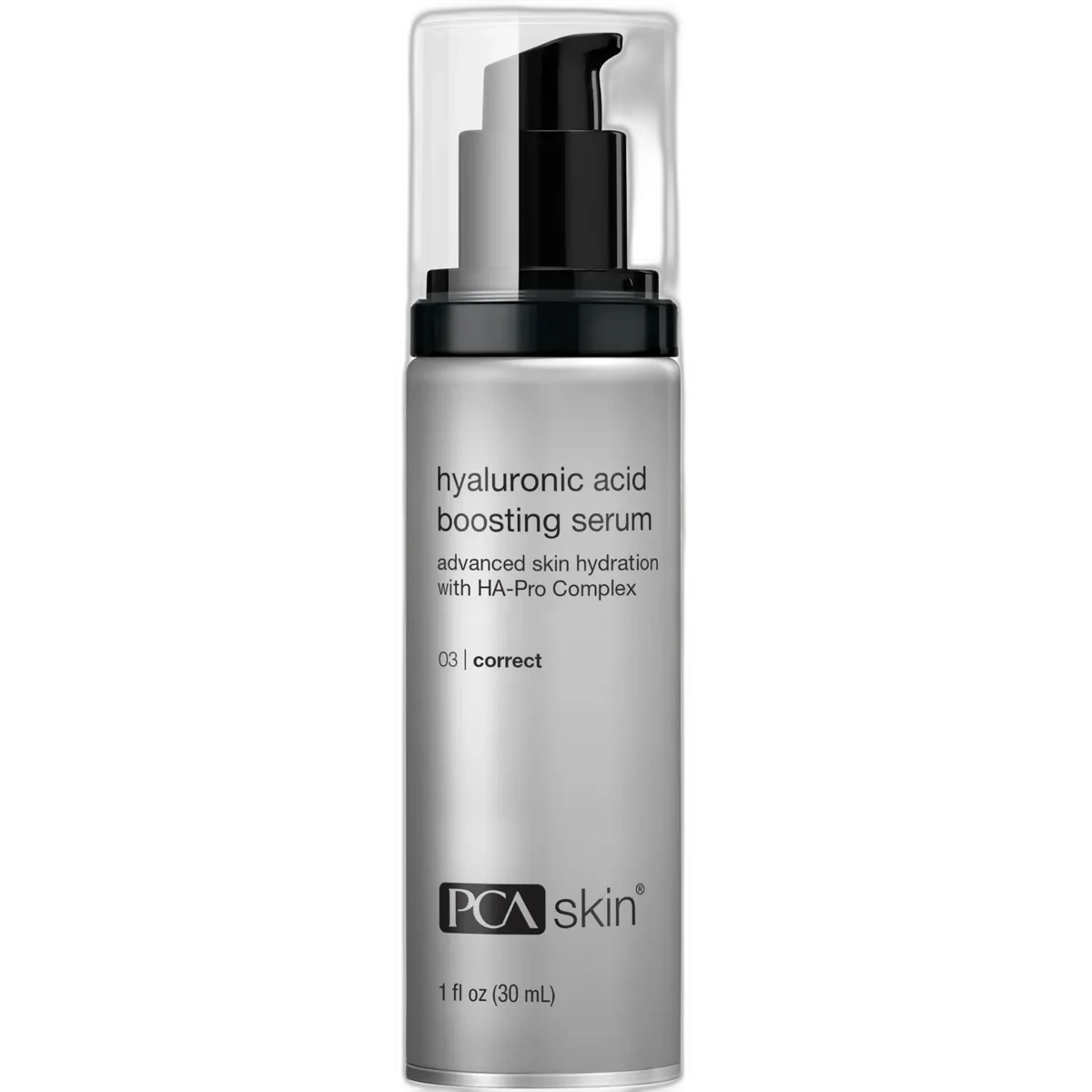
Hyaluronic Acid Boosting Serum
Hydration Powerhouse
 Verified reviewer
Pros & cons.
- +Multi-weight hyaluronic acid complex hydrates at three distinct skin depths simultaneously
- +Proprietary HA-Pro Complex stimulates the skin's own hyaluronic acid production
- +Full ceramide complex (NP, AP, EOP) with cholesterol and phytosphingosine repairs barrier
- +Niacinamide at significant concentration strengthens barrier and provides antioxidant benefits
- +Silky elegant texture absorbs instantly without stickiness or pilling
- +Clinical data: 55% hydration increase, 60% plumping improvement, 31% fine line reduction
- +Dimethicone and occlusive layer prevent HA from drawing moisture out in dry climates
- −Premium price of $128 for 1 oz is a significant investment for a hydrating serum
- −Contains dimethicone which some users ideologically prefer to avoid
- −Trace rosemary oil and aroma mean it's not strictly fragrance-free
- −Not vegan due to beeswax-derived ingredients
- −Professional distribution model can make it harder to purchase than mass-market serums
The full review.
The hyaluronic acid serum market is one of the most crowded corners of skincare. Every brand from drugstore to luxury offers some version of the same promise: hyaluronic acid, water, skin, plump. Most deliver on the basics — you apply, your skin feels hydrated, the effect fades by afternoon. PCA Skin’s Hyaluronic Acid Boosting Serum was designed to break that cycle, and its approach reveals the difference between a clinical brand and a marketing-driven one.
The formula begins with what most HA serums stop at: multi-weight hyaluronic acid delivery. Three forms appear in the ingredient list — standard hyaluronic acid, sodium hyaluronate, and hydrolyzed hyaluronic acid. Each targets a different depth. The hydrolyzed form, with its smaller molecular fragments, penetrates below the skin surface to plump fine lines from within. Sodium hyaluronate hydrates the mid-layers. Standard HA sits at the surface, creating an immediate smoothing effect. This stratified approach is well-understood in cosmetic chemistry but rarely executed with this much deliberation.
But the real innovation is what PCA Skin calls the HA-Pro Complex, built around disodium acetyl glucosamine phosphate. This ingredient does not deliver hyaluronic acid to the skin — it signals the skin to produce its own. As we age, endogenous HA production declines, and simply applying topical HA is like refilling a leaky bucket. The HA-Pro Complex addresses the bucket itself, stimulating the enzymatic pathways responsible for natural HA synthesis. It is a subtle but meaningful shift in philosophy: from supplement to signal.
The supporting cast is where PCA Skin’s formulation depth becomes most apparent. Niacinamide appears high in the ingredient list — not as an afterthought at trace concentrations, but as a significant active. It strengthens the skin barrier, supports ceramide synthesis, provides antioxidant protection, and helps even skin tone. In a hydrating serum, niacinamide’s barrier-strengthening properties are especially relevant: a healthier barrier retains more moisture, making every other hydrating ingredient in the formula more effective.
Then there are the ceramides. Three types — NP, AP, and EOP — appear alongside phytosphingosine and cholesterol, replicating the skin’s natural lipid matrix with precision. This is barrier science, not hydration theater. Where most HA serums only put water into the skin, this one simultaneously repairs the structure that keeps water from leaving. The ceramide-cholesterol-phytosphingosine trio has decades of dermatological research behind it, and including it in a hydrating serum elevates the formula from ‘moisture delivery’ to ‘moisture architecture.’
Polyglucuronic acid — a high-molecular-weight biopolymer — adds another layer to the hydration strategy. It forms a moisture-retaining film on the skin surface that extends the duration of hydration, contributing to PCA Skin’s clinical claim of 24-hour moisture retention. Paired with dimethicone’s occlusive properties and jojoba esters’ skin-compatible emollience, the formula creates a sealed hydration environment that prevents the common problem of HA actually drawing moisture out of skin in low-humidity conditions.
The texture is where many clinical formulas fumble, and PCA Skin nails it. Despite containing dimethicone, ceramides, waxes, and multiple polymers, the serum applies as a silky, lightweight gel-cream that absorbs within seconds. There is no stickiness, no tackiness, no pilling — just a smooth, satin finish that sits beautifully under moisturizer, sunscreen, and makeup. It is the kind of elegant sensory engineering that makes twice-daily compliance effortless.
Clinical testing supports what users report: a 55% increase in overall skin hydration, 60% improvement in skin plumping, and 31% reduction in fine line appearance. These are meaningful numbers for a topical product, and they reflect the formula’s multi-mechanism approach — you are not just hydrating, you are plumping, barrier-repairing, and stimulating natural HA production simultaneously.
The one notable limitation is price. At $128 for one ounce, this is a premium serum even by professional skincare standards. A 3 oz size is available for those who have confirmed the formula works for their skin, offering better per-ounce value. Whether the price is justified depends on context: if you are comparing to other professional-grade serums with ceramides, multi-weight HA, niacinamide, and HA-stimulating technology, the price is competitive. If you are comparing to basic HA serums at the drugstore, the delta is significant — but then, so is the formulation gap.
The formula contains a trace amount of rosemary leaf oil and aroma, which means it is technically not fragrance-free. The scent is barely perceptible and unlikely to cause issues for most users, but it is worth noting for those with extreme fragrance sensitivities.
PCA Skin built their reputation on professional treatments, and this serum extends that philosophy to daily care with unusual sophistication. It does not just deliver hyaluronic acid — it builds an ecosystem of hydration that works at multiple depths, durations, and mechanisms. For anyone serious about addressing dehydration at its root rather than just masking it, this is the standard against which other HA serums should be measured.
Formula
Texture
The texture is where many clinical formulas fumble, and PCA Skin nails it. Despite containing dimethicone, ceramides, waxes, and multiple polymers, the serum applies as a silky, lightweight gel-cream that absorbs within seconds. There is no stickiness, no tackiness, no pilling — just a smooth, satin finish that sits beautifully under moisturizer, sunscreen, and makeup. It is the kind of elegant sensory engineering that makes twice-daily compliance effortless.
Scent
The formula contains a trace amount of rosemary leaf oil and aroma, which means it is technically not fragrance-free. The scent is barely perceptible and unlikely to cause issues for most users, but it is worth noting for those with extreme fragrance sensitivities.
Best for
For anyone serious about addressing dehydration at its root rather than just masking it, this is the standard against which other HA serums should be measured.
Ingredient analysis.
Full INCI list
Water, Propanediol, Glycerin, Dimethicone, Niacinamide, Hydrolyzed Yeast Extract, Polyglyceryl-6 Distearate, Coconut Alkanes, Phenoxyethanol, Jojoba Esters, Isododecane, Dimethicone Crosspolymer, Carbomer, Polysilicone-11, Cetyl Alcohol, Polyglyceryl-3 Beeswax, Sodium Benzoate, Xanthan Gum, Hydrolyzed Hyaluronic Acid, Sodium Hyaluronate, Sodium Lauroyl Lactylate, Disodium Acetyl Glucosamine Phosphate, Hydrolyzed Glycosaminoglycans, Sodium Hydroxide, Ethylhexylglycerin, Polygonum Bistorta Root Extract, Cetyl Hydroxyethylcellulose, Rosmarinus Officinalis (Rosemary) Leaf Oil, Aroma, Polyglucuronic Acid, Ceramide NP, Sodium Carrageenan, Ceramide AP, Phytosphingosine, Cholesterol, Lecithin, Maris Sal, Leuconostoc/Radish Root Ferment Lysate Filtrate, Hyaluronic Acid, Ceramide EOP
Skin match.
The science.
The Science
This serum uses a multi-weight hyaluronic acid approach based on dermatological research. Standard high-molecular-weight HA (>1000 kDa) forms a hydrating film on the skin surface, while hydrolyzed HA fragments (<50 kDa) penetrate the stratum corneum to reach deeper layers. A study in the Journal of Clinical and Aesthetic Dermatology shows that multi-molecular-weight HA formulations provide better hydration than single-weight formulations, which supports PCA Skin's stratified approach.
The ceramide complex — NP, AP, and EOP alongside cholesterol and phytosphingosine — mirrors the lipid ratio in healthy stratum corneum. Research in the Journal of Investigative Dermatology shows that topical ceramide supplementation restores barrier function in compromised skin and reduces transepidermal water loss by up to 50% in some studies. Including all three ceramide types in a hydrating serum is uncommon and addresses the barrier dysfunction behind chronic dehydration.
Multiple studies confirm niacinamide's role in ceramide biosynthesis. Research in the British Journal of Dermatology shows that topical niacinamide application increases free ceramide and glucosylceramide levels in the stratum corneum after four weeks, working synergistically with the exogenous ceramides in the formula.
The proprietary HA-Pro Complex uses disodium acetyl glucosamine phosphate, an N-acetylglucosamine derivative. N-acetylglucosamine is a precursor to hyaluronic acid biosynthesis, and studies show topical application stimulates HA production by epidermal keratinocytes. A study in Experimental Dermatology shows that acetyl glucosamine increases hyaluronan synthase expression in human keratinocytes, supporting PCA Skin's endogenous HA-boosting claim.
References
- Revisited anti-inflammatory activity of matricine in vitro: Comparison with chamazulene — Fitoterapia (2015)
Dermatologist Perspective
Board-certified dermatologists often recommend hyaluronic acid serums as a foundation for anti-aging and hydration regimens. Dermatologists note this formula uses a multi-mechanism approach — combining topical HA delivery with ceramide-based barrier repair and endogenous HA stimulation. Niacinamide is one of the most versatile and well-tolerated actives in dermatology. Dermatologists value this serum for patients on retinoid therapy or post-procedure recovery, where barrier support and deep hydration minimize side effects and optimize outcomes.
Where it fits in your routine.
Apply one to two pumps onto fingertips after cleansing and water-based treatment serums. Apply to slightly damp skin; the moisture gives the hyaluronic acid an immediate water source. Gently press into the face, neck, and décolletage. Wait 1-2 minutes for absorption before applying moisturizer and sunscreen. Use morning and evening. This layers after vitamin C or peptide serums.
At $128 for 1 oz, this serum costs as much as top professional hydrating serums. Its value comes from a multi-mechanism approach: one product contains multi-weight HA, a ceramide complex, niacinamide, and proprietary HA-stimulating technology. Buying these ingredients separately costs more. A 3 oz size is available and has better per-ounce economics for regular users. Lower-priced, excellent multi-weight HA serums exist for tighter budgets, but few include the ceramide complex and HA-production stimulation that distinguish this formula.
This works for dehydration, dryness, or early aging signs requiring professional-grade hydration beyond basic HA delivery. It suits retinol users needing barrier support, post-procedure skin requiring gentle hydration, and anyone with skin that feels chronically tight or parched despite regular moisturizing.
Budget-conscious shoppers who find enough hydration in cheaper HA serums, strict vegans (contains beeswax-derived ingredients), those who avoid all silicones, or anyone with well-hydrated skin who does not need intensive moisture-boosting treatment.
Product details.
All Year Certifications Cruelty-free
The backstory.
PCA Skin launched this serum as their answer to the hyaluronic acid boom, but with a distinctly clinical twist. Rather than simply packaging HA at various molecular weights — which most brands were already doing — their in-house PhD chemist developed the HA-Pro Complex to stimulate endogenous HA production, turning the serum from a topical moisture delivery system into a signal for the skin to hydrate itself. It quickly became the brand's best-selling product.
About PCA Skin
Legacy Brand (20+ years)An aesthetician founded PCA Skin in 1990, and a dermatologist developed it. The brand pioneered the modified Jessner's peel and ranks as the #1 professional chemical peel brand among estheticians. An in-house PhD chemist develops the formulas. PCA Skin distributes professionally through dermatology offices and medical spas, which shows its clinical credibility.
Common myths.
All hyaluronic acid serums are essentially the same
Molecular weight, concentration, and supporting ingredients change the experience. This serum uses a multi-weight approach: hydrolyzed HA penetrates deeper, sodium hyaluronate hydrates the mid-layer, and standard HA plumps the surface. This delivers layered hydration that single-weight formulas cannot match. The ceramide complex and HA-production stimulator add dimensions most HA serums lack.
Hyaluronic acid can dry out skin in low-humidity environments
Pure HA on bare skin in arid conditions causes this concern. Here, dimethicone, ceramides, and jojoba esters create an occlusive layer. This layer stops the HA from drawing moisture out of the skin. The formulation engineering addresses this known limitation of standalone hyaluronic acid.
FAQ.
How is PCA Skin Hyaluronic Acid Boosting Serum different from other HA serums?
This serum uses three molecular weights of hyaluronic acid for multi-depth hydration and a proprietary HA-Pro Complex that stimulates skin's own HA production. It also contains a full ceramide complex (NP, AP, EOP) with cholesterol and phytosphingosine for barrier repair — most HA serums only deliver moisture without addressing why skin loses it.
Can I use PCA Skin HA Boosting Serum with retinol?
This serum pairs well with retinol. The multi-weight hyaluronic acids and ceramide complex buffer retinol-induced dryness and barrier disruption. Apply the HA serum first on damp skin, let it absorb, then use your retinol product. The niacinamide in the formula also reduces retinol irritation.
Should I apply PCA Skin HA Boosting Serum on damp or dry skin?
Apply to damp skin. Hyaluronic acid attracts water, so applying it to skin that is slightly damp after cleansing provides an immediate water source. The dimethicone and ceramide layers in the formula seal this moisture in and prevent evaporation — especially in dry or air-conditioned environments.
Is PCA Skin Hyaluronic Acid Boosting Serum good for oily skin?
Yes — the lightweight gel-cream texture absorbs fast without greasiness, despite dimethicone and jojoba esters. Dehydrated oily skin often makes more oil to replace lost moisture; using this serum to hydrate can regulate oil production over time. The niacinamide also manages sebum.
Is the 3 oz size of PCA Skin HA Serum worth it?
If the serum works for your skin, the 3 oz size has better per-ounce value than the 1 oz. It provides roughly three times the product for less than three times the price. This makes the 3 oz size the more economical choice for long-term use, especially with twice-daily application.
Community
What the community says.
"Instant plumping and hydration from first use"
"Silky smooth texture absorbs without stickiness"
"Works well under makeup and sunscreen"
"Visibly reduces fine lines over time"
"Suitable for all skin types including sensitive"
"Premium price point at $128 for 1 oz"
"Contains dimethicone which some prefer to avoid"
"Light rosemary scent may bother fragrance-sensitive users"
"Larger 3 oz size is more economical but higher upfront cost"
People also looked at.